


实验动物与比较医学 ›› 2026, Vol. 46 ›› Issue (4): 515-530.DOI: 10.12300/j.issn.1674-5817.2025.170
李德生1,2, 赵彦光1,2( )
)
收稿日期:2025-10-11
修回日期:2026-02-15
出版日期:2026-08-25
发布日期:2026-08-22
通讯作者:
赵彦光(1973—),男,硕士,研究员,从事小型猪资源评价利用和医学模型创新研究。E-mail: zhaoyanguang@slarc.org.cn。ORCID:0000-0001-7596-0493
作者简介:李德生(1999—),男,硕士,从事实验小型猪资源培育和医学模型构建研究。E-mail: lidesheng@slarc.org.cn基金资助:
LI Desheng1,2, ZHAO Yanguang1,2()
Received:2025-10-11
Revised:2026-02-15
Published:2026-08-25
Online:2026-08-22
Correspondence to:
ZHAO Yanguang (ORCID: 0000-0001-7596-0493), E-mail: zhaoyanguang@slarc.org.cn摘要:
抑郁症是一种复杂、多因素且高度异质性的临床综合征,是常见的精神疾病,严重影响患者的生活质量和社会功能。该病发病机制复杂,涉及遗传、环境、神经生物学与心理社会等多重因素的交互作用,且具有治疗抵抗性和复发性,极大地限制了现有治疗策略的临床效果。目前,主要涉及表观遗传、单胺类神经递质、下丘脑-垂体-肾上腺轴、大脑组织结构和神经可塑性、脑源性神经营养因子、肠道微生物群和炎症等多个角度的假说。因此,需要开发新的治疗策略,而建立能够有效模拟人类抑郁症核心表型与病理机制的动物模型,是推动这一目标实现的关键基础。猪在神经解剖、生理和行为上与人类高度相似,正逐步成为连接基础研究与临床转化的重要桥梁。本文系统阐述了猪抑郁症模型的构建和评价方法,在模型构建方面,重点介绍了急性应激、慢性不可预测温和应激、母子分离、社会挫败等应激造模,以及手术、药物和基因编辑造模的研究进展,并比较了不同方法的优势与局限;在模型评价方面,重点阐述了以摄食行为与蔗糖偏好测试、旷场实验、新物体识别实验、迷宫测试和社交互动测试等为代表的行为学指标,以及单胺类神经递质、下丘脑-垂体-肾上腺轴激素、脑源性神经营养因子和炎症因子等生理生化指标。同时分析了当前猪抑郁症模型在构建和评价体系、成本、设备及伦理等方面面临的挑战。最后,展望了未来猪抑郁症模型研究的发展方向,强调了整合行为学、神经影像、生理生化及分子生物学等多模态评估手段的必要性,以及精准模拟人类抑郁症的迫切需求,以期为相关领域的基础研究与临床转化提供参考与借鉴。
中图分类号:
李德生,赵彦光. 猪抑郁症模型的构建及评价研究进展[J]. 实验动物与比较医学, 2026, 46(4): 515-530. DOI: 10.12300/j.issn.1674-5817.2025.170.
LI Desheng,ZHAO Yanguang. Research Progress in the Construction and Evaluation of Pig Depression Models[J]. Laboratory Animal and Comparative Medicine, 2026, 46(4): 515-530. DOI: 10.12300/j.issn.1674-5817.2025.170.
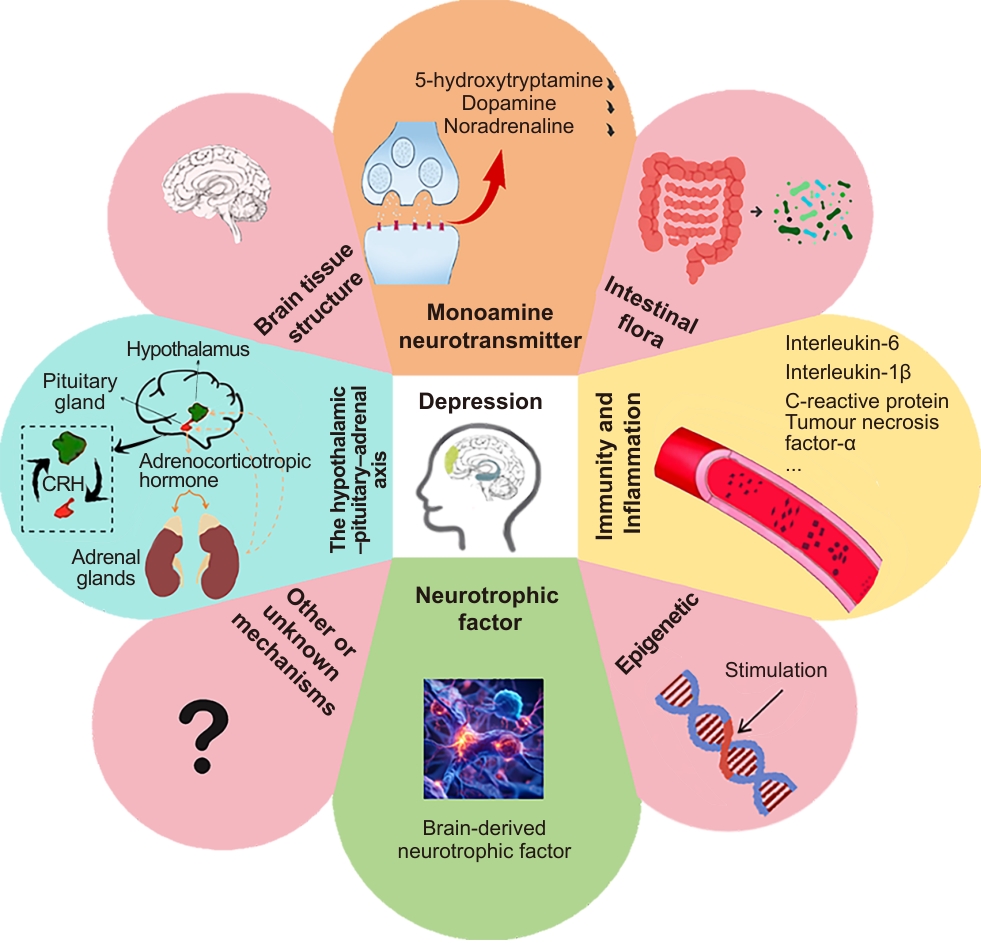
图1 抑郁症发病机制的假说
Figure 1 Hypotheses on the pathogenesis of depression
模型 Model | 方法 Method | 优势 Advantage | 局限性 Limitation |
|---|---|---|---|
急性应激模型 Acute stress model | 进行一次或短期的强烈应激刺激 | 操作简便快捷,适合抗抑郁药物的初步筛选 | 与人类抑郁症的发病情况吻合度较低,个体差异较大 |
慢性不可预测温和应激诱导模型 Chronic unpredictable mild stress model | 通过长期、低强度、随机的多因素刺激 | 与人类抑郁症的吻合度高,能较好地模拟长期处于压力状态下所产生的抑郁症症状 | 造模周期长,工作量大,稳定性和可重复性有待提高 |
母子分离模型 Maternal separation model | 在早期发育阶段分离幼崽与母亲 | 可模拟早期生活压力导致的抑郁风险因素,诱导其发生长期的神经生物学和行为学的改变 | 仅适用于新生动物。不同动物种类的研究尚不成熟,难以普遍应用 |
社会挫败模型 Social defeat stress model | 以同物种间的从属关系为基础,使个体反复遭受社会挫败,从而表现出抑郁样行为 | 从社会层面模拟抑郁症的发病机制,适用于社交压力引发的抑郁样行为 | 更适用于雄性动物,对雌性动物和青春期动物效果较差,且模型构建难度较大 |
手术造模 Surgically induced model | 通过切除嗅球造成脑区损伤诱导抑郁样行为出现,或通过手术方式联合应激构建卒中后抑郁症模型等 | 造模成功后效果稳定持久,无药物交互影响,适合抗抑郁药物的筛选及神经生物学机制的研究 | 技术难度高、动物死亡率高、术后恢复期长,且限制恢复机制及治疗干预的研究 |
药物造模 Drug-induced model | 利用药物诱导单胺类神经递质耗竭,或使下丘脑-垂体-肾上腺轴过度激活等诱发抑郁样行为 | 模型稳定性较好、操作简便、周期短、可重复性良好 | 模拟的抑郁症症状较为单一,且在不同物种间药物种类、剂量和生物安全性等方面差异显著 |
基因编辑模型 Gene editing model | 通过基因工程技术对特定基因进行编辑 | 能特异性研究特定基因的功能,从而阐述抑郁机制 | 基因修饰特异性强,难以完全模拟抑郁症的复杂多基因与环境交互作用;成本较高,随着研究的深入模型构建可能更困难 |
表1 抑郁症动物模型的不同构建方法、对应的优势和局限性
Table 1 Animal models of depression: construction methods, advantages, and limitations
模型 Model | 方法 Method | 优势 Advantage | 局限性 Limitation |
|---|---|---|---|
急性应激模型 Acute stress model | 进行一次或短期的强烈应激刺激 | 操作简便快捷,适合抗抑郁药物的初步筛选 | 与人类抑郁症的发病情况吻合度较低,个体差异较大 |
慢性不可预测温和应激诱导模型 Chronic unpredictable mild stress model | 通过长期、低强度、随机的多因素刺激 | 与人类抑郁症的吻合度高,能较好地模拟长期处于压力状态下所产生的抑郁症症状 | 造模周期长,工作量大,稳定性和可重复性有待提高 |
母子分离模型 Maternal separation model | 在早期发育阶段分离幼崽与母亲 | 可模拟早期生活压力导致的抑郁风险因素,诱导其发生长期的神经生物学和行为学的改变 | 仅适用于新生动物。不同动物种类的研究尚不成熟,难以普遍应用 |
社会挫败模型 Social defeat stress model | 以同物种间的从属关系为基础,使个体反复遭受社会挫败,从而表现出抑郁样行为 | 从社会层面模拟抑郁症的发病机制,适用于社交压力引发的抑郁样行为 | 更适用于雄性动物,对雌性动物和青春期动物效果较差,且模型构建难度较大 |
手术造模 Surgically induced model | 通过切除嗅球造成脑区损伤诱导抑郁样行为出现,或通过手术方式联合应激构建卒中后抑郁症模型等 | 造模成功后效果稳定持久,无药物交互影响,适合抗抑郁药物的筛选及神经生物学机制的研究 | 技术难度高、动物死亡率高、术后恢复期长,且限制恢复机制及治疗干预的研究 |
药物造模 Drug-induced model | 利用药物诱导单胺类神经递质耗竭,或使下丘脑-垂体-肾上腺轴过度激活等诱发抑郁样行为 | 模型稳定性较好、操作简便、周期短、可重复性良好 | 模拟的抑郁症症状较为单一,且在不同物种间药物种类、剂量和生物安全性等方面差异显著 |
基因编辑模型 Gene editing model | 通过基因工程技术对特定基因进行编辑 | 能特异性研究特定基因的功能,从而阐述抑郁机制 | 基因修饰特异性强,难以完全模拟抑郁症的复杂多基因与环境交互作用;成本较高,随着研究的深入模型构建可能更困难 |
周期 Period | 方式 Method | 刺激因素 Stimulus factors | 行为学测试 Behavioral test | 参数 Parameter | 时间 Time | 模型效果 Model performance | 参考文献 References |
|---|---|---|---|---|---|---|---|
| 24 h | 应激 (急性) | 禁食、禁水、束缚、黑暗 | 旷场实验 | 旷场参数3 m×3 m,高1 m | 10 min | 动物主要表现出典型的抑郁样行为,如快感缺失、坐立不安、焦虑、恐慌和摄食减少,而生理指标的变化较小,如血清皮质醇水平升高,海马中5-羟色胺水平降低等,但该模型存在一定局限性,其可靠性及稳定性需进一步验证 | [ |
| 新物体识别实验 | 采用新物体探索[如橙色塑料棒15 cm(长)×6 cm(直径)] | 10 min | |||||
| 蔗糖偏好测试 | 2%蔗糖溶液和水 | 24 h | |||||
7周 7 weeks | 应激 (慢性) | 单独饲养、声音刺激(警报、金属声、枪声等)、灯光刺激[白天每10 min(误差 ± 30%),夜间每120 min(误差 ± 30%)]、社会隔离 | 行为观察 | 姿势(站立、站在料槽上、坐立、跪、卧、靠墙站立) 活动(不动、自我清洁、探索、非活动状态、走、观察实验人员、咬、玩耍、排泄、饮食饮水、蹭痒) 声音(长声尖叫、咕噜声、吠叫、不发声) | 第2、3、5、6周 | 诱导了与下丘脑-垂体-肾上腺轴、海马及微生物群-肠道-大脑轴显著改变相关的抑郁样行为。唾液中皮质醇显著升高,海马中5-羟色胺受体表达水平显著降低 | [ |
| 旷场实验 | 旷场参数3.5 m×3.5 m(高度不详) | 10 min | |||||
| 新奇抑制进食测试 | 食物+黄色气球 | 10 min | |||||
| 约束测试 | 采用束缚带悬空吊起 | 5 min | |||||
3周 3 weeks | 应激 (社会挫败) | 每周2次,实验猪与优势猪对抗(遭受社会挫败),持续3周(居民-入侵者范式的变体) | 行为观察 | 攻击性行为(定义为实验猪攻击优势对手或进行反击,如推搡、咬击、用头撞击对手);被动接受攻击(定义为实验猪未进行反击);主动回避攻击(定义为猪转头避开攻击对象或逃跑) | 整个周期 | 年轻雌性猪在反复社会挫败中会发生行为适应,但不会诱发长期的抑郁样神经内分泌症状 | [ |
| 28 d | 应激 (慢性) | 禁食、禁水、束缚、辛辣刺激、昼夜颠倒、电刺激、笼具倾斜 | 采食量 | 造模前期(1~3 d)、中期(13~15 d)和后期(26~28 d)的平均采食量 | 每个阶段3 d的平均采食量 | 慢性不可预测温和应激模型表观行为和生理指标变化均与抑郁症相符。行为表现为采食量极显著下降,蔗糖偏好极显著下降甚至拒饮糖水,接触新事物的潜伏期极显著升高,接触次数和时间极显著降低;生理表现为血清皮质醇水平升高,海马中5-羟色胺、去甲肾上腺素和脑源性神经营养因子水平显著下降 | [ |
| 旷场实验 | 旷场参数3 m×3 m,高1 m | 10 min | |||||
| 新物体识别实验 | 复杂花纹的新物体 | 10 min | |||||
| 蔗糖偏好测试 | 2%蔗糖溶液和水 | 24 h |
表2 不同应激造模法的猪抑郁症模型效果
Table 2 Efficacy of different stress-induction methods in pig depression models
周期 Period | 方式 Method | 刺激因素 Stimulus factors | 行为学测试 Behavioral test | 参数 Parameter | 时间 Time | 模型效果 Model performance | 参考文献 References |
|---|---|---|---|---|---|---|---|
| 24 h | 应激 (急性) | 禁食、禁水、束缚、黑暗 | 旷场实验 | 旷场参数3 m×3 m,高1 m | 10 min | 动物主要表现出典型的抑郁样行为,如快感缺失、坐立不安、焦虑、恐慌和摄食减少,而生理指标的变化较小,如血清皮质醇水平升高,海马中5-羟色胺水平降低等,但该模型存在一定局限性,其可靠性及稳定性需进一步验证 | [ |
| 新物体识别实验 | 采用新物体探索[如橙色塑料棒15 cm(长)×6 cm(直径)] | 10 min | |||||
| 蔗糖偏好测试 | 2%蔗糖溶液和水 | 24 h | |||||
7周 7 weeks | 应激 (慢性) | 单独饲养、声音刺激(警报、金属声、枪声等)、灯光刺激[白天每10 min(误差 ± 30%),夜间每120 min(误差 ± 30%)]、社会隔离 | 行为观察 | 姿势(站立、站在料槽上、坐立、跪、卧、靠墙站立) 活动(不动、自我清洁、探索、非活动状态、走、观察实验人员、咬、玩耍、排泄、饮食饮水、蹭痒) 声音(长声尖叫、咕噜声、吠叫、不发声) | 第2、3、5、6周 | 诱导了与下丘脑-垂体-肾上腺轴、海马及微生物群-肠道-大脑轴显著改变相关的抑郁样行为。唾液中皮质醇显著升高,海马中5-羟色胺受体表达水平显著降低 | [ |
| 旷场实验 | 旷场参数3.5 m×3.5 m(高度不详) | 10 min | |||||
| 新奇抑制进食测试 | 食物+黄色气球 | 10 min | |||||
| 约束测试 | 采用束缚带悬空吊起 | 5 min | |||||
3周 3 weeks | 应激 (社会挫败) | 每周2次,实验猪与优势猪对抗(遭受社会挫败),持续3周(居民-入侵者范式的变体) | 行为观察 | 攻击性行为(定义为实验猪攻击优势对手或进行反击,如推搡、咬击、用头撞击对手);被动接受攻击(定义为实验猪未进行反击);主动回避攻击(定义为猪转头避开攻击对象或逃跑) | 整个周期 | 年轻雌性猪在反复社会挫败中会发生行为适应,但不会诱发长期的抑郁样神经内分泌症状 | [ |
| 28 d | 应激 (慢性) | 禁食、禁水、束缚、辛辣刺激、昼夜颠倒、电刺激、笼具倾斜 | 采食量 | 造模前期(1~3 d)、中期(13~15 d)和后期(26~28 d)的平均采食量 | 每个阶段3 d的平均采食量 | 慢性不可预测温和应激模型表观行为和生理指标变化均与抑郁症相符。行为表现为采食量极显著下降,蔗糖偏好极显著下降甚至拒饮糖水,接触新事物的潜伏期极显著升高,接触次数和时间极显著降低;生理表现为血清皮质醇水平升高,海马中5-羟色胺、去甲肾上腺素和脑源性神经营养因子水平显著下降 | [ |
| 旷场实验 | 旷场参数3 m×3 m,高1 m | 10 min | |||||
| 新物体识别实验 | 复杂花纹的新物体 | 10 min | |||||
| 蔗糖偏好测试 | 2%蔗糖溶液和水 | 24 h |
作用机制 Action mechanism | 常用药物名称 Common medication names |
|---|---|
选择性5-羟色胺再摄取抑制剂 Selective serotonin reuptake inhibitor | 舍曲林片、氟西汀胶囊 |
选择性5-羟色胺及去甲肾上腺素再摄取抑制剂 Selective serotonin–norepinephrine reuptake inhibitor | 文拉法辛缓释胶囊、度洛西汀肠溶片 |
去甲肾上腺素及特异性5-羟色胺能抗抑郁药 Noradrenergic and specific serotonergic antidepressant | 米氮平片 |
选择性去甲肾上腺素再摄取抑制剂 Selective norepinephrine reuptake inhibitor | 瑞波西汀胶囊 |
三环类抗抑郁药 Tricyclic antidepressant | 阿米替林片、多塞平片、氯米帕明片 |
去甲肾上腺素和多巴胺再摄取抑制剂 Norepinephrine-dopamine reuptake inhibitor | 安非他酮缓释片 |
单胺氧化酶抑制剂 Monoamine oxidase inhibitor | 吗氯贝胺片 |
5-羟色胺2型受体拮抗剂和再摄取抑制剂 Serotonin type 2 receptor antagonist and reuptake inhibitor | 曲唑酮片 |
表3 常用抗抑郁药物
Table 3 Common antidepressant medications
作用机制 Action mechanism | 常用药物名称 Common medication names |
|---|---|
选择性5-羟色胺再摄取抑制剂 Selective serotonin reuptake inhibitor | 舍曲林片、氟西汀胶囊 |
选择性5-羟色胺及去甲肾上腺素再摄取抑制剂 Selective serotonin–norepinephrine reuptake inhibitor | 文拉法辛缓释胶囊、度洛西汀肠溶片 |
去甲肾上腺素及特异性5-羟色胺能抗抑郁药 Noradrenergic and specific serotonergic antidepressant | 米氮平片 |
选择性去甲肾上腺素再摄取抑制剂 Selective norepinephrine reuptake inhibitor | 瑞波西汀胶囊 |
三环类抗抑郁药 Tricyclic antidepressant | 阿米替林片、多塞平片、氯米帕明片 |
去甲肾上腺素和多巴胺再摄取抑制剂 Norepinephrine-dopamine reuptake inhibitor | 安非他酮缓释片 |
单胺氧化酶抑制剂 Monoamine oxidase inhibitor | 吗氯贝胺片 |
5-羟色胺2型受体拮抗剂和再摄取抑制剂 Serotonin type 2 receptor antagonist and reuptake inhibitor | 曲唑酮片 |
| [1] | DADKHAH M, JAFARZADEHGHAREHZIAADDIN M, MOLAEI S, et al. Major depressive disorder: Biomarkers and biosensors[J]. Clin Chim Acta, 2023, 547: 117437. DOI: 10.1016/j.cca.2023. 117437 . |
| [2] | TOLENTINO J C, SCHMIDT S L. DSM-5 criteria and depression severity: implications for clinical practice[J]. Front Psychiatry, 2018, 9: 450. DOI: 10.3389/fpsyt.2018.00450 . |
| [3] | MIRET M, AYUSO-MATEOS J L, SANCHEZ-MORENO J, et al. Depressive disorders and suicide: Epidemiology, risk factors, and burden[J]. Neurosci Biobehav Rev, 2013, 37(10 Pt 1): 2372-2374. DOI: 10.1016/j.neubiorev.2013.01.008 . |
| [4] | CUI L L, LI S, WANG S M, et al. Major depressive disorder: hypothesis, mechanism, prevention and treatment[J]. Signal Transduct Target Ther, 2024, 9(1): 30. DOI: 10.1038/s41392-024-01738-y . |
| [5] | MALHI G S, MANN J J. Depression[J]. Lancet, 2018, 392(10161): 2299-2312. DOI: 10.1016/s0140-6736(18)31948-2 . |
| [6] | DEMIN K A, SYSOEV M, CHERNYSH M V, et al. Animal models of major depressive disorder and the implications for drug discovery and development[J]. Expert Opin Drug Discov, 2019, 14(4): 365-378. DOI: 10.1080/17460441.2019.1575360 . |
| [7] | 章冰倩, 陈员庆, 李丽琴, 等. 动物抑郁模型构建方法研究进展[C/OL]//中国毒理学会第十一次全国毒理学大会论文集, 2024. . |
| ZHANG B Q, CHEN Y Q, LI L Q, et al. Research progress on methods for constructing animal depression models[C/OL]//Proceedings of the 11th National Congress of Toxicology of the Chinese Society of Toxicology, 2024. . | |
| [8] | DE ABREU M S, FRIEND A J, DEMIN K A, et al. Zebrafish models: do we have valid paradigms for depression?[J]. J Pharmacol Toxicol Methods, 2018, 94(Pt 2): 16-22. DOI: 10. 1016/j.vascn.2018.07.002 . |
| [9] | NETZLEY A H, PELLED G. The pig as a translational animal model for biobehavioral and neurotrauma research[J]. Biomedicines, 2023, 11(8): 2165. DOI: 10.3390/biomedicines11082165 . |
| [10] | YANG S, ZHENG Q, YIN G A. A 24-h restraint with food and water deprivation: a potential method to establish a model of depression in pigs[J]. Front Vet Sci, 2023, 10: 1274497. DOI: 10.3389/fvets.2023.1274497 . |
| [11] | LIU S F, CRAWFORD J, TAO F. Assessing orofacial pain behaviors in animal models: a review[J]. Brain Sci, 2023, 13(3): 390. DOI: 10.3390/brainsci13030390 . |
| [12] | JESULOLA E, MICALOS P, BAGULEY I J. Understanding the pathophysiology of depression: From monoamines to the neurogenesis hypothesis model - are we there yet?[J]. Behav Brain Res, 2018, 341: 79-90. DOI: 10.1016/j.bbr.2017.12.025 . |
| [13] | DING W X, WANG L L, LI L, et al. Pathogenesis of depression and the potential for traditional Chinese medicine treatment[J]. Front Pharmacol, 2024, 15: 1407869. DOI: 10.3389/fphar. 2024.1407869 . |
| [14] | MCEWEN B S. Central effects of stress hormones in health and disease: Understanding the protective and damaging effects of stress and stress mediators[J]. Eur J Pharmacol, 2008, 583(2-3): 174-185. DOI: 10.1016/j.ejphar.2007.11.071 . |
| [15] | DOOLIN K, FARRELL C, TOZZI L, et al. Diurnal hypothalamic-pituitary-adrenal axis measures and inflammatory marker correlates in major depressive disorder[J]. Int J Mol Sci, 2017, 18(10): 2226. DOI: 10.3390/ijms18102226 . |
| [16] | OTTE C, GOLD S M, PENNINX B W, et al. Major depressive disorder[J]. Nat Rev Dis Primers, 2016, 2: 16065. DOI: 10.1038/nrdp.2016.65 . |
| [17] | VESTRING S, SERCHOV T, NORMANN C. Animal models of depression - chronic despair model (CDM)[J]. JoVE, 2021(175): e62579. DOI: 10.3791/62579-v . |
| [18] | CAN A, DAO D T, TERRILLION C E, et al. The tail suspension test[J]. JoVE, 2011(58): e3769. DOI: 10.3791/3769 . |
| [19] | SCHROETER C A, GORLOVA A, SICKER M, et al. Unveiling the mechanisms of a remission in major depressive disorder (MDD)-like syndrome: the role of hippocampal palmitoyltransferase expression and stress susceptibility[J]. Biomolecules, 2025, 15(1): 67. DOI: 10.3390/biom15010067 . |
| [20] | HUANG W Y, KE Y, CHEN R Q. Region-specific dysregulation of endocannabinoid system in learned helplessness model of depression[J]. Neuroreport, 2021, 32(5): 345-351. DOI: 10.1097/WNR.0000000000001601 . |
| [21] | LI B, PIRIZ J, MIRRIONE M, et al. Synaptic potentiation onto habenula neurons in the learned helplessness model of depression[J]. Nature, 2011, 470(7335): 535-539. DOI: 10.1038/nature09742 . |
| [22] | KIM Y, PEROVA Z, MIRRIONE M M, et al. Whole-brain mapping of neuronal activity in the learned helplessness model of depression[J]. Front Neural Circuits, 2016, 10: 3. DOI: 10.3389/fncir.2016.00003 . |
| [23] | 薛涛, 邬丽莎, 刘新民, 等. 抑郁症动物模型及评价方法研究进展[J]. 中国实验动物学报, 2015, 23(3): 321-326. DOI: 10.3969/j.issn.1005-4847.2015.03.019 . |
| XUE T, WU L S, LIU X M, et al. Research progress on animal models of depression and their evaluation methods[J]. Acta Lab Anim Sci Sin, 2015, 23(3): 321-326. DOI: 10.3969/j. issn.1005-4847.2015.03.019 . | |
| [24] | SHARMA S, CHAWLA S, KUMAR P, et al. The chronic unpredictable mild stress (CUMS) Paradigm: Bridging the gap in depression research from bench to bedside[J]. Brain Res, 2024, 1843: 149123. DOI: 10.1016/j.brainres.2024.149123 . |
| [25] | 刘子轩, 霍清, 孙雅煊, 等. 抑郁症动物模型的建立及评价方法研究进展[J]. 中国实验动物学报, 2025, 33(2): 249-258. DOI: 10.3969/j.issn.1005-4847.2025.02.010 . |
| LIU Z X, HUO Q, SUN Y X, et al. Development of an animal model of depression and evaluation methods[J]. Acta Lab Anim Sci Sin, 2025, 33(2): 249-258. DOI: 10.3969/j.issn.1005-4847.2025.02.010 . | |
| [26] | MENNESON S, MÉNICOT S, FERRET-BERNARD S, et al. Validation of a psychosocial chronic stress model in the pig using a multidisciplinary approach at the gut-brain and behavior levels[J]. Front Behav Neurosci, 2019, 13: 161. DOI: 10.3389/fnbeh.2019.00161 . |
| [27] | FENG X L, WANG J J, WU J, et al. Abnormality of anxious behaviors and functional connectivity between the amygdala and the frontal lobe in maternally deprived monkeys[J]. Brain Behav, 2023, 13(9): e3027. DOI: 10.1002/brb3.3027 . |
| [28] | REITE M, KAEMINGK K, BOCCIA M L. Maternal separation in bonnet monkey infants: altered attachment and social support[J]. Child Dev, 1989, 60(2): 473-480. |
| [29] | HOWELL B R, MCCORMACK K M, GRAND A P, et al. Brain white matter microstructure alterations in adolescent rhesus monkeys exposed to early life stress: associations with high Cortisol during infancy[J]. Biol Mood Anxiety Disord, 2013, 3(1): 21. DOI: 10.1186/2045-5380-3-21 . |
| [30] | VETULANI J. Early maternal separation: a rodent model of depression and a prevailing human condition[J]. Pharmacol Rep, 2013, 65(6): 1451-1461. DOI: 10.1016/s1734-1140(13)71505-6 . |
| [31] | YANG Z, WANG D N. A standardized protocol for early-life stress-induced social defeat in mice[J]. Bio Protoc, 2023, 13(12): e4703. DOI: 10.21769/BioProtoc.4703 . |
| [32] | KIM H D, CALL T, CAROTENUTO S, et al. Testing depression in mice: a chronic social defeat stress model[J]. Bio Protoc, 2017, 7(7): e2203. DOI: 10.21769/BioProtoc.2203 . |
| [33] | CHEN H Y, CHIANG H Y, LEE T H, et al. Effects of chronic social defeat stress on social behavior and cognitive flexibility for early and late adolescent[J]. Behav Brain Res, 2025, 476: 115251. DOI: 10.1016/j.bbr.2024.115251 . |
| [34] | MANZ K M, LEVINE W A, SECKLER J C, et al. A novel adolescent chronic social defeat model: reverse-Resident-Intruder Paradigm (rRIP) in male rats[J]. Stress, 2018, 21(2): 169-178. DOI: 10.1080/10253890.2017.1423285 . |
| [35] | YOHN C N, DIETERICH A, BAZER A S, et al. Chronic non-discriminatory social defeat is an effective chronic stress paradigm for both male and female mice[J]. Neuropsycho-pharmacology, 2019, 44(13): 2220-2229. DOI: 10.1038/s41386-019-0520-7 . |
| [36] | PANTOJA-URBÁN A H, RICHER S, GIROUX M, et al. Social defeat stress model for adolescent C57BL/6 male and female mice[J]. JoVE, 2024(205): e66455. DOI: 10.3791/66455 . |
| [37] | ZHU Y Q, KLOMPARENS E A, GUO S C, et al. Neuroinflammation caused by mental stress: the effect of chronic restraint stress and acute repeated social defeat stress in mice[J]. Neurol Res, 2019, 41(8): 762-769. DOI: 10.1080/01616412.2019.1615670 . |
| [38] | RODRIGUEZ M, THEMANN A, GARCIA-CARACHURE I, et al. Chronic social defeat stress in prairie voles (Microtus ochrogaster): a preclinical model for the study of depression-related phenotypes[J]. J Affect Disord, 2024, 351: 833-842. DOI: 10.1016/j.jad.2024.02.001 . |
| [39] | VAN DER STAAY F J, DE GROOT J, SCHUURMAN T, et al. Repeated social defeat in female pigs does not induce neuroendocrine symptoms of depression, but behavioral adaptation[J]. Physiol Behav, 2008, 93(3): 453-460. DOI: 10.1016/j.physbeh.2007.10.002 . |
| [40] | TUERSUNJIANG T, WANG Q C, WANG Z Z, et al. Photochemically induced thrombosis combined with chronic restraint stress for modeling post-stroke depression in mice[J]. Front Neurosci, 2025, 19: 1547551. DOI: 10.3389/fnins. 2025. 1547551 . |
| [41] | STRACKE J, OTTEN W, TUCHSCHERER A, et al. Serotonin depletion induces pessimistic-like behavior in a cognitive bias paradigm in pigs[J]. Physiol Behav, 2017, 174: 18-26. DOI: 10.1016/j.physbeh.2017.02.036 . |
| [42] | PARK B K, KIM N S, KIM Y R, et al. Antidepressant and anti-neuroinflammatory effects of bangpungtongsung-San[J]. Front Pharmacol, 2020, 11: 958. DOI: 10.3389/fphar. 2020. 00958 . |
| [43] | MIGUEL TELEGA L, BERTI R, BLAZHENETS G, et al. Reserpine-induced rat model for depression: Behavioral, physiological and PET-based dopamine receptor availability validation[J]. Prog Neuropsychopharmacol Biol Psychiatry, 2024, 133: 111013. DOI: 10.1016/j.pnpbp.2024.111013 . |
| [44] | LEBEDEVA K A, ALLEN J, KULHAWY E Y, et al. Cyclical administration of corticosterone results in aggravation of depression-like behaviors and accompanying downregulations in reelin in an animal model of chronic stress relevant to human recurrent depression[J]. Physiol Behav, 2020, 224: 113070. DOI: 10.1016/j.physbeh.2020.113070 . |
| [45] | KOTT J M, MOONEY-LEBER S M, LI J, et al. Elevated stress hormone levels and antidepressant treatment starting before pregnancy affect maternal care and litter characteristics in an animal model of depression[J]. Behav Brain Res, 2018, 348: 101-114. DOI: 10.1016/j.bbr.2018.04.006 . |
| [46] | YIN R, ZHANG K L, LI Y M, et al. Lipopolysaccharide-induced depression-like model in mice: meta-analysis and systematic evaluation[J]. Front Immunol, 2023, 14: 1181973. DOI: 10.3389/fimmu.2023.1181973 . |
| [47] | WANG M L, LI H J, ZHANG W J, et al. Saikosaponin A alleviates depressive-like behavior induced by reserpine in mice by regulating gut microflora and inflammatory responses[J]. PLoS One, 2025, 20(2): e0311207. DOI: 10.1371/journal.pone.0311207 . |
| [48] | DE MELO MARTINS G M, PETERSEN B D, RÜBENSAM G, et al. Physical exercise prevents behavioral alterations in a reserpine-treated zebrafish: a putative depression model[J]. Pharmacol Biochem Behav, 2022, 220: 173455. DOI: 10.1016/j.pbb.2022.173455 . |
| [49] | QIAN X, ZHONG Z D, LU S T, et al. Repeated reserpine treatment induces depressive-like behaviors accompanied with hippocampal impairment and synapse deficit in mice[J]. Brain Res, 2023, 1819: 148541. DOI: 10.1016/j.brainres. 2023. 148541 . |
| [50] | SCHERMA M, GIUNTI E, FRATTA W, et al. Gene knockout animal models of depression, anxiety and obsessive compulsive disorders[J]. Psychiatr Genet, 2019, 29(5): 191-199. DOI: 10.1097/YPG.0000000000000238 . |
| [51] | HAN H J, XU M X, WANG J, et al. CRISPR/Cas9 based gene editing of Frizzled class receptor 6 (FZD6) reveals its role in depressive symptoms through disrupting Wnt/β-catenin signaling pathway[J]. J Adv Res, 2024, 58: 129-138. DOI: 10.1016/j.jare.2023.06.001 . |
| [52] | GAO M Y, ZHU X L, YANG G, et al. CRISPR/Cas9-mediated gene editing in porcine models for medical research[J]. DNA Cell Biol, 2021, 40(12): 1462-1475. DOI: 10.1089/dna.2020.6474 . |
| [53] | WATANABE M, NAGASHIMA H. Genome editing of pig[M]//Genome Editing in Animals. New York, NY: Springer US, 2023: 269-292. DOI: 10.1007/978-1-0716-3016-7_21 . |
| [54] | 杨森. 不同应激条件下猪抑郁症模型构建及评价[D]. 大庆: 黑龙江八一农垦大学, 2024. DOI. 10.27122/d.cnki.ghlnu.2024.000064. |
| YANG S. Construction and evaluation of pig depression model under different stress conditions[D]. Daqing: Heilongjiang Bayi Agricultural University, 2024. DOI: 10.27122/d.cnki.ghlnu.2024.000064 . | |
| [55] | BECKER M, PINHASOV A, ORNOY A. Animal models of depression: what can they teach us about the human disease?[J]. Diagnostics, 2021, 11(1): 123. DOI: 10.3390/diagnostics11010123 . |
| [56] | MURPHY E, NORDQUIST R E, VAN DER STAAY F J. A review of behavioural methods to study emotion and mood in pigs, Sus scrofa [J]. Appl Anim Behav Sci, 2014, 159: 9-28. DOI: 10.1016/j.applanim.2014.08.002 . |
| [57] | ENKEL T, GHOLIZADEH D, VON BOHLEN UND HALBACH O, et al. Ambiguous-cue interpretation is biased under stress- and depression-like states in rats[J]. Neuropsychopharmacology, 2010, 35(4): 1008-1015. DOI: 10. 1038/npp.2009.204 . |
| [58] | MARKOV D D. Sucrose preference test as a measure of anhedonic behavior in a chronic unpredictable mild stress model of depression: outstanding issues[J]. Brain Sci, 2022, 12(10): 1287. DOI: 10.3390/brainsci12101287 . |
| [59] | SONG W, GUO Y, JIANG S, et al. Antidepressant effects of the ginsenoside metabolite compound K, assessed by behavioral despair test and chronic unpredictable mild stress model[J]. Neurochem Res, 2018, 43(7): 1371-1382. DOI: 10.1007/s11064-018-2552-5 . |
| [60] | LUO Y Q, BEI X Y, ZHANG Y W, et al. Cichorium intybus L. oligo-polysaccharides (CIO) exerts antianxiety and antidepressant effects on mice experiencing behavioral despair and chronic unpredicted mild stress[J]. Foods, 2025, 14(1): 135. DOI: 10.3390/foods14010135 . |
| [61] | MINAMI S, SATOYOSHI H, IDE S, et al. Suppression of reward-induced dopamine release in the nucleus accumbens in animal models of depression: Differential responses to drug treatment[J]. Neurosci Lett, 2017, 650: 72-76. DOI: 10.1016/j.neulet.2017.04.028 . |
| [62] | CHEN Z G, DUAN S Y, LI J L, et al. T-2 toxin triggers depression-like behaviors via upregulation of dopamine transporter in nucleus accumbens of male mice[J]. Ecotoxicol Environ Saf, 2025, 289: 117392. DOI: 10.1016/j.ecoenv.2024.117392 . |
| [63] | ALKANAT M, ALKANAT H Ö. D-Limonene reduces depression-like behaviour and enhances learning and memory through an anti-neuroinflammatory mechanism in male rats subjected to chronic restraint stress[J]. Eur J Neurosci, 2024, 60(4): 4491-4502. DOI: 10.1111/ejn.16455 . |
| [64] | FANG Y, GUO H, WANG Q N, et al. The role and mechanism of NLRP3 inflammasome-mediated astrocyte activation in dehydrocorydaline against CUMS-induced depression[J]. Front Pharmacol, 2022, 13: 1008249. DOI: 10.3389/fphar. 2022. 1008249 . |
| [65] | PAN X, CHEN K Z, HAN S J, et al. Total triterpenes of Wolfiporia cocos (schwein.) ryvarden & gilb exerts antidepressant-like effects in a chronic unpredictable mild stress rat model and regulates the levels of neurotransmitters, HPA axis and NLRP3 pathway[J]. Front Pharmacol, 2022, 13: 793525. DOI: 10.3389/fphar.2022.793525 . |
| [66] | MA J, GUO C Y, LI H B, et al. Prophylactic effects of hemp seed oil on perimenopausal depression: a role of HPA axis[J]. J Oleo Sci, 2023, 72(10): 939-955. DOI: 10.5650/jos.ess23062 . |
| [67] | LI Z Y, LI L Q, XU H, et al. Modulating gut microbiota: the mechanism of electroacupuncture at the "siguan" acupoints in alleviating post-stroke depression[J]. Neuropsychiatr Dis Treat, 2025, 21: 281-294. DOI: 10.2147/NDT.S495460 . |
| [68] | SCHULZ M, ZIEGLOWSKI L, KOPACZKA M, et al. The open field test as a tool for behaviour analysis in pigs: recommendations for set-up standardization - a systematic review[J]. Eur Surg Res, 2023, 64(1): 7-26. DOI: 10.1159/000525680 . |
| [69] | DONALD R D, HEALY S D, LAWRENCE A B, et al. Emotionality in growing pigs: is the open field a valid test?[J]. Physiol Behav, 2011, 104(5): 906-913. DOI: 10.1016/j.physbeh.2011. 05.031 . |
| [70] | WILLNER P, GRUCA P, LASON M, et al. Validation of chronic mild stress in the Wistar-Kyoto rat as an animal model of treatment-resistant depression[J]. Behav Pharmacol, 2019, 30(2 and 3-Spec Issue): 239-250. DOI: 10.1097/FBP.000000000 0000431 . |
| [71] | LIU L F, HU Y X, SHAN Q, et al. VGLUT2 may improve cognitive function in depressed rats by protecting prefrontal cortex neurons[J]. Front Behav Neurosci, 2024, 18: 1453161. DOI: 10.3389/fnbeh.2024.1453161 . |
| [72] | ALLEN L M, MURPHY D A, ROLDAN V, et al. Testing spatial working memory in pigs using an automated T-maze[J]. Oxf Open Neurosci, 2023, 2: kvad010. DOI: 10.1093/oons/kvad010 . |
| [73] | NAKAMOTO C, KAWAMURA M, NAKATSUKASA E, et al. GluD1 knockout mice with a pure C57BL/6N background show impaired fear memory, social interaction, and enhanced depressive-like behavior[J]. PLoS One, 2020, 15(2): e0229288. DOI: 10.1371/journal.pone.0229288 . |
| [74] | WELLER J E, TURNER S P, FUTRO A, et al. The influence of early life socialisation on cognition in the domestic pig (Sus scrofa domestica)[J]. Sci Rep, 2020, 10(1): 19077. DOI: 10.1038/s41598-020-76110-5 . |
| [75] | FERREIRA S C M, DE ANGELIS F, AMBRUOSI S, et al. Bridging human and animal personality: a behavioral test to assess reward sensitivity[J]. iScience, 2025, 28(10): 113487. DOI: 10.1016/j.isci.2025.113487 . |
| [76] | BARONE F, NANNONI E, ELMI A, et al. Behavioral assessment of vision in pigs[J]. J Am Assoc Lab Anim Sci, 2018, 57(4): 350-356. DOI: 10.30802/aalas-jaalas-17-000163 . |
| [77] | GOLDEN R K, DILGER R N. Validating an updated protocol for the novel object recognition task in young pigs[J]. Front Behav Neurosci, 2025, 19: 1480389. DOI: 10.3389/fnbeh.2025. 1480389 . |
| [78] | FLEMING S A, DILGER R N. Young pigs exhibit differential exploratory behavior during novelty preference tasks in response to age, sex, and delay[J]. Behav Brain Res, 2017, 321: 50-60. DOI: 10.1016/j.bbr.2016.12.027 . |
| [79] | BARTLETT E A, ZANDERIGO F, SHIEH D, et al. Serotonin transporter binding in major depressive disorder: impact of serotonin system anatomy[J]. Mol Psychiatry, 2022, 27(8): 3417-3424. DOI: 10.1038/s41380-022-01578-8 . |
| [80] | KÖHLER-FORSBERG K, DAM V H, OZENNE B, et al. Serotonin 4 receptor brain binding in major depressive disorder and association with memory dysfunction[J]. JAMA Psychiatry, 2023, 80(4): 296-304. DOI: 10.1001/jamapsychiatry. 2022.4539 . |
| [81] | JENSEN K H R, DAM V H, KÖHLER-FORSBERG K, et al. Changes in hippocampal volume, 5-HT(4) receptor binding, and verbal memory over the course of antidepressant treatment in major depressive disorder[J]. J Psychiatr Res, 2025, 181: 197-205. DOI: 10.1016/j.jpsychires.2024.11.043 . |
| [82] | NAJJAR S A, HUNG L Y, MARGOLIS K G. Serotonergic control of gastrointestinal development, motility, and inflammation[J]. Compr Physiol, 2023, 13(3): 4851-4868. DOI: 10.1002/cphy.c220024 . |
| [83] | NANTHAKUMARAN S, SRIDHARAN S, SOMAGUTTA M R, et al. The gut-brain axis and its role in depression[J]. Cureus, 2020, 12(9): e10280. DOI: 10.7759/cureus.10280 . |
| [84] | RAVAL N R, JOHANSEN A, DONOVAN L L, et al. A single dose of psilocybin increases synaptic density and decreases 5-HT2A receptor density in the pig brain[J]. Int J Mol Sci, 2021, 22(2): 835. DOI: 10.3390/ijms22020835 . |
| [85] | DELVA N C, STANWOOD G D. Dysregulation of brain dopamine systems in major depressive disorder[J]. Exp Biol Med, 2021, 246(9): 1084-1093. DOI: 10.1177/1535370221991830 . |
| [86] | SZCZYPIŃSKI J J, GOLA M. Dopamine dysregulation hypothesis: the common basis for motivational anhedonia in major depressive disorder and schizophrenia?[J]. Rev Neurosci, 2018, 29(7): 727-744. DOI: 10.1515/revneuro-2017-0091 . |
| [87] | MALLET J, GORWOOD P, LE STRAT Y, et al. Major depressive disorder (MDD) and schizophrenia- addressing unmet needs with partial agonists at the D2 receptor: a review[J]. Int J Neuropsychopharmacol, 2019, 22(10): 651-664. DOI: 10.1093/ijnp/pyz043 . |
| [88] | PIZZAGALLI D A, BERRETTA S, WOOTEN D, et al. Assessment of striatal dopamine transporter binding in individuals with major depressive disorder: in vivo positron emission tomography and postmortem evidence[J]. JAMA Psychiatry, 2019, 76(8): 854-861. DOI: 10.1001/jamapsychiatry. 2019.0801 . |
| [89] | SETTELL M L, TESTINI P, CHO S, et al. Functional circuitry effect of ventral tegmental area deep brain stimulation: imaging and neurochemical evidence of mesocortical and mesolimbic pathway modulation[J]. Front Neurosci, 2017, 11: 104. DOI: 10.3389/fnins.2017.00104 . |
| [90] | SEKI K, YOSHIDA S, JAISWAL M K. Molecular mechanism of noradrenaline during the stress-induced major depressive disorder[J]. Neural Regen Res, 2018, 13(7): 1159-1169. DOI: 10.4103/1673-5374.235019 . |
| [91] | GODDARD A W, BALL S G, MARTINEZ J, et al. Current perspectives of the roles of the central norepinephrine system in anxiety and depression[J]. Depress Anxiety, 2010, 27(4): 339-350. DOI: 10.1002/da.20642 . |
| [92] | WANG B, WANG Y, WU Q, et al. Effects of α2A adrenoceptors on norepinephrine secretion from the locus coeruleus during chronic stress-induced depression[J]. Front Neurosci, 2017, 11: 243. DOI: 10.3389/fnins.2017.00243 . |
| [93] | ZHANG C H, DONG Y Q, LI S H, et al. Ghrelin and depressive symptoms in patients with first-episode drug-naïve major depressive disorder: The mediating role of hypothalamic-pituitary-adrenal axis[J]. Asia Pac Psychiatry, 2024, 16(1): e12552. DOI: 10.1111/appy.12552 . |
| [94] | MCALLISTER-WILLIAMS R H, FERRIER I N, YOUNG A H. Mood and neuropsychological function in depression: the role of corticosteroids and serotonin[J]. Psychol Med, 1998, 28(3): 573-584. DOI: 10.1017/s0033291798006680 . |
| [95] | HAN H J, YAO J H, WU J H, et al. Implications of neurogenesis in depression through BDNF: rodent models, regulatory pathways, gut microbiota, and potential therapy[J]. Mol Psychiatry, 2025, 30(9): 4409-4421. DOI: 10.1038/s41380-025-03044-7 . |
| [96] | RAMAWAT R B, QURAISHI R, DEEP R, et al. An observational case-control study for BDNF Val66Met polymorphism and serum BDNF in patients with major depressive disorder (MDD)[J]. Indian J Psychol Med, 2024: 02537176241280050. DOI: 10.1177/02537176241280050 . |
| [97] | KHAN M S, WU G W Y, REUS V I, et al. Low serum brain-derived neurotrophic factor is associated with suicidal ideation in major depressive disorder[J]. Psychiatry Res, 2019, 273: 108-113. DOI: 10.1016/j.psychres.2019.01.013 . |
| [98] | ZHANG J X, LIU D, LIU B H, et al. Combined detection of serum brain-derived neurotrophic factor and interleukin-6 for evaluating therapeutic efficacy in major depressive disorder[J]. Anal Chem, 2025, 97(6): 3563-3569. DOI: 10.1021/acs.analchem.4c05967 . |
| [99] | WOHLEB E S, FRANKLIN T, IWATA M, et al. Integrating neuroimmune systems in the neurobiology of depression[J]. Nat Rev Neurosci, 2016, 17(8): 497-511. DOI: 10.1038/nrn. 2016.69 . |
| [100] | NUSSLOCK R, ALLOY L B, BRODY G H, et al. Annual Research Review: Neuroimmune network model of depression: a developmental perspective[J]. Child Psychology Psychiatry, 2024, 65(4): 538-567. DOI: 10.1111/jcpp.13961 . |
| [101] | KANG Y B, SHIN D, KIM A, et al. The effect of inflammation markers on cortical thinning in major depressive disorder: a possible mediator of depression and cortical changes[J]. J Affect Disord, 2024, 348: 229-237. DOI: 10.1016/j.jad.2023. 12.071 . |
| [102] | GOLDSMITH D R, RAPAPORT M H, MILLER B J. A meta-analysis of blood cytokine network alterations in psychiatric patients: comparisons between schizophrenia, bipolar disorder and depression[J]. Mol Psychiatry, 2016, 21(12): 1696-1709. DOI. 10.1038/mp.2016.3. |
| [103] | XIE Z L, GAO Z, Li X, et al. Sertraline and inflammatory markers in major depression: a systematic review and meta-analysis[J]. Ann Gen Psychiatry, 2025, 24(1): 53. DOI. 10.1186/s12991-025-00596-4. |
| [104] | BRÁS J P, PINTO S, ALMEIDA M I, et al. Peripheral biomarkers of inflammation in depression: evidence from animal models and clinical studies[J]. Methods Mol Biol, 2019, 2011: 467-492. DOI: 10.1007/978-1-4939-9554-7_28 . |
| [1] | 刘意抒, 王正, 来娟, 蔡丽萍. 动态麻醉保障跨洲际超远程机器人肾部分切除术动物零体动的可行性研究[J]. 实验动物与比较医学, 2026, 46(3): 397-407. |
| [2] | 赵赫, 张涛, 李丽, 肖宇宙, 安学芳, 张帆. 猪抑制素多克隆抗体对C57BL/6J小鼠超数排卵的增效作用[J]. 实验动物与比较医学, 2026, 46(2): 271-278. |
| [3] | 张滢, 彭自伟, 杨畅, 王晶, 赵红芳, 陈根, 赵红业, 魏红江. 版纳微型猪近交系同种异体肾移植技术体系的建立[J]. 实验动物与比较医学, 2025, 45(5): 623-633. |
| [4] | 林振华, 褚祥宇, 魏振西, 董传俊, 赵增琳, 孙晓霞, 李庆雨, 张琪. 椎体成形术用于实验猪体内骨水泥安全性及有效性评价[J]. 实验动物与比较医学, 2025, 45(4): 466-472. |
| [5] | 王娇祥, 张璐, 陈姝含, 角德灵, 赵恒, 魏太云, 郭建雄, 徐凯祥, 魏红江. GTKO/hCD55基因编辑异种器官移植供体猪的构建及功能验证[J]. 实验动物与比较医学, 2025, 45(4): 379-392. |
| [6] | 刘园园, 辛文水, 晁哲, 曹宗喜, 蔡艺菲, 李强, 李凌伟, 刘光亮. 五指山猪MHCⅡ类分子基因鉴定与分析[J]. 实验动物与比较医学, 2025, 45(3): 340-348. |
| [7] | 刘意抒, 蔡丽萍. 实验猪在达芬奇手术机器人培训中的应用进展及挑战[J]. 实验动物与比较医学, 2024, 44(6): 667-674. |
| [8] | 涂颖欣, 纪依澜, 王菲, 杨东明, 王冬冬, 孙芷馨, 戴悦欣, 王言吉, 阚广捍, 吴斌, 赵德明, 杨利峰. 小型猪后肢去负荷模拟失重模型的建立与组织损伤研究[J]. 实验动物与比较医学, 2024, 44(5): 475-486. |
| [9] | 朱婵, 张栋梁, 赵德莉, 石雪琴, 千磊, 张玄, 金艳, 段伟, 戚若晨, 刘超华, 杨薛康, 韩军涛, 潘登科. 基因编辑猪-猴异种组织器官移植围手术期动物护理[J]. 实验动物与比较医学, 2024, 44(5): 495-501. |
| [10] | 刘凯, 胡毓琦, 耿亚田, 程文杰, 王晶, 魏太云, 赵红芳, 李加宇, 角德灵, 赵红业, 魏红江. 版纳微型猪1型糖尿病模型的构建方法初探[J]. 实验动物与比较医学, 2024, 44(4): 384-392. |
| [11] | 刘意抒, 赵善民, 蔡丽萍. 不同麻醉通气方法在胸外科微创手术培训中的应用与比较[J]. 实验动物与比较医学, 2024, 44(1): 97-104. |
| [12] | 王娇祥, 王艳, 胡珂, 徐凯祥, 魏太云, 角德灵, 赵恒, 赵红业, 魏红江. 猪血型PCR鉴定方法的建立[J]. 实验动物与比较医学, 2023, 43(6): 585-594. |
| [13] | 张淑珍, 赵彦光. 实验小型猪生产和使用现状调研报告[J]. 实验动物与比较医学, 2023, 43(5): 559-565. |
| [14] | 陆涛峰, 张慧, 周洁, 李倩, 吴曙光, 吴延军. 广藿香对贵州小型猪血清代谢组的影响及其机制探讨[J]. 实验动物与比较医学, 2023, 43(3): 253-261. |
| [15] | 李晓波, 王吉, 王洪, 王淑菁, 王莎莎, 秦骁, 李威, 岳秉飞, 付瑞. 猪细小病毒核酸检测实验室能力验证结果分析[J]. 实验动物与比较医学, 2022, 42(6): 490-497. |
| 阅读次数 | ||||||
|
全文 |
|
|||||
|
摘要 |
|
|||||
