


实验动物与比较医学 ›› 2026, Vol. 46 ›› Issue (4): 531-540.DOI: 10.12300/j.issn.1674-5817.2025.172
赵玉磊1( ), 韩冰冰1, 王兴鑫2, 杨广建3, 王雅杰3, 唐晓勇3()
收稿日期:2025-10-13
修回日期:2026-02-05
出版日期:2026-08-25
发布日期:2026-08-22
作者简介:赵玉磊(1996—),女,硕士,研究方向:中西医结合防治肿瘤基础研究。E-mail:2023110073@sdutcm.edu.cn。ORCID:0009-0006-5825-5382基金资助:
ZHAO Yulei1(), HAN Bingbing1, WANG Xingxin2, YANG Guangjian3, WANG Yajie3, TANG Xiaoyong3()
Received:2025-10-13
Revised:2026-02-05
Published:2026-08-25
Online:2026-08-22
Correspondence to:
TANG Xiaoyong (ORCID: 0009-0001-6580-3096), E-mail: sdtangxiaoyong2025@163.com摘要:
肺癌是全球范围内病死率最高的恶性肿瘤,严重威胁人类健康。中医治疗肺癌具有独特优势,而病证结合动物模型是中医肺癌研究的关键环节。根据中医病因病机,肺癌属本虚标实之证,临床常分为气阴两虚证、肺脾气虚证、肺阴虚证、气滞血瘀证、痰热阻肺证等证型,治疗应以“扶正祛邪”为根本法则。本文系统检索了2005—2025年病证结合肺癌动物模型相关文献,总结了气阴两虚型、脾气虚型、气滞血瘀型、肾虚型4类核心病证结合模型的构建理论依据与制备方法,并进一步讨论了各自的评价体系及局限性。此外,本文还总结了阳虚型、脾虚型、气虚血瘀型等其他病证结合模型的造模方式,从行为学特征和生化指标归纳了模型评价方法。分析结果表明,当前模型多以C57BL/6小鼠为造模对象,存在临床吻合度不足、造模方法复杂、干扰因素多、标准化程度低等问题,提出了未来病证结合肺癌动物模型的改进方向:可利用成簇规律间隔短回文重复序列技术(clustered regularly interspaced short palindromic repeats,CRISPR)建立类器官-患者来源的异种移植物模型;构建可控性复合应激体系,开发如梯度温控寒热交替箱、程序化饮食调控系统等标准化刺激模块,减少非特异性干扰;在发展多维度动态造模技术方面,整合代谢组学、影像特征等临床大数据设计动态干预方案,为阐释中医防治肺癌作用机制提供更精准、更可靠的实验工具。
中图分类号:
赵玉磊,韩冰冰,王兴鑫,等. 病证结合肺癌小鼠模型研究进展[J]. 实验动物与比较医学, 2026, 46(4): 531-540. DOI: 10.12300/j.issn.1674-5817.2025.172.
ZHAO Yulei,HAN Bingbing,WANG Xingxin,et al. Progress in Disease-Syndrome-Integrated Mouse Models of Lung Cancer[J]. Laboratory Animal and Comparative Medicine, 2026, 46(4): 531-540. DOI: 10.12300/j.issn.1674-5817.2025.172.
证型 Syndrome pattern | 症状 Symptoms | 舌脉 Tongue and pulse | 治则 Treatment principles |
|---|---|---|---|
气阴两虚证 Qi and yin deficiency syndrome | ①咳嗽有痰或无痰;②神疲乏力;③汗出气短;④口干发热;⑤午后潮热;⑥手足心热;⑦有时心悸 | 舌质红苔薄或舌质胖大有齿痕,脉细 | 益气养阴 |
肺脾气虚证 Lung-spleen qi deficiency syndrome | ①久咳痰稀;②胸闷;③气短;④神疲乏力;⑤腹胀纳呆;⑥浮肿便溏 | 舌质淡、苔薄、边有齿痕,脉沉细 | 补肺健脾,益气 |
肺阴虚证 Lung yin deficiency syndrome | ①咳嗽气短;②干咳;③少痰;④潮热盗汗;⑤五心烦热;⑥口干口渴;⑦声音嘶哑 | 舌赤少苔或舌体瘦小、苔薄,脉细数 | 养阴润肺 |
气滞血瘀证 Qi stagnation and blood stasis syndrome | ①咳嗽气短而不爽;②气促胸闷;③心胸刺痛或胀痛;④痞块疼痛拒按;⑤唇暗 | 舌紫暗或有瘀血斑、苔薄,脉弦或涩 | 活血化瘀,行气止痛 |
痰热阻肺证 Phlegm-heat obstructing the lungs syndrome | ①痰多咳重;②痰黄黏稠;③气憋胸闷;④发热;⑤纳呆 | 舌质红、苔厚或黄,脉弦滑或兼数 | 清热化痰,降气止咳 |
表1 肺癌中医辨证分型
Table 1 Traditional Chinese medicine pattern differentiation of lung cancer
证型 Syndrome pattern | 症状 Symptoms | 舌脉 Tongue and pulse | 治则 Treatment principles |
|---|---|---|---|
气阴两虚证 Qi and yin deficiency syndrome | ①咳嗽有痰或无痰;②神疲乏力;③汗出气短;④口干发热;⑤午后潮热;⑥手足心热;⑦有时心悸 | 舌质红苔薄或舌质胖大有齿痕,脉细 | 益气养阴 |
肺脾气虚证 Lung-spleen qi deficiency syndrome | ①久咳痰稀;②胸闷;③气短;④神疲乏力;⑤腹胀纳呆;⑥浮肿便溏 | 舌质淡、苔薄、边有齿痕,脉沉细 | 补肺健脾,益气 |
肺阴虚证 Lung yin deficiency syndrome | ①咳嗽气短;②干咳;③少痰;④潮热盗汗;⑤五心烦热;⑥口干口渴;⑦声音嘶哑 | 舌赤少苔或舌体瘦小、苔薄,脉细数 | 养阴润肺 |
气滞血瘀证 Qi stagnation and blood stasis syndrome | ①咳嗽气短而不爽;②气促胸闷;③心胸刺痛或胀痛;④痞块疼痛拒按;⑤唇暗 | 舌紫暗或有瘀血斑、苔薄,脉弦或涩 | 活血化瘀,行气止痛 |
痰热阻肺证 Phlegm-heat obstructing the lungs syndrome | ①痰多咳重;②痰黄黏稠;③气憋胸闷;④发热;⑤纳呆 | 舌质红、苔厚或黄,脉弦滑或兼数 | 清热化痰,降气止咳 |
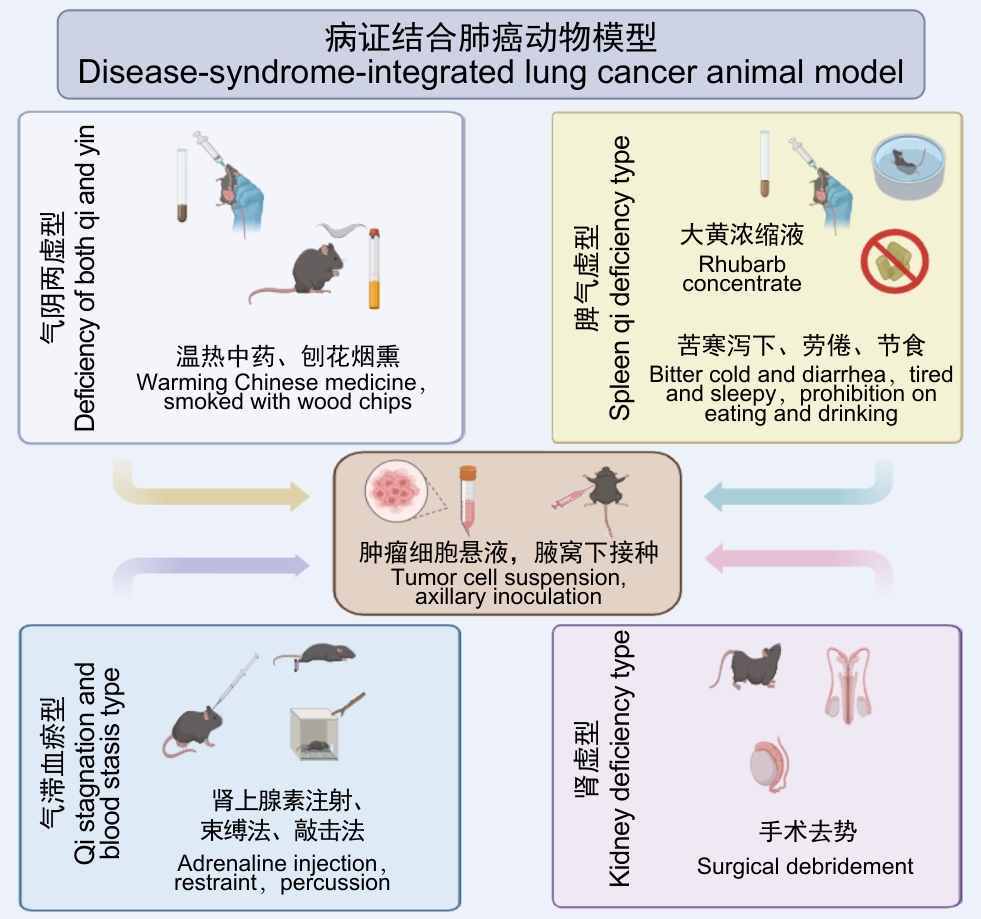
图1 常见病证结合肺癌动物模型的制备方法
Figure 1 Preparation methods for common disease-syndrome-integrated animal models of lung cancer
证型 Syndrome type | 动物品系 Animal strain | 造模方式 Modeling method | 造模时间 Modeling duration | 模型评价 Model evaluation |
|---|---|---|---|---|
阳虚型[ Yang deficiency pattern[ | C57BL/6小鼠(雄性) | 肌肉注射氢化可的松+腋下皮下接种Lewis细胞悬液 | 21 d | 小鼠畏寒肢冷、活动减少、精神萎靡、食欲下降、皮毛暗淡、大便溏稀,症状评分显著升高。环磷酸腺苷水平下降、环磷酸鸟苷水平升高、环磷酸腺苷/环磷酸鸟苷比值降低,血清三碘甲状腺原氨酸含量下降。肿瘤组织生长迅速,可扪及肿块 |
脾虚型[ Spleen deficiency pattern[ | C57BL/6J小鼠(雌雄各半/雄性) | 小承气汤+隔日禁食+高脂饮食+过度疲劳+腋下皮下接种Lewis细胞悬液 | 21 d | 小鼠体重减轻、食量减少、便溏、运动耐力下降、活动减少、肌力减弱、毛发粗糙、畏寒。血清D-木糖吸收率<10%,胃泌素含量<50 pg/mL,白细胞介素-2水平显著降低,可扪及肿块 |
气虚血瘀型[ Qi deficiency and blood stasis pattern[ | C57BL/6小鼠(雄性) | 疲劳+惊恐+高脂饮食+腋下皮下接种Lewis细胞悬液 | 15 d | 小鼠倦怠、活动减少、体重下降、气短、毛发稀疏、舌暗、尾瘀斑。血浆黏度显著升高,血浆凝血酶原时间、活化部分凝血活酶时间及血浆纤维蛋白原水平均显著降低,可扪及肿块 |
肺肾两虚型[ Lung-kidney deficiency pattern[ | C57BL/6小鼠(雄性) | 烟熏+腹腔注射氢化可的松+腋下皮下接种Lewis细胞悬液 | 14 d | 小鼠毛发暗淡、眼睑下垂、缩肩拱背、自主活动减少、肌力减退、尿量增多、垂尾。血清中的白细胞介素-1、丙二醛含量升高,环磷酸腺苷水平下降、环磷酸鸟苷水平升高、环磷酸腺苷/环磷酸鸟苷比值降低,血清三碘甲状腺原氨酸含量下降,可扪及肿块 |
寒热错杂型[ Mixed cold-heat pattern[ | C57BL/6小鼠(雄性) | 丙硫氧嘧啶+知母石膏水煎液+番泻叶灌胃+冰水游泳+皮下注射干酵母混悬液+腋下皮下接种Lewis细胞悬液 | 35 d | 小鼠体温下降、粪便含水量升高、蜷缩扎堆、少动嗜卧、毛发枯槁、形体消瘦。血清三碘甲状腺原氨酸与四碘甲状腺原氨酸水平降低,超氧化物歧化酶与丙二醛含量均降低,可扪及肿块 |
表2 常见病证结合动物模型总结
Table 2 Summary of common disease-syndrome-integrated animal models
证型 Syndrome type | 动物品系 Animal strain | 造模方式 Modeling method | 造模时间 Modeling duration | 模型评价 Model evaluation |
|---|---|---|---|---|
阳虚型[ Yang deficiency pattern[ | C57BL/6小鼠(雄性) | 肌肉注射氢化可的松+腋下皮下接种Lewis细胞悬液 | 21 d | 小鼠畏寒肢冷、活动减少、精神萎靡、食欲下降、皮毛暗淡、大便溏稀,症状评分显著升高。环磷酸腺苷水平下降、环磷酸鸟苷水平升高、环磷酸腺苷/环磷酸鸟苷比值降低,血清三碘甲状腺原氨酸含量下降。肿瘤组织生长迅速,可扪及肿块 |
脾虚型[ Spleen deficiency pattern[ | C57BL/6J小鼠(雌雄各半/雄性) | 小承气汤+隔日禁食+高脂饮食+过度疲劳+腋下皮下接种Lewis细胞悬液 | 21 d | 小鼠体重减轻、食量减少、便溏、运动耐力下降、活动减少、肌力减弱、毛发粗糙、畏寒。血清D-木糖吸收率<10%,胃泌素含量<50 pg/mL,白细胞介素-2水平显著降低,可扪及肿块 |
气虚血瘀型[ Qi deficiency and blood stasis pattern[ | C57BL/6小鼠(雄性) | 疲劳+惊恐+高脂饮食+腋下皮下接种Lewis细胞悬液 | 15 d | 小鼠倦怠、活动减少、体重下降、气短、毛发稀疏、舌暗、尾瘀斑。血浆黏度显著升高,血浆凝血酶原时间、活化部分凝血活酶时间及血浆纤维蛋白原水平均显著降低,可扪及肿块 |
肺肾两虚型[ Lung-kidney deficiency pattern[ | C57BL/6小鼠(雄性) | 烟熏+腹腔注射氢化可的松+腋下皮下接种Lewis细胞悬液 | 14 d | 小鼠毛发暗淡、眼睑下垂、缩肩拱背、自主活动减少、肌力减退、尿量增多、垂尾。血清中的白细胞介素-1、丙二醛含量升高,环磷酸腺苷水平下降、环磷酸鸟苷水平升高、环磷酸腺苷/环磷酸鸟苷比值降低,血清三碘甲状腺原氨酸含量下降,可扪及肿块 |
寒热错杂型[ Mixed cold-heat pattern[ | C57BL/6小鼠(雄性) | 丙硫氧嘧啶+知母石膏水煎液+番泻叶灌胃+冰水游泳+皮下注射干酵母混悬液+腋下皮下接种Lewis细胞悬液 | 35 d | 小鼠体温下降、粪便含水量升高、蜷缩扎堆、少动嗜卧、毛发枯槁、形体消瘦。血清三碘甲状腺原氨酸与四碘甲状腺原氨酸水平降低,超氧化物歧化酶与丙二醛含量均降低,可扪及肿块 |
| [1] | BRAY F, LAVERSANNE M, SUNG H, et al. Global cancer statistics 2022: GLOBOCAN estimates of incidence and mortality worldwide for 36 cancers in 185 countries[J]. CA Cancer J Clin, 2024, 74(3): 229-263. DOI: 10.3322/caac.21834 . |
| [2] | LUO G F, ZHANG Y T, RUMGAY H, et al. Estimated worldwide variation and trends in incidence of lung cancer by histological subtype in 2022 and over time: a population-based study[J]. Lancet Respir Med, 2025, 13(4): 348-363. DOI: 10.1016/S2213-2600(24)00428-4 . |
| [3] | SMOLARZ B, ŁUKASIEWICZ H, SAMULAK D, et al. Lung cancer-epidemiology, pathogenesis, treatment and molecular aspect (review of literature)[J]. Int J Mol Sci, 2025, 26(5): 2049. DOI: 10.3390/ijms26052049 . |
| [4] | 唐坤, 冯磊. 老年肺癌患者合并肺部真菌感染危险因素及诊疗研究进展[J]. 中国病原生物学杂志, 2025, 20(5): 666-669, 682. DOI: 10.13350/j.cjpb.250525 . |
| TANG K, FENG L. Risk factors and research progress in diagnosis and treatment of elderly lung cancer patients complicated with pulmonary fungal infection[J]. J Pathog Biol, 2025, 20(5): 666-669, 682. DOI: 10.13350/j.cjpb.250525 . | |
| [5] | 马伟丽, 靳晓峰, 史巧霞, 等. 氧化苦参碱抗肿瘤作用及机制研究进展[J]. 中国中医药图书情报杂志, 2025, 49(6): 243-247. DOI: 10.3969/j.issn.2095-5707.202411141 . |
| MA W L, JIN X F, SHI Q X, et al. Research progress in the anti-tumor effect and mechanism of oxymatrine[J]. Chin J Libr Inf Sci Tradit Chin Med, 2025, 49(6): 243-247. DOI: 10.3969/j.issn.2095-5707.202411141 . | |
| [6] | 应敏, 翁克贵, 周伟. 非小细胞肺癌免疫治疗疗效影响因素的研究进展[J]. 中国肿瘤, 2025, 34(12): 987-995. DOI: 10.11735/j.issn.1004-0242.2025.12.A011 . |
| YING M, WENG K G, ZHOU W. Research progress on factors affecting the efficacy of immunotherapy in non-small cell lung cancer[J]. China Cancer, 2025, 34(12): 987-995. DOI: 10.11735/j.issn.1004-0242.2025.12.A011 . | |
| [7] | 王忠照, 唐昊. «中华医学会肺癌临床诊疗指南(2024版)»更新要点解读[J]. 海军军医大学学报, 2025, 46(1): 17-23. DOI: 10.16781/j.CN31-2187/R.20240697 . |
| WANG Z Z, TANG H. Chinese Medical Association guideline for clinical diagnosis and treatment of lung cancer(2024 edition): an interpretation of updated points[J]. Acad J Nav Med Univ, 2025, 46(1): 17-23. DOI: 10.16781/j.CN31-2187/R.20240697 . | |
| [10] | 刘媛, 王捷虹. 香砂六君子汤治疗消化系统疾病临床研究现状[J]. 河北中医, 2025, 47(11): 1932-1936. DOI: 10.3969/j.issn.1002-2619.2025.11.037 . |
| LIU Y, WANG J H. Clinical research status of Xiangsha Liujunzi decoction in treating digestive system diseases[J]. Hebei J Tradit Chin Med, 2025, 47(11): 1932-1936. DOI: 10.3969/j.issn.1002-2619.2025.11.037 . | |
| [11] | 包祺, 寿伟臻, 俞杞泉, 等. 益气养阴方对肺癌围手术期患者免疫功能的调节作用[J]. 上海中医药大学学报, 2017, 31(3): 23-25. DOI: 10.16306/j.1008-861x.2017.03.007 . |
| BAO Q, SHOU W Z, YU Q Q, et al. Regulation effects of Yiqi Yangyin prescription on immune function in patients with non small cell lung cancer at perioperative period[J]. Acta Univ Tradit Med Sin Pharmacol Shanghai, 2017, 31(3): 23-25. DOI: 10.16306/j.1008-861x.2017.03.007 . | |
| [8] | 姬佳琦, 胡校庆, 赵艺涵, 等. 血府逐瘀汤在恶性肿瘤疾病中的研究进展[J]. 中国实验方剂学杂志, 2026, 32(3): 321-330. DOI: 10.13422/j.cnki.syfjx.20250623 . |
| JI J Q, HU X Q, ZHAO Y H, et al. Xuefu Zhuyutang in malignant tumor disease: a review[J]. Chin J Exp Tradit Med Formulae, 2026, 32(3): 321-330. DOI: 10.13422/j.cnki.syfjx.20250623 . | |
| [9] | 张茂福, 张志明, 宋忠阳, 等. 中医药靶向Wnt/β-catenin信号通路防治肺癌的研究进展[J]. 中国实验方剂学杂志, 2024, 30(8): 262-270. DOI: 10.13422/j.cnki.syfjx.20231421 . |
| ZHANG M F, ZHANG Z M, SONG Z Y, et al. Prevention and treatment of lung cancer by traditional Chinese medicine targeting Wnt/β-catenin signaling pathway: a review[J]. Chin J Exp Tradit Med Formulae, 2024, 30(8): 262-270. DOI: 10.13422/j.cnki.syfjx.20231421 . | |
| [12] | 李维, 刘旭, 张国倩, 等. 动物水平的绿原酸通过Notch1信号通路调控非小细胞肺癌凋亡及机制研究[J]. 中国肺癌杂志, 2017, 20(8): 555-561. DOI: 10.3779/j.issn.1009-3419.2017.08.10 . |
| LI W, LIU X, ZHANG G Q, et al. Mechanism of chlorogenic acid in apoptotic regulation through Notch1 pathway in non-small cell lung carcinoma in animal level[J]. Chin J Lung Cancer, 2017, 20(8): 555-561. DOI: 10.3779/j.issn.1009-3419.2017.08.10 . | |
| [13] | 阿依达娜·毛兰, 郭秋均, 亓润智, 等. "同气相求"理论在肺癌辨治中的应用[J]. 中国实验方剂学杂志, 2026, 32(2): 261-268. DOI: 10.13422/j.cnki.syfjx.20250622 . |
| Maolan Ayidana, GUO Q J, QI R Z, et al. Application of ''Sensation and response'' theory in syndrome differentiation and treatment of lung cancer[J]. Chin J Exp Tradit Med Formulae, 2026, 32(2): 261-268. DOI: 10.13422/j.cnki.syfjx.20250622 . | |
| [14] | 钱艺蕾, 李冲, 王钰, 等. 西红花及其活性成分治疗肺系疾病的研究进展[J]. 中草药, 2025, 56(9): 3354-3365. DOI: 10.7501/j.issn.0253-2670.2025.09.031 . |
| QIAN Y L, LI C, WANG Y, et al. Research progress on Croci Stigma and its bioactive constituents for treatment of pulmonary diseases[J]. Chin Tradit Herb Drugs, 2025, 56(9): 3354-3365. DOI: 10.7501/j.issn.0253-2670.2025.09.031 . | |
| [15] | 王莹, 黄婧漪, 刘玥彤, 等. 基于Wnt/JNK信号通路探讨补中益气汤联合顺铂增强A549细胞移植瘤对顺铂敏感性的分子机制[J]. 辽宁中医杂志, 2025, 52(8): 188-192, 225. DOI: 10.13192/j.issn.1000-1719.2025.08.046 . |
| WANG Y, HUANG J Y, LIU Y T, et al. Exploring molecular mechanism of Buzhong Yiqi decoction combined with cisplatin in enhancing sensitivity of A549 cell transplantation tumors to cisplatin based on Wnt/JNK signaling pathway[J]. Liaoning J Tradit Chin Med, 2025, 52(8): 188-192, 225. DOI: 10.13192/j.issn.1000-1719.2025.08.046 . | |
| [16] | 李沅音, 张少望, 李高, 等. 国医大师刘尚义从"膜"论治肺癌经验[J]. 世界中医药, 2025, 20(6): 994-998. DOI: 10.3969/j.issn.1673-7202.2025.06.015 . |
| LI Y Y, ZHANG S W, LI G, et al. TCM master LIU shangyi's experience in the treatment of lung cancer from ''membrane'' theory[J]. World Chin Med, 2025, 20(6): 994-998. DOI: 10.3969/j.issn.1673-7202.2025.06.015 . | |
| [17] | 黎明霞, 刘伟锐, 孙梦豫, 等. 基于网络药理学-分子对接技术和斑马鱼模型探究莪术-三棱药对调控血管生成抗肺癌作用机制[J]. 世界科学技术-中医药现代化, 2025, 27(5): 1485-1500. DOI: 10.11842/wst.20240713002 . |
| LI M X, LIU W R, SUN M Y, et al. Study on the mechanism of angiogenesis-regulating anti-lung cancer action of herbal couple curcumae rhizoma-sparganii rhizoma based on network pharmacology-molecular docking and zebrafish model[J]. Mod Tradit Chin Med Mater Med World Sci Technol, 2025, 27(5): 1485-1500. DOI: 10.11842/wst.20240713002 . | |
| [18] | 李玉敏, 陈玉瑛. 基于培土生金理论的五音疗法联合引导性想象用于晚期肺癌化疗患者心理痛苦干预的研究进展[J]. 中国典型病例大全, 2025, 19(2): 1083-1086. DOI: 10.20256/j.cnki.zgdxbl.20250320.001 . |
| LI Y M, CHEN Y Y. Research progress of five-tone therapy combined with guided imagination based on the theory of enriching the soil and generating gold in psychological pain intervention for patients with advanced lung cancer undergoing chemotherapy[J]. Chin Typ Case Database, 2025, 19(2): 1083-1086. DOI: 10.20256/j.cnki.zgdxbl.20250320.001 . | |
| [19] | 涂建国,曹文淼,汪步海.黄芪多糖对肺癌荷瘤小鼠机体免疫功能、肿瘤细胞生长的调节作用[J].中华中医药学刊,2026,44(4):17-20.DOI:10.13193/j.issn.1673-7717.2026.04.004 . |
| TU J G, CAO W M, WANG B H. Regulatory effects of astragalus polysaccharides on immune function and tumor cell growth in lung cancer-bearing mice [J]. Chin J Tradit Chin Med, 2026,44(4):17-20. DOI:10.13193/j.issn.1673-7717.2026.04.004 . | |
| [20] | 刘梦雅, 郑玉玲, 张亚玲, 等. 基于"异病同治"理论运用清肺排毒汤治疗肺癌经验[J]. 中华中医药杂志, 2024, 39(12): 6524-6527. |
| LIU M Y, ZHENG Y L, ZHANG Y L, et al. Experience of Qingfei Paidu Decoction in treating lung cancer based on the theory of ''treating different diseases with the same treatment''[J]. China J Tradit Chin Med Pharm, 2024, 39(12): 6524-6527. | |
| [21] | 李娟, 刘瑞, 花宝金. 基于共生菌探讨调气解毒论治肺癌的作用机制[J]. 中华中医药杂志, 2025, 40(1): 136-139. |
| LI J, LIU R, HUA B J. Analysis on mechanism of lung cancer by theory of regulating qi and detoxification based on symbiotic bacteria[J]. China J Tradit Chin Med Pharm, 2025, 40(1): 136-139. | |
| [22] | 林洪生. 恶性肿瘤中医诊疗指南[M]. 北京: 人民卫生出版社, 2014. |
| LIN H S. Chinese medicine diagnosis and treatment guidelines for malignant tumors[M]. Beijing: People's Medical Publishing House, 2014. | |
| [23] | «肺癌中西医结合诊疗指南»标准化项目组. 肺癌中西医结合诊疗指南[J]. 中医肿瘤学杂志, 2024, 6(6): 1-25. DOI: 10.19811/j.cnki.ISSN2096-6628.2024.11.001 . |
| Standardization Project Team of "Guideline for Diagnosis and Treatment of Lung Cancer with Integrated Traditional Chinese and Western Medicine". Guideline for diagnosis and treatment of lung cancer with integrated traditional Chinese and western medicine[J]. J Oncol Chin Med, 2024, 6(6): 1-25. DOI: 10.19811/j.cnki.ISSN2096-6628.2024.11.001 . | |
| [24] | 国家癌症中心/国家肿瘤临床医学研究中心/中国医学科学院北京协和医学院肿瘤医院, 中国医疗保健国际交流促进会临床药学分会, 中国抗癌协会肿瘤临床药学分会, 等. 肺癌治疗相关中成药药学服务专家共识(2024)[J]. 中国医院用药评价与分析, 2024, 24(10): 1153-1166. DOI: 10.14009/j.issn.1672-2124.2024.10.001 . |
| National Cancer Center/National Clinical Research Center for Cancer/Cancer Hospital, Chinese Academy of Medical Sciences and Peking Union Medical College, Clinical Pharmacy Branch of China International, Exchange and Promotive Association for Medical and Health Care, Clinical Pharmacy Branch of China Anti-Cancer Association, et al. Expert consensus on pharmaceutical care for Chinese patent medicine treatment in lung cancer(2024)[J]. Eval Anal Drug Use Hosp China, 2024, 24(10): 1153-1166. DOI: 10.14009/j.issn.1672-2124.2024.10.001 . | |
| [25] | 康乐, 田硕, 苗晋鑫, 等. 基于中西医临床病症特点的肺癌动物模型分析[J]. 中药药理与临床, 2020, 36(6): 197-202. |
| KANG L, TIAN S, MIAO J X, et al. Analysis of lung cancer animal models based on the characteristics of clinical symptoms in traditional Chinese medicine and western medicine[J]. Pharmacol Clin Chin Mater Med, 2020, 36(6): 197-202. | |
| [26] | 郭雯, 冯贞贞, 王露, 等. 基于文献的肺癌常见中医证候研究[J]. 中医杂志, 2021, 62(16): 1447-1454. DOI: 10.13288/j.11-2166/r.2021.16.014 . |
| GUO W, FENG Z Z, WANG L, et al. Literature-based analysis of common traditional Chinese medicine syndromes of lung cancers[J]. J Tradit Chin Med, 2021, 62(16): 1447-1454. DOI: 10.13288/j.11-2166/r.2021.16.014 . | |
| [27] | 陈思, 梁众擎, 苏婷婷, 等. 黄芪-莪术-蚤休配伍调控PINK1/Parkin信号通路抑制小鼠结肠癌生长转移的研究[J]. 南京中医药大学学报, 2025, 41(4): 473-482. DOI: 10.14148/j.issn.1672-0482.2025.0473 . |
| CHEN S, LIANG Z Q, SU T T, et al. Study on the effect of astragali Radix-Curcuma zedoaria-paridis rhizoma compatibility on inhibiting the growth and metastasis of colon cancer in mice by regulating the PINK1/parkin signaling pathway[J]. J Nanjing Univ Tradit Chin Med, 2025, 41(4): 473-482. DOI: 10.14148/j.issn.1672-0482.2025.0473 . | |
| [28] | 张兴涵, 于明薇, 游佳凤, 等. 基于肿瘤力学微环境探讨从阴阳辨治恶性肺结节[J]. 辽宁中医杂志, 2026, 53(4): 38-42. DOI: 10.13192/j.issn.1000-1719.2026.04.009 . |
| ZHANG X H, YU M W, YOU J F, et al. Discussion on Yin-Yang syndrome differentiation and treatment of malignant pulmonary nodules based on tumor mechanics microenvironment[J]. Liaoning J Tradit Chin Med, 2026, 53(4): 38-42. DOI: 10.13192/j.issn.1000-1719.2026.04.009 . | |
| [29] | 肖航, 张钰芹, 张文强, 等. 国医大师洪广祥从脾胃论治肺癌化学治疗不良反应经验[J]. 中华中医药杂志, 2024, 39(3): 1279-1282. |
| XIAO H, ZHANG Y Q, ZHANG W Q, et al. TCM master HONG Guangxiang's experience in treating lung cancer chemotherapy adverse reactions from spleen and stomach[J]. China J Tradit Chin Med Pharm, 2024, 39(3): 1279-1282. | |
| [30] | 吴海良, 田静. 气阴两虚型肺癌动物模型的建立和评价[J]. 浙江中西医结合杂志, 2012, 22(12): 941-942. |
| WU H L, TIAN J. Establishment and evaluation of lung cancer animal model with both Qi- and Yin-deficiency in traditional Chinese medicine[J]. Zhejiang J Integr Tradit Chin West Med, 2012, 22(12): 941-942. | |
| [31] | 师林, 柯斌, 宋朝阳. 加味龟鹿二仙胶汤对气阴两虚Lewis荷瘤小鼠化疗的减毒增效作用[J]. 中药材, 2014, 37(8): 1434-1437. DOI: 10.13863/j.issn1001-4454.2014.08.031 . |
| SHI L, KE B, SONG Z Y. Attenuation and synergistic effect of Jiawei Guilu Erxianjiao decoction on chemotherapy of Lewis tumor-bearing mice with deficiency of both Qi and Yin[J]. J Chin Med Mater, 2014, 37(8): 1434-1437. DOI: 10.13863/j.issn1001-4454.2014.08.031 . | |
| [32] | 师林, 柯斌, 黄圆圆, 等. 加味龟鹿二仙胶汤联合顺铂对小鼠Lewis肺癌组织、骨髓组织TGF-β1/Smad信号通路的影响[J]. 中药材, 2017, 40(10): 2419-2423. DOI: 10.13863/j.issn1001-4454.2017.10.041 . |
| SHI L, KE B, HUANG Y Y, et al. The effect of modified Guilu erxianjiao decoction combined with cisplatin on TGF-β1/smad signaling pathway in lewis lung cancer tissues and bone marrow[J]. J Chin Med Mater, 2017, 40(10): 2419-2423. DOI: 10.13863/j.issn1001-4454.2017.10.041 . | |
| [33] | 师林, 柯斌, 黄圆圆, 等. 加味龟鹿二仙胶汤联合顺铂对小鼠Lewis肺癌PI3K/AKT/mTOR通路的影响[J]. 中成药, 2017, 39(10): 2148-2152. DOI: 10.3969/j.issn.1001-1528.2017.10.034 . |
| SHI L, KE B, HUANG Y Y, et al. Effect of Jiawei Guilu erxianjiao decoction combined with cisplatin on PI3K/AKT/mTOR pathway of lewis lung cancer in mice[J]. Chin Tradit Pat Med, 2017, 39(10): 2148-2152. DOI: 10.3969/j.issn.1001-1528.2017.10.034 . | |
| [34] | 师林, 黄圆圆, 柯斌. 加味龟鹿二仙胶汤联合顺铂对Lewis肺癌小鼠免疫功能的影响[J]. 中药材, 2021, 44(2): 452-455. DOI: 10.13863/j.issn1001-4454.2021.02.037 . |
| SHI L, HUANG Y Y, KE B. Effect of Jiawei Guilu Erxianjiao Decoction combined with cisplatin on immune function of Lewis lung cancer mice[J]. J Chin Med Mater, 2021, 44(2): 452-455. DOI: 10.13863/j.issn1001-4454.2021.02.037 . | |
| [35] | 李杨, 杨玲玲, 白彦丽, 等. 黄芪多糖对气阴两虚Lewis肺癌荷瘤小鼠肿瘤生长、转移及细胞周期的影响[J]. 肿瘤防治研究, 2018, 45(3): 131-137. DOI: 10.3971/j.issn.1000-8578.2018.17.0220 . |
| LI Y, YANG L L, BAI Y L, et al. Effects of Astragalus polysaccharides on growth, metastasis and cell cycle of lewis lung cancer in tumor-bearing mice with Qi and Yin deficiency[J]. Cancer Res Prev Treat, 2018, 45(3): 131-137. DOI: 10.3971/j.issn.1000-8578.2018.17.0220 . | |
| [36] | 董丹, 李滢, 王雪峰. 基于"脾统四脏"理论以"滋生健脾法"辨治儿童矮身材探析[J]. 中国中西医结合儿科学, 2024, 16(5): 387-391. DOI: 10.3969/j.issn.1674-3865.2024.05.006 . |
| DONG D, LI Y, WANG X F. Exploring the treatment for short stature in children with "the method of nourishing the spleen" based on the theory of "the spleen governing the four internal organs"[J]. Chin Pediatr Integr Tradit West Med, 2024, 16(5): 387-391. DOI: 10.3969/j.issn.1674-3865.2024.05.006 . | |
| [37] | 王保芹, 华文山, 杨敏. 近20年肺癌中医辨证分型研究[J]. 中医药导报, 2024, 30(10): 103-106. DOI: 10.13862/j.cn43-1446/r.2024.10.018 . |
| WANG B Q, HUA W S, YANG M. Study on TCM syndrome differentiation of lung cancer in recent 20 years[J]. Guid J Tradit Chin Med Pharm, 2024, 30(10): 103-106. DOI: 10.13862/j.cn43-1446/r.2024.10.018 . | |
| [38] | 孙在典, 包素珍, 郑小伟, 等. 黄芪建中汤对小鼠脾气虚证肺癌转移FAK基因表达的影响[J]. 浙江中医杂志, 2009, 44(6): 400-401. DOI: 10.3969/j.issn.0411-8421.2009.06.005 . |
| SUN Z D, BAO S Z, ZHENG X W, et al. Effects of Huangqi Jianzhong decoction on the expression of FAK in spleen-deficiency syndrome of lung cancer cell in mice[J]. Zhejiang J Tradit Chin Med, 2009, 44(6): 400-401. DOI: 10.3969/j.issn.0411-8421.2009.06.005 . | |
| [39] | 魏自太, 包素珍, 李恒楠, 等. 加味黄芪建中汤对脾气虚证Lewis肺癌小鼠CXCL12、CXCR4、TGF-β基因表达的影响[J]. 上海中医药大学学报, 2017, 31(3): 57-61. DOI: 10.16306/j.1008-861x.2017.03.015 . |
| WEI Z T, BAO S Z, LI H N, et al. Influence of modified Huangqi Jianzhong decoction on the gene expressions of CXCL12 CXCR4 and TGF-β in mice bearing lewis lung cancer with syndrome of spleen qi deficiency[J]. Acta Univ Tradit Med Sin Pharmacol Shanghai, 2017, 31(3): 57-61. DOI: 10.16306/j.1008-861x.2017.03.015 . | |
| [40] | 钱钧, 姜涛, 包素珍, 等. 加味黄芪建中汤通过miR-574-5p对脾气虚Lewis肺癌小鼠Wnt/β-catenin信号转导途径的调控机制研究[J]. 中华中医药杂志, 2019, 34(1): 298-301. |
| QIAN J, JIANG T, BAO S Z, et al. Study on regulation mechanism of modified Huangqi Jianzhong Decoction on Wnt/β-catenin signaling pathway in Lewis lung carcinoma mice with spleen qi deficiency syndrome via miR-574-5p[J]. China J Tradit Chin Med Pharm, 2019, 34(1): 298-301. | |
| [41] | O'KEEFFE L M, TAYLOR G, HUXLEY R R, et al. Smoking as a risk factor for lung cancer in women and men: a systematic review and meta-analysis[J]. BMJ Open, 2018, 8(10): e021611. DOI: 10.1136/bmjopen-2018-021611 . |
| [42] | 张光霁, 徐楚韵. 基于中医病机"瘀毒互结"致病理论的肿瘤"瘀毒同治"特色理论及抗肿瘤创新药物研究[J]. 浙江中医药大学学报, 2019, 43(10): 1052-1057. DOI: 10.16466/j.issn1005-5509.2019.10.007 . |
| ZHANG G J, XU C Y. Researches of characteristic theory of "eliminating blood stasis and toxin together to remedy tumor" and anti-tumor innovative drug development based on TCM pathogenesis theory of "blood stasis and toxin interconnection inducing tumor"[J]. J Zhejiang Chin Med Univ, 2019, 43(10): 1052-1057. DOI: 10.16466/j.issn1005-5509.2019.10.007 . | |
| [43] | 刘楠, 姜云耀, 李莹, 等. 气滞血瘀证动物模型研究现状[J]. 中国实验方剂学杂志, 2018, 24(1): 217-226. DOI: 10.13422/j.cnki.syfjx.2018010217 . |
| LIU N, JIANG Y Y, LI Y, et al. Current status of animal model research of Qi stagnation and blood stasis syndrome[J]. Chin J Exp Tradit Med Formulae, 2018, 24(1): 217-226. DOI: 10.13422/j.cnki.syfjx.2018010217 . | |
| [44] | 彭召云, 郑心, 鲁兴隆. 肺抑瘤膏对气滞血瘀质Lewis肺癌小鼠肿瘤生长及VEGF-C表达的影响[J]. 时珍国医国药, 2015, 26(12): 2895-2896. DOI: 10.3969/j.issn.1008-0805.2015.12.030 . |
| PENG Z Y, ZHENG X, LU X L. Effect of Feiyiliu ointment on tumor growth and VEGF-C expression in Lewis lung cancer mice with Qi stagnation and blood stasis[J]. Lishizhen Med Mater Med Res, 2015, 26(12): 2895-2896. DOI: 10.3969/j.issn.1008-0805.2015.12.030 . | |
| [45] | 上官文姬, 田建辉. 从肾论治肺癌转移[J]. 中医学报, 2022, 37(3): 475-478. DOI: 10.16368/j.issn.1674-8999.2022.03.089 . |
| SHANGGUAN W J, TIAN J H. Treatment of lung cancer metastasis from kidney[J]. Acta Chin Med, 2022, 37(3): 475-478. DOI: 10.16368/j.issn.1674-8999.2022.03.089 . | |
| [46] | 豆萌萌, 王淑玲, 周学良, 等. 去势小鼠肾虚肺癌模型建立后性激素对肺癌发生的作用机制探讨[J]. 肿瘤, 2017, 37(9): 917-923, 952. DOI: 10.3781/j.issn.1000-7431.2017.11.266 . |
| DOU M M, WANG S L, ZHOU X L, et al. Role of sex hormones in the occurrence of lung cancer based on the foundation of kidney deficiency and lung cancer model in castrated mice[J]. Tumor, 2017, 37(9): 917-923, 952. DOI: 10.3781/j.issn.1000-7431.2017.11.266 . | |
| [47] | 李仲普, 胡学军, 冯磊, 等. 阳和汤抑制阳虚证小鼠Lewis肺癌生长的实验研究[J]. 中医药导报, 2017, 23(9): 25-29. DOI: 10.13862/j.cnki.cn43-1446/r.2017.09.008 . |
| LI Z P, HU X J, FENG L, et al. Experimental study of Yanghe decoctionon inhibiting lewis lung carcinoma in mice of Yang deficiency syndrome[J]. Guid J Tradit Chin Med Pharm, 2017, 23(9): 25-29. DOI: 10.13862/j.cnki.cn43-1446/r.2017.09.008 . | |
| [48] | 何佩珊, 杨公博, 姜敏, 等. 阳虚证肺腺癌骨转移活体荧光成像模型的建立与评价[J]. 中华中医药杂志, 2019, 34(3): 1220-1223. DOI: CNKI:SUN:BXYY.0.2019-03-097 . |
| HE P S, YANG G B, JIANG M, et al. Establishment and evaluation of in vivo fluorescence imaging model in Yang deficiency syndrome of lung adenocarcinoma with bone metastasis[J]. China J Tradit Chin Med Pharm, 2019, 34(3): 1220-1223. DOI: CNKI:SUN:BXYY.0.2019-03-097 . | |
| [49] | 林丽珠, 王淑美, 周京旭. 益气除痰方对脾虚Lewis肺癌小鼠肿瘤生长、生存期及PRDX-1、PRDX-6表达的影响[J]. 中国中西医结合杂志, 2011, 31(1): 99-103. |
| LIN L Z, WANG S M, ZHOU J X. Effects of Yiqi chutan recipe on tumor growth, survival time and expressions of PRDX-1 and PRDX-6 in lewis lung carcinoma model mice with pi-deficiency syndrome[J]. Chin J Integr Tradit West Med, 2011, 31(1): 99-103. | |
| [50] | 陶志广, 周岱翰, 陈林香, 等. 参芪固本方治疗脾虚荷Lewis肺癌小鼠的实验研究[J]. 广州中医药大学学报, 2008, 25(1): 56-59. DOI: 10.13359/j.cnki.gzxbtcm.2008.01.024 . |
| TAO Z G, ZHOU D H, CHEN L X, et al. Experimental research of Shen qi Guben recipe for the treatment of lewis lung cancer mice with spleen-deficiency[J]. J Guangzhou Univ Tradit Chin Med, 2008, 25(1): 56-59. DOI: 10.13359/j.cnki.gzxbtcm.2008.01.024 . | |
| [51] | 蔡菊芬, 卢红阳, 杜灵彬, 等. 半夏泻心汤改善伊立替康致小细胞肺癌荷瘤鼠脾虚的作用[J]. 中华中医药学刊, 2012, 30(6): 1313-1314. DOI: 10.13193/j.archtcm.2012.06.131.caijf.043 . |
| CAI J F, LU H Y, DU L B, et al. Study on improvement of Banxia Xiexin decoction against irinotecan-induced spleen deficiency of tumor-bearing mice with small-cell lung cancer[J]. Chin Arch Tradit Chin Med, 2012, 30(6): 1313-1314. DOI: 10.13193/j.archtcm.2012.06.131.caijf.043 . | |
| [52] | 魏玉林, 王淑美, 刘启欧, 等. 益气除痰方治疗脾虚型肺癌作用机制探讨[J]. 中药材, 2016, 39(9): 2097-2101. DOI: 10.13863/j.issn1001-4454.2016.09.041 . |
| WEI Y L, WANG S M, LIU Q O, et al. Study on the mechanism of Yiqi chutan recipe in the treatment of lung cancer with splenasthenic syndrome[J]. J Chin Med Mater, 2016, 39(9): 2097-2101. DOI: 10.13863/j.issn1001-4454.2016.09.041 . | |
| [53] | 冯原, 江颖, 周颖, 等. 补肺化瘀汤对气虚血瘀证Lewis肺癌小鼠的影响[J]. 中成药, 2019, 41(11): 2625-2631. DOI: 10.3969/j.issn.1001-1528.2019.11.014 . |
| FENG Y, JIANG Y, ZHOU Y, et al. Effects of Bufei Huayu Decoction on mice with Lewis lung cancer of Qi-Deficiency and Blood-Stasis Pattern[J]. Chin Tradit Pat Med, 2019, 41(11): 2625-2631. DOI: 10.3969/j.issn.1001-1528.2019.11.014 . | |
| [54] | 王菊勇, 郭净, 郑展, 等. 小鼠肺肾两虚型肺癌模型的建立[J]. 实验动物与比较医学, 2011, 31(4): 242-247. DOI: 10.3969/j.issn.1674-5817.2011.04.003 . |
| WANG J Y, GUO J, ZHENG Z, et al. Establishment of mice model of lung cancer with lung and kidney deficiency[J]. Lab Anim Comp Med, 2011, 31(4): 242-247. DOI: 10.3969/j.issn.1674-5817.2011.04.003 . | |
| [55] | 俞赟丰, 上官雪丽, 李新. 基于HGF/C-Met信号通路探讨乌梅丸对寒热错杂证Lewis肺癌小鼠的抑癌作用及机制[J]. 中国实验方剂学杂志, 2022, 28(21): 32-41. DOI: 10.13422/j.cnki.syfjx.202201722 . |
| YU Y F, SHANGGUAN X L, LI X. Effect and mechanism of wumeiwan against lewis lung cancer in mice with syndrome of cold and heat in complexity based on HGF/C-met signaling pathway[J]. Chin J Exp Tradit Med Formulae, 2022, 28(21): 32-41. DOI: 10.13422/j.cnki.syfjx.202201722 . | |
| [56] | 何朝, 张唯佳, 张彤, 等. 基于病证结合特点构建寒热错杂型溃疡性结肠炎大鼠模型的实验研究[J]. 上海中医药杂志, 2024, 58(8): 88-96. DOI: 10.16305/j.1007-1334.2024.2311068 . |
| HE C, ZHANG W J, ZHANG T, et al. Experimental study on establishment of a rat model of ulcerative colitis with cold-heat complex syndrome based on characteristics of combination of disease and syndromes[J]. Shanghai J Tradit Chin Med, 2024, 58(8): 88-96. DOI: 10.16305/j.1007-1334.2024.2311068 . | |
| [57] | LAHIRI A, MAJI A, POTDAR P D, et al. Lung cancer immunotherapy: progress, pitfalls, and promises[J]. Mol Cancer, 2023, 22(1): 40. DOI: 10.1186/s12943-023-01740-y . |
| [58] | 姜伟华, 高永山, 刘娜, 等. 通过CRISPR/Cas9敲除PD-1有效增强EGFR-CAR-T细胞对肺癌的抗肿瘤活性[J]. 中国老年学杂志, 2023, 43(14): 3483-3487. DOI: 10.3969/j.issn.1005-9202.2023.14.039 . |
| JIANG W H, GAO Y S, LIU N, et al. The anti-tumor activity of EGFR-CAR-T cells against lung cancer was effectively enhanced by knocking out PD-1 by CRISPR/Cas9[J]. Chin J Gerontol, 2023, 43(14): 3483-3487. DOI: 10.3969/j.issn.1005-9202.2023.14.039 . | |
| [59] | 范衍序, 白易, 张雅敏. CRISPR/Cas9基因编辑技术应用于肿瘤治疗耐药性研究的新进展[J]. 天津医科大学学报, 2025, 31(2): 180-183. DOI: 10.20135/j.issn.1006-8147.2025.02.0180 . |
| FAN Y X, BAI Y, ZHANG Y M. New progress of CRISPR/Cas9 gene editing technology in the study of drug resistance in tumor treatment[J]. J Tianjin Med Univ, 2025, 31(2): 180-183. DOI: 10.20135/j.issn.1006-8147.2025.02.0180 . | |
| [60] | 王博康, 朱名扬, 张秀森, 等. 基于AAV6-CRISPR-Cas9系统抑制NBR1表达对肺癌小鼠肿瘤免疫调控的影响[J]. 安徽医科大学学报, 2024, 59(12): 2103-2111. DOI: 10.19405/j.cnki.issn1000-1492.2024.12.006 . |
| WANG B K, ZHU M Y, ZHANG X S, et al. Inhibiting NBR1 expression using the AAV6-CRISPR-Cas9 system affects tumor immune regulation in lung cancer mice[J]. Acta Univ Med Anhui, 2024, 59(12): 2103-2111. DOI: 10.19405/j.cnki.issn1000-1492.2024.12.006 . | |
| [61] | 张璐瑶, 王杨静, 刘兵兵, 等. 补中益气汤通过PERK/eIF2α/ATF4/CHOP通路调控凋亡改善CIH小鼠肺表面活性蛋白C的表达及肺损伤[J]. 中国实验方剂学杂志, 2025, 31(15): 19-27. DOI: 10.13422/j.cnki.syfjx.20242242 . |
| ZHANG L Y, WANG Y J, LIU B B, et al. Apoptosis regulation by Buzhong yiqitang via PERK/eIF2α/ATF4/CHOP pathway to enhance pulmonary surfactant-associated protein C expression and ameliorate lung injury in CIH mice[J]. Chin J Exp Tradit Med Formulae, 2025, 31(15): 19-27. DOI: 10.13422/j.cnki.syfjx.20242242 . | |
| [62] | 赵贞, 李超红, 赵宝生, 等. 慢性间歇性低氧通过Ang Ⅱ-AT1R激活PI3K/Akt促进LLC细胞迁移研究[J]. 中华肿瘤防治杂志, 2022, 29(16): 1184-1193. DOI: 10.16073/j.cnki.cjcpt.2022.16.06 . |
| ZHAO Z, LI C H, ZHAO B S, et al. Chronic intermittent hypoxia promotes the migration of LLC cells by activating the PI3K/Akt signaling pathway through Ang Ⅱ-AT1R[J]. Chin J Cancer Prev Treat, 2022, 29(16): 1184-1193. DOI: 10.16073/j.cnki.cjcpt.2022.16.06 . |
| [1] | 龚志群, 饶希午, 张天弋, 吴荣琛, 叶明楠, 蒋春曦, 王苏美, 朱燕娟, 柴小姝. 免疫检查点抑制剂相关性肺炎小鼠模型的构建与评价[J]. 实验动物与比较医学, 2026, 46(4): 498-506. |
| [2] | 潘林琴, 邓向亮, 罗云霞. 缺血性脑卒中动物模型的中西医整合转化研究进展[J]. 实验动物与比较医学, 2026, 46(3): 344-356. |
| [3] | 何家祺, 周园园, 聂永强, 王朝霞, 徐汪节. 香烟烟雾暴露诱导慢性阻塞性肺疾病小鼠模型的构建及多维度病理评估[J]. 实验动物与比较医学, 2026, 46(1): 11-19. |
| [4] | 徐波, 陈泰任, 方乾, 吴际. 脊髓压迫和半横断损伤小鼠模型的时空基因表达谱及修复机制研究[J]. 实验动物与比较医学, 2026, 46(1): 32-45. |
| [5] | 王笑铭, 孟晨晨, 范鹿, 李艳阳, 张军平, 吕仕超. 中医证候类动物模型构建方法概述[J]. 实验动物与比较医学, 2025, 45(5): 596-610. |
| [6] | 刘子琪, 李云英, 李钦, 李元涵, 何芳雁, 温伟波. 脾胃虚寒型胃溃疡动物模型研究进展[J]. 实验动物与比较医学, 2025, 45(5): 574-585. |
| [7] | 刘洋, 程来洋, 郭中坤. 中医病症结合的围绝经期综合征动物模型研究进展[J]. 实验动物与比较医学, 2025, 45(5): 586-595. |
| [8] | 刘亚益, 贾云凤, 左一鸣, 张军平, 吕仕超. 心气阴两虚证动物模型的构建方法与评价进展[J]. 实验动物与比较医学, 2025, 45(4): 411-421. |
| [9] | 贡磊磊, 王晓霞, 封学伟, 李心蕾, 赵涵, 张雪艳, 冯欣. 不同浓度环磷酰胺诱导早发性卵巢功能不全小鼠模型及作用机制研究[J]. 实验动物与比较医学, 2025, 45(4): 403-410. |
| [10] | 姜娟, 宋宁, 连文博, 邵丛丛, 顾文文, 石燕. 两种浓度乙醇溶液灌注建立小鼠宫腔粘连模型的组织病理和分子病理表型比较[J]. 实验动物与比较医学, 2025, 45(4): 393-402. |
| [11] | 罗莲莲, 袁艳春, 王俊岭, 时广森. 肌萎缩侧索硬化症小鼠模型研究进展[J]. 实验动物与比较医学, 2025, 45(3): 290-299. |
| [12] | 陈钰涵, 陈瑾玲, 李欣, 区燕华, 王斯, 陈镜伊, 王兴易, 袁嘉丽, 段媛媛, 羊忠山, 牛海涛. 基于中西医临床病证特点的重症肌无力动物模型分析[J]. 实验动物与比较医学, 2025, 45(2): 176-186. |
| [13] | 于士颜. 小鼠模型在消化道黏膜免疫及感染性疾病研究中的应用进展[J]. 实验动物与比较医学, 2022, 42(1): 3-10. |
| [14] | 姚玎, 周晶, 严国锋, 王会阳, 汪雅荻, 马政文. 盐敏感性高血压小鼠模型的建立[J]. 实验动物与比较医学, 2020, 40(4): 314-. |
| [15] | 柴文君, 孙 磊, 刘晓丽, 潘洪玉, 郭天安, 徐 烨, 闫明霞. 超声引导下左心室内注射人肺癌细胞建立骨转移小鼠模型[J]. 实验动物与比较医学, 2020, 40(3): 183-. |
| 阅读次数 | ||||||
|
全文 |
|
|||||
|
摘要 |
|
|||||
