



实验动物与比较医学 ›› 2026, Vol. 46 ›› Issue (3): 437-445.DOI: 10.12300/j.issn.1674-5817.2025.135
艾秀峰, 张利棕, 方明笋, 吕东颖, 陈楚, 蔡兆伟, 王德军( )(
)( )
)
收稿日期:2025-08-19
修回日期:2025-12-19
出版日期:2026-06-25
发布日期:2026-06-19
通讯作者:
王德军(1975—),男,硕士,正高级实验师,研究方向:实验动物资源开发、疾病动物模型机制及中药干预。E-mail:wdj@zcmu.edu.cn。ORCID:0009-0009-6689-3212作者简介:艾秀峰(1982—),男,硕士,实验师,研究方向:实验动物资源开发。E-mail:20191015@zcmu.edu.cn
AI Xiufeng, ZHANG Lizong, FANG Mingsun, LÜ Dongying, CHEN Chu, CAI Zhaowei, WANG Dejun()()
Received:2025-08-19
Revised:2025-12-19
Published:2026-06-25
Online:2026-06-19
Correspondence to:
WANG Dejun (ORCID: 0009-0009-6689-3212), E-mail: wdj@zcmu.edu.cn摘要:
目的 评估饮用含氯水对大鼠、小鼠肠道菌群的影响,探讨模式动物肠道微生态对含氯饮用水中氯刺激的响应差异。 方法 6只8周龄雄性SD大鼠与6只8周龄雄性C57BL/6小鼠,适应性喂养5 d后,将大鼠和小鼠的饮用水由纯水换为含25.4~32.4 nmol/L游离氯的水,持续干预8周,实验期间饲喂相同的饲料。分别于干预前(第0周,作为对照组)和第3周、第8周的最后一天(作为饮用含氯水组)收集粪便样本,通过16S rRNA测序分析菌群组成,并进行α多样性(Chao1和Shannon指数)、β多样性[主成分分析(principal component analysis,PCA)]及线性判别分析效应量(linear discriminant analysis effect size,LEfSe)分析。 结果 干预3周后,饮用含氯水组大鼠和小鼠肠道菌群的α多样性均显著低于对照组(P<0.01);干预8周后,大鼠菌群的α多样性与对照组无显著差异,而小鼠的α多样性仍显著低于对照组(P<0.01)。β多样性分析显示,与对照组相比,饮用含氯水大鼠和小鼠组的菌群结构发生显著改变。LEfSe分析表明,与对照组相比,饮用含氯水组(大鼠和小鼠)的拟杆菌属和瘤胃球菌属丰度均显著降低,且对小鼠的菌群扰动更显著[线性判别分析(linear discriminant analysis,LDA)>4.0],菌群多样性的降幅更大,差异菌属的数量更多。 结论 饮用含氯水可改变大鼠、小鼠肠道菌群的多样性及结构,且小鼠对此更为敏感,提示在动物实验饮水管理及模型选择中,应关注氯对肠道微生态的潜在影响。
中图分类号:
艾秀峰,张利棕,方明笋,等. 16S rRNA测序分析饮用含氯水对大鼠和小鼠肠道菌群的影响差异[J]. 实验动物与比较医学, 2026, 46(3): 437-445. DOI: 10.12300/j.issn.1674-5817.2025.135.
AI Xiufeng,ZHANG Lizong,FANG Mingsun,et al. Analysis of Differences in the Intestinal Flora of Rats and Mice after Drinking Chlorinated Water Based on 16S rRNA Sequencing[J]. Laboratory Animal and Comparative Medicine, 2026, 46(3): 437-445. DOI: 10.12300/j.issn.1674-5817.2025.135.
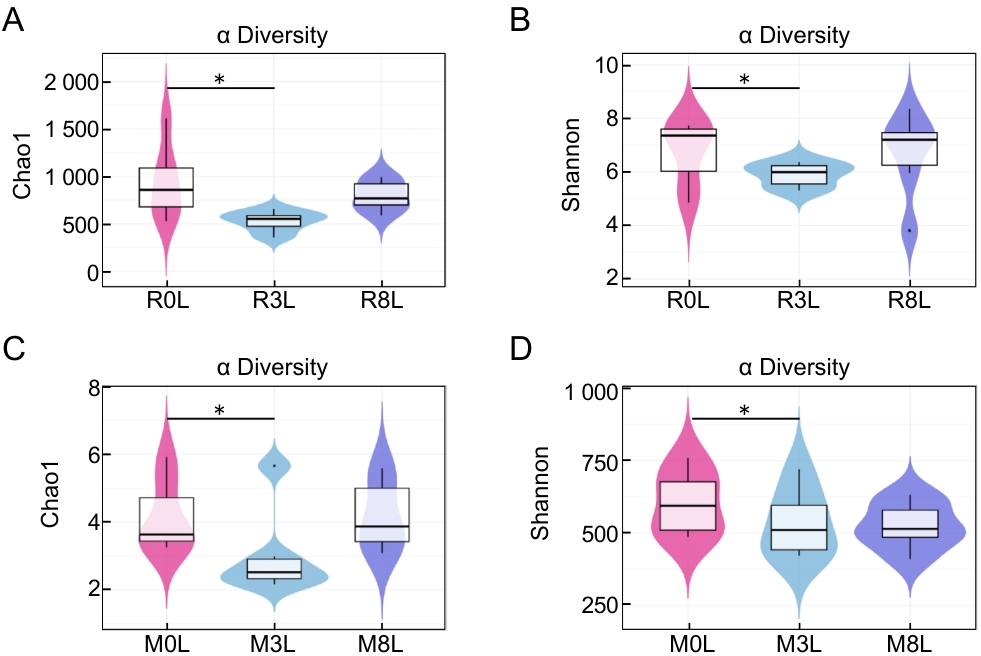
图1 大鼠和小鼠肠道菌群的α多样性分析
注:A~B,饮用含氯水0周、3周、8周大鼠之间粪便菌群的Chao1指数和Shannon指数;C~D,饮用含氯水0周、3周、8周小鼠之间粪便菌群的Chao1指数和Shannon指数。R0L、R3L、R8L分别为饮用含氯水0周、3周和8周的大鼠组;M0L、M3L、M8L分别为饮用含氯水0周、3周和8周的小鼠组;n=6,*P<0.05。
Figure 1 Analysis of intestinal flora α diversity in rats and mice
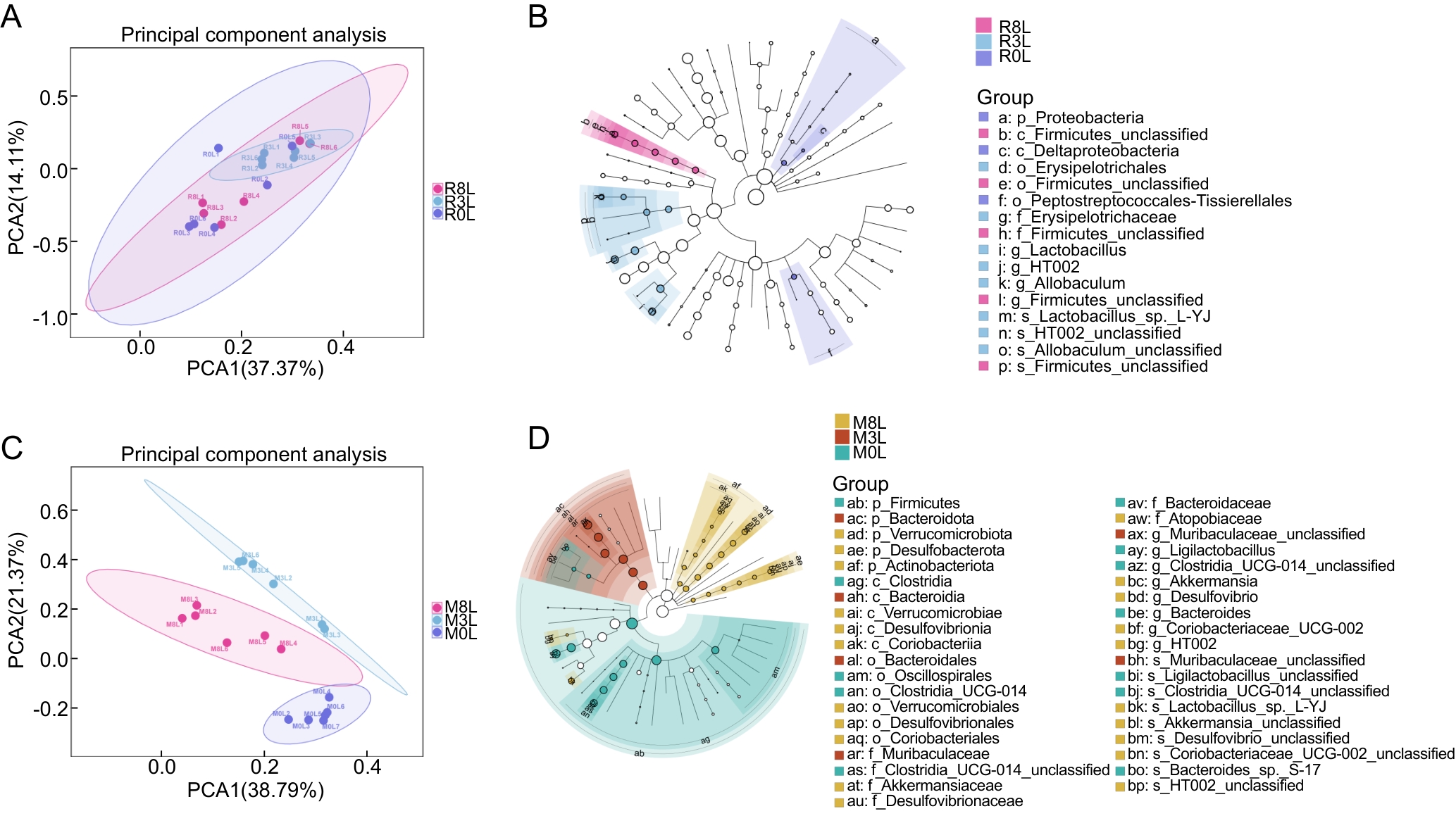
图2 大鼠和小鼠肠道菌群β多样性分析与LDA差异菌群分类树分析
注:A~B,饮用含氯水0周、3周、8周大鼠之间的主成分分析(PCA)结果以及基于线性判别分析效应量(LEfSe)的支系图(从门级到种级);C~D,饮用含氯水0周、3周、8周小鼠之间的PCA结果以及基于LEfSe的支系图(从门级到种级)。p,门水平;c,纲水平;o,目水平;f,科水平;g,属水平;s,种水平;R0L、R3L、R8L分别为饮用含氯水0周、3周和8周的大鼠组;M0L、M3L、M8L分别为饮用含氯水0周、3周和8周的小鼠组;n=6。
Figure 2 Intestinal flora β diversity and LEfSe differential taxa analysis in rats and mice
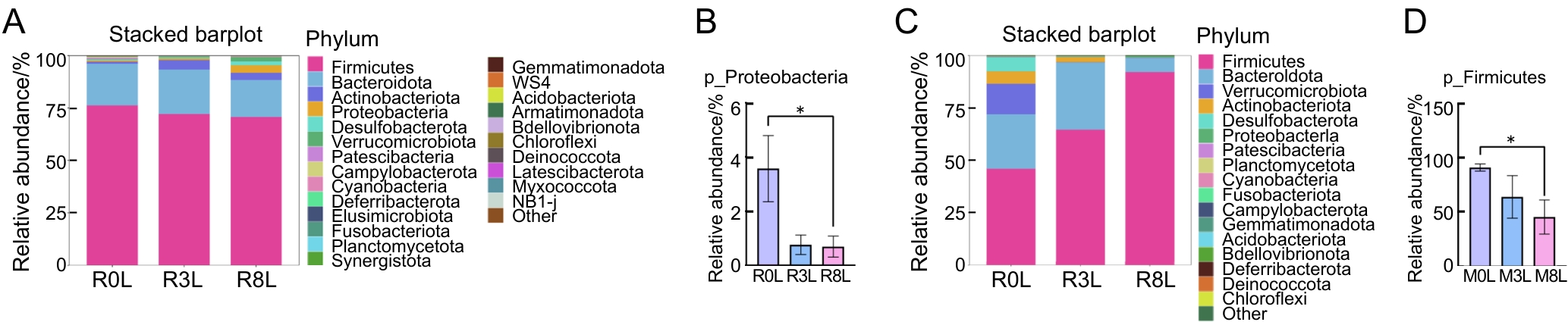
图 3 大鼠与小鼠微生物菌群在门水平上的相对丰度差异
注:A~B,饮用含氯水0周、3周、8周后,大鼠粪便微生物在门水平上的群落组成的直方图(A)及其丰度最大菌[变形杆菌门(Proteobacteria)]的相对丰度(B);C~D,饮用含氯水0周、3周、8周小鼠粪便微生物在门水平上的群落组成的直方图(C)及其丰度最大菌[厚壁菌门(Firmicutes)]的相对丰度(D)。R0L、R3L、R8L分别为饮用含氯水0周、3周和8周的大鼠组;M0L、M3L、M8L分别为饮用含氯水0周、3周和8周的小鼠组;n=6,*P<0.05。
Figure 3 Comparison of the relative abundance of microbial communities at the phylum level between rats and mice
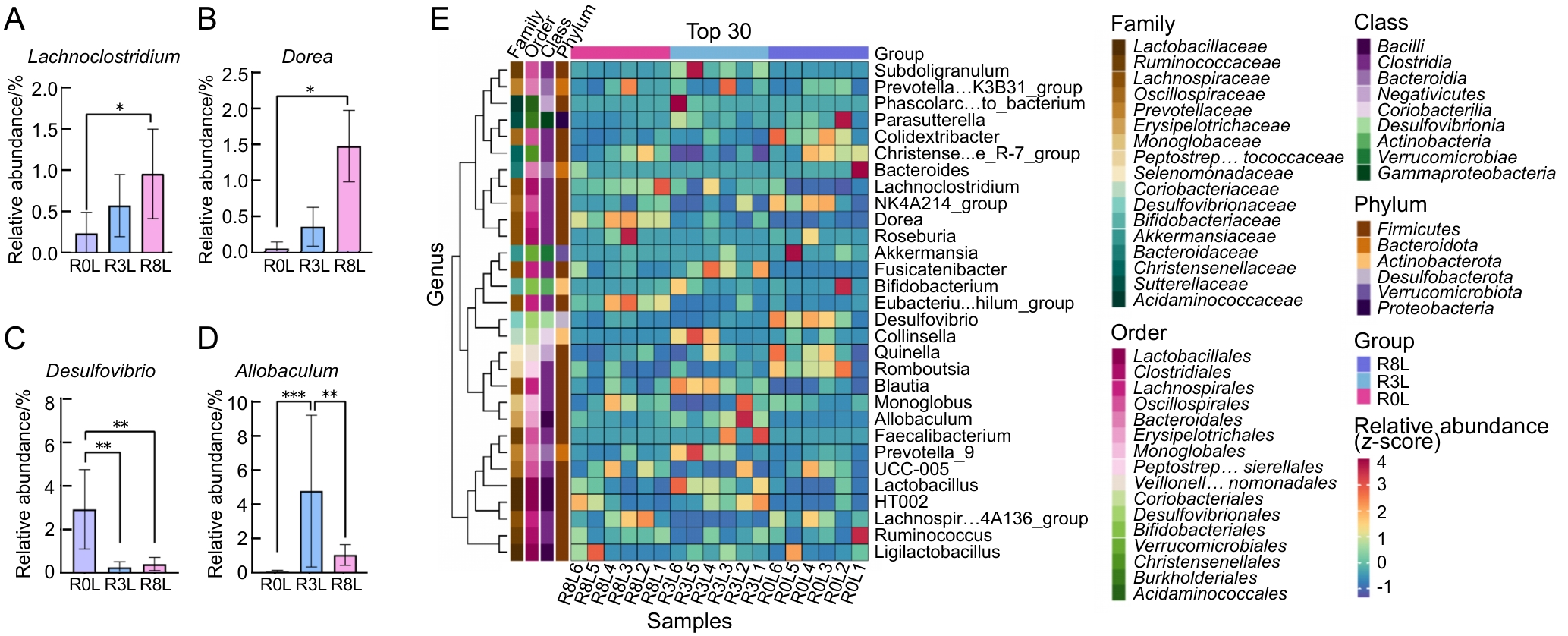
图4 大鼠肠道菌群关键菌属及热图分析
注:A~D,饮用含氯水0周、3周、8周大鼠组粪便微生物中拉奇诺梭菌属、多尔氏菌属、脱硫弧菌属和异杆菌属的相对丰度;E,饮用含氯水0周、3周、8周大鼠组粪便微生物中前30种优势菌属的相对丰度热图。R0L、R3L、R8L分别为饮用含氯水0周、3周和8周的大鼠组;n=6,*P<0.05,**P<0.01,***P<0.001。
Figure 4 Key genus and heatmap analysis of intestinal flora in rats
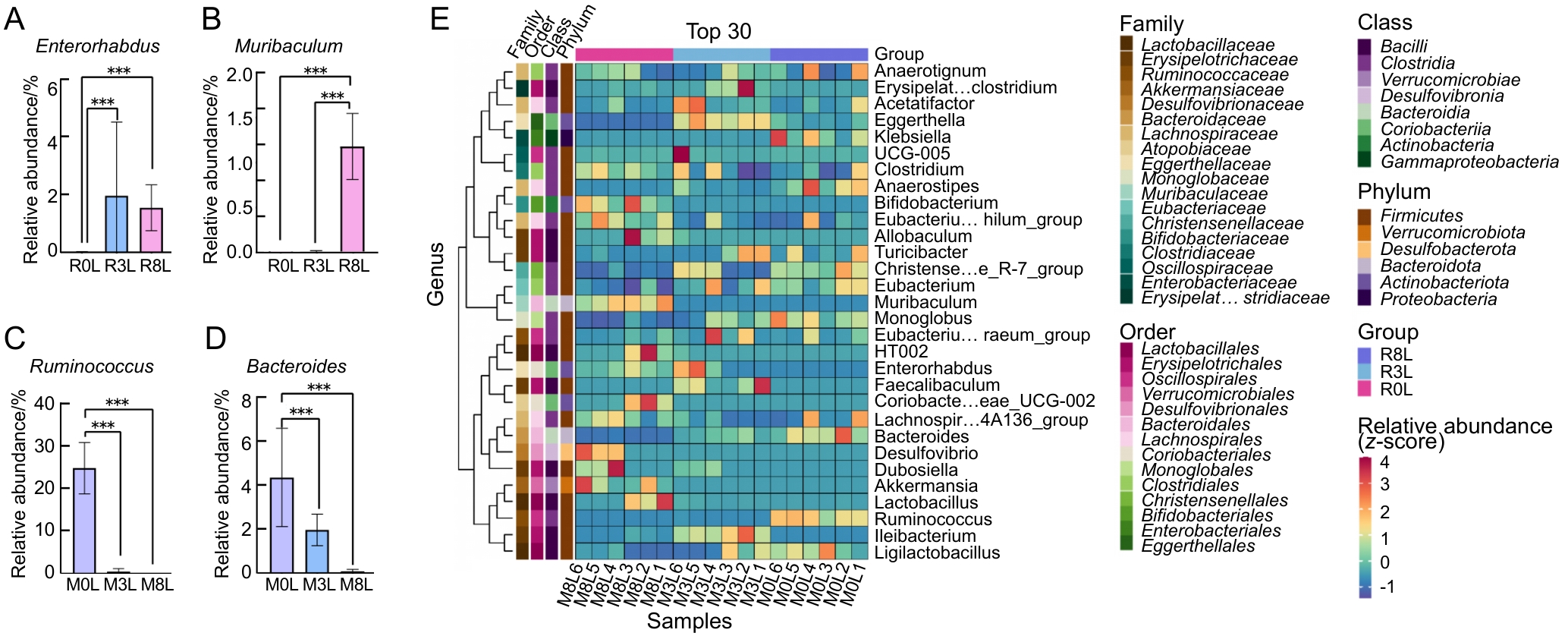
图5 小鼠肠道菌群关键菌属及热图分析
注:A~D,肠杆状菌属、鼠杆菌属、瘤胃球菌属和拟杆菌属的相对丰度;E,饮用含氯水0周、3周、8周小鼠组粪便微生物中前30种优势物种的相对丰度热图。M0L、M3L、M8L分别为饮用含氯水0周、3周和8周的小鼠组;n=6,***P<0.001。
Figure 5 Key genus and heatmap analysis of intestinal flora in mice
| [1] | NGWENYA N, NCUBE E J, PARSONS J. Recent advances in drinking water disinfection: successes and challenges[J]. Rev Environ ContamToxicol, 2013, 222: 111-170. DOI: 10.1007/978-1-4614-4717-7_4 . |
| [2] | TAYLOR K, POPE R. A new form of automatic watering system for laboratory animals[J]. Lab Anim, 1978, 12(3): 129-131. DOI: 10.1258/002367778780936241 . |
| [3] | SNELL J A, JANDOVA J, WONDRAK G T. Hypochlorous acid: from innate immune factor and environmental toxicant to chemopreventive agent targeting solar UV-induced skin cancer[J]. Front Oncol, 2022, 12: 887220. DOI: 10.3389/fonc. 2022.887220 . |
| [4] | SNELL J A, VAISHAMPAYAN P, DICKINSON S E, et al. The drinking water and swimming pool disinfectant trichloroisocyanuric acid causes chlorination stress enhancing solar UV-induced inflammatory gene expression in AP-1 transgenic SKH-1 luciferase reporter mouse skin[J]. Photochem Photobiol, 2023, 99(2): 835-843. DOI: 10.1111/php. 13675 . |
| [5] | JANDOVA J, SCHIRO G, DUCA F A, et al. Exposure to chlorinated drinking water alters the murine fecal microbiota[J]. Sci Total Environ, 2024, 914: 169933. DOI: 10.1016/j.scitotenv. 2024.169933 . |
| [6] | ROOKS M G, GARRETT W S. Gut microbiota, metabolites and host immunity[J]. Nat Rev Immunol, 2016, 16(6): 341-352. DOI: 10.1038/nri.2016.42 . |
| [7] | WATSON K, SHAW G, LEUSCH F D L, et al. Chlorine disinfection by-products in wastewater effluent: Bioassay-based assessment of toxicological impact[J]. Water Res, 2012, 46(18): 6069-6083. DOI: 10.1016/j.watres.2012.08.026 . |
| [8] | MOUDGAL C J, LIPSCOMB J C, BRUCE R M. Potential health effects of drinking water disinfection by-products using quantitative structure toxicity relationship[J]. Toxicology, 2000, 147(2): 109-131. DOI: 10.1016/s0300-483x(00)00188-8 . |
| [9] | SHI J Y, ZHANG K, XIAO T S, et al. Exposure to disinfection by-products and risk of cancer: a systematic review and dose-response meta-analysis[J]. Ecotoxicol Environ Saf, 2024, 270: 115925. DOI: 10.1016/j.ecoenv.2023.115925 . |
| [10] | NADIMPALLI M L, LANZA V F, MONTEALEGRE M C, et al. Drinking water chlorination has minor effects on the intestinal flora and resistomes of Bangladeshi children[J]. Nat Microbiol, 2022, 7(5): 620-629. DOI: 10.1038/s41564-022-01101-3 . |
| [11] | DIAS M F, REIS M P, ACURCIO L B, et al. Changes in mouse gut bacterial community in response to different types of drinking water[J]. Water Res, 2018, 132: 79-89. DOI: 10.1016/j.watres.2017.12.052 . |
| [12] | CHIU K, WARNER G, NOWAK R A, et al. The impact of environmental chemicals on the gut microbiome[J]. Toxicol Sci, 2020, 176(2): 253-284. DOI: 10.1093/toxsci/kfaa065 . |
| [13] | NGUYEN T L A, VIEIRA-SILVA S, LISTON A, et al. How informative is the mouse for human gut microbiota research[J]. Dis Model Mech, 2015, 8(1): 1-16. DOI: 10.1242/dmm.017400 . |
| [14] | FAN J H, QU Y J, QU L L, et al. Oral exposure to PLA microplastics induces time-dependent nanotoxicity via the gut-liver axis[J]. J Hazard Mater, 2025, 495: 138931. DOI: 10.1016/j.jhazmat.2025.138931 . |
| [15] | BELKAID Y, HAND T W. Role of the microbiota in immunity and inflammation[J]. Cell, 2014, 157(1): 121-141. DOI: 10.1016/j.cell.2014.03.011 . |
| [16] | DE FILIPPIS F, VALENTINO V, SEQUINO G, et al. Exposure to environmental pollutants selects for xenobiotic-degrading functions in the human gut microbiome[J]. Nat Commun, 2024, 15(1): 4482. DOI: 10.1038/s41467-024-48739-7 . |
| [17] | ERICSSON A C, FRANKLIN C L. The gut microbiome of laboratory mice: considerations and best practices for translational research[J]. Mamm Genome, 2021, 32(4): 239-250. DOI: 10.1007/s00335-021-09863-7 . |
| [18] | NAGPAL R, WANG S H, SOLBERG WOODS L C, et al. Comparative microbiome signatures and short-chain fatty acids in mouse, rat, non-human primate, and human feces[J]. Front Microbiol, 2018, 9: 2897. DOI: 10.3389/fmicb.2018.02897 . |
| [19] | RAVINDRAN S, HOPKINS B, BOVA S, et al. In vivo metabolism of norbormide in rats and mice[J]. Environ Toxicol Pharmacol, 2009, 28(1): 147-151. DOI: 10.1016/j.etap. 2009.03.013 . |
| [20] | DE VOS W M, TILG H, VAN HUL M, et al. Gut microbiome and health: mechanistic insights[J]. Gut, 2022, 71(5): 1020-1032. DOI: 10.1136/gutjnl-2021-326789 . |
| [21] | KRAVITZ A, LAWTON S, BUCKMASTER C A, et al. Influence of water delivery method on the gut microbiome in laboratory mice (Mus musculus)[J]. J Am Assoc Lab Anim Sci, 2025, 64(4): 1-12. DOI: 10.30802/AALAS-JAALAS-24-085 . |
| [22] | WANG Z X, CHEN G, SUN X T, et al. Multi-omics integration reveals the impact of Mediterranean diet on hepatic metabolism and gut microbiota in mice with metabolic dysfunction-associated steatotic liver disease[J]. Front Nutr, 2025, 12: 1644014. DOI: 10.3389/fnut.2025.1644014 . |
| [23] | MEDINA-LARQUÉ A S, RODRÍGUEZ-DAZA M C, ROQUIM M, et al. Cranberry polyphenols and agave agavins impact gut immune response and microbiota composition while improving gut barrier function, inflammation, and glucose metabolism in mice fed an obesogenic diet[J]. Front Immunol, 2022, 13: 871080. DOI: 10.3389/fimmu.2022.871080 . |
| [24] | WEI W, LIU Y L, HOU Y L, et al. Psychological stress-induced microbial metabolite indole-3-acetate disrupts intestinal cell lineage commitment[J]. Cell Metab, 2024, 36(3): 466-483.e7. DOI: 10.1016/j.cmet.2023.12.026 . |
| [25] | HEMARAJATA P, VERSALOVIC J. Effects of probiotics on gut microbiota: mechanisms of intestinal immunomodulation and neuromodulation[J]. Therap Adv Gastroenterol, 2013, 6(1): 39-51. DOI: 10.1177/1756283X12459294 . |
| [26] | HAYS K E, PFAFFINGER J M, RYZNAR R. The interplay between gut microbiota, short-chain fatty acids, and implications for host health and disease[J]. Gut Microbes, 2024, 16(1): 2393270. DOI: 10.1080/19490976.2024.2393270 . |
| [27] | SONG C Y, CHAI Z L, CHEN S, et al. Intestinal mucus components and secretion mechanisms: what we do and do not know[J]. Exp Mol Med, 2023, 55(4): 681-691. DOI: 10.1038/s12276-023-00960-y . |
| [28] | MUKHOPADHYA I, LOUIS P. Gut microbiota-derived short-chain fatty acids and their role in human health and disease[J]. Nat Rev Microbiol, 2025, 23(10): 635-651. DOI: 10.1038/s41579-025-01183-w . |
| [29] | SHIN N R, WHON T W, BAE J W. Proteobacteria: microbial signature of dysbiosis in gut microbiota[J]. Trends Biotechnol, 2015, 33(9): 496-503. DOI: 10.1016/j.tibtech.2015. 06.011 . |
| [30] | ROSSHART S P, HERZ J, VASSALLO B G, et al. Laboratory mice born to wild mice have natural microbiota and model human immune responses[J]. Science, 2019, 365(6452): eaaw4361. DOI: 10.1126/science.aaw4361 . |
| [31] | 王珍, 周亚洲, 王立坤, 等. 持续低氧条件下大鼠肠道微生物变化及其与心肌损伤的关联研究[J]. 微生物学报, 2023, 63(8): 3054-3067. DOI: 10.13343/j.cnki.wsxb.20220862 . |
| WANG Z, ZHOU Y Z, WANG L K, et al. Alterations in gut microbiota and their associations with cardiac injury in rats after exposure to continuous normobaric hypoxia[J]. Acta Microbiol Sin, 2023, 63(8): 3054-3067. DOI: 10.13343/j.cnki.wsxb.20220862 . |
| [1] | 王娟, 徐佳慧, 田韵远, 张萌萌, 李敏, 王四旺, 李瑶. 两种雌性小鼠溃疡性结肠炎模型的比较与行为学观察[J]. 实验动物与比较医学, 2026, 46(3): 332-343. |
| [2] | 吴宪文, 刘丽丽, 陈烨, 徐国恒. 繁育体系中育成期小鼠换笼周期及刨花垫料使用量的优化研究[J]. 实验动物与比较医学, 2026, 46(2): 251-260. |
| [3] | 徐英韬, 王蒙蒙, 林平, 迟海涛, 王怡, 白鹰. 外泌体通过NRF2/SLC7A11/GPX4通路调控铁死亡治疗小鼠缺血性脑卒中[J]. 实验动物与比较医学, 2026, 46(1): 20-31. |
| [4] | 秦超, 李双星, 赵婷婷, 蒋晨晨, 赵晶, 杨艳伟, 林志, 王三龙, 文海若. 药物安全评价用SD大鼠90 d喂养试验的背景数据研究[J]. 实验动物与比较医学, 2025, 45(4): 439-448. |
| [5] | 潘颐聪, 蒋汶洪, 胡明, 覃晓. 慢性肾脏病大鼠主动脉钙化模型的术式优化及效果评价[J]. 实验动物与比较医学, 2025, 45(3): 279-289. |
| [6] | 沈黄奕, 黄宇飞, 杨云鹏. 实验动物肠道菌群特征分析及性别差异性的研究进展[J]. 实验动物与比较医学, 2025, 45(3): 349-359. |
| [7] | 潘钱家, 葛峻沂, 胡楠, 华飞, 顾敏. 基于16S rRNA测序的2型糖尿病db/db小鼠模型口腔菌群差异分析[J]. 实验动物与比较医学, 2025, 45(2): 147-157. |
| [8] | 张一粟, 刘欣茹, 武若杰, 刘睿, 欧阳红, 李晓红. 慢性不可预知性应激与完全弗氏佐剂、福尔马林诱导的妊娠期疼痛-抑郁共病小鼠模型的构建与评价[J]. 实验动物与比较医学, 2024, 44(3): 259-269. |
| [9] | 梁敏, 郭洋, 王津津, 朱梦妍, 池骏, 陈艳娟, 王成稷, 喻智澜, 沈如凌. Dmd基因突变小鼠构建及在肌肉及免疫系统的表型验证[J]. 实验动物与比较医学, 2024, 44(1): 42-51. |
| [10] | 葛健, 孙静芬, 吴永杰. 牛磺酸对苯扎氯铵损伤大鼠眼角膜内皮细胞无保护作用[J]. 实验动物与比较医学, 2023, 43(1): 39-43. |
| [11] | 许琴, 倪艳, 是文辉, 李建瑛, 刘江伟, 赵红琼, 徐新明. SPF级雄性SD大鼠回肠与结肠菌群结构比较分析[J]. 实验动物与比较医学, 2023, 43(1): 53-60. |
| [12] | 李晗, 张笑瑞, 张成芳. 间歇禁食法在改善奥氮平诱导小鼠代谢紊乱中的机制研究[J]. 实验动物与比较医学, 2023, 43(1): 3-10. |
| [13] | 张笑瑞, 曹静, 吴倩倩, 刘季俊, 陈国元, 吴宝金. 不同剂型普罗布考对大鼠肠系膜淋巴转运及药代动力学的影响[J]. 实验动物与比较医学, 2022, 42(4): 275-283. |
| [14] | 赵斯佳, 何新宇, 景泉, 马林, 郭春岚, 万阔. 大鼠急性牙髓炎痛敏模型的疼痛效应评价[J]. 实验动物与比较医学, 2022, 42(4): 333-341. |
| [15] | 王怡如, 蒋笑影, 董若曦, 潘一滨, 韩向晖, 曹永清. 三硝基苯磺酸诱导急性肠纤维化大鼠模型的改良方法[J]. 实验动物与比较医学, 2022, 42(4): 284-293. |
| 阅读次数 | ||||||
|
全文 |
|
|||||
|
摘要 |
|
|||||
