




• •
卜纪雯1( )(
)( ), 华叶2, 金仕容2, 任宁欣1, 李福宁1, 杜久林1
出版日期:2026-03-04
通讯作者:
卜纪雯(1982—),女,硕士,高级实验师,研究方向:分子发育生物学,E-mail:jwbu@ion.ac.cn。ORCID:0009-0006-0933-7314作者简介:华叶(1983—),女,硕士,助理研究员,研究方向:斑马鱼早胚发育与精子发生,E-mail:ye.hua@ion.ac.cn;基金资助:
BU Jiwen1()(), HUA Ye2, JIN Shirong2, REN Ningxin1, LI Funing1, DU Jiulin1
Published:2026-03-04
Contact:
BU Jiwen (ORCID: 0009-0006-0933-7314), E-mail:jwbu@ion.ac.cn摘要:
目的 本研究旨在提升斑马鱼品系及鱼房管理效率,变革依赖人力的传统管理范式。推动管理模式从传统人工操作向标准化、数字化、自动化与精细化的全面转型,从而显著提升管理质量与工作效率。 方法 中国科学院脑科学与智能技术卓越创新中心感觉整合与行为研究组自主开发了“斑马鱼房及品系自动化管理系统V1.0”(软著登记号:2021SR0236837),完整记录了斑马鱼房全部运行数据及斑马鱼品系完整数据。基于以上数据的深度挖掘并结合管理经验,将管理规定转化为可执行的系统指令集,构建了“监测-分析-预警-任务派发-执行-记录”的全流程自动化管理闭环。 结果 本管理系统已稳定运行五年,成功应用于三个斑马鱼实验室,累计为78名科研人员提供支持,高效管理了1 108个质粒和1 123个斑马鱼品系,其中291个品系已纳入斑马鱼精子库管理。采用李克特五点量表对28名核心用户进行使用调研,四个大类共计14个评估维度平均分(M=4.46~4.89)均远高于中点值(3分),表明用户对系统的各个维度均给予了高度评价。同时,绝大多数维度标准差处于较低水平(SD≤ 0.44),反映出用户评价具有良好的一致性。 结论 本研究融合信息技术、大数据分析和现代管理理念,实现了斑马鱼房管理的“数据采集-分析执行-系统优化”的良性循环,显著提升了斑马鱼房的管理效率与精细化水平,推动了管理模式向自动化方向发展。
中图分类号:
卜纪雯,华叶,金仕容,等.斑马鱼品系及斑马鱼房的自动化管理[J]. 实验动物与比较医学.. DOI: 10.12300/j.issn.1674-5817.2025.136.
BU Jiwen,HUA Ye,JIN Shirong,et al. Automated Management of Zebrafish Strains and Its Facilities[J]. Laboratory Animal and Comparative Medicine. DOI: 10.12300/j.issn.1674-5817.2025.136.
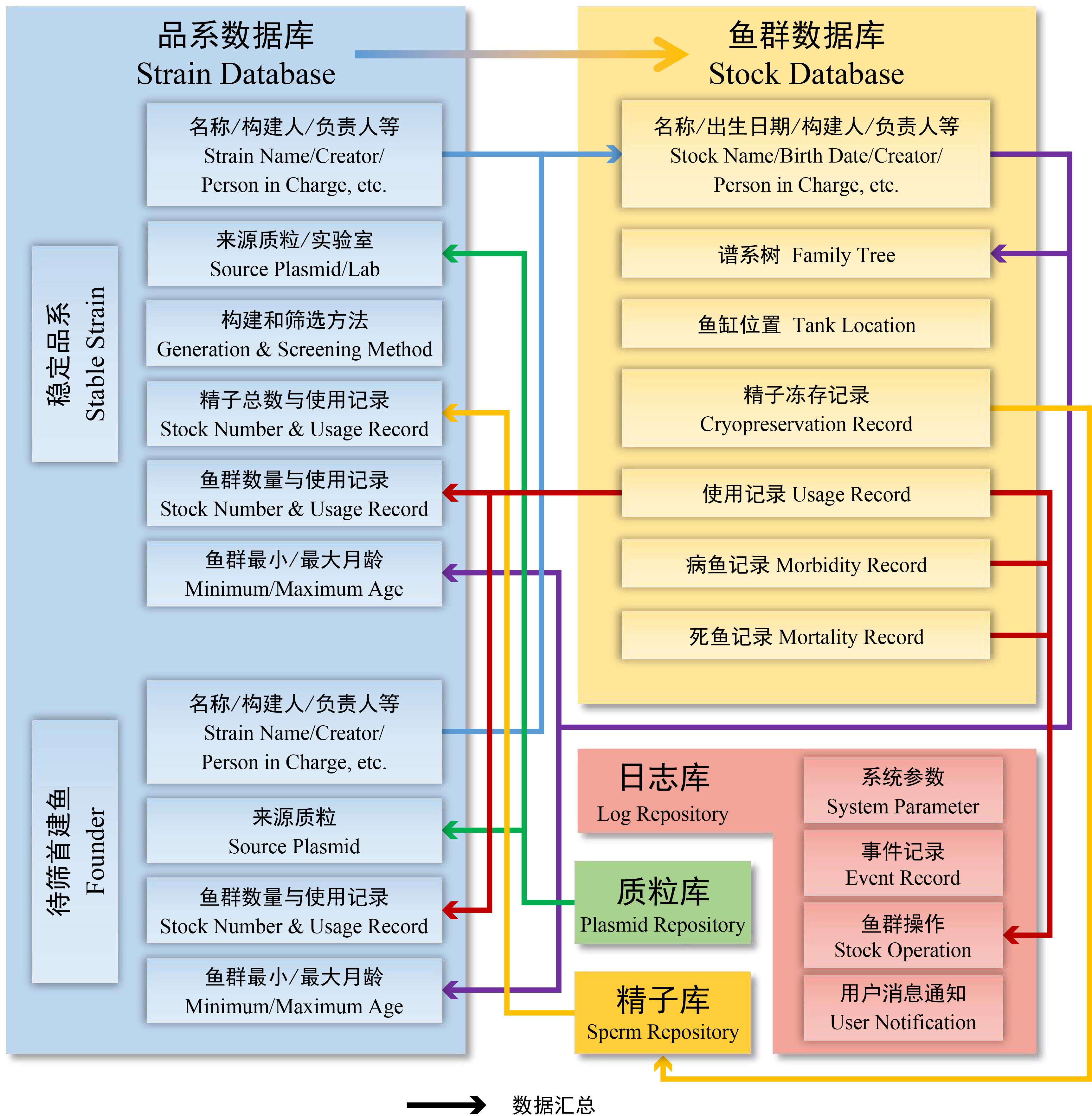
图1 斑马鱼房大数据系统的数据构架示意图
Figure 1 Schematic diagram of the data architecture for the zebrafish facility big data system.
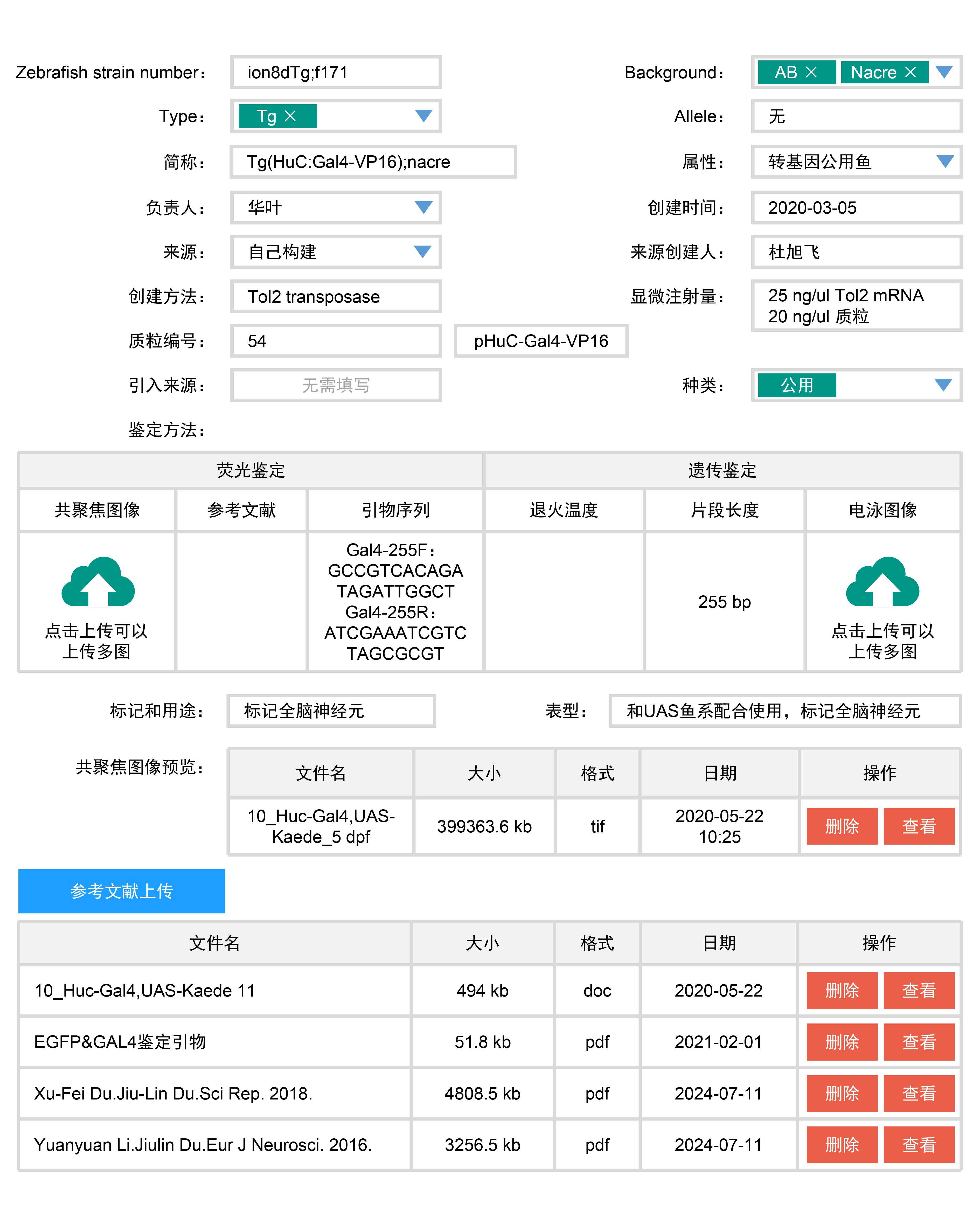
图 2 斑马鱼品系信息页部分截图
Figure 2 Partial Screenshot of Zebrafish Strain Information Page
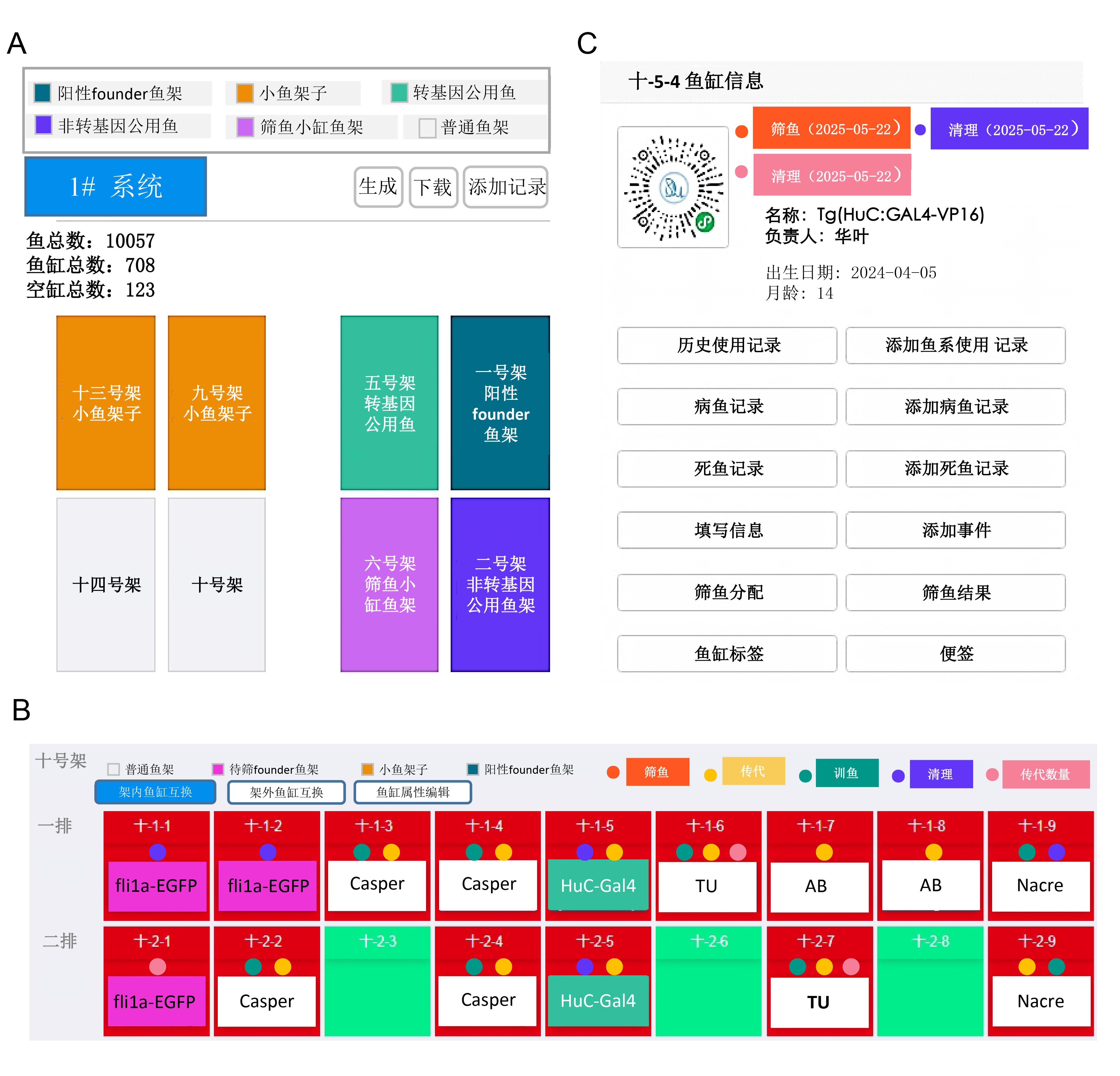
图3 数字斑马鱼房分级展示图
Figure 3 Zoned operational diagram of the digital zebrafish room
信息类别 Information Category | 核心内容 Core Content | 查看与录入 View and Enter | 各模块关联整合情况 Inter-module Connectivity and Integration | 自动统计功能 Auto-statistics Function |
|---|---|---|---|---|
鱼群基本信息 Basic Information of the Fish Stock | 品系/Sock唯一编号、出生日期、传代人、负责人、鱼总数、鱼缸位置、父母本信息等 | 查看方式: 1)Stock板块搜索; 2)线下扫描鱼缸二维码; 3)3D数字鱼房点击鱼缸; 录入方式: 1)Stock板块“新建”; 2)Stock板块“复制”; 3)3D数字鱼房点击鱼缸“新建” | 1)关联品系信息,可一键导入基本信息; 2)关联“3D数字鱼房”:3D快速定位查找鱼群; 3)关联“精子数据库”:进行精子冻存、取用操作; 4)关联“死鱼/病鱼记录”:自动更新鱼群数量; 5)关联“谱系树” | 根据死鱼/病鱼记录,自动核减鱼群中鱼的数量 |
鱼群使用记录 Fish Stock Operation Records | 使用人、使用时间、用途、交配对象等历史记录 | 查看方式: 1)Stock板块搜索; 2)线下扫描鱼缸二维码; 3)3D数字鱼房点击鱼缸; 录入方式: 1)线下扫描鱼缸二维码; 2)3D数字鱼房点击鱼缸; | 关联“3D数字鱼房:3D快速定位查找鱼群 | 自动统计鱼群累计使用频次,以数据决策繁殖计划,优化种群数量 |
健康事件记录 Health Event Record | 死鱼记录:时间、数量、症状 病鱼记录:时间、数量、症状 | 查看方式: 1)Stock,Founder板块搜索; 2)线下扫描鱼缸二维码; 3)3D数字鱼房点击鱼缸; 录入方式: 1)线下扫描鱼缸二维码; 2)3D数字鱼房点击鱼缸 | 1)关联“3D数字鱼房”:3D快速定位查找鱼群; 2)关联“事件”板块,可查看整个鱼房各循环系统死鱼/病鱼总体情况 | 实时汇总,可按照年/月/系统时时查询死鱼/病鱼数量和比例统计图 |
鱼群预定 Fish Stock order | 申请人、用途、所需数量、需用日期 | 查看方式: 3D数字鱼房鱼缸上显示; 录入方式: 3D数字鱼房点击鱼缸 | 关联“数字鱼房”:3D快速定位查看 | 自动与使用记录联动,自动检测鱼群使用情况 |
鱼群谱系树 Fish Stock Family Tree | 父本、母本及后代的血缘关系图谱(谱系树) | 查看方式: “谱系树”板块,根据位置、鱼系名称搜索查看; 交互操作: 点击谱系树中任意节点鱼群、生成该鱼群的谱系树 | 关联“3D数字鱼房”:3D快速定位查找鱼群 | 便于研究其遗传背景、种质和谱系关系 |
表1 活体鱼群数据库及各模块关联整合情况
Table 1 Stock database and its module integration
信息类别 Information Category | 核心内容 Core Content | 查看与录入 View and Enter | 各模块关联整合情况 Inter-module Connectivity and Integration | 自动统计功能 Auto-statistics Function |
|---|---|---|---|---|
鱼群基本信息 Basic Information of the Fish Stock | 品系/Sock唯一编号、出生日期、传代人、负责人、鱼总数、鱼缸位置、父母本信息等 | 查看方式: 1)Stock板块搜索; 2)线下扫描鱼缸二维码; 3)3D数字鱼房点击鱼缸; 录入方式: 1)Stock板块“新建”; 2)Stock板块“复制”; 3)3D数字鱼房点击鱼缸“新建” | 1)关联品系信息,可一键导入基本信息; 2)关联“3D数字鱼房”:3D快速定位查找鱼群; 3)关联“精子数据库”:进行精子冻存、取用操作; 4)关联“死鱼/病鱼记录”:自动更新鱼群数量; 5)关联“谱系树” | 根据死鱼/病鱼记录,自动核减鱼群中鱼的数量 |
鱼群使用记录 Fish Stock Operation Records | 使用人、使用时间、用途、交配对象等历史记录 | 查看方式: 1)Stock板块搜索; 2)线下扫描鱼缸二维码; 3)3D数字鱼房点击鱼缸; 录入方式: 1)线下扫描鱼缸二维码; 2)3D数字鱼房点击鱼缸; | 关联“3D数字鱼房:3D快速定位查找鱼群 | 自动统计鱼群累计使用频次,以数据决策繁殖计划,优化种群数量 |
健康事件记录 Health Event Record | 死鱼记录:时间、数量、症状 病鱼记录:时间、数量、症状 | 查看方式: 1)Stock,Founder板块搜索; 2)线下扫描鱼缸二维码; 3)3D数字鱼房点击鱼缸; 录入方式: 1)线下扫描鱼缸二维码; 2)3D数字鱼房点击鱼缸 | 1)关联“3D数字鱼房”:3D快速定位查找鱼群; 2)关联“事件”板块,可查看整个鱼房各循环系统死鱼/病鱼总体情况 | 实时汇总,可按照年/月/系统时时查询死鱼/病鱼数量和比例统计图 |
鱼群预定 Fish Stock order | 申请人、用途、所需数量、需用日期 | 查看方式: 3D数字鱼房鱼缸上显示; 录入方式: 3D数字鱼房点击鱼缸 | 关联“数字鱼房”:3D快速定位查看 | 自动与使用记录联动,自动检测鱼群使用情况 |
鱼群谱系树 Fish Stock Family Tree | 父本、母本及后代的血缘关系图谱(谱系树) | 查看方式: “谱系树”板块,根据位置、鱼系名称搜索查看; 交互操作: 点击谱系树中任意节点鱼群、生成该鱼群的谱系树 | 关联“3D数字鱼房”:3D快速定位查找鱼群 | 便于研究其遗传背景、种质和谱系关系 |
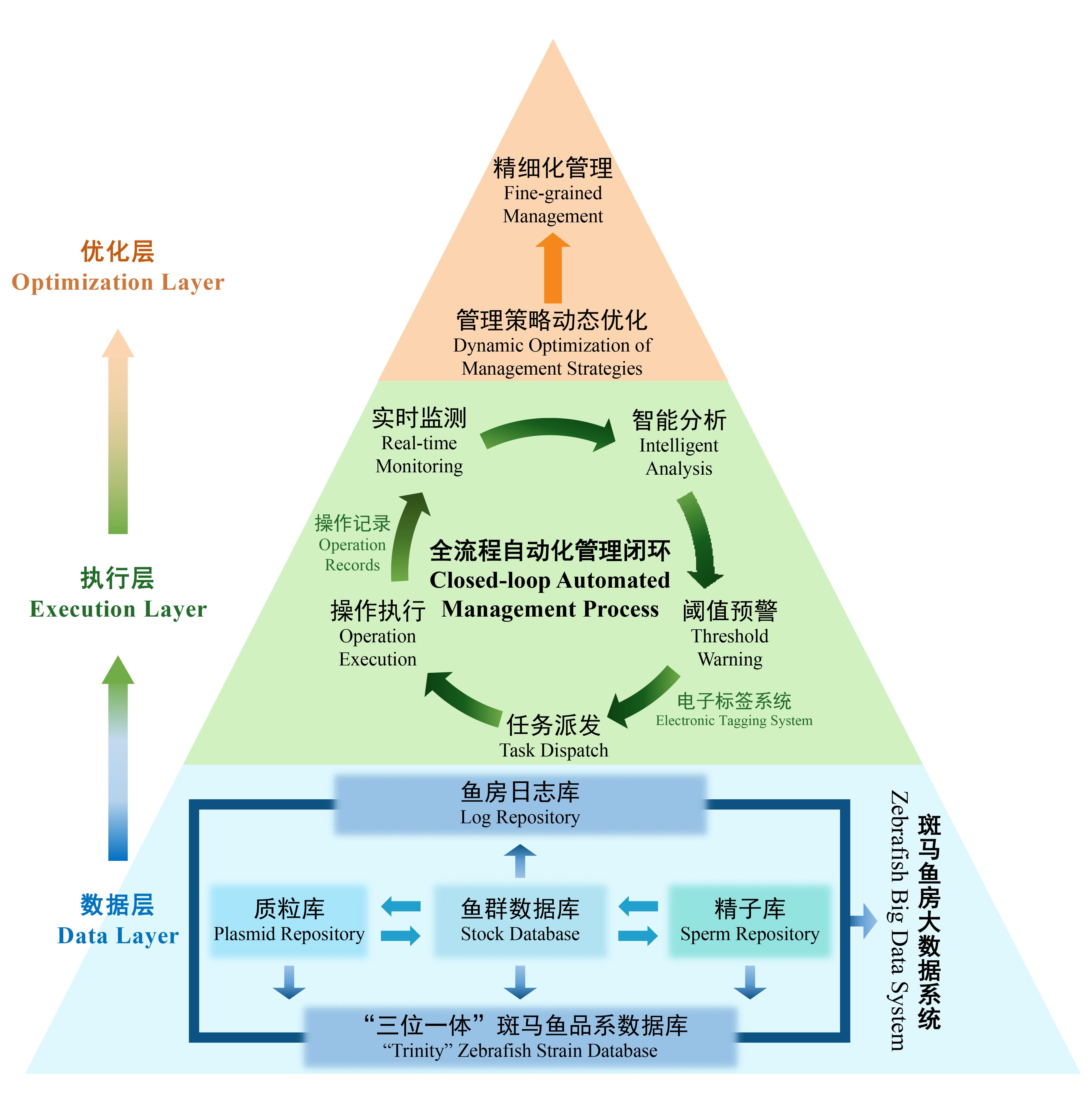
图4 管理构架模式图
Figure 4 Management framework
指令大类 Major Categories of Commands | 指令小类 Sub-categories of Commands | 监测目标 Monitoring Target | 预警触发条件 Alert Trigger Conditions | 系统响应与操作 System Response and Actions | 执行要求与流程 System Execution Requirements and Procedures |
|---|---|---|---|---|---|
资源库监控指令 Resource Repository Monitoring Command | 质粒库监控 | 质粒库存量 | < 5 µL | 自动发送预警提醒 | 需及时补充库存,系统追踪补充进度,直至恢复安全库存。 |
| 精子库监控 | 品系冻存精子总数 | < 3 管 | 自动发送预警提醒 | 需立即进行精子采集与冻存,系统追踪补充进度,直至恢复安全库存。 | |
| 鱼群库监控 | 同一品系下活体鱼总数及月龄 | 鱼总数< 10条,或所有月龄 ≥ 14月 | 自动发送传代繁殖指令,挂载传代电子标签 | 需立即启动繁殖计划,系统追踪进度,直至恢复安全水平 | |
信息录入规范指令 Data Entry Standardization Command | 新建品系 | 自构建品系 | 构建品系用质粒未入库 | 系统提示无法创建新品系 | 需提前将该质粒录入质粒库 |
| 外部引入品系(已发表) | 未上传参考文献 | 系统提示无法创建新品系 | 需完善论文发表信息 | ||
| 新建鱼群 | 新建鱼群所属的品系 | 没有建立品系; 未填父母本信息 | 系统提示品系未建立; 系统提示父母本信息缺失 | 需提前创建品系 需选择父母本 | |
| 新建质粒 | 质粒信息 | 已发表质粒缺失参考文献 | 系统提示无参考文献无法新建质粒 | 需补充文献信息 | |
交配用鱼指导指令 mating Fish Command | 交配间隔 | 品系交配记录 | 交配间隔 < 7天 | 系统禁止使用,提示繁殖间隔不足 | 需等待≥7天后才可再次交配 |
| 定期训鱼 | 品系交配记录 | 3–4个月内无交配使用记录 | 自动发送训鱼指令 | 需完成训鱼并提交使用记录 | |
品系传代指令 Fish Line Propagation Command | 常规传代 | 品系最年轻鱼群月龄 | ≥14月龄 | 自动发送传代指令,挂载传代电子标签 | 30日内完成新增鱼群登记,系统每日监测进度直至完成 |
| 应急传代 | 新引入或濒危品系 | 由管理员手动启动 | 挂载传代电子标签 | 30日内完成新增鱼群登记,系统每日监测进度直至完成 | |
空间轮转指令 Space Rotation Command | 小鱼属性鱼架 | 小鱼月龄 | ≥ 2月龄 | 自动发送挪缸指令,挂载挪缸电子标签 | 5天内挪至普通鱼架,按成鱼方案喂养 |
| 筛鱼小缸鱼架 | 单条鱼放置时长 | 放置时间≥ 10天 | 自动发送挪缸指令,挂载“挪缸”电子标签 | 14天内完成筛选,严禁长时间占用筛鱼小缸 |
表2 管理指令集
Table 2 Management commands set
指令大类 Major Categories of Commands | 指令小类 Sub-categories of Commands | 监测目标 Monitoring Target | 预警触发条件 Alert Trigger Conditions | 系统响应与操作 System Response and Actions | 执行要求与流程 System Execution Requirements and Procedures |
|---|---|---|---|---|---|
资源库监控指令 Resource Repository Monitoring Command | 质粒库监控 | 质粒库存量 | < 5 µL | 自动发送预警提醒 | 需及时补充库存,系统追踪补充进度,直至恢复安全库存。 |
| 精子库监控 | 品系冻存精子总数 | < 3 管 | 自动发送预警提醒 | 需立即进行精子采集与冻存,系统追踪补充进度,直至恢复安全库存。 | |
| 鱼群库监控 | 同一品系下活体鱼总数及月龄 | 鱼总数< 10条,或所有月龄 ≥ 14月 | 自动发送传代繁殖指令,挂载传代电子标签 | 需立即启动繁殖计划,系统追踪进度,直至恢复安全水平 | |
信息录入规范指令 Data Entry Standardization Command | 新建品系 | 自构建品系 | 构建品系用质粒未入库 | 系统提示无法创建新品系 | 需提前将该质粒录入质粒库 |
| 外部引入品系(已发表) | 未上传参考文献 | 系统提示无法创建新品系 | 需完善论文发表信息 | ||
| 新建鱼群 | 新建鱼群所属的品系 | 没有建立品系; 未填父母本信息 | 系统提示品系未建立; 系统提示父母本信息缺失 | 需提前创建品系 需选择父母本 | |
| 新建质粒 | 质粒信息 | 已发表质粒缺失参考文献 | 系统提示无参考文献无法新建质粒 | 需补充文献信息 | |
交配用鱼指导指令 mating Fish Command | 交配间隔 | 品系交配记录 | 交配间隔 < 7天 | 系统禁止使用,提示繁殖间隔不足 | 需等待≥7天后才可再次交配 |
| 定期训鱼 | 品系交配记录 | 3–4个月内无交配使用记录 | 自动发送训鱼指令 | 需完成训鱼并提交使用记录 | |
品系传代指令 Fish Line Propagation Command | 常规传代 | 品系最年轻鱼群月龄 | ≥14月龄 | 自动发送传代指令,挂载传代电子标签 | 30日内完成新增鱼群登记,系统每日监测进度直至完成 |
| 应急传代 | 新引入或濒危品系 | 由管理员手动启动 | 挂载传代电子标签 | 30日内完成新增鱼群登记,系统每日监测进度直至完成 | |
空间轮转指令 Space Rotation Command | 小鱼属性鱼架 | 小鱼月龄 | ≥ 2月龄 | 自动发送挪缸指令,挂载挪缸电子标签 | 5天内挪至普通鱼架,按成鱼方案喂养 |
| 筛鱼小缸鱼架 | 单条鱼放置时长 | 放置时间≥ 10天 | 自动发送挪缸指令,挂载“挪缸”电子标签 | 14天内完成筛选,严禁长时间占用筛鱼小缸 |
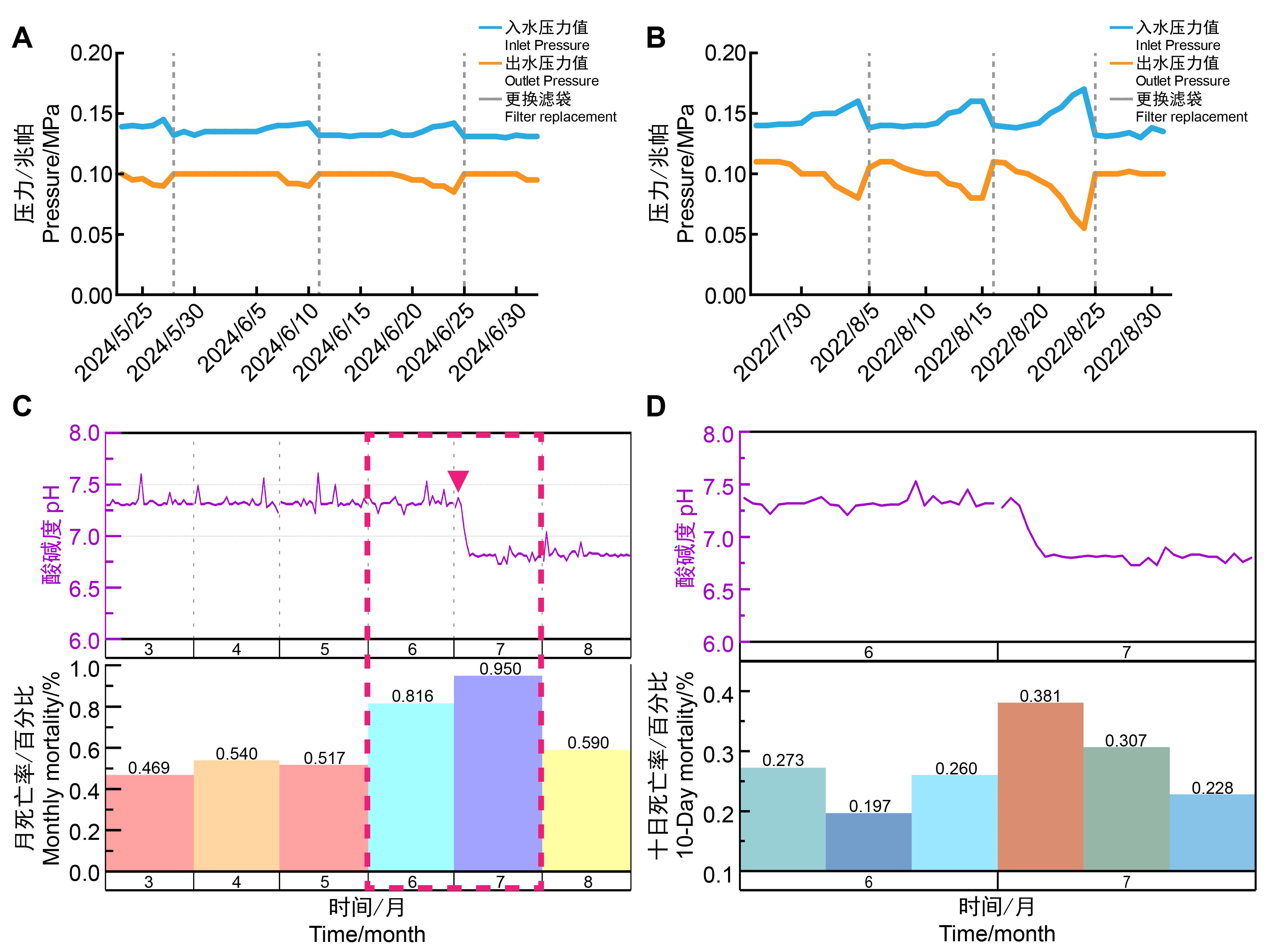
图5 养殖循环系统监控
Figure 5 Aquaculture Recirculating System Monitoring
维度 Category | 评估问题描述 Assessment Item | 平均分 Mean | 标准差 SD |
|---|---|---|---|
数据系统性和完整性维度 Data Systematicity and Integrity Dimension | ·数据录入完整性:系统的强制填写项保证了记录数据的完整性。 | 4.79 | 0.42 |
| ·数据录入规范性:系统的标准化选项保证了数据录入的规范性。 | 4.89 | 0.31 | |
| ·数据录入准确性:系统关键字段的“一键导入”功能避免了手动输入的多样性,确保数据准确。 | 4.86 | 0.36 | |
| ·数据可追溯性:系统中每个品系和每缸鱼都建立了完整的“终身档案”,可随时查看全部历史记录。 | 4.89 | 0.31 | |
效率维度 Efficiency Dimension | ·数据录入效率:系统关键字段“一键导入”和“一键操作”等功能减少了手动输入的时间,操作简易直观,极大提高了效率。 | 4.86 | 0.36 |
| ·数据查询效率:所有功能模块深度互相关联,可任意点快速导航至相关信息。 | 4.86 | 0.36 | |
| ·库存盘点和计划效率:所有鱼系、质粒、精子库存和数量动态自动统计,进行全资源盘点可以减少人力投入,帮助我更容易地制定和跟踪品系的繁殖计划。 | 4.71 | 0.53 | |
| ·现场效率:可以在鱼房工作现场使用手持设备完成信息的查询和录入。 | 4.68 | 0.61 | |
安全和稳定性维度 Safety and Stability Dimension | ·实时预警:系统的预警功能(如“需要传代”、“小鱼需要挪缸”、“需要定期训鱼”,“需要清理”,“精子库存不足”等)能及时、有效地提醒我避免出现潜在问题和失误,保障资源安全。 | 4.46 | 0.69 |
| ·预见性决策:系统自动统计循环系统 pH参数,电导参数,水压参数,温度等详情,可以时时观测变化曲线,支持我做出了更好的日常管理决策,确保养殖系统稳定。 | 4.89 | 0.31 | |
整体印象与接受度 Overall Satisfaction | ·整体效率:总体而言,该系统提高了我在鱼房工作的效率。 | 4.89 | 0.31 |
| ·整体信任:我信任该系统中所记录数据的准确性。 | 4.75 | 0.44 | |
| ·整体满意:总的来说,我对使用该系统的体验感到满意。 | 4.86 | 0.36 | |
| ·整体推荐:我会毫不犹豫地向其他斑马鱼研究人员推荐该系统。 | 4.89 | 0.32 |
表3 鱼房与品系管理系统用户满意度调查量表
Table3 Survey Questionnaire: User Satisfaction with the Fish Room and Strain Management System
维度 Category | 评估问题描述 Assessment Item | 平均分 Mean | 标准差 SD |
|---|---|---|---|
数据系统性和完整性维度 Data Systematicity and Integrity Dimension | ·数据录入完整性:系统的强制填写项保证了记录数据的完整性。 | 4.79 | 0.42 |
| ·数据录入规范性:系统的标准化选项保证了数据录入的规范性。 | 4.89 | 0.31 | |
| ·数据录入准确性:系统关键字段的“一键导入”功能避免了手动输入的多样性,确保数据准确。 | 4.86 | 0.36 | |
| ·数据可追溯性:系统中每个品系和每缸鱼都建立了完整的“终身档案”,可随时查看全部历史记录。 | 4.89 | 0.31 | |
效率维度 Efficiency Dimension | ·数据录入效率:系统关键字段“一键导入”和“一键操作”等功能减少了手动输入的时间,操作简易直观,极大提高了效率。 | 4.86 | 0.36 |
| ·数据查询效率:所有功能模块深度互相关联,可任意点快速导航至相关信息。 | 4.86 | 0.36 | |
| ·库存盘点和计划效率:所有鱼系、质粒、精子库存和数量动态自动统计,进行全资源盘点可以减少人力投入,帮助我更容易地制定和跟踪品系的繁殖计划。 | 4.71 | 0.53 | |
| ·现场效率:可以在鱼房工作现场使用手持设备完成信息的查询和录入。 | 4.68 | 0.61 | |
安全和稳定性维度 Safety and Stability Dimension | ·实时预警:系统的预警功能(如“需要传代”、“小鱼需要挪缸”、“需要定期训鱼”,“需要清理”,“精子库存不足”等)能及时、有效地提醒我避免出现潜在问题和失误,保障资源安全。 | 4.46 | 0.69 |
| ·预见性决策:系统自动统计循环系统 pH参数,电导参数,水压参数,温度等详情,可以时时观测变化曲线,支持我做出了更好的日常管理决策,确保养殖系统稳定。 | 4.89 | 0.31 | |
整体印象与接受度 Overall Satisfaction | ·整体效率:总体而言,该系统提高了我在鱼房工作的效率。 | 4.89 | 0.31 |
| ·整体信任:我信任该系统中所记录数据的准确性。 | 4.75 | 0.44 | |
| ·整体满意:总的来说,我对使用该系统的体验感到满意。 | 4.86 | 0.36 | |
| ·整体推荐:我会毫不犹豫地向其他斑马鱼研究人员推荐该系统。 | 4.89 | 0.32 |
| [1] | HOWE K, CLARK M D, TORROJA C F, et al. The zebrafish reference genome sequence and its relationship to the human genome[J]. Nature, 2013, 496(7446): 498-503. DOI: 10.1038/nature12111 . |
| [2] | ASTELL K R, SIEGER D. Zebrafish in vivo models of cancer and metastasis[J]. Cold Spring Harb Perspect Med, 2020, 10(8): a037077. DOI: 10.1101/cshperspect.a037077 . |
| [3] | BAUER B, MALLY A, LIEDTKE D. Zebrafish embryos and larvae as alternative animal models for toxicity testing[J]. Int J Mol Sci, 2021, 22(24): 13417. DOI: 10.3390/ijms222413417 . |
| [4] | BIAN C Y, MA D Y, LIU F. The future of zebrafish research: highlights from the 18th International Zebrafish Conference[J]. J Genet Genomics, 2025, 52(1): 1-3. DOI: 10.1016/j.jgg.2024.09.006 . |
| [5] | DE ABREU M S, GENARIO R, GIACOMINI A C V V, et al. Zebrafish as a model of neurodevelopmental disorders[J]. Neuroscience, 2020, 445: 3-11. DOI: 10.1016/j.neuroscience.2019.08.034 . |
| [6] | KANUNGO J. Special issue "zebrafish: a model organism for human health and disease"[J]. Int J Mol Sci, 2025, 26(10): 4624. DOI: 10.3390/ijms26104624 . |
| [7] | SANTOS ROSA J G, LIMA C, LOPES-FERREIRA M. Zebrafish larvae behavior models as a tool for drug screenings and pre-clinical trials: a review[J]. Int J Mol Sci, 2022, 23(12): 6647. DOI: 10.3390/ijms23126647 . |
| [8] | SERTORI R, ZHANG Y, WIEST D L. Zebrafish: a tractable model for analysis of T cell development[J]. Methods Mol Biol, 2023, 2580: 355-377. DOI: 10.1007/978-1-0716-2740-2_22 . |
| [9] | 李玲璐, 刘涛, 柳力月, 等. 斑马鱼实验动物福利讨论[J]. 水生生物学报, 2026, 50(2): 211-222. DOI: 10.3724/1000-3207.2025.2025.0172 . |
| LI L L, LIU T, LIU L Y, et al. Discussion on the animal welfare in zebrafish[J]. Acta Hydrobiol Sin, 2026, 50(2): 211-222. DOI: 10.3724/1000-3207.2025.2025.0172 . | |
| [10] | AVDESH A, CHEN M Q, MARTIN-IVERSON M T, et al. Regular care and maintenance of a zebrafish (Danio rerio) laboratory: an introduction[J]. J Vis Exp, 2012(69): e4196. DOI: 10.3791/4196 . |
| [11] | ALESTRÖM P, D'ANGELO L, MIDTLYNG P J, et al. Zebrafish: housing and husbandry recommendations[J]. Lab Anim, 2020, 54(3): 213-224. DOI: 10.1177/0023677219869037 . |
| [12] | COLLYMORE C, CRIM M J, LIEGGI C. Recommendations for health monitoring and reporting for zebrafish research facilities[J]. Zebrafish, 2016, 13(): S138-S148. DOI: 10.1089/zeb.2015.1210 . |
| [13] | LAWRENCE C. Advances in zebrafish husbandry and management[M]//The Zebrafish: Genetics, Genomics and Informatics. Amsterdam: Elsevier, 2011: 429-451. DOI: 10.1016/b978-0-12-374814-0.00023-9 . |
| [14] | LAWRENCE C, MASON T. Zebrafish housing systems: a review of basic operating principles and considerations for design and functionality[J]. ILAR J, 2012, 53(2): 179-191. DOI: 10.1093/ilar.53.2.179 . |
| [15] | PARKER M, HILLMAN C, FONTANA B, et al. Housing and husbandry factors affecting zebrafish (Danio rerio) novel tank test responses: a global multi-laboratory study[J]. Res Sq. 2024: 156-164. DOI: 10.21203/rs.3.rs-4849877/v1 . |
| [16] | 李阔宇, 潘鲁湲, 孙永华. 斑马鱼鱼房和养殖系统建设标准[J]. 中国比较医学杂志, 2020, 30(6): 121-127. DOI: 10.3969/j.issn.1671-7856.2020.06.018 . |
| LI K Y, PAN L Y, SUN Y H. Standards for constructing zebrafish houses and breeding systems[J]. Chin J Comp Med, 2020, 30(6): 121-127. DOI: 10.3969/j.issn.1671-7856.2020.06.018 . | |
| [17] | 金仕容, 华叶, 訾化星, 等. 一种显著提高实验用斑马鱼繁殖效率和使用寿命的优化养殖方案[J]. 实验动物与比较医学, 2023, 43(3): 297-306. DOI: 10.12300/j.issn.1674-5817.2023.004 . |
| JIN S R, HUA Y, ZI H X, et al. An optimized experimental zebrafish breeding scheme for significantly enhancing reproductive efficiency and service life[J]. Lab Anim Comp Med, 2023, 43(3): 297-306. DOI: 10.12300/j.issn.1674-5817.2023.004 . |
| [1] | 赵鑫, 王晨曦, 石文清, 娄月芬. 斑马鱼在炎症性肠病机制及药物研究中的应用进展[J]. 实验动物与比较医学, 2025, 45(4): 422-431. |
| [2] | 林金杏, 王新栋, 白雪兵, 冯丽萍, 谢淑武, 陈秋生. 成年斑马鱼体肾的微细结构及其外泌体的分布鉴定[J]. 实验动物与比较医学, 2023, 43(5): 531-540. |
| [3] | 杨晋娴, 王淑娟, 翟金云, 朱顺星. Micall2a基因表达下调抑制斑马鱼血管发育[J]. 实验动物与比较医学, 2023, 43(3): 282-287. |
| [4] | 谭志刚, 刘锦信, 郑楚雅, 廖文峰, 冯露平, 彭红丽, 严秀, 卓振建. 神经母细胞瘤动物模型研究进展与应用[J]. 实验动物与比较医学, 2023, 43(3): 288-296. |
| [5] | 金仕容, 华叶, 訾化星, 杜旭飞, 卜纪雯. 一种显著提高实验用斑马鱼繁殖效率和使用寿命的优化养殖方案[J]. 实验动物与比较医学, 2023, 43(3): 297-306. |
| [6] | 江霞, 钱豪杰, 魏迅, 郑羽旋, 周正宇. 斑马鱼糖尿病模型的构建及应用进展[J]. 实验动物与比较医学, 2020, 40(6): 547-552. |
| [7] | 邸亚男, 朱丽英, 钱雯, 潘卫. 斑马鱼作为模式动物在人类眼睛疾病研究中的应用[J]. 实验动物与比较医学, 2020, 40(5): 440-. |
| [8] | 王 雪, 刘可春, 杨学亮, 马玉奎, 张 云. 冈田酸对斑马鱼幼鱼神经行为功能的影响[J]. 实验动物与比较医学, 2020, 40(3): 190-. |
| [9] | 李英娘, 戴玮, 盛健. 斑马鱼甲状腺肿大病例分析[J]. 实验动物与比较医学, 2019, 39(6): 462-466. |
| [10] | 王俐梅, 张建, 刘忠华, 杨威. 视网膜母细胞瘤斑马鱼模型及rb1基因研究进展[J]. 实验动物与比较医学, 2019, 39(3): 244-248. |
| [11] | 周斌, 盛哲津, 冯琛卓, 李利妹. 一种体内实时观察黑色素瘤的斑马鱼模型[J]. 实验动物与比较医学, 2018, 38(1): 22-28. |
| [12] | 田芳, 王玉柱, 夏敏杰, 孙冰, 丁训城, 李卫华, 许慧慧, 胡晶莹. 实验用斑马鱼成鱼内脏组织病理学检查方法的优化[J]. 实验动物与比较医学, 2017, 37(6): 465-469. |
| [13] | 金璐, 李燕, 李志操, 吴西军, 周艳华, 何志旭, 舒莉萍. Irx5a基因过表达对斑马鱼胚胎早期造血的影响[J]. 实验动物与比较医学, 2017, 37(4): 309-314. |
| [14] | 林金杏, 冯丽萍, 胡建华, 高诚. 斑马鱼鳍和鳞片色素细胞的显微观察[J]. 实验动物与比较医学, 2017, 37(2): 94-101. |
| [15] | 张城达, 张丽丽, 张立将, 陈云祥. 阿霉素致斑马鱼心血管毒性模型的建立[J]. 实验动物与比较医学, 2015, 35(5): 362-366. |
| 阅读次数 | ||||||
|
全文 |
|
|||||
|
摘要 |
|
|||||
