





• •
吴剑锋( ), 邵志强, 贺颖(), 吴素琴()
出版日期:2026-07-30
作者简介:吴剑锋(1988—),男,博士,讲师,研究方向:人类疾病动物模型。E-mail:wzqwjf0728@xmu.edu.cn。ORCID: 0000-0002-8992-2030基金资助:
WU Jianfeng(), SHAO Zhiqiang, HE Ying(), WU Suqin()
Published:2026-07-30
Correspondence to:
WU Suqin (ORCID: 0009-0008-5852-5914), E-mail: caca_china@xmu.edu.cn摘要:
基因工程小鼠是解析基因功能、阐明疾病机制及推动药物研发的重要工具,其构建技术包括以胚胎干细胞(embryonic stem cells,ESCs)同源重组为代表的定向基因打靶体系和以随机诱变为代表的正向遗传学策略,并进一步拓展至以可编程核酸酶为基础的新型基因组编辑技术。ESCs同源重组奠定了精准基因修饰的技术基础,可实现全身或组织特异性敲除及精确点突变,但其存在周期长、成本高及品系适应性受限等问题。N-乙基-N-亚硝基脲诱变与转座子插入等随机突变方法在正向遗传学筛选中具有独特优势。而以锌指核酸酶、转录激活因子样效应物核酸酶及成簇规律间隔短回文重复序列(clustered regularly interspaced short palindromic repeats,CRISPR)/CRISPR相关蛋白系统为代表的新型基因组编辑技术显著提升了基因组定点修饰效率,实现了多基因联合编辑和复杂遗传修饰模型的构建,推动基因工程小鼠构建由“单基因逐步构建”向“多位点高通量编辑”转变。近年来,碱基编辑、引导编辑及核糖核酸编辑等衍生技术在无需或减少DNA双链断裂的条件下,成功实现单碱基转换、小范围插入、缺失及转录本水平调控,进一步提高了编辑精度与多样性。然而,在新型基因组编辑方法研发的F0代小鼠及后续代际传递过程中,仍可能出现脱靶效应或非预期基因组改变,需结合高保真编辑工具、系统性脱靶检测、多代回交及功能救援实验加以控制,确保结论的准确性。总体而言,基因组编辑技术的持续创新正推动基因工程小鼠研究向精细化、系统化与高通量方向发展,在实际应用中应统筹编辑效率、安全性与伦理规范,以保障模型构建的科学性与可靠性。
中图分类号:
吴剑锋,邵志强,贺颖,等.基因工程小鼠构建技术的演进与新型基因组编辑技术的应用[J]. 实验动物与比较医学.. DOI: 10.12300/j.issn.1674-5817.2026.028.
WU Jianfeng,SHAO Zhiqiang,HE Ying,et al. The Evolution of Genetic Engineering Strategies for Mouse Model Generation and Applications of Emerging Genome Editing Technologies[J]. Laboratory Animal and Comparative Medicine. DOI: 10.12300/j.issn.1674-5817.2026.028.
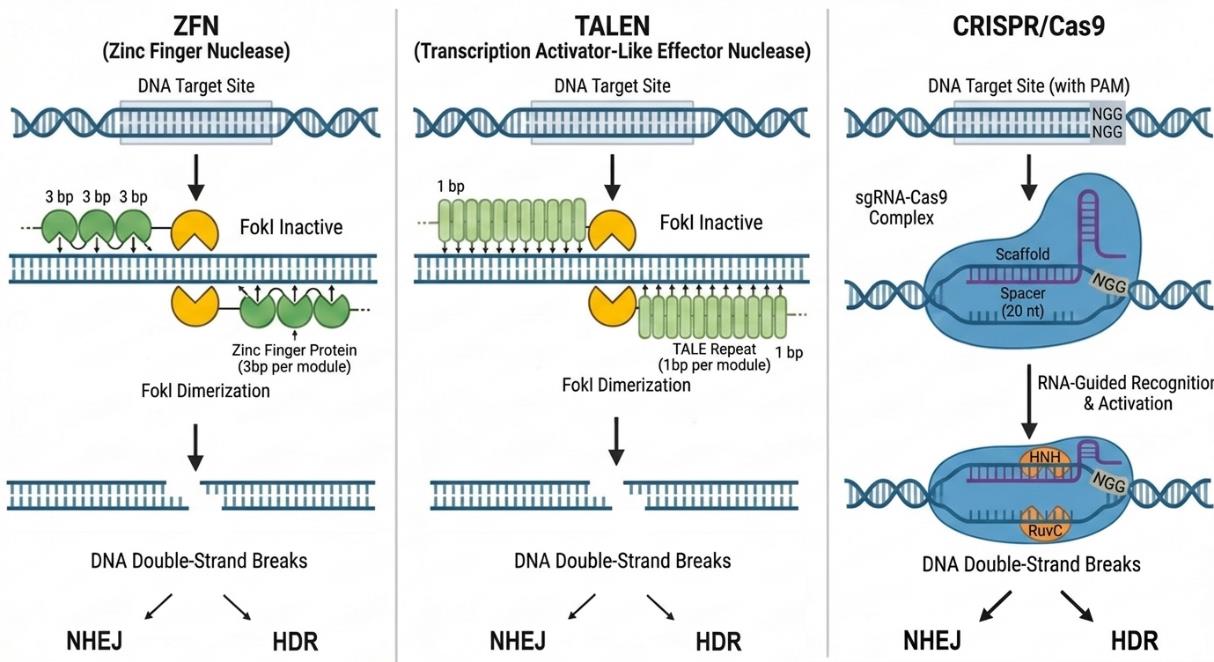
图1 三种新型基因组编辑技术的工作原理示意图
Figure 1 Schematic illustration of the mechanisms of three genome editing technologies
技术类型 Technology | 编辑原理 Editing principle | 是否依赖DSBs Dependence on DSBs | 可实现突变类型 Types of mutations achievable | 编辑效率 Editing efficiency | 构建周期 Model generation time | 成本水平 Cost | 品系适应性 Strain compatibility | 多基因编辑能力 Multiplex editing capability | 脱靶风险 Off-target risk | 主要优势 Key advantage | 主要局限 Key limitation | 适用场景 Typical application |
|---|---|---|---|---|---|---|---|---|---|---|---|---|
胚胎干细胞同源重组 ESC-based Homologous Recombination | 同源重组介导靶位点定向替换 | 否 | KO、KI、点突变等均可实现 | 低 | 长(6~12月) | 高 | 受限(前期主要为129等品系) | 低 | 低 | 精确性高,遗传结果稳定 | 周期长、成本高 | 精确遗传修饰、经典敲除/敲入模型 |
ENU/转座子诱变 ENU/Transposon Mutagenesis | ENU诱导碱基烷基化引起点突变;转座子在基因组中随机或偏好性插入导致基因功能破坏 | 否 | 点突变(ENU)、插入突变(转座子) | 高(突变率高) | 长 | 中 | 高 | 高(但随机性强) | 不适用于传统脱靶概念,但存在随机突变背景 | 无需预设靶点,可进行正向遗传筛选 | 位点鉴定困难、表型归因复杂 | 正向遗传筛选、新基因发现 |
| 锌指核酸酶Zinc finger nucleases | 蛋白识别DNA序列并由FokI诱导DSBs | 是 | KO、KI、点突变等均可实现 | 中 | 中 | 高 | 高 | 低 | 中 | 开创性定点编辑工具 | 设计复杂、成本高、专利限制 | 特定靶点编辑或既有体系延续 |
转录激活因子样效应物核酸酶 Transcription activator-like effector nuclease | 转录激活因子样效应物识别DNA序列并由FokI诱导DSBs | 是 | KO、KI、点突变等均可实现 | 中–高 | 中 | 中~高 | 高 | 低 | 低 | 特异性较高、识别规则明确 | 构建复杂、递送受限 | 高特异性需求或复杂靶点编辑 |
成簇规律间隔短回文重复序列/CRISPR相关蛋白系统 Clustered regularly interspaced short palindromic repeats/CRISPR-associated proteins | sgRNA引导Cas9在靶位点产生DSBs | 是 | KO、KI、点突变等均可实现 | 高 | 短(2~3月) | 低 | 高 | 高(多条sgRNA实现多靶向) | 中 | 灵活、高效、适于多基因编辑 | 存在脱靶及嵌合性风险 | 常规基因工程小鼠构建首选 |
| 碱基编辑Base editing | 脱氨酶介导碱基转换 | 否 | 主要为点突变 | 高 | 短 | 中 | 高 | 中 | 低–中 | 无DSBs、高精度 | 编辑窗口受限 | 单碱基突变疾病模型 |
| 引导编辑Prime editing | 逆转录酶介导靶序列定向写入 | 否 | 片段序列精准插入/缺失/替换 | 中 | 短~中 | 中 | 高 | 中 | 低 | 突变类型多样、灵活性高 | 编辑效率相对较低 | 复杂突变或非编码区精细编辑模型 |
表1 不同基因组编辑技术在基因工程小鼠构建中的关键特征比较
Table 1 Comparison of key features of genome editing technologies for genetically engineered mouse model generation
技术类型 Technology | 编辑原理 Editing principle | 是否依赖DSBs Dependence on DSBs | 可实现突变类型 Types of mutations achievable | 编辑效率 Editing efficiency | 构建周期 Model generation time | 成本水平 Cost | 品系适应性 Strain compatibility | 多基因编辑能力 Multiplex editing capability | 脱靶风险 Off-target risk | 主要优势 Key advantage | 主要局限 Key limitation | 适用场景 Typical application |
|---|---|---|---|---|---|---|---|---|---|---|---|---|
胚胎干细胞同源重组 ESC-based Homologous Recombination | 同源重组介导靶位点定向替换 | 否 | KO、KI、点突变等均可实现 | 低 | 长(6~12月) | 高 | 受限(前期主要为129等品系) | 低 | 低 | 精确性高,遗传结果稳定 | 周期长、成本高 | 精确遗传修饰、经典敲除/敲入模型 |
ENU/转座子诱变 ENU/Transposon Mutagenesis | ENU诱导碱基烷基化引起点突变;转座子在基因组中随机或偏好性插入导致基因功能破坏 | 否 | 点突变(ENU)、插入突变(转座子) | 高(突变率高) | 长 | 中 | 高 | 高(但随机性强) | 不适用于传统脱靶概念,但存在随机突变背景 | 无需预设靶点,可进行正向遗传筛选 | 位点鉴定困难、表型归因复杂 | 正向遗传筛选、新基因发现 |
| 锌指核酸酶Zinc finger nucleases | 蛋白识别DNA序列并由FokI诱导DSBs | 是 | KO、KI、点突变等均可实现 | 中 | 中 | 高 | 高 | 低 | 中 | 开创性定点编辑工具 | 设计复杂、成本高、专利限制 | 特定靶点编辑或既有体系延续 |
转录激活因子样效应物核酸酶 Transcription activator-like effector nuclease | 转录激活因子样效应物识别DNA序列并由FokI诱导DSBs | 是 | KO、KI、点突变等均可实现 | 中–高 | 中 | 中~高 | 高 | 低 | 低 | 特异性较高、识别规则明确 | 构建复杂、递送受限 | 高特异性需求或复杂靶点编辑 |
成簇规律间隔短回文重复序列/CRISPR相关蛋白系统 Clustered regularly interspaced short palindromic repeats/CRISPR-associated proteins | sgRNA引导Cas9在靶位点产生DSBs | 是 | KO、KI、点突变等均可实现 | 高 | 短(2~3月) | 低 | 高 | 高(多条sgRNA实现多靶向) | 中 | 灵活、高效、适于多基因编辑 | 存在脱靶及嵌合性风险 | 常规基因工程小鼠构建首选 |
| 碱基编辑Base editing | 脱氨酶介导碱基转换 | 否 | 主要为点突变 | 高 | 短 | 中 | 高 | 中 | 低–中 | 无DSBs、高精度 | 编辑窗口受限 | 单碱基突变疾病模型 |
| 引导编辑Prime editing | 逆转录酶介导靶序列定向写入 | 否 | 片段序列精准插入/缺失/替换 | 中 | 短~中 | 中 | 高 | 中 | 低 | 突变类型多样、灵活性高 | 编辑效率相对较低 | 复杂突变或非编码区精细编辑模型 |
| [1] | MONTOLIU L. Transgenesis and genome engineering: a historical review[J]. Methods Mol Biol, 2023, 2631: 1-32. DOI: 10.1007/978-1-0716-2990-1_1 . |
| [2] | KIM H S, KWEON J, KIM Y. Recent advances in CRISPR-based functional genomics for the study of disease-associated genetic variants[J]. Exp Mol Med, 2024, 56(4): 861-869. DOI: 10.1038/s12276-024-01212-3 . |
| [3] | VARSHNEY G K, BURGESS S M. CRISPR-based functional genomics tools in vertebrate models[J]. Exp Mol Med, 2025, 57(7): 1355-1372. DOI: 10.1038/s12276-025-01514-0 . |
| [4] | SHAMSHIRGARAN Y, LIU J, SUMER H, et al. Tools for efficient genome editing; ZFN, TALEN, and CRISPR[M]//VERMA P J, SUMER H, LIU J. Applications of genome modulation and editing. New York: Humana Press, 2022: 29-46. DOI: 10.1007/978-1-0716-2301-5_2 . |
| [5] | LIU D Q, CAO D, HAN R Z. Recent advances in therapeutic gene-editing technologies[J]. Mol Ther, 2025, 33(6): 2619-2644. DOI: 10.1016/j.ymthe.2025.03.026 . |
| [6] | HARBERS K, JÄHNER D, JAENISCH R. Microinjection of cloned retroviral genomes into mouse zygotes: integration and expression in the animal[J]. Nature, 1981, 293(5833): 540-542. DOI: 10.1038/293540a0 . |
| [7] | DOETSCHMAN T, GREGG R G, MAEDA N, et al. Targetted correction of a mutant HPRT gene in mouse embryonic stem cells[J]. Nature, 1987, 330(6148): 576-578. DOI: 10.1038/330576a0 . |
| [8] | THOMAS K R, CAPECCHI M R. Site-directed mutagenesis by gene targeting in mouse embryo-derived stem cells[J]. Cell, 1987, 51(3): 503-512. DOI: 10.1016/0092-8674(87)90646-5 . |
| [9] | NGUYEN N, JUDD L M, KALANTZIS A, et al. Random mutagenesis of the mouse genome: a strategy for discovering gene function and the molecular basis of disease[J]. Am J Physiol Gastrointest Liver Physiol, 2011, 300(1): G1-G11. DOI: 10.1152/ajpgi.00343.2010 . |
| [10] | LEBLANC D P M, ZHOU G, WILLIAMS A, et al. Duplex sequencing identifies unique characteristics of ENU-induced mutations in male mouse germ cells[J]. Biol Reprod, 2025, 112(5): 1015-1027. DOI: 10.1093/biolre/ioaf029 . |
| [11] | LUO X X, LIU L F, RONG H W, et al. ENU-based dominant genetic screen identifies contractile and neuronal gene mutations in congenital heart disease[J]. Genome Med, 2024, 16(1): 97. DOI: 10.1186/s13073-024-01372-x . |
| [12] | BECKMANN P J, LARGAESPADA D A. Transposon insertion mutagenesis in mice for modeling human cancers: critical insights gained and new opportunities[J]. Int J Mol Sci, 2020, 21(3): 1172. DOI: 10.3390/ijms21031172 . |
| [13] | KOVAČ A, MISKEY C, IVICS Z. Sleeping beauty transposon insertions into nucleolar DNA by an engineered transposase localized in the nucleolus[J]. Int J Mol Sci, 2023, 24(19): 14978. DOI: 10.3390/ijms241914978 . |
| [14] | NUTTLE X, BURT N D, CURRALL B, et al. Parallelized engineering of mutational models using piggyBac transposon delivery of CRISPR libraries[J]. Cell Rep Methods, 2024, 4(1): 100672. DOI: 10.1016/j.crmeth.2023.100672 . |
| [15] | SATOH Y, ASAKAWA J I, NISHIMURA M, et al. Characteristics of induced mutations in offspring derived from irradiated mouse spermatogonia and mature oocytes[J]. Sci Rep, 2020, 10: 37. DOI: 10.1038/s41598-019-56881-2 . |
| [16] | HAN M, PERKINS M H, NOVAES L S, et al. Advances in transposable elements: from mechanisms to applications in mammalian genomics[J]. Front Genet, 2023, 14: 1290146. DOI: 10.3389/fgene.2023.1290146 . |
| [17] | LIAO H Y, WU J H, VANDUSEN N J, et al. CRISPR-Cas9-mediated homology-directed repair for precise gene editing[J]. Mol Ther Nucleic Acids, 2024, 35(4): 102344. DOI: 10.1016/j.omtn.2024.102344 . |
| [18] | PHAN H T L, KIM K, LEE H, et al. Progress in and prospects of genome editing tools for human disease model development and therapeutic applications[J]. Genes, 2023, 14(2): 483. DOI: 10.3390/genes14020483 . |
| [19] | DURAI S, MANI M, KANDAVELOU K, et al. Zinc finger nucleases: custom-designed molecular scissors for genome engineering of plant and mammalian cells[J]. Nucleic Acids Res, 2005, 33(18): 5978-5990. DOI: 10.1093/nar/gki912 . |
| [20] | CARBERY I D, JI D A, HARRINGTON A, et al. Targeted genome modification in mice using zinc-finger nucleases[J]. Genetics, 2010, 186(2): 451-459. DOI: 10.1534/genetics.110.117002 . |
| [21] | MEYER M, DE ANGELIS M H, WURST W, et al. Gene targeting by homologous recombination in mouse zygotes mediated by zinc-finger nucleases[J]. Proc Natl Acad Sci U S A, 2010, 107(34): 15022-15026. DOI: 10.1073/pnas.1009424107 . |
| [22] | MAHATA B, BISWAS K. Generation of stable knockout mammalian cells by TALEN-mediated locus-specific gene editing[M]//REEVES A. In vitro mutagenesis: methods and protocols. New York: Humana Press, 2017: 107-120. DOI: 10.1007/978-1-4939-6472-7_7 . |
| [23] | LI C L, QI R, SINGLETERRY R, et al. Simultaneous gene editing by injection of mRNAs encoding transcription activator-like effector nucleases into mouse zygotes[J]. Mol Cell Biol, 2014, 34(9): 1649-1658. DOI: 10.1128/MCB.00023-14 . |
| [24] | MUSSOLINO C, ALZUBI J, FINE E J, et al. TALENs facilitate targeted genome editing in human cells with high specificity and low cytotoxicity[J]. Nucleic Acids Res, 2014, 42(10): 6762-6773. DOI: 10.1093/nar/gku305 . |
| [25] | JINEK M, CHYLINSKI K, FONFARA I, et al. A programmable dual-RNA–guided DNA endonuclease in adaptive bacterial immunity[J]. Science, 2012, 337(6096): 816-821. DOI: 10.1126/science.1225829 . |
| [26] | WANG H Y, YANG H, SHIVALILA C S, et al. One-step generation of mice carrying mutations in multiple genes by CRISPR/cas-mediated genome engineering[J]. Cell, 2013, 153(4): 910-918. DOI: 10.1016/j.cell.2013.04.025 . |
| [27] | YANG H, WANG H Y, SHIVALILA C S, et al. One-step generation of mice carrying reporter and conditional alleles by CRISPR/cas-mediated genome engineering[J]. Cell, 2013, 154(6): 1370-1379. DOI: 10.1016/j.cell.2013.08.022 . |
| [28] | KARVELIS T, BIGELYTE G, YOUNG J K, et al. PAM recognition by miniature CRISPR–Cas12f nucleases triggers programmable double-stranded DNA target cleavage[J]. Nucleic Acids Res, 2020, 48(9): 5016-5023. DOI: 10.1093/nar/gkaa208 . |
| [29] | ZETSCHE B, GOOTENBERG J S, ABUDAYYEH O O, et al. Cpf1 is a single RNA-guided endonuclease of a class 2 CRISPR-cas system[J]. Cell, 2015, 163(3): 759-771. DOI: 10.1016/j.cell.2015.09.038 . |
| [30] | PACESA M, PELEA O, JINEK M. Past, present, and future of CRISPR genome editing technologies[J]. Cell, 2024, 187(5): 1076-1100. DOI: 10.1016/j.cell.2024.01.042 . |
| [31] | CETIN B, ERENDOR F, EKSI Y E, et al. Advancing CRISPR genome editing into gene therapy clinical trials: progress and future prospects[J]. Expert Rev Mol Med, 2025, 27: e16. DOI: 10.1017/erm.2025.10 . |
| [32] | RAN F A, HSU P D, LIN C Y, et al. Double nicking by RNA-guided CRISPR Cas9 for enhanced genome editing specificity[J]. Cell, 2013, 154(6): 1380-1389. DOI: 10.1016/j.cell.2013.08.021 . |
| [33] | KLEINSTIVER B P, PATTANAYAK V, PREW M S, et al. High-fidelity CRISPR-Cas9 nucleases with no detectable genome-wide off-target effects[J]. Nature, 2016, 529(7587): 490-495. DOI: 10.1038/nature16526 . |
| [34] | JONES I R, REN X J, SHEN Y. High-throughput CRISPRi and CRISPRa technologies in 3D genome regulation for neuropsychiatric diseases[J]. Hum Mol Genet, 2022, 31(R1): R47-R53. DOI: 10.1093/hmg/ddac193 . |
| [35] | LIU B, JING Z Y, ZHANG X M, et al. Large-scale multiplexed mosaic CRISPR perturbation in the whole organism[J]. Cell, 2022, 185(16): 3008-3024.e16. DOI: 10.1016/j.cell.2022.06.039 . |
| [36] | LIANG Y H, CHEN F B, WANG K P, et al. Base editors: development and applications in biomedicine[J]. Front Med, 2023, 17(3): 359-387. DOI: 10.1007/s11684-023-1013-y . |
| [37] | LEE S, LEE H, BAEK G, et al. Enhanced mitochondrial DNA editing in mice using nuclear-exported TALE-linked deaminases and nucleases[J]. Genome Biol, 2022, 23(1): 211. DOI: 10.1186/s13059-022-02782-z . |
| [38] | MOK B Y, KOTRYS A V, RAGURAM A, et al. CRISPR-free base editors with enhanced activity and expanded targeting scope in mitochondrial and nuclear DNA[J]. Nat Biotechnol, 2022, 40(9): 1378-1387. DOI: 10.1038/s41587-022-01256-8 . |
| [39] | KIM K, RYU S M, KIM S T, et al. Highly efficient RNA-guided base editing in mouse embryos[J]. Nat Biotechnol, 2017, 35(5): 435-437. DOI: 10.1038/nbt.3816 . |
| [40] | SHELKE P, TRIBHUVAN S, AGRAHARI A K, et al. The evolving landscape of mitochondrial base editing: advances in precision, modeling, and therapeutic potential[J]. Mitochondrion, 2026, 86: 102093. DOI: 10.1016/j.mito.2025.102093 . |
| [41] | YI Z Y, ZHANG X X, TANG W, et al. Strand-selective base editing of human mitochondrial DNA using mitoBEs[J]. Nat Biotechnol, 2024, 42(3): 498-509. DOI: 10.1038/s41587-023-01791-y . |
| [42] | WEI Y H, JIN M, HUANG S H, et al. Enhanced C-to-T and A-to-G base editing in mitochondrial DNA with engineered DdCBE and TALED[J]. Adv Sci, 2024, 11(3): 2304113. DOI: 10.1002/advs.202304113 . |
| [43] | BRETTMANN E, CHEN F Q, BEISHIR S, et al. Cytosine base editor-DNA binding domain fusions for editing window modulation in the RNP format[J]. BMC Biotechnol, 2025, 25(1): 92. DOI: 10.1186/s12896-025-01020-1 . |
| [44] | KISSLING L, MOLLAYSA A, JANJUHA S, et al. Predicting adenine base editing efficiencies in different cellular contexts by deep learning[J]. Genome Biol, 2025, 26(1): 115. DOI: 10.1186/s13059-025-03586-7 . |
| [45] | TANG J L, DU K Z. Mitochondrial base editing: from principle, optimization to application[J]. Cell Biosci, 2025, 15(1): 9. DOI: 10.1186/s13578-025-01351-8 . |
| [46] | LUE N Z, LIAU B B. Base editor screens for in situ mutational scanning at scale[J]. Mol Cell, 2023, 83(13): 2167-2187. DOI: 10.1016/j.molcel.2023.06.009 . |
| [47] | ANZALONE A V, RANDOLPH P B, DAVIS J R, et al. Search-and-replace genome editing without double-strand breaks or donor DNA[J]. Nature, 2019, 576(7785): 149-157. DOI: 10.1038/s41586-019-1711-4 . |
| [48] | ELY Z A, MATHEY-ANDREWS N, NARANJO S, et al. A prime editor mouse to model a broad spectrum of somatic mutations in vivo [J]. Nat Biotechnol, 2024, 42(3): 424-436. DOI: 10.1038/s41587-023-01783-y . |
| [49] | KIM-YIP R P, MCNULTY R, JOYCE B, et al. Efficient prime editing in two-cell mouse embryos using PEmbryo[J]. Nat Biotechnol, 2024, 42(12): 1822-1830. DOI: 10.1038/s41587-023-02106-x . |
| [50] | LIU Y, LI X Y, HE S T, et al. Efficient generation of mouse models with the prime editing system[J]. Cell Discov, 2020, 6: 27. DOI: 10.1038/s41421-020-0165-z . |
| [51] | ZHANG W T, PETRI K, MA J Y, et al. Enhancing CRISPR prime editing by reducing misfolded pegRNA interactions[J]. eLife, 2024, 12: RP90948. DOI: 10.7554/elife.90948 . |
| [52] | AI X L, TANG Z. Aptazyme-directed A-to-I RNA editing[J]. Methods Enzymol, 2025, 710: 267-283. DOI: 10.1016/bs.mie.2024.11.022 . |
| [53] | KASENIIT K E, KATZ N, KOLBER N S, et al. Modular, programmable RNA sensing using ADAR editing in living cells[J]. Nat Biotechnol, 2023, 41(4): 482-487. DOI: 10.1038/s41587-022-01493-x . |
| [54] | RAVICHANDRAN K, KHARGONKAR T, SAMADDAR S, et al. CRISPR based programmable RNA editing in primary hippocampal neurons[J]. Curr Protoc, 2023, 3(9): e886. DOI: 10.1002/cpz1.886 . |
| [55] | YU J, SHIN J, YU J, et al. Programmable RNA base editing with photoactivatable CRISPR-Cas13[J]. Nat Commun, 2024, 15: 673. DOI: 10.1038/s41467-024-44867-2 . |
| [56] | COX D B T, GOOTENBERG J S, ABUDAYYEH O O, et al. RNA editing with CRISPR-cas13[J]. Science, 2017, 358(6366): 1019-1027. DOI: 10.1126/science.aaq0180 . |
| [57] | YI Z Y, QU L, TANG H X, et al. Engineered circular ADAR-recruiting RNAs increase the efficiency and fidelity of RNA editing in vitro and in vivo [J]. Nat Biotechnol, 2022, 40(6): 946-955. DOI: 10.1038/s41587-021-01180-3 . |
| [58] | 赖梭梅, 丁一夫, 李劲松. 复杂疾病小鼠模型构建新策略: 类精子单倍体胚胎干细胞介导的半克隆技术[J]. 实验动物与比较医学, 2021, 41(5): 369-383. DOI: 10.12300/j.issn.1674-5817.2021.143 . |
| LAI S M, DING Y F, LI J S. A new strategy for constructing mouse models of complex diseases: semi-cloning technology based on sperm-like haploid embryonic stem cells[J]. Lab Anim Comp Med, 2021, 41(5): 369-383. DOI: 10.12300/j.issn.1674-5817.2021.143 . | |
| [59] | SHEN B, ZHANG W S, ZHANG J, et al. Efficient genome modification by CRISPR-Cas9 nickase with minimal off-target effects[J]. Nat Meth, 2014, 11(4): 399-402. DOI: 10.1038/nmeth.2857 . |
| [60] | GUO C T, MA X T, GAO F, et al. Off-target effects in CRISPR/Cas9 gene editing[J]. Front Bioeng Biotechnol, 2023, 11: 1143157. DOI: 10.3389/fbioe.2023.1143157 . |
| [1] | 李秋菊, 贾六军, 李悦, 彭鹏, 王佩合, 岳广新. 绵羊外周插管体外循环动物模型的建立及要点总结[J]. 实验动物与比较医学, 2026, (): 1-7. |
| [2] | 许静茹, 范思思, 丘淑琪, 闫娜娜, 范克伟. 金黄色葡萄球菌4种感染疾病动物模型的研究进展[J]. 实验动物与比较医学, 2026, (): 1-9. |
| [3] | 许浩莀, 乐卿清, 何西文, 蔡兵, 杨隆河. 护眼复合配方对蓝光损伤小鼠视网膜的功效评估[J]. 实验动物与比较医学, 2026, (): 1-11. |
| [4] | 赵玉磊, 韩冰冰, 王兴鑫, 杨广建, 王雅杰, 唐晓勇. 病证结合肺癌小鼠模型研究进展[J]. 实验动物与比较医学, 2026, 46(4): 531-540. |
| [5] | 宫田田, 王馨培, 郭天革, 安洋, 孟子皓, 姚明辉, 张贺. 寒冷环境对胃肠爆震复合伤模型比格犬的病理生理影响[J]. 实验动物与比较医学, 2026, 46(4): 507-514. |
| [6] | 龚志群, 饶希午, 张天弋, 吴荣琛, 叶明楠, 蒋春曦, 王苏美, 朱燕娟, 柴小姝. 免疫检查点抑制剂相关性肺炎小鼠模型的构建与评价[J]. 实验动物与比较医学, 2026, 46(4): 498-506. |
| [7] | 杜红枝, 范瑾, 魏晓露, 王连嵋, 刘艳, 陈韡亚, 陈腾飞, 高云航, 宋玲, 张广平, 侯红平. 多技术联合评估缺氧性肺动脉高压小鼠模型[J]. 实验动物与比较医学, 2026, 46(4): 476-486. |
| [8] | 蒙飞彪, 王林仪, 张文强, 唐瑞欣, 黄雪映, 方美荣, 杨威, 郭健敏. 盐酸普萘洛尔诱导豚鼠耳部银屑病模型的建立与验证[J]. 实验动物与比较医学, 2026, (): 1-10. |
| [9] | 李丽美, 黄雪萍, 陈建清, 和秀魁. 五种卵巢储备功能减退大鼠模型的表型比较[J]. 实验动物与比较医学, 2026, (): 1-10. |
| [10] | 温福利, 徐永君, 付云烽, 薛来恩, 崔琳琳, 王君竹, 路君, 郑和平. 基于“三分”模式的实验动物从业人员岗前培训效果评估[J]. 实验动物与比较医学, 2026, (): 1-8. |
| [11] | 李龙雪, 万崇凡, 张琦, 雷茹婷, 王潇玥, 程乐妍, 赖琦, 刘荣华, 刘漩, 徐铁龙. 基于miRNA测序分析清肺排毒汤防治小鼠急性肺损伤的分子机制研究[J]. 实验动物与比较医学, 2026, 46(3): 311-320. |
| [12] | 潘林琴, 邓向亮, 罗云霞. 缺血性脑卒中动物模型的中西医整合转化研究进展[J]. 实验动物与比较医学, 2026, 46(3): 344-356. |
| [13] | 王娟, 徐佳慧, 田韵远, 张萌萌, 李敏, 王四旺, 李瑶. 两种雌性小鼠溃疡性结肠炎模型的比较与行为学观察[J]. 实验动物与比较医学, 2026, 46(3): 332-343. |
| [14] | 卜瑜, 候金婷, 李媛媛, 沙静涛, 解晨露, 王文刚, 孙兴伟. 中西医病证结合的痔疮动物模型研究现状与评价[J]. 实验动物与比较医学, 2026, 46(3): 357-366. |
| [15] | 王秀然, 李浩, 陈正涛, 于杨, 张素英, 陶如, 王可洲. 医学院校实验动物专业“三位一体”人才培养体系建设的创新与实践[J]. 实验动物与比较医学, 2026, 46(3): 446-455. |
| 阅读次数 | ||||||
|
全文 |
|
|||||
|
摘要 |
|
|||||
