



• •
李丽美1,2( ), 黄雪萍1,2, 陈建清1,2, 和秀魁2,3(
 )()
)()
出版日期:2026-07-28
作者简介:李丽美(1985—),女,博士,副主任医师。研究方向:卵巢功能减退、早发性卵巢功能不全和卵巢早衰。E-mail:372266894@qq.com。基金资助:
LI Limei1,2(), HUANG Xueping1,2, CHEN Jianqing1,2, HE Xiukui2,3()()
Published:2026-07-28
Correspondence to:
HE Xiukui (ORCID: 0000-0002-5117-9771), E-mail: ama_he@163.com摘要:
目的 以生理性卵巢储备功能减退(diminished ovarian reserve,DOR)的围绝经期大鼠为参照,观察比较不同病理性DOR大鼠模型的表型。 方法 将动情周期正常的8周龄雌性SD大鼠,随机分为对照组、环磷酰胺(cyclophosphamide,CTX)单次组、CTX两次组、CTX多次组、雷公藤组和制动+左甲状腺素钠片(levothyroxine sodium tablet,LTS)组,每组6只,分别采用不同剂量CTX腹腔注射、雷公藤灌胃、重复制动应激联合LTS灌胃造模。另取6只11月龄雌性SD大鼠作为围绝经期组(阳性对照组)。造模期间观察大鼠的阴道脱落细胞与体重,造模结束后ELISA法检测大鼠血清促卵泡激素(follicle-stimulating hormone,FSH)、黄体生成素(luteinizing hormone,LH)、雌二醇(estradiol,E2)和抗苗勒氏管激素(anti-Müllerian hormone,AMH)浓度,计算卵巢、子宫指数,HE染色后观察卵巢组织病理改变与卵泡计数。 结果 不同造模方法均可造成大鼠体重增长减慢,动情周期紊乱,卵巢髓质萎缩,皮质增生,颗粒细胞减少,排列疏松,甚至空泡,原始、成熟卵泡减少(P<0.05),而次级卵泡和闭锁卵泡显著增加(P<0.05)。各模型组大鼠卵巢、子宫重量与指数无明显变化(P>0.05)。各模型组大鼠血清LH水平都显著升高(P<0.05),但血清FSH、E2和AMH水平在不同模型组变化不同,有的显著升高,有的显著降低(P<0.05)。 结论 本研究中的造模方法均可成功构建DOR动物模型。同一药物、不同给药剂量与给药频次,或不同药物、不同造模方法损伤卵巢功能的程度与机制可能不同。模型评价需要综合临床表型、卵巢组织病理与血清生化指标。重复制动应激联合LTS灌胃动物模型最接近围绝经期大鼠模型,可能更符合临床大多数DOR患者的发病特点,值得进一步深入研究。
中图分类号:
李丽美,黄雪萍,陈建清,等.五种卵巢储备功能减退大鼠模型的表型比较[J]. 实验动物与比较医学.. DOI: 10.12300/j.issn.1674-5817.2025.205.
LI Limei,HUANG Xueping,CHEN Jianqing,et al. Comparison of Five Methods for Induction of Model Rat with Diminished Ovarian Reserve[J]. Laboratory Animal and Comparative Medicine. DOI: 10.12300/j.issn.1674-5817.2025.205.
组别 Group | 动情周期 Estrous cycle | χ2 值 χ2 value | P值 P value | ||
|---|---|---|---|---|---|
正常 Regular | 紊乱 Dsorder | 延长 Delayed | |||
| 对照组 Control group | 6(100%) | 0(0%) | 0(0%) | ||
| CTX单次组 Single-dose CTX group | 2(33.3%) | 3(50.0%) | 1(16.7%) | 6.00 | 0.05 |
| CTX两次组 Double-dose CTX group | 2(33.3%) | 3(50.0%) | 1(16.7%) | 6.00 | 0.05 |
| CTX多次组 Multiple-dose CTX group | 1(16.7%) | 5(83.3%) | 0(0%) | 8.57 | 0.003* |
| 雷公藤组 Tripterygium wilfordii group | 1(16.7%) | 4(66.7%) | 1(16.7%) | 8.57 | 0.014* |
| 制动+LTS组 Restraint stress +LTS group | 2(33.3%) | 3(50.0%) | 1(16.7%) | 6.00 | 0.05 |
| 围绝经期组 Perimenopausal group | 1(16.7%) | 3(50.0%) | 2(33.3%) | 8.57 | 0.014* |
表1 各组大鼠动情周期变化 (n(%);n=6)
Table 1 Changes of estrous cycle of rats in each group
组别 Group | 动情周期 Estrous cycle | χ2 值 χ2 value | P值 P value | ||
|---|---|---|---|---|---|
正常 Regular | 紊乱 Dsorder | 延长 Delayed | |||
| 对照组 Control group | 6(100%) | 0(0%) | 0(0%) | ||
| CTX单次组 Single-dose CTX group | 2(33.3%) | 3(50.0%) | 1(16.7%) | 6.00 | 0.05 |
| CTX两次组 Double-dose CTX group | 2(33.3%) | 3(50.0%) | 1(16.7%) | 6.00 | 0.05 |
| CTX多次组 Multiple-dose CTX group | 1(16.7%) | 5(83.3%) | 0(0%) | 8.57 | 0.003* |
| 雷公藤组 Tripterygium wilfordii group | 1(16.7%) | 4(66.7%) | 1(16.7%) | 8.57 | 0.014* |
| 制动+LTS组 Restraint stress +LTS group | 2(33.3%) | 3(50.0%) | 1(16.7%) | 6.00 | 0.05 |
| 围绝经期组 Perimenopausal group | 1(16.7%) | 3(50.0%) | 2(33.3%) | 8.57 | 0.014* |
组别 Group | 体重增长率/% Growth rate of body mass/% | ||
|---|---|---|---|
第1周 Week 1 | 第2周 Week 2 | 第2周-第1周 Week 2-week 1 | |
| 对照组 Control group | 9.58±2.67#●○♥ | 19.49±5.79#●○♥♣ | 9.92±7.62#●○♥♣ |
| CTX单次组 Single-dose CTX group | 8.07±3.22#●○♥ | 17.85±1.85#○♥♣ | 9.78±3.84#●○♥♣ |
| CTX两次组 Double-dose CTX group | 14.34±4.31*#♠ | 9.10±3.50*#♠♣ | -5.24±6.69*♠ |
| CTX多次组 Multiple-dose CTX group | 10.24±4.45#●○ | 1.44±6.72*●○♠♥ | -8.80±5.05*#♠ |
| 雷公藤组 Tripterygium wilfordii group | 16.86±3.60*#♠♣ | 9.00±6.65*#♠♣ | -7.86±6.97*♠ |
| 制动+LTS组 Restraint stress +LTS group | 17.71±5.02*#♠♣ | 12.91±2.88*#♣ | -4.80±7.11*♠ |
| 围绝经期组 Perimenopausal group | 1.76±2.23*●○♠♥♣ | 0.12±0.58*●○♠♥ | -1.64±2.18*♠♣ |
| F值 F value | 13.207 | 15.820 | 10.655 |
| P值 P value | 0.000 | 0.000 | 0.000 |
表2 各组大鼠每周体重增长率比较 (
Table 2 Comparison of weekly body weight growth rate in each group
组别 Group | 体重增长率/% Growth rate of body mass/% | ||
|---|---|---|---|
第1周 Week 1 | 第2周 Week 2 | 第2周-第1周 Week 2-week 1 | |
| 对照组 Control group | 9.58±2.67#●○♥ | 19.49±5.79#●○♥♣ | 9.92±7.62#●○♥♣ |
| CTX单次组 Single-dose CTX group | 8.07±3.22#●○♥ | 17.85±1.85#○♥♣ | 9.78±3.84#●○♥♣ |
| CTX两次组 Double-dose CTX group | 14.34±4.31*#♠ | 9.10±3.50*#♠♣ | -5.24±6.69*♠ |
| CTX多次组 Multiple-dose CTX group | 10.24±4.45#●○ | 1.44±6.72*●○♠♥ | -8.80±5.05*#♠ |
| 雷公藤组 Tripterygium wilfordii group | 16.86±3.60*#♠♣ | 9.00±6.65*#♠♣ | -7.86±6.97*♠ |
| 制动+LTS组 Restraint stress +LTS group | 17.71±5.02*#♠♣ | 12.91±2.88*#♣ | -4.80±7.11*♠ |
| 围绝经期组 Perimenopausal group | 1.76±2.23*●○♠♥♣ | 0.12±0.58*●○♠♥ | -1.64±2.18*♠♣ |
| F值 F value | 13.207 | 15.820 | 10.655 |
| P值 P value | 0.000 | 0.000 | 0.000 |
组别 Group | 卵巢重量/mg Ovarian weight/mg | 子宫重量/mg Uterine weight/mg | 卵巢指数/%(mg/g) Ovarian index/%(mg/g) | 子宫指数/%(mg/g) Uterine index/%(mg/g) |
|---|---|---|---|---|
| 对照组Control group | 122.68±5.09 | 412.87±50.75 | 56.71±2.48# | 190.01±13.32 |
| CTX单次组Single-dose CTX group | 124.35±13.07 | 408.87±75.22# | 59.19±5.95# | 195.13±39.13 |
| CTX两次组Double-dose CTX group | 125.35±10.53 | 422.52±110.21 | 61.85±5.18# | 208.29±53.33 |
| CTX多次组Multiple-dose CTX group | 112.47±14.05 | 399.1±114.50# | 62.16±6.05# | 219.57±55.00 |
| 雷公藤组Tripterygium wilfordii group | 118.67±15.37 | 358.83±36.25# | 57.30±7.99# | 173.65±22.36 |
| 制动+LTS组Restraint stress +LTS group | 132.48±15.34 | 387.55±58.68# | 60.59±6.00# | 177.01±22.03 |
| 围绝经期组Perimenopausal group | 123.27±29.16 | 703.03±150.86 | 27.58±6.46*●○♠♥♣ | 157.04±30.99 |
| F值F value | 0.869 | 9.430 | 25.748 | 2.018 |
| P值P value | 0.527 | 0.000 | 0.000 | 0.089 |
表3 各组大鼠卵巢、子宫重量与卵巢、子宫指数比较 (
Table 3 Comparison of ovary and uterus weight,ovarian and uterine index in each group
组别 Group | 卵巢重量/mg Ovarian weight/mg | 子宫重量/mg Uterine weight/mg | 卵巢指数/%(mg/g) Ovarian index/%(mg/g) | 子宫指数/%(mg/g) Uterine index/%(mg/g) |
|---|---|---|---|---|
| 对照组Control group | 122.68±5.09 | 412.87±50.75 | 56.71±2.48# | 190.01±13.32 |
| CTX单次组Single-dose CTX group | 124.35±13.07 | 408.87±75.22# | 59.19±5.95# | 195.13±39.13 |
| CTX两次组Double-dose CTX group | 125.35±10.53 | 422.52±110.21 | 61.85±5.18# | 208.29±53.33 |
| CTX多次组Multiple-dose CTX group | 112.47±14.05 | 399.1±114.50# | 62.16±6.05# | 219.57±55.00 |
| 雷公藤组Tripterygium wilfordii group | 118.67±15.37 | 358.83±36.25# | 57.30±7.99# | 173.65±22.36 |
| 制动+LTS组Restraint stress +LTS group | 132.48±15.34 | 387.55±58.68# | 60.59±6.00# | 177.01±22.03 |
| 围绝经期组Perimenopausal group | 123.27±29.16 | 703.03±150.86 | 27.58±6.46*●○♠♥♣ | 157.04±30.99 |
| F值F value | 0.869 | 9.430 | 25.748 | 2.018 |
| P值P value | 0.527 | 0.000 | 0.000 | 0.089 |
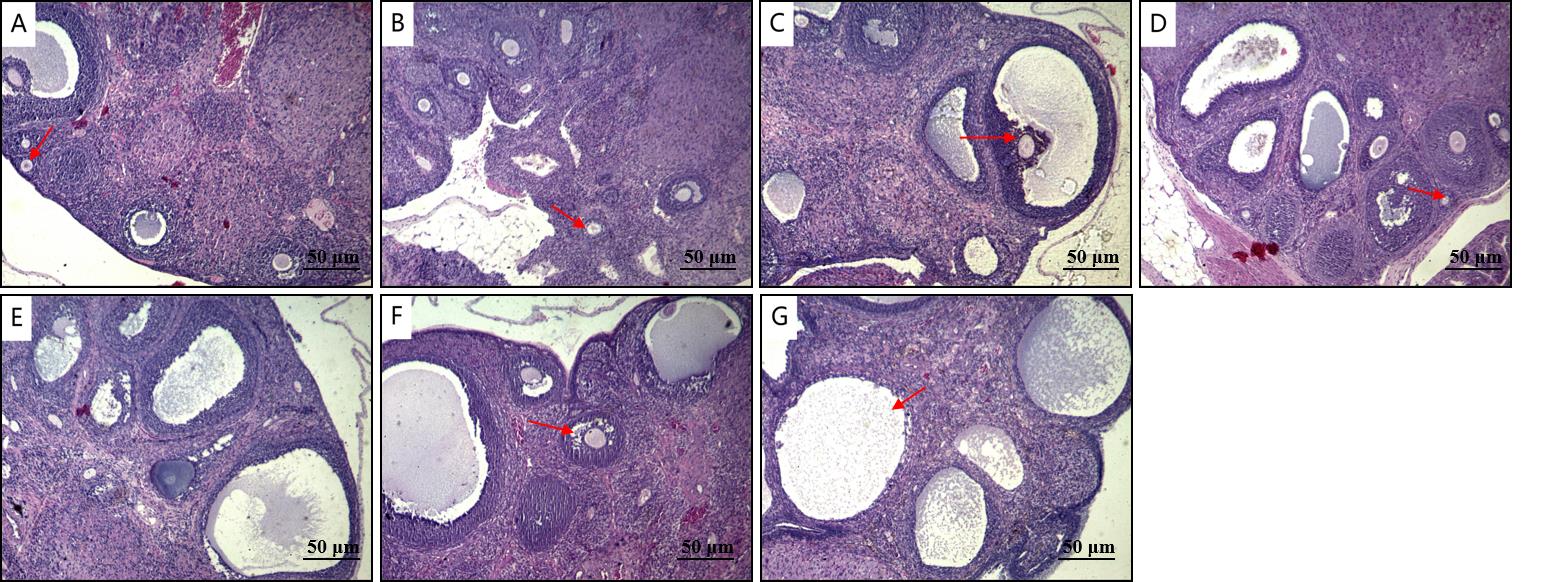
图1 大鼠卵巢HE染色(×100):A.对照组 B.CTX单次组 C.CTX两次组 D.CTX多次组 E.雷公藤组 F.制动+LTS组 G.围绝经期组
Figure 1 HE staining of rat ovary (×100) : A. control group B. single-dose CTX group C. double-dose CTX group D. multiple-dose CTX group E. tripterygium wilfordii group F. restraint stress +LTS group G. perimenopausal group
组别 group | 原始卵泡数 Number of primordial follicles | 初级卵泡数 Number of primary follicles | 次级卵泡数 Number of secondary follicle | 成熟卵泡数 Number of mature follicles | 闭锁卵泡数 Number of atretic follicles |
|---|---|---|---|---|---|
对照组 Control group | 10.67±0.58#○♠♥♣ | 8.33±0.58a | 8.33±1.16abceff | 1.67±1.16 | 3.67±1.16#●○♠♥♣ |
CTX单次组 Single-dose CTX group | 5.67±1.53*# | 11.33±0.58n | 13.67±2.31*# | 0.33±0.58 | 7.67±1.16*●○♣ |
CTX两次组 Double-dose CTX group | 4.67±0.58* | 11.33±3.22 | 14.00±4.36*# | 0.33±0.58 | 9.67±1.16*●○ |
CTX多次组 Multiple-dose CTX group | 6.33±0.58*# | 10.33±1.16 | 14.00±3.61*# | 0.67±1.16 | 12.00±1.73*#♠ |
雷公藤组 Tripterygium wilfordii group | 6.33±0.58*# | 13.33±5.03 | 13.00±1.73# | 2.00±0.00 | 13.00±1.73*#♠♥ |
制动+LTS组 Restraint stress +LTS group | 6.33±1.16*# | 11.00±1.73 | 14.67±2.31*# | 0.33±0.58 | 13.33±0.58*#♠♥ |
围绝经期组 Perimenopausal group | 3.00±1.73*●○♠♣ | 6.33±4.93 | 1.00±1.73*●○♠♥♣ | 0.00±0.00 | 8.67±1.53*●○♣ |
F值 F value | 14.375 | 1.692 | 10.449 | 3.333 | 19.614 |
P值 P value | 0.000 | 0.195 | 0.000 | 0.030 | 0.000 |
表4 各组大鼠卵巢各级卵泡计数比较 (
Table 4 Comparison of ovarian follicle count at all levels in each group
组别 group | 原始卵泡数 Number of primordial follicles | 初级卵泡数 Number of primary follicles | 次级卵泡数 Number of secondary follicle | 成熟卵泡数 Number of mature follicles | 闭锁卵泡数 Number of atretic follicles |
|---|---|---|---|---|---|
对照组 Control group | 10.67±0.58#○♠♥♣ | 8.33±0.58a | 8.33±1.16abceff | 1.67±1.16 | 3.67±1.16#●○♠♥♣ |
CTX单次组 Single-dose CTX group | 5.67±1.53*# | 11.33±0.58n | 13.67±2.31*# | 0.33±0.58 | 7.67±1.16*●○♣ |
CTX两次组 Double-dose CTX group | 4.67±0.58* | 11.33±3.22 | 14.00±4.36*# | 0.33±0.58 | 9.67±1.16*●○ |
CTX多次组 Multiple-dose CTX group | 6.33±0.58*# | 10.33±1.16 | 14.00±3.61*# | 0.67±1.16 | 12.00±1.73*#♠ |
雷公藤组 Tripterygium wilfordii group | 6.33±0.58*# | 13.33±5.03 | 13.00±1.73# | 2.00±0.00 | 13.00±1.73*#♠♥ |
制动+LTS组 Restraint stress +LTS group | 6.33±1.16*# | 11.00±1.73 | 14.67±2.31*# | 0.33±0.58 | 13.33±0.58*#♠♥ |
围绝经期组 Perimenopausal group | 3.00±1.73*●○♠♣ | 6.33±4.93 | 1.00±1.73*●○♠♥♣ | 0.00±0.00 | 8.67±1.53*●○♣ |
F值 F value | 14.375 | 1.692 | 10.449 | 3.333 | 19.614 |
P值 P value | 0.000 | 0.195 | 0.000 | 0.030 | 0.000 |
组别 Group | 雌二醇ρ/(pg·mL-1) E2ρ/(pg·mL-1) | 黄体生成素ρ/(pg·mL-1) LHρ/(pg·mL-1) | 促卵泡激素ρ/(pg·mL-1) FSHρ/(pg·mL-1) | 抗苗勒氏管激素ρ/(ng·mL-1) AMHρ/(ng·mL-1) |
|---|---|---|---|---|
| 对照组 Control group | 310.02±36.80# | 353.33±64.79#●♣ | 10.11±0.83○♥ | 1.16±0.32#●♠ |
| CTX单次组 Single-dose CTX group | 304.40±28.63# | 473.64±101.95#● | 11.35±4.80 | 1.65±0.58*○♥♣ |
| CTX两次组 Double-dose CTX group | 321.28±36.98# | 448.60±103.37#● | 7.08±0.97* | 0.97±0.35#●♠ |
| CTX多次组 Multiple-dose CTX group | 325.62±25.30# | 508.77±130.94* | 8.18±1.19 | 0.90±0.47#●♠ |
| 雷公藤组 Tripterygium wilfordii group | 310.43±36.89# | 499.03±122.67 | 8.24±0.83* | 1.13±0.31#●♠ |
| 制动+LTS组 Restraint stress +LTS group | 271.99±42.61♥♣ | 631.27±200.25*♠♥ | 8.78±1.62 | 1.92±0.43* |
| 围绝经期组 Perimenopausal group | 250.93±30.33*○♠♥♣ | 634.50±149.51*♠♥ | 8.73±1.93 | 1.81±0.34* |
| F值 F value | 3.827 | 2.484 | 3.497 | 6.232 |
| P值 P value | 0.005 | 0.042 | 0.008 | 0.000 |
表5 各组大鼠血清FSH、LH、E2、AMH比较 (
Table 5 Comparison of serum FSH, LH, E2 and AMH in each group
组别 Group | 雌二醇ρ/(pg·mL-1) E2ρ/(pg·mL-1) | 黄体生成素ρ/(pg·mL-1) LHρ/(pg·mL-1) | 促卵泡激素ρ/(pg·mL-1) FSHρ/(pg·mL-1) | 抗苗勒氏管激素ρ/(ng·mL-1) AMHρ/(ng·mL-1) |
|---|---|---|---|---|
| 对照组 Control group | 310.02±36.80# | 353.33±64.79#●♣ | 10.11±0.83○♥ | 1.16±0.32#●♠ |
| CTX单次组 Single-dose CTX group | 304.40±28.63# | 473.64±101.95#● | 11.35±4.80 | 1.65±0.58*○♥♣ |
| CTX两次组 Double-dose CTX group | 321.28±36.98# | 448.60±103.37#● | 7.08±0.97* | 0.97±0.35#●♠ |
| CTX多次组 Multiple-dose CTX group | 325.62±25.30# | 508.77±130.94* | 8.18±1.19 | 0.90±0.47#●♠ |
| 雷公藤组 Tripterygium wilfordii group | 310.43±36.89# | 499.03±122.67 | 8.24±0.83* | 1.13±0.31#●♠ |
| 制动+LTS组 Restraint stress +LTS group | 271.99±42.61♥♣ | 631.27±200.25*♠♥ | 8.78±1.62 | 1.92±0.43* |
| 围绝经期组 Perimenopausal group | 250.93±30.33*○♠♥♣ | 634.50±149.51*♠♥ | 8.73±1.93 | 1.81±0.34* |
| F值 F value | 3.827 | 2.484 | 3.497 | 6.232 |
| P值 P value | 0.005 | 0.042 | 0.008 | 0.000 |
| [1] | 卵巢储备功能减退临床诊治专家共识专家组, 中华预防医学会生育力保护分会生殖内分泌生育保护学组. 卵巢储备功能减退临床诊治专家共识[J]. 生殖医学杂志, 2022, 31(4): 425-434. |
| Expert Group of Consensus on Clinical Diagnosis & Management of Diminished Ovarian Reserve, Reproductive Endocrinology & Fertility Preservation Section of Chinese Society on Fertility Preservation under Chinese Preventive Medicine Association. Consensus on clinical diagnosis and management of diminished ovarian reserve[J]. J Reprod Med, 2022, 31(4): 425-434. | |
| [2] | 黄慧, 邓亚胜, 梁天薇, 等. 卵巢储备功能减退动物模型的造模方法评价与分析[J]. 实验动物与比较医学, 2023, 43(4): 422-428. DOI: 10.12300/j.issn.1674-5817.2023.032 . |
| HUANG H, DENG Y S, LIANG T W, et al. Evaluation and analysis of modeling methods for animal models with diminished ovarian reserve[J]. Lab Anim Comp Med, 2023, 43(4): 422-428. DOI: 10.12300/j.issn.1674-5817.2023.032 . | |
| [3] | 李丽美, 陶莉莉, 和秀魁, 等. 环磷酰胺建立SD大鼠卵巢功能减退模型的研究[J]. 重庆医学, 2019, 48(13): 2180-2183, 2188. DOI: 10.3969/j.issn.1671-8348.2019.13.005 . |
| LI L M, TAO L L, HE X K, et al. Study on cyclophosphamide for constructing SD rat diminished ovarian reserve model[J]. Chongqing Med, 2019, 48(13): 2180-2183, 2188. DOI: 10.3969/j.issn.1671-8348.2019.13.005 . | |
| [4] | 黄雪君, 孙冬梅, 陈玉兴, 等. 护卵颗粒对重复制动应激致卵巢功能减退模型大鼠的影响[J]. 世界中医药, 2016, 11(3): 502-506. DOI: 10.3969/j.issn.1673-7202.2016.03.035 . |
| HUANG X J, SUN D M, CHEN Y X, et al. Effect of hu Luan ke Li on diminished ovarian reserve rats with repeated immobilization stress[J]. World Chin Med, 2016, 11(3): 502-506. DOI: 10.3969/j.issn.1673-7202.2016.03.035 . | |
| [5] | 张子怡, 陈宝军, 张英杰, 等. 肾阳虚、肾阴虚证大鼠模型的建立与稳定性观察[J]. 福建中医药, 2015, 46(1): 51-54. DOI: 10.13260/j.cnki.jfjtcm.010856 . |
| ZHANG Z Y, CHEN B J, ZHANG Y J, et al. Establishment and stability observation of rat model with kidney-Yang deficiency and kidney-Yin deficiency syndrome[J]. Fujian J Tradit Chin Med, 2015, 46(1): 51-54. DOI: 10.13260/j.cnki.jfjtcm.010856 . | |
| [6] | 陈思充, 陈子豪, 高青华, 等. 不同阴道涂片方法的比较及对大鼠动情周期的判断[J]. 解剖科学进展, 2023, 29(1): 93-95, 102. DOI: 10.16695/j.cnki.1006-2947.2023.01.025 . |
| CHEN S C, CHEN Z H, GAO Q H, et al. Comparison of different vaginal smears and judgment of estrous cycle in rats[J]. Prog Anat Sci, 2023, 29(1): 93-95, 102. DOI: 10.16695/j.cnki.1006-2947.2023.01.025 . | |
| [7] | 范雅祺, 郑燕鹏, 周子婷, 等. 雷公藤建立卵巢早衰大鼠模型的实验研究[J]. 中国实验动物学报, 2023, 31(3): 355-364. DOI: 10.3969/j.issn.1005-4847.2023.03.010 . |
| FAN Y Q, ZHENG Y P, ZHOU Z T, et al. Establishment of a rat model of premature ovarian failure induced by Tripterygium wilfordii [J]. Acta Lab Anim Sci Sin, 2023, 31(3): 355-364. DOI: 10.3969/j.issn.1005-4847.2023.03.010 . | |
| [8] | TOURAINE P, CHABBERT-BUFFET N, PLU-BUREAU G, et al. Premature ovarian insufficiency[J]. Nat Rev Dis Primers, 2024, 10: 63. DOI: 10.1038/s41572-024-00547-5 . |
| [9] | 陈佳芳, 雷磊. 早发性卵巢功能不全动物模型评价思路[J]. 中华中医药杂志, 2023, 38(9): 4255-4258. |
| CHEN J F, LEI L. Evaluation thought of premature ovarian insufficiency animal models[J]. China J Tradit Chin Med Pharm, 2023, 38(9): 4255-4258. | |
| [10] | LE D C, NGO M T, KUO Y C, et al. Secretome from estrogen-responding human placenta-derived mesenchymal stem cells rescues ovarian function and circadian rhythm in mice with cyclophosphamide-induced primary ovarian insufficiency[J]. J Biomed Sci, 2024, 31(1): 95. DOI: 10.1186/s12929-024-01085-8 . |
| [11] | SENGUPTA P. The laboratory rat: relating its age with human's[J]. Int J Prev Med, 2013, 4(6): 624-630. |
| [12] | 陈燕霞, 袁苑, 马堃, 等. 定坤丹对雷公藤多苷诱导卵巢储备功能低下小鼠性激素和卵泡计数的影响[J]. 中国实验方剂学杂志, 2020, 26(14): 78-84. DOI: 10.13422/j.cnki.syfjx.20201339 . |
| CHEN Y X, YUAN Y, MA K, et al. Effect of dingkundan on sex hormone and follicle count in mice of Tripterygium wilfordii polyglycosides induced diminished ovarian reserve[J]. Chin J Exp Tradit Med Formulae, 2020, 26(14): 78-84. DOI: 10.13422/j.cnki.syfjx.20201339 . | |
| [13] | 苏德慧, 苏会娜, 谈诚, 等. 不同剂量环磷酰胺诱发卵巢早衰小鼠模型对衰老和凋亡的影响及机制探讨[J]. 中国妇产科临床杂志, 2025, 26(2): 129-133. DOI: 10.13390/j.issn.1672-1861.2025.02.009 . |
| SU D H, SU H N, TAN C, et al. Effects and mechanisms of cyclophosphamide-induced premature ovarian failure in mouse models: the impact of different doses on senescence and apoptosis[J]. Chin J Clin Obstet Gynecol, 2025, 26(2): 129-133. DOI: 10.13390/j.issn.1672-1861.2025.02.009 . | |
| [14] | 林华丹, 王旭, 陈春宏, 等. 三种卵巢储备功能减退小鼠模型的效果比较[J]. 中国比较医学杂志, 2025, 35(5): 51-59. DOI: 10.3969/j.issn.1671-7856.2025.05.005 . |
| LIN H D, WANG X, CHEN C H, et al. Comparison of three methods for induction of model mice with diminished ovarian reserve[J]. Chin J Comp Med, 2025, 35(5): 51-59. DOI: 10.3969/j.issn.1671-7856.2025.05.005 . | |
| [15] | GONFLONI S, JODICE C, GUSTAVINO B, et al. DNA damage stress response and follicle activation: signaling routes of mammalian ovarian reserve[J]. Int J Mol Sci, 2022, 23(22): 14379. DOI: 10.3390/ijms232214379 . |
| [16] | 贡磊磊, 王晓霞, 封学伟, 等. 不同浓度环磷酰胺诱导早发性卵巢功能不全小鼠模型及作用机制研究[J]. 实验动物与比较医学, 2025, 45(4): 403-410. DOI: 10.12300/j.issn.1674-5817.2024.194 . |
| GONG L L, WANG X X, FENG X W, et al. A mouse model and mechanism study of premature ovarian insufficiency induced by different concentrations of cyclophosphamide[J]. Lab Anim Comp Med, 2025, 45(4): 403-410. DOI: 10.12300/j.issn.1674-5817.2024.194 . | |
| [17] | STRINGER J M, ALESI L R, WINSHIP A L, et al. Beyond apoptosis: evidence of other regulated cell death pathways in the ovary throughout development and life[J]. Hum Reprod Update, 2023, 29(4): 434-456. DOI: 10.1093/humupd/dmad005 . |
| [18] | 王凤, 张会永, 李芹, 等. 肝郁证动物模型造模方法与模型评价研究进展[J]. 中华中医药杂志, 2021, 36(2): 934-939. |
| WANG F, ZHANG H Y, LI Q, et al. Research progress on animal modeling methods and model evaluation of liver depression syndrome[J]. China J Tradit Chin Med Pharm, 2021, 36(2): 934-939. | |
| [19] | 韦柳彤, 赖东梅. 慢性应激与卵巢功能减退的相关性研究进展[J]. 上海交通大学学报(医学版), 2024, 44(12): 1601-1606. DOI: 10.3969/j.issn.1674-8115.2024.12.014 . |
| WEI L T, LAI D M. Research progress in the correlation between chronic stress and ovarian dysfunction[J]. J Shanghai Jiaotong Univ Med Sci, 2024, 44(12): 1601-1606. DOI: 10.3969/j.issn.1674-8115.2024.12.014 . | |
| [20] | 丁杨, 向菁菁, 吴慧华, 等. 基础FSH/LH比值及年龄因素在高龄女性患者体外受精-胚胎移植治疗中的预测价值[J]. 实用医学杂志, 2016, 32(10): 1669-1672. DOI: 10.3969/j.issn.1006-5725.2016.10.035 . |
| DING Y, XIANG J J, WU H H, et al. Predictive value of basic FSH/LH ratio and age factors in in vitro fertilization-embryo transfer treatment for elderly female patients[J]. J Pract Med, 2016, 32(10): 1669-1672. DOI: 10.3969/j.issn.1006-5725.2016.10.035 . | |
| [21] | 尚丹丹, 刘萍, 刘利贞, 等. 卵巢抵抗综合征和早发性卵巢功能不全诊断与个体化管理进展[J]. 实用医学杂志, 2025, 41(1): 146-152. DOI: 10.3969/j.issn.1006-5725.2025.01.024 . |
| SHANG D D, LIU P, LIU L Z, et al. Diagnosis and advances in individualized management of resistant ovary syndrome and premature ovarian insufficiency[J]. J Pract Med, 2025, 41(1): 146-152. DOI: 10.3969/j.issn.1006-5725.2025.01.024 . | |
| [22] | 宗国霞, 王威, 夏宇跃, 等. 早发性卵巢功能不全患者外周血CD3+ HLA-DR细胞水平与卵巢储备功能的相关性[J]. 实用医学杂志, 2019, 35(13): 2108-2111. DOI: 10.3969/j.issn.1006-5725.2019.13.017 . |
| ZONG G X, WANG W, XIA Y Y, et al. Correlation between peripheral blood CD3+ HLA-DR cell levels and ovarian reserve function in patients with premature ovarian insufficiency[J]. J Pract Med, 2019, 35(13): 2108-2111. DOI: 10.3969/j.issn.1006-5725.2019.13.017 . |
| [1] | 强苏静, 李冬婷, 徐瑾华, 蔡莉, 韦思羽, 邹嘉镭, 丁玉强. 实验大鼠和小鼠中肺炎克雷伯菌复合体的鉴定与分析[J]. 实验动物与比较医学, 2026, 46(4): 564-572. |
| [2] | 雷建军, 索晨浩, 张贺. 白藜芦醇通过调控CCL3/CCR5信号通路减轻脑缺血再灌注大鼠模型的血脑屏障损伤[J]. 实验动物与比较医学, 2026, 46(4): 487-497. |
| [3] | 汤建平, 赵丽亚, 赵莹. 常用近交系大鼠微卫星遗传位点筛选及分析[J]. 实验动物与比较医学, 2026, 46(3): 388-396. |
| [4] | 李嘉菲, 张朕豪, 王硕, 田歌, 温爽, 闫玉雪, 崔然, 叶振, 崔永春. 自主神经调节剂对房颤模型大鼠心房电重塑及组织病理变化的影响[J]. 实验动物与比较医学, 2026, 46(3): 321-331. |
| [5] | 艾秀峰, 张利棕, 方明笋, 吕东颖, 陈楚, 蔡兆伟, 王德军. 16S rRNA测序分析饮用含氯水对大鼠和小鼠肠道菌群的影响差异[J]. 实验动物与比较医学, 2026, 46(3): 437-445. |
| [6] | 宋静, 杨宗统, 李晓晶, 李自发, 苏凤云, 徐东川, 隋在云. 泻白散对过敏性哮喘大鼠肺、肠组织形态结构及PI3K和Akt表达水平的影响[J]. 实验动物与比较医学, 2026, 46(2): 191-204. |
| [7] | 唐小杭, 谷颖敏, 吕阳阳, 黄明姝, 田雪松. 一种自研固定液用于制备大鼠眼球切片的组织学染色效果评价[J]. 实验动物与比较医学, 2026, 46(2): 261-270. |
| [8] | 姜海涛, 袁韩涛, 黄雯婷, 杨蓉蓉, 陈晓春, 禹宝庆, 李四波. 腰舒逐瘀方通过miR-17-5P/MDM2/p53通路调控大鼠椎间盘纤维环细胞增殖与凋亡[J]. 实验动物与比较医学, 2026, 46(1): 55-65. |
| [9] | 曹星新, 李艾亦, 侯婧涵, 李明学, 李艳艳, 靳玮华, 杨凤梅, 段素琴, 和占龙. 黄芪或其成分治疗急性胰腺炎的动物实验Meta分析[J]. 实验动物与比较医学, 2025, 45(5): 561-573. |
| [10] | 高超奇, 祝志波, 孙显东. 大鼠血管重构模型的应用进展与分类分析[J]. 实验动物与比较医学, 2025, 45(5): 542-550. |
| [11] | 罗一凡, 张臻玮, 梅璐, 史叶萍, 邢艺彤, 张泽奇, 李楚欣, 韩春霞, 杨平顺, 陈秋生. 特络细胞介导肥胖症大鼠膏摩寡肽中草药复合制剂的减肥作用及其机制[J]. 实验动物与比较医学, 2025, 45(5): 551-560. |
| [12] | 贡磊磊, 王晓霞, 封学伟, 李心蕾, 赵涵, 张雪艳, 冯欣. 不同浓度环磷酰胺诱导早发性卵巢功能不全小鼠模型及作用机制研究[J]. 实验动物与比较医学, 2025, 45(4): 403-410. |
| [13] | 秦超, 李双星, 赵婷婷, 蒋晨晨, 赵晶, 杨艳伟, 林志, 王三龙, 文海若. 药物安全评价用SD大鼠90 d喂养试验的背景数据研究[J]. 实验动物与比较医学, 2025, 45(4): 439-448. |
| [14] | 刘力瑜, 嵇波, 刘小玄, 方洋, 张玲, 郭亭廷, 全烨, 李鹤文, 刘翼天. 大鼠胎儿期肺组织固定方法的探索[J]. 实验动物与比较医学, 2025, 45(4): 432-438. |
| [15] | 潘颐聪, 蒋汶洪, 胡明, 覃晓. 慢性肾脏病大鼠主动脉钙化模型的术式优化及效果评价[J]. 实验动物与比较医学, 2025, 45(3): 279-289. |
| 阅读次数 | ||||||
|
全文 |
|
|||||
|
摘要 |
|
|||||
