





实验动物与比较医学 ›› 2026, Vol. 46 ›› Issue (3): 311-320.DOI: 10.12300/j.issn.1674-5817.2025.203
• 人类疾病动物模型 • 下一篇
李龙雪1( ), 万崇凡2, 张琦2, 雷茹婷2, 王潇玥3, 程乐妍2, 赖琦2, 刘荣华4()(
 ), 刘漩1()(), 徐铁龙5()()
收稿日期:2025-12-10
修回日期:2026-04-12
出版日期:2026-06-25
发布日期:2026-06-19
通讯作者:
作者简介:李龙雪(1988—),女,硕士,实验师,研究方向:中药药效学研究。E-mail: llx669822@163.com。ORCID:0000-0002-9602-6269
基金资助:
LI Longxue1(), WAN Chongfan2, ZHANG Qi2, LEI Ruting2, WANG Xiaoyue3, CHENG Leyan2, LAI Qi2, LIU Ronghua4()(), LIU Xuan1()(), XU Tielong5()()
Received:2025-12-10
Revised:2026-04-12
Published:2026-06-25
Online:2026-06-19
Contact:
LIU Ronghua (ORCID: 0009-0000-7015-6324), E-mail: rhliujxucm@163.com摘要:
目的 基于miRNA测序技术探讨清肺排毒汤(Qingfei Paidu decoction,QFPDD)对小鼠急性肺损伤的防治作用及其分子机制。 方法 24只4周龄雄性KM小鼠随机分为对照组、模型组和QFPDD组,每组8只。适应性饲养1周后,对照组和模型组灌胃给予超纯水(0.2 mL/次),QFPDD组灌胃给予QFPDD汤剂(0.2 mL/次,含生药1.6 g/mL),2次/d,连续8 d;第2~8天,模型组和QFPDD组给予2.5 g/L脂多糖(lipopolysaccharide,LPS)水溶液4 mL雾化,连续雾化7 d。第9天深度麻醉后通过眼底静脉丛采血,取小鼠肺组织,称取各组小鼠体重和肺组织质量,计算肺系数。采用ELISA法检测小鼠血清中炎症因子肿瘤坏死因子α(tumor necrosis factor-α,TNF-α)、白细胞介素(interleukin,IL)-1β和IL-6水平。对肺组织进行石蜡切片后行HE染色,观察肺组织形态学变化。用Illumina HiSeq 2500测序平台检测小鼠肺组织miRNA表达谱,通过数据库预测差异表达miRNA的靶基因,利用基因本体(gene ontology,GO)和京都基因与基因组数据库(Kyoto Encyclopedia of Genes and Genomes,KEGG)富集分析差异表达miRNA的靶基因功能;通过反转录实时荧光定量PCR技术对差异表达的miRNA进行验证。 结果 与对照组相比,模型组小鼠体重增长趋势一致,但肺系数显著升高(P<0.01)。ELISA结果显示,与对照组相比,模型组小鼠血清TNF-α和IL-6水平显著升高(P<0.01);与模型组相比,QFPDD组小鼠血清TNF-α和IL-6水平显著降低(P<0.05)。HE染色结果显示,与对照组相比,模型组小鼠肺泡间隔增宽,大量炎症细胞浸润,部分肺泡扩张,少量毛细血管扩张伴淤血;与模型组相比,QFPDD组小鼠肺泡间隔稍增宽,少量炎症细胞浸润。miRNA测序结合交集分析筛选出模型组与对照组、QFPDD组与模型组之间均存在显著差异的13个miRNA,其中6个miRNA(分别为mmu-miR-203-3p、mmu-miR-181b-5p_R-1、hsa-miR-4286_R+1、mmu-miR-1843b-5p_L+1R-1_2、mmu-miR-22-3p和mmu-miR-1964-3p)在模型组中显著上调(P<0.05),QFPDD治疗后显著下调(P<0.05),呈治疗性回调趋势。GO分析显示,差异表达miRNA的靶基因主要富集于RNA聚合酶Ⅱ转录调控等生物学过程。KEGG分析显示,靶基因主要富集于丝裂原活化蛋白激酶(mitogen-activated protein kinase,MAPK)信号通路。针对mmu-miR-203-3p的PCR验证结果显示与测序分析结果一致。 结论 QFPDD可能通过调控mmu-miR-203-3p等表达,调节炎症反应和MAPK信号通路,参与肺损伤的病理过程,发挥防治急性肺损伤的作用。
中图分类号:
李龙雪,李龙雪,万崇凡,等. 基于miRNA测序分析清肺排毒汤防治小鼠急性肺损伤的分子机制研究[J]. 实验动物与比较医学, 2026, 46(3): 311-320. DOI: 10.12300/j.issn.1674-5817.2025.203.
LI Longxue,LI Longxue,WAN Chongfan,et al. Molecular Mechanisms of Qingfei Paidu Decoction in the Prevention and Treatment of Acute Lung Injury in Mice Based on miRNA Sequencing[J]. Laboratory Animal and Comparative Medicine, 2026, 46(3): 311-320. DOI: 10.12300/j.issn.1674-5817.2025.203.
组别 Group | 初始体重/g Initial body weight/g | 终末体重/g Final body weight/g | 肺系数/% Lung coefficient/% | TNF-α ρ/(pg·mL-¹) | IL-1β ρ/(pg·mL-¹) | IL-6 ρ/(pg·mL-¹) |
|---|---|---|---|---|---|---|
对照组 Control group | 23.3±1.0 | 28.9±1.5 | 0.57±0.03 | 118.3±8.9 | 19.8±4.4 | 18.2±3.6 |
模型组 Model group | 23.3±1.4 | 28.1±1.9 | 0.75±0.07∗∗ | 148.6±13.4∗∗ | 24.6±3.3 | 29.5±7.7∗∗ |
QFPDD 组 QFPDD group | 23.4±0.8 | 28.4±1.9 | 0.73±0.07 | 131.3±16.9# | 22.2±6.4 | 21.8±5.0# |
表1 各组小鼠的体重、肺系数和血清炎症因子水平比较 (n=8, x?±s)
Table 1 Comparisons of body weight, lung coefficient, and serum inflammatory factors in different groups of mice
组别 Group | 初始体重/g Initial body weight/g | 终末体重/g Final body weight/g | 肺系数/% Lung coefficient/% | TNF-α ρ/(pg·mL-¹) | IL-1β ρ/(pg·mL-¹) | IL-6 ρ/(pg·mL-¹) |
|---|---|---|---|---|---|---|
对照组 Control group | 23.3±1.0 | 28.9±1.5 | 0.57±0.03 | 118.3±8.9 | 19.8±4.4 | 18.2±3.6 |
模型组 Model group | 23.3±1.4 | 28.1±1.9 | 0.75±0.07∗∗ | 148.6±13.4∗∗ | 24.6±3.3 | 29.5±7.7∗∗ |
QFPDD 组 QFPDD group | 23.4±0.8 | 28.4±1.9 | 0.73±0.07 | 131.3±16.9# | 22.2±6.4 | 21.8±5.0# |
组别 Group | 初始体重/g Initial body weight/g | 终末体重/g Final body weight/g | 肺系数/% Lung coefficient/% | TNF-α ρ/(pg·mL-¹) | IL-1β ρ/(pg·mL-¹) | IL-6 ρ/(pg·mL-¹) |
|---|---|---|---|---|---|---|
对照组 Control group | 23.3±1.0 | 28.9±1.5 | 0.57±0.03 | 118.3±8.9 | 19.8±4.4 | 18.2±3.6 |
模型组 Model group | 23.3±1.4 | 28.1±1.9 | 0.75±0.07∗∗ | 148.6±13.4∗∗ | 24.6±3.3 | 29.5±7.7∗∗ |
QFPDD 组 QFPDD group | 23.4±0.8 | 28.4±1.9 | 0.73±0.07 | 131.3±16.9# | 22.2±6.4 | 21.8±5.0# |
表1 各组小鼠的体重、肺系数和血清炎症因子水平比较 (n=8, x?±s)
Table 1 Comparisons of body weight, lung coefficient, and serum inflammatory factors in different groups of mice
组别 Group | 初始体重/g Initial body weight/g | 终末体重/g Final body weight/g | 肺系数/% Lung coefficient/% | TNF-α ρ/(pg·mL-¹) | IL-1β ρ/(pg·mL-¹) | IL-6 ρ/(pg·mL-¹) |
|---|---|---|---|---|---|---|
对照组 Control group | 23.3±1.0 | 28.9±1.5 | 0.57±0.03 | 118.3±8.9 | 19.8±4.4 | 18.2±3.6 |
模型组 Model group | 23.3±1.4 | 28.1±1.9 | 0.75±0.07∗∗ | 148.6±13.4∗∗ | 24.6±3.3 | 29.5±7.7∗∗ |
QFPDD 组 QFPDD group | 23.4±0.8 | 28.4±1.9 | 0.73±0.07 | 131.3±16.9# | 22.2±6.4 | 21.8±5.0# |
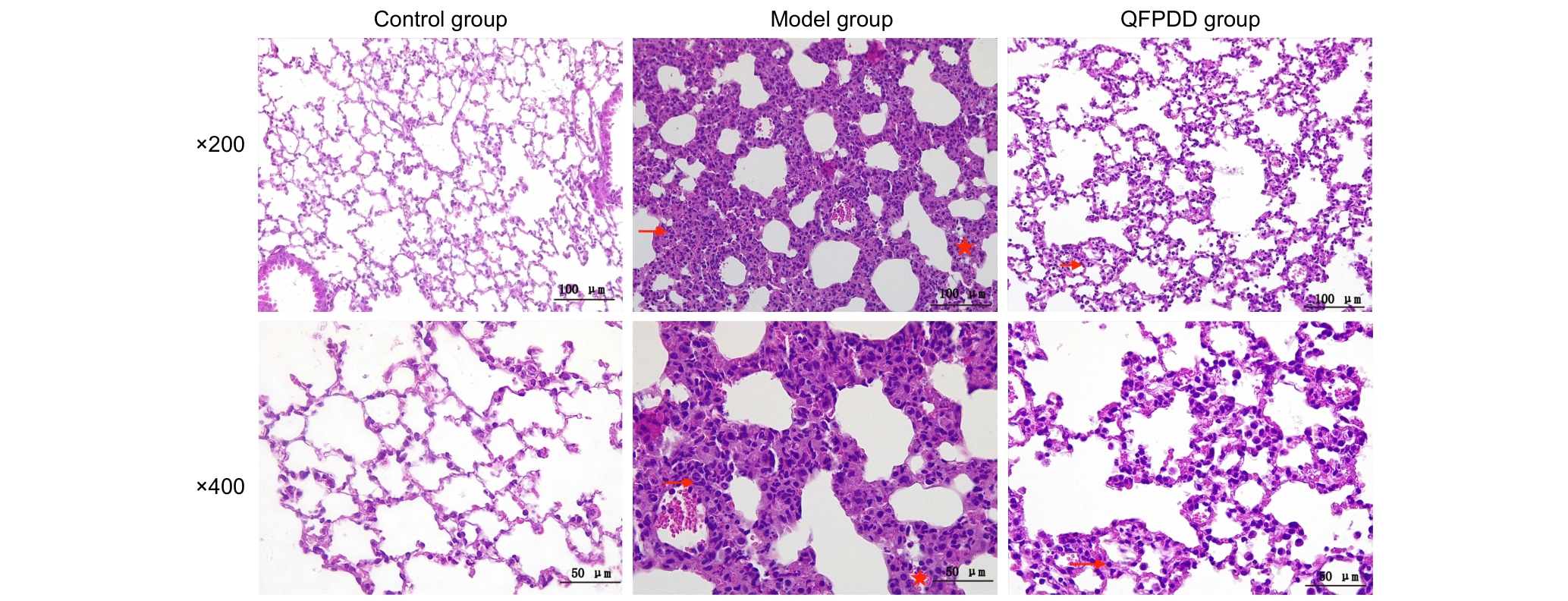
图1 各组小鼠肺组织HE染色结果
Figure 1 HE staining of lung tissues from mice in different groups
图1 各组小鼠肺组织HE染色结果
Figure 1 HE staining of lung tissues from mice in different groups
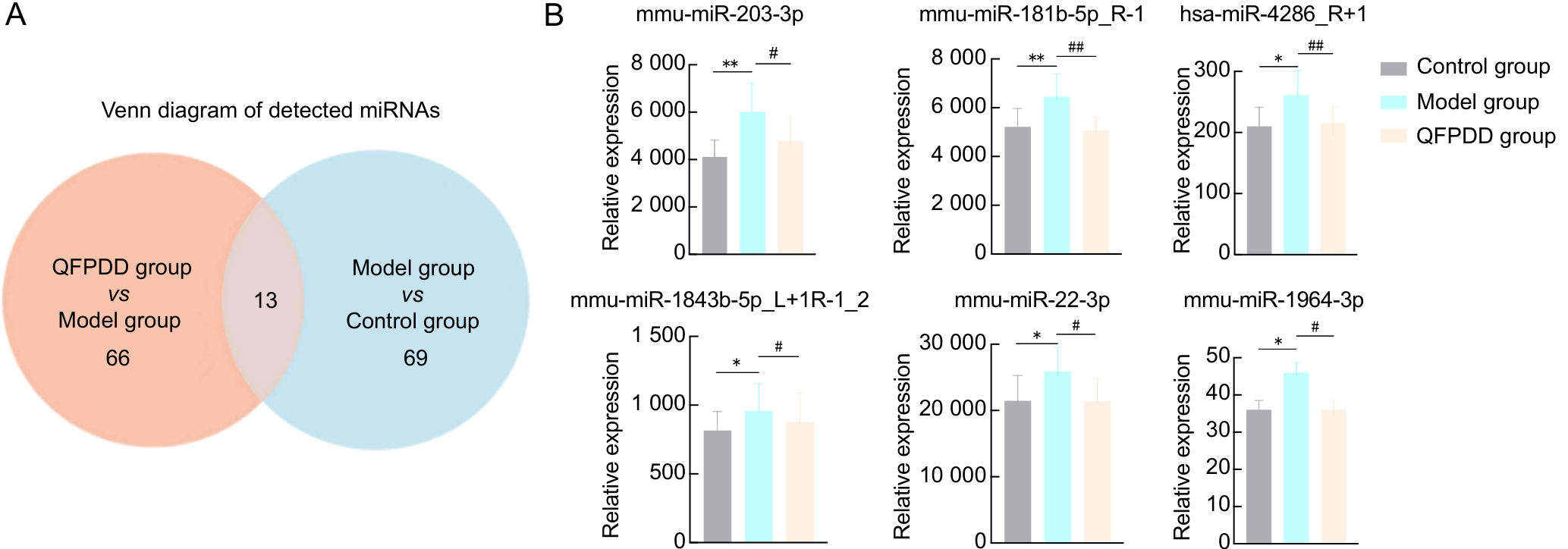
图2 miRNA测序分析各组小鼠肺组织中差异表达的miRNA
Figure 2 Differentially expressed miRNAs in lung tissues of mice among groups detected by miRNA sequencing
图2 miRNA测序分析各组小鼠肺组织中差异表达的miRNA
Figure 2 Differentially expressed miRNAs in lung tissues of mice among groups detected by miRNA sequencing
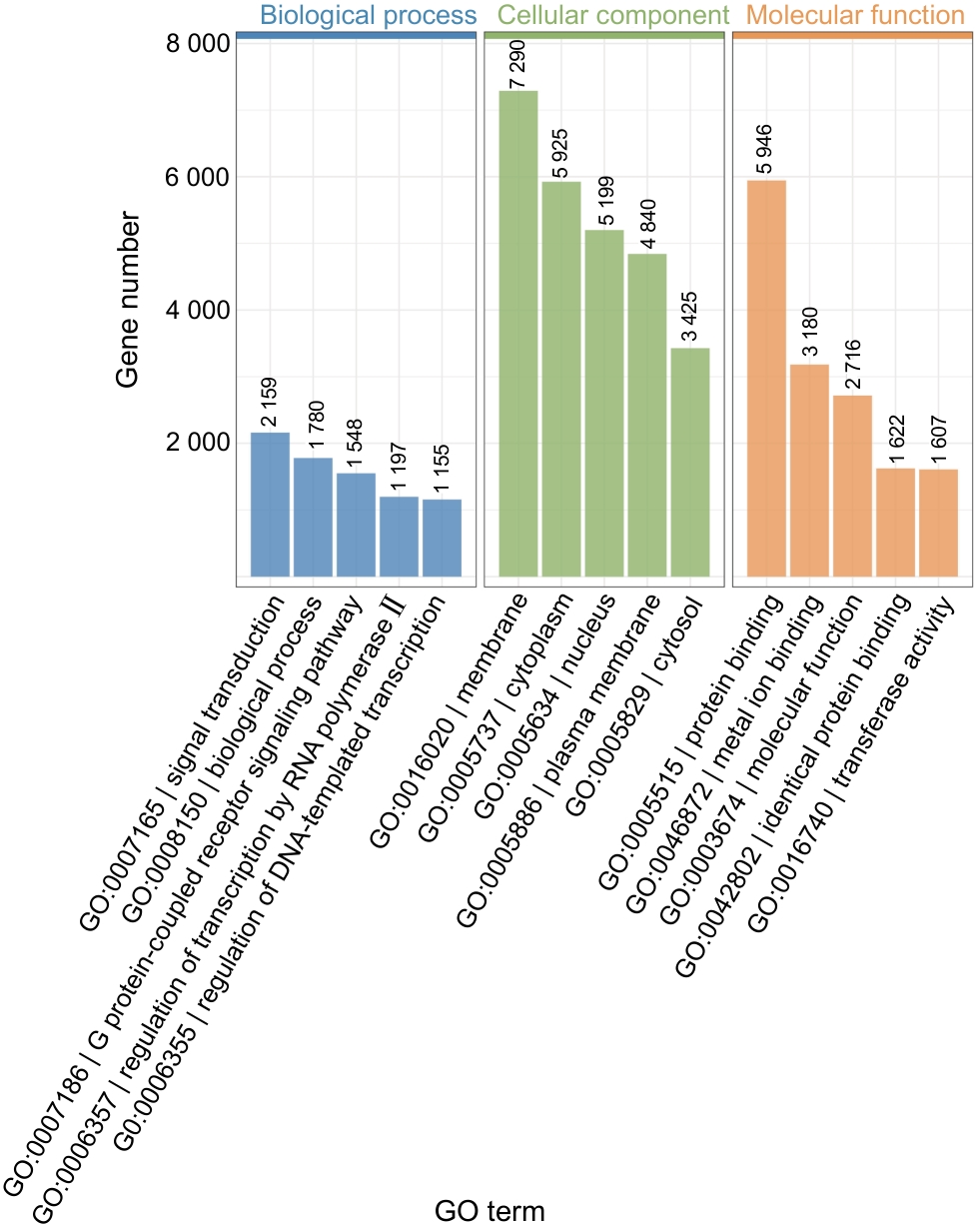
图3 差异表达miRNA的靶基因GO富集分析
Figure 3 GO enrichment analysis of target genes of differentially expressed miRNAs
图3 差异表达miRNA的靶基因GO富集分析
Figure 3 GO enrichment analysis of target genes of differentially expressed miRNAs
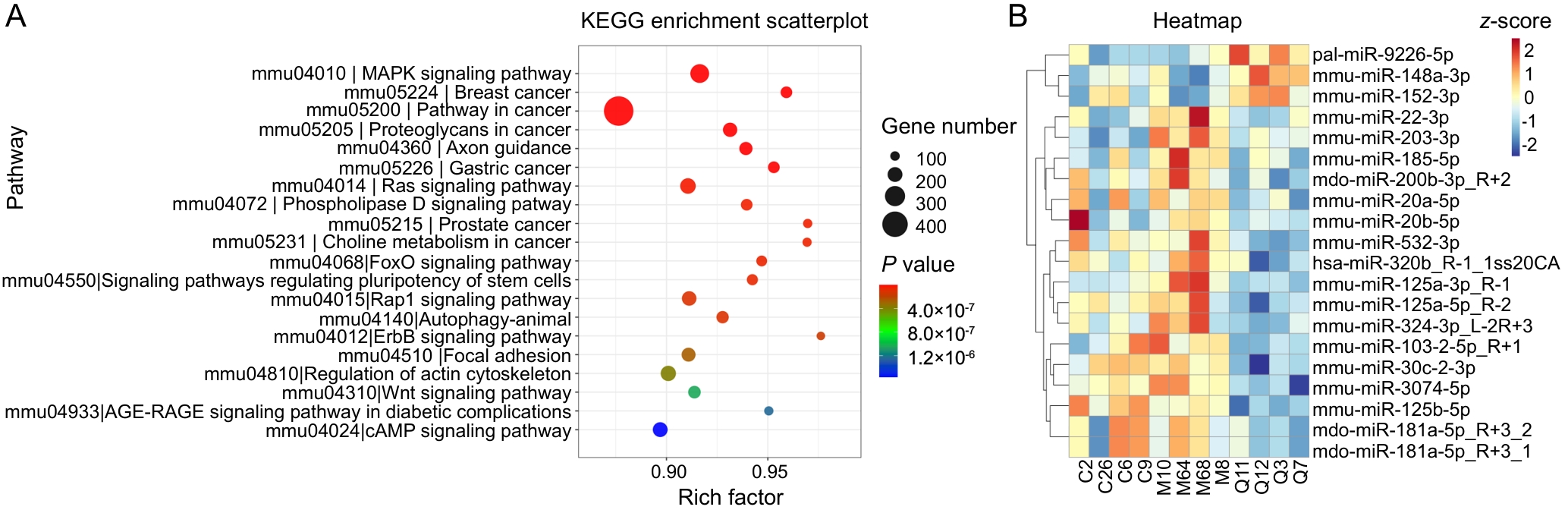
图 4 差异表达 miRNA的靶基因KEGG富集分析
Figure 4 KEGG enrichment analysis of target genes for differentially expressed miRNAs
图 4 差异表达 miRNA的靶基因KEGG富集分析
Figure 4 KEGG enrichment analysis of target genes for differentially expressed miRNAs
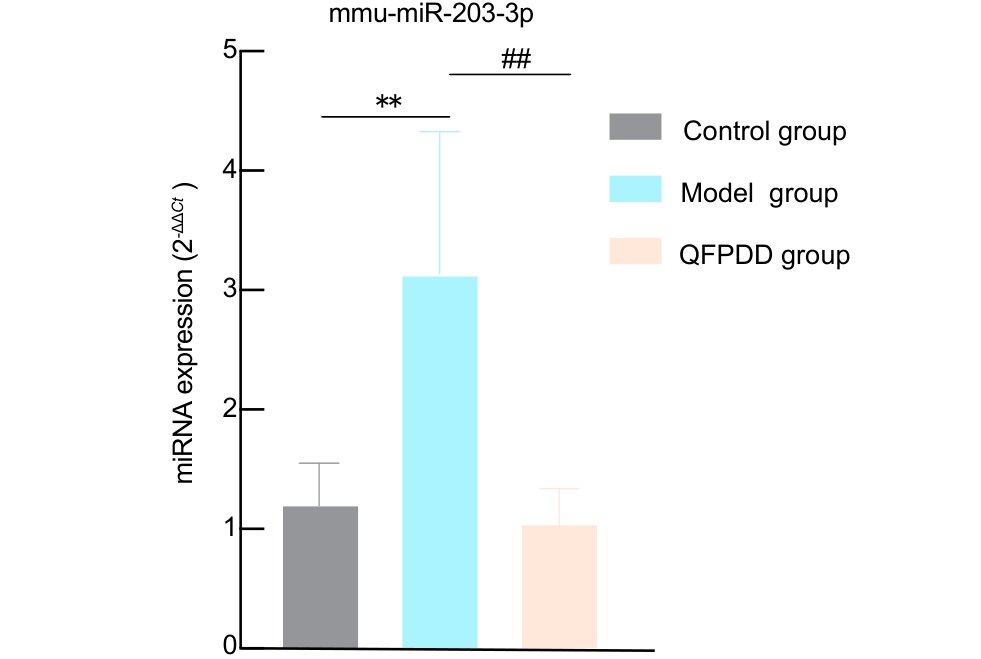
图 5 实时荧光定量PCR验证mmu-miR-203-3p差异表达
Figure 5 Validation of differential expression of mmu-miR-203-3p by quantitative real-time PCR
图 5 实时荧光定量PCR验证mmu-miR-203-3p差异表达
Figure 5 Validation of differential expression of mmu-miR-203-3p by quantitative real-time PCR
| [1] | LIU H Q, DONG J L, XU C L, et al. Acute lung injury: pathogenesis and treatment[J]. J Transl Med, 2025, 23(1): 926. DOI: 10.1186/s12967-025-06994-2 . |
| LIU H Q, DONG J L, XU C L, et al. Acute lung injury: pathogenesis and treatment[J]. J Transl Med, 2025, 23(1): 926. DOI: 10.1186/s12967-025-06994-2 . | |
| [2] | VERMA N, HOCHHEGGER B, MUKHOPADHYAY S, et al. Acute lung injury[J]. J Thorac Imag, 2025, 40(3): e0820. DOI: 10.1097/rti.0000000000000820 . |
| VERMA N, HOCHHEGGER B, MUKHOPADHYAY S, et al. Acute lung injury[J]. J Thorac Imag, 2025, 40(3): e0820. DOI: 10.1097/rti.0000000000000820 . | |
| [3] | 国家卫生健康委, 国家中医药局. 新型冠状病毒感染诊疗方案(试行第十版)[J]. 传染病信息, 2023, 36(1): 18-25. DOI: 10.3760/j.issn.1673-4777.2023.02.001 . |
| 国家卫生健康委, 国家中医药局. 新型冠状病毒感染诊疗方案(试行第十版)[J]. 传染病信息, 2023, 36(1): 18-25. DOI: 10.3760/j.issn.1673-4777.2023.02.001 . | |
| National Health Commission of the PRC, National Administration of Traditional Chinese Medicine. Guideline on diagnosis and treatment of novel coronavirus pneumonia(interim 10th edition)[J]. Infect Dis Inf, 2023, 36(1): 18-25. DOI: 10.3760/j.issn.1673-4777.2023.02.001 . | |
| National Health Commission of the PRC, National Administration of Traditional Chinese Medicine. Guideline on diagnosis and treatment of novel coronavirus pneumonia(interim 10th edition)[J]. Infect Dis Inf, 2023, 36(1): 18-25. DOI: 10.3760/j.issn.1673-4777.2023.02.001 . | |
| [4] | LU J N, TANG Y, LI H T, et al. Exploring anti-SARS-CoV-2 natural products: dual-viral target inhibition by delphinidin and the anti-coronaviral efficacy of deapio platycodin D[J]. Nat Prod Bioprospect, 2025, 15(1): 39. DOI: 10.1007/s13659-025-00523-w . |
| LU J N, TANG Y, LI H T, et al. Exploring anti-SARS-CoV-2 natural products: dual-viral target inhibition by delphinidin and the anti-coronaviral efficacy of deapio platycodin D[J]. Nat Prod Bioprospect, 2025, 15(1): 39. DOI: 10.1007/s13659-025-00523-w . | |
| [5] | REN W, MA Y, WANG R Q, et al. Research advance on Qingfei Paidu decoction in prescription principle, mechanism analysis and clinical application[J]. Front Pharmacol, 2021, 11: 589714. DOI: 10.3389/fphar.2020.589714 . |
| REN W, MA Y, WANG R Q, et al. Research advance on Qingfei Paidu decoction in prescription principle, mechanism analysis and clinical application[J]. Front Pharmacol, 2021, 11: 589714. DOI: 10.3389/fphar.2020.589714 . | |
| [6] | YE X L, TIAN S S, TANG C C, et al. Cytokine storm in acute viral respiratory injury: role of Qing-Fei-Pai-Du decoction in inhibiting the infiltration of neutrophils and macrophages through TAK1/IKK/NF-κB pathway[J]. Am J Chin Med, 2023, 51(5): 1153-1188. DOI: 10.1142/s0192415x23500532 . |
| YE X L, TIAN S S, TANG C C, et al. Cytokine storm in acute viral respiratory injury: role of Qing-Fei-Pai-Du decoction in inhibiting the infiltration of neutrophils and macrophages through TAK1/IKK/NF-κB pathway[J]. Am J Chin Med, 2023, 51(5): 1153-1188. DOI: 10.1142/s0192415x23500532 . | |
| [7] | 张平, 潘广涛. 清肺排毒汤改善新型冠状病毒肺炎危重型患者炎性细胞因子的临床研究[J]. 世界科学技术-中医药现代化, 2021, 23(2): 391-395. DOI: 10.11842/wst.20200416003 . |
| 张平, 潘广涛. 清肺排毒汤改善新型冠状病毒肺炎危重型患者炎性细胞因子的临床研究[J]. 世界科学技术-中医药现代化, 2021, 23(2): 391-395. DOI: 10.11842/wst.20200416003 . | |
| ZHANG P, PAN G T. Clinical study on the improvement of inflammatory cytokines in critically ill patients with COVID-19 treated by Qingfei Paidu decoction[J]. Mod Tradit Chin Med Mater Med World Sci Technol, 2021, 23(2): 391-395. DOI: 10.11842/wst.20200416003 . | |
| ZHANG P, PAN G T. Clinical study on the improvement of inflammatory cytokines in critically ill patients with COVID-19 treated by Qingfei Paidu decoction[J]. Mod Tradit Chin Med Mater Med World Sci Technol, 2021, 23(2): 391-395. DOI: 10.11842/wst.20200416003 . | |
| [8] | ZHANG X, YU Y, NING Y, et al. Advances in microRNA promoting gene expression[J]. Hereditas, 2025, 47(7): 729-741. DOI: 10.16288/j.yczz.24-374 . |
| ZHANG X, YU Y, NING Y, et al. Advances in microRNA promoting gene expression[J]. Hereditas, 2025, 47(7): 729-741. DOI: 10.16288/j.yczz.24-374 . | |
| [9] | OLIVETO S, MANFRINI N, BIFFO S. The power of microRNA regulation: insights into immunity and metabolism[J]. FEBS Lett, 2025, 599(13): 1821-1851. DOI: 10.1002/1873-3468.70039 . |
| OLIVETO S, MANFRINI N, BIFFO S. The power of microRNA regulation: insights into immunity and metabolism[J]. FEBS Lett, 2025, 599(13): 1821-1851. DOI: 10.1002/1873-3468.70039 . | |
| [10] | MCGEARY S E, LIN K S, SHI C Y, et al. The biochemical basis of microRNA targeting efficacy[J]. Science, 2019, 366(6472): eaav1741. DOI: 10.1126/science.aav1741 . |
| MCGEARY S E, LIN K S, SHI C Y, et al. The biochemical basis of microRNA targeting efficacy[J]. Science, 2019, 366(6472): eaav1741. DOI: 10.1126/science.aav1741 . | |
| [11] | BARTEL D P. microRNA genomics, biogenesis, mechanism, and function[J]. Cell, 2004, 116(2): 281-297. DOI: 10.1016/S0092-8674(04)00045-5 . |
| BARTEL D P. microRNA genomics, biogenesis, mechanism, and function[J]. Cell, 2004, 116(2): 281-297. DOI: 10.1016/S0092-8674(04)00045-5 . | |
| [12] | ARTIMOVIČ P, ŠPAKOVÁ I, MACEJKOVÁ E, et al. The ability of microRNAs to regulate the immune response in ischemia/reperfusion inflammatory pathways[J]. Genes Immun, 2024, 25(4): 277-296. DOI: 10.1038/s41435-024-00283-6 . |
| ARTIMOVIČ P, ŠPAKOVÁ I, MACEJKOVÁ E, et al. The ability of microRNAs to regulate the immune response in ischemia/reperfusion inflammatory pathways[J]. Genes Immun, 2024, 25(4): 277-296. DOI: 10.1038/s41435-024-00283-6 . | |
| [13] | LI Y, PENG B, LI Y, et al. MiR-203a-3p/153-3p improves cognitive impairments induced by ischemia/reperfusion via blockade of SRC-mediated MAPK signaling pathway in ischemic stroke[J]. Chem Biol Interact, 2022, 358:109900. DOI: 10.1016/j.cbi.2022.109900 . |
| LI Y, PENG B, LI Y, et al. MiR-203a-3p/153-3p improves cognitive impairments induced by ischemia/reperfusion via blockade of SRC-mediated MAPK signaling pathway in ischemic stroke[J]. Chem Biol Interact, 2022, 358:109900. DOI: 10.1016/j.cbi.2022.109900 . | |
| [14] | DENG A X, ZHAO L, RUZE A, et al. Application of ultrasound in assessment of acute lung injury in mice[J]. PLoS One, 2025, 20(10): e0332912. DOI: 10.1371/journal.pone.0332912 . |
| DENG A X, ZHAO L, RUZE A, et al. Application of ultrasound in assessment of acute lung injury in mice[J]. PLoS One, 2025, 20(10): e0332912. DOI: 10.1371/journal.pone.0332912 . | |
| [15] | ZHANG M Q, SHANG L R, ZHOU F Y, et al. Dachengqi decoction dispensing granule ameliorates LPS-induced acute lung injury by inhibiting PANoptosis in vivo and in vitro [J]. J Ethnopharmacol, 2025, 336: 118699. DOI: 10.1016/j.jep.2024.118699 . |
| ZHANG M Q, SHANG L R, ZHOU F Y, et al. Dachengqi decoction dispensing granule ameliorates LPS-induced acute lung injury by inhibiting PANoptosis in vivo and in vitro [J]. J Ethnopharmacol, 2025, 336: 118699. DOI: 10.1016/j.jep.2024.118699 . | |
| [16] | LIU H Y, LIU Y Q, LIN X X, et al. Mitoxantrone attenuates lipopolysaccharide-induced acute lung injury via inhibition of NEDD8 activating enzyme[J]. Int Immunopharmacol, 2024, 143: 113605. DOI: 10.1016/j.intimp.2024.113605 . |
| LIU H Y, LIU Y Q, LIN X X, et al. Mitoxantrone attenuates lipopolysaccharide-induced acute lung injury via inhibition of NEDD8 activating enzyme[J]. Int Immunopharmacol, 2024, 143: 113605. DOI: 10.1016/j.intimp.2024.113605 . | |
| [17] | ZHANG H, WANG Y, WANG S H, et al. Tangeretin alleviates sepsis-induced acute lung injury by inhibiting ferroptosis of macrophage via Nrf2 signaling pathway[J]. Chin Med, 2025, 20(1): 11. DOI: 10.1186/s13020-025-01063-8 . |
| ZHANG H, WANG Y, WANG S H, et al. Tangeretin alleviates sepsis-induced acute lung injury by inhibiting ferroptosis of macrophage via Nrf2 signaling pathway[J]. Chin Med, 2025, 20(1): 11. DOI: 10.1186/s13020-025-01063-8 . | |
| [18] | LI D D, PAN L Y, CHEN M J, et al. TREM2 protects against LPS-induced murine acute lung injury through suppressing macrophage ferroptosis[J]. Int Immunopharmacol, 2025, 150: 114247. DOI: 10.1016/j.intimp.2025.114247 . |
| LI D D, PAN L Y, CHEN M J, et al. TREM2 protects against LPS-induced murine acute lung injury through suppressing macrophage ferroptosis[J]. Int Immunopharmacol, 2025, 150: 114247. DOI: 10.1016/j.intimp.2025.114247 . | |
| [19] | MA W T, ZHOU J X, QIAN Y, et al. Transcriptomics reveals the underlying mechanism of Prostaglandin E1 in improving severe pneumonia[J]. BMC Pulm Med, 2025, 25(1): 389. DOI: 10.1186/s12890-025-03847-y . |
| MA W T, ZHOU J X, QIAN Y, et al. Transcriptomics reveals the underlying mechanism of Prostaglandin E1 in improving severe pneumonia[J]. BMC Pulm Med, 2025, 25(1): 389. DOI: 10.1186/s12890-025-03847-y . | |
| [20] | FU J M, LIU Z L, FENG Z Y, et al. Platycodon grandiflorum exosome-like nanoparticles: the material basis of fresh Platycodon grandiflorum optimality and its mechanism in regulating acute lung injury[J]. J Nanobiotechnology, 2025, 23(1): 270. DOI: 10.1186/s12951-025-03331-z . |
| FU J M, LIU Z L, FENG Z Y, et al. Platycodon grandiflorum exosome-like nanoparticles: the material basis of fresh Platycodon grandiflorum optimality and its mechanism in regulating acute lung injury[J]. J Nanobiotechnology, 2025, 23(1): 270. DOI: 10.1186/s12951-025-03331-z . | |
| [21] | ZHOU M, MENG L, HE Q K, et al. Valsartan attenuates LPS-induced ALI by modulating NF-κB and MAPK pathways[J]. Front Pharmacol, 2024, 15: 1321095. DOI: 10.3389/fphar.2024. 1321095 . |
| ZHOU M, MENG L, HE Q K, et al. Valsartan attenuates LPS-induced ALI by modulating NF-κB and MAPK pathways[J]. Front Pharmacol, 2024, 15: 1321095. DOI: 10.3389/fphar.2024. 1321095 . | |
| [22] | LI S F, LI L P, LI J L, et al. miR-203, fine-tunning neuroinflammation by juggling different components of NF-κB signaling[J]. J Neuroinflammation, 2022, 19(1): 84. DOI: 10.1186/s12974-022-02451-9 . |
| LI S F, LI L P, LI J L, et al. miR-203, fine-tunning neuroinflammation by juggling different components of NF-κB signaling[J]. J Neuroinflammation, 2022, 19(1): 84. DOI: 10.1186/s12974-022-02451-9 . | |
| [23] | JURČIĆ V, BOLHA L, MATJAŠIČ A, et al. Association between histopathological changes and expression of selected microRNAs in skin of adult patients with IgA vasculitis[J]. Histopathology, 2019, 75(5): 683-693. DOI: 10.1111/his.13927 . |
| JURČIĆ V, BOLHA L, MATJAŠIČ A, et al. Association between histopathological changes and expression of selected microRNAs in skin of adult patients with IgA vasculitis[J]. Histopathology, 2019, 75(5): 683-693. DOI: 10.1111/his.13927 . | |
| [24] | CAI Z X, LI K P, YANG K S, et al. Suppression of miR-203-3p inhibits lipopolysaccharide induced human intervertebral disc inflammation and degeneration through upregulating estrogen receptor α[J]. Gene Ther, 2020, 27(9): 417-426. DOI: 10.1038/s41434-019-0118-z . |
| CAI Z X, LI K P, YANG K S, et al. Suppression of miR-203-3p inhibits lipopolysaccharide induced human intervertebral disc inflammation and degeneration through upregulating estrogen receptor α[J]. Gene Ther, 2020, 27(9): 417-426. DOI: 10.1038/s41434-019-0118-z . | |
| [25] | ZHANG W, LIU H T. MAPK signal pathways in the regulation of cell proliferation in mammalian cells[J]. Cell Res, 2002, 12(1): 9-18. DOI: 10.1038/sj.cr.7290105 . |
| ZHANG W, LIU H T. MAPK signal pathways in the regulation of cell proliferation in mammalian cells[J]. Cell Res, 2002, 12(1): 9-18. DOI: 10.1038/sj.cr.7290105 . | |
| [26] | HONG H W, LOU S Y, ZHENG F L, et al. Hydnocarpin D attenuates lipopolysaccharide-induced acute lung injury via MAPK/NF-κB and Keap1/Nrf2/HO-1 pathway[J]. Phyto-medicine, 2022, 101: 154143. DOI: 10.1016/j.phymed.2022. 154143 . |
| HONG H W, LOU S Y, ZHENG F L, et al. Hydnocarpin D attenuates lipopolysaccharide-induced acute lung injury via MAPK/NF-κB and Keap1/Nrf2/HO-1 pathway[J]. Phyto-medicine, 2022, 101: 154143. DOI: 10.1016/j.phymed.2022. 154143 . | |
| [27] | NGUYEN T T, DENG Z, GUO R Y, et al. Periplaneta americana extract ameliorates LPS-induced acute lung injury via reducing inflammation and oxidative stress[J]. Curr Med Sci, 2023, 43(3): 445-455. DOI: 10.1007/s11596-023-2723-8 . |
| NGUYEN T T, DENG Z, GUO R Y, et al. Periplaneta americana extract ameliorates LPS-induced acute lung injury via reducing inflammation and oxidative stress[J]. Curr Med Sci, 2023, 43(3): 445-455. DOI: 10.1007/s11596-023-2723-8 . | |
| [28] | HE X D, SHI J Y, BU L N, et al. Ursodeoxycholic acid alleviates fat embolism syndrome-induced acute lung injury by inhibiting the p38 MAPK/NF-κB signalling pathway through FXR[J]. Biochem Pharmacol, 2024, 230: 116574. DOI: 10.1016/j.bcp.2024.116574 . |
| HE X D, SHI J Y, BU L N, et al. Ursodeoxycholic acid alleviates fat embolism syndrome-induced acute lung injury by inhibiting the p38 MAPK/NF-κB signalling pathway through FXR[J]. Biochem Pharmacol, 2024, 230: 116574. DOI: 10.1016/j.bcp.2024.116574 . |
| [1] | 刘畅, 项雪松, 贺辉煌, 陈晓青, 邱文洪. 2,4-二硝基氟苯诱导特应性皮炎氧化应激模型的建立及评价[J]. 实验动物与比较医学, 2026, 46(1): 46-54. |
| [2] | 赵鑫, 王晨曦, 石文清, 娄月芬. 斑马鱼在炎症性肠病机制及药物研究中的应用进展[J]. 实验动物与比较医学, 2025, 45(4): 422-431. |
| [3] | 姜娟, 宋宁, 连文博, 邵丛丛, 顾文文, 石燕. 两种浓度乙醇溶液灌注建立小鼠宫腔粘连模型的组织病理和分子病理表型比较[J]. 实验动物与比较医学, 2025, 45(4): 393-402. |
| [4] | 刘智伟, 杨然, 连浩, 张玉, 金立伦. 秦皮素对碘乙酸钠诱导骨关节炎模型大鼠的软骨保护与抗炎作用[J]. 实验动物与比较医学, 2025, 45(3): 259-268. |
| [5] | 殷玉莲, 马丽娜, 屠思远, 陈玲, 叶媚娜, 陈红风. 非哺乳期乳腺炎大鼠模型的建立及评价[J]. 实验动物与比较医学, 2024, 44(6): 587-596. |
| [6] | 张一粟, 刘欣茹, 武若杰, 刘睿, 欧阳红, 李晓红. 慢性不可预知性应激与完全弗氏佐剂、福尔马林诱导的妊娠期疼痛-抑郁共病小鼠模型的构建与评价[J]. 实验动物与比较医学, 2024, 44(3): 259-269. |
| [7] | 郭文文, 赵亚, 王颖花, 刘可, 葛煦, 张延英, 汪永锋, 师长宏. 人参皂苷Rg1在小鼠创伤性脑损伤修复中的作用[J]. 实验动物与比较医学, 2023, 43(3): 243-252. |
| [8] | 王怡如, 蒋笑影, 董若曦, 潘一滨, 韩向晖, 曹永清. 三硝基苯磺酸诱导急性肠纤维化大鼠模型的改良方法[J]. 实验动物与比较医学, 2022, 42(4): 284-293. |
| [9] | 朱丽坤, 曹爽, 蒋仕林, 尹晓琳. 黄芪注射液对db/db小鼠肾脏IL-1β、MCP-1和TNF-α的mRNA表达的影响[J]. 实验动物与比较医学, 2020, 40(1): 60-64. |
| [10] | 陆登成, 石安华, 陈帅, 韦姗姗. 小胶质细胞在焦虑症发病过程中作用及其机制研究进展[J]. 实验动物与比较医学, 2020, 40(1): 80-86. |
| [11] | 贾欢欢, 曾业文, 罗挺, 龚宝勇, 麦冬梅, 潘迎春, 赵维波. 不同浓度含铬垫料对小鼠血液学及脏器的毒性观察[J]. 实验动物与比较医学, 2019, 39(6): 454-461. |
| [12] | 孙理华, 张颖, 曹桂秋, 李鹏, 胡强, 张雅玲, 幸世峰. 循环内皮微粒相关microRNA在巨噬细胞炎性反应诱发小鼠动脉粥样硬化发生的机制[J]. 实验动物与比较医学, 2019, 39(3): 201-207. |
| [13] | 杨健莉, 王猛, 李兆阳, 郑志红. 哺乳仔鼠数量控制对KM小鼠生长发育和繁殖性能影响初探[J]. 实验动物与比较医学, 2018, 38(3): 239-241. |
| [14] | 温福利, 梁成, 庄跃宏, 马雷, 郑和平. 几种炎症因子在小鼠跨区供血耳瓣choke区血管新生过程中的作用[J]. 实验动物与比较医学, 2017, 37(6): 428-433. |
| [15] | 李剑波, 余陈欢, 王志远, 方杰, 应华忠. 槲皮素对大鼠非酒精性脂肪肝炎的治疗作用及其机制[J]. 实验动物与比较医学, 2017, 37(2): 83-88. |
| 阅读次数 | ||||||
|
全文 |
|
|||||
|
摘要 |
|
|||||
