



实验动物与比较医学 ›› 2026, Vol. 46 ›› Issue (3): 332-343.DOI: 10.12300/j.issn.1674-5817.2025.105
王娟1( ), 徐佳慧1, 田韵远2, 张萌萌1, 李敏1, 王四旺2, 李瑶1()(
 )
)
收稿日期:2025-07-02
修回日期:2025-12-09
出版日期:2026-06-25
发布日期:2026-06-19
通讯作者:
作者简介:王 娟(2001—),女,硕士研究生,研究方向为中药抗溃疡性结肠炎。E-mail:15389667931@163.com。ORCID:0009-0000-3566-9271
基金资助:
WANG Juan1(), XU Jiahui1, TIAN Yunyuan2, ZHANG Mengmeng1, LI Min1, WANG Siwang2, LI Yao1()()
Received:2025-07-02
Revised:2025-12-09
Published:2026-06-25
Online:2026-06-19
Correspondence to:
LI Yao (ORCID: 0000-0001-5464-8855), E-mail: 18792768149@163.com摘要:
目的 比较葡聚糖硫酸钠(dextran sulfate sodium salt,DSS)诱导建立的雌性C57BL/6J和BALB/c溃疡性结肠炎(ulcerative colitis,UC)小鼠模型,为治疗UC创新药物研究中雌性动物模型选择提供依据。 方法 6~8周龄的C57BL/6J和BALB/c雌性小鼠各24只,分别分为对照组、2.5% DSS饮用3 d(UC-3d)组、2.5% DSS饮用7 d(UC-7d)组和2.5% DSS饮用7 d后更换纯水3 d(UC-停药)组,每组6只。每日记录每只小鼠体重、便血及粪便性状,计算疾病活动指数(disease activity index,DAI)评分。DSS诱导结束后,取材前给小鼠灌胃异硫氰酸荧光素(fluorescein isothiocyanate,FITC)-葡聚糖溶液,4 h后在吸入4%异氟烷深度麻醉下,经眼底静脉丛采血后以颈椎脱臼法实施安乐死。随即分离结肠,测量从肛门至回盲部的长度;取结肠段进行固定、包埋、切片后,采用HE染色和阿尔新蓝-过碘酸希夫(alcian blue-periodic acid-Schiff,AB-PAS)染色法综合评估结肠炎症程度。同时摘取脾脏并称重,计算脾脏系数。通过检测血清中FITC荧光强度及D-乳酸浓度,评价肠道通透性及屏障损伤情况。通过测定小鼠的理毛时长、埋球个数及旷场中心停留时间与总运动路程,评估小鼠的焦虑/抑郁样行为。 结果 DSS自由饮用3 d后,C57BL/6J和BALB/c小鼠均出现粪便隐血。与对照组相比,UC-7d组和UC-停药组BALB/c雌性小鼠体重下降率无显著变化(P>0.05),但DAI评分升高(P<0.01);而UC-7d组和UC-停药组C57BL/6J雌性小鼠体重下降率和DAI评分均升高(P<0.01)。C57BL/6J雌性小鼠的UC-7d组和UC-停药组脾脏系数较对照组升高(P<0.05),且结肠显著缩短(P<0.01),血清中FITC荧光强度明显升高(P<0.01),结肠出现明显的炎症反应区域,杯状细胞及酸性黏液层受损;而BALB/c雌性小鼠的UC-7d组和UC-停药组结肠长度及血清中FITC荧光强度和D-乳酸浓度均较对照组无显著变化(P>0.05),结肠组织黏膜层有少量炎症细胞和受损杯状细胞,其余无明显病变。此外,UC-7d组C57BL/6J雌性小鼠的旷场总运动路程和埋球个数均明显减少(P<0.05),表现出抑郁行为;理毛时长增加(P<0.05),表现出焦虑行为。 结论 BALB/c雌性小鼠对2.5% DSS不敏感,无法表现出典型的UC结肠病理变化。而2.5% DSS自由饮用7 d可成功诱导C57BL/6J雌性小鼠出现典型的UC病理症状和结肠病理变化,这一变化可持续至DSS停药后3 d,并且伴随小鼠焦虑/抑郁症状,提示该模型或可用于UC发病机制和治疗药物的研究。
中图分类号:
王娟,徐佳慧,田韵远,等. 两种雌性小鼠溃疡性结肠炎模型的比较与行为学观察[J]. 实验动物与比较医学, 2026, 46(3): 332-343. DOI: 10.12300/j.issn.1674-5817.2025.105.
WANG Juan,XU Jiahui,TIAN Yunyuan,et al. Comparison and Behavioral Observation of Two Female Mice Models of Ulcerative Colitis[J]. Laboratory Animal and Comparative Medicine, 2026, 46(3): 332-343. DOI: 10.12300/j.issn.1674-5817.2025.105.
评分 Score | 体重下降率/% Weight loss rate/% | 粪便性状 Stool consistency | 粪便隐血检查 Fecal occult blood test |
|---|---|---|---|
| 0 | 无丢失 | 正常 | 阴性(-) |
| 1 | 1~5 | 介于正常与稀便 | 弱阳性(+) |
| 2 | 6~10 | 稀便 | 阳性(++) |
| 3 | 11~20 | 介于稀便与腹泻 | 强阳性(+++) |
| 4 | >20 | 腹泻 | 肉眼血便 |
表 1 溃疡性结肠炎小鼠疾病活动指数评分标准
Table 1 Scoring criteria of disease activity index for ulcerative colitis mice
评分 Score | 体重下降率/% Weight loss rate/% | 粪便性状 Stool consistency | 粪便隐血检查 Fecal occult blood test |
|---|---|---|---|
| 0 | 无丢失 | 正常 | 阴性(-) |
| 1 | 1~5 | 介于正常与稀便 | 弱阳性(+) |
| 2 | 6~10 | 稀便 | 阳性(++) |
| 3 | 11~20 | 介于稀便与腹泻 | 强阳性(+++) |
| 4 | >20 | 腹泻 | 肉眼血便 |
评分 Score | 炎症严重程度Inflammation severity | 炎症范围 Extent of inflammation | 病变深度 Depth of lesion | 隐窝破坏 Crypt destruction |
|---|---|---|---|---|
| 0 | 无 | 0% | 无 | 无 |
| 1 | 浅显炎症 | 0%~10% | 黏膜层 | 基底层1/3 |
| 2 | 轻微炎症 | 11%~25% | 黏膜下层 | 基底层2/3 |
| 3 | 明显炎症 | 26%~50% | 肌层 | 仅上皮完整 |
| 4 | / | 51%~100% | 全层 | 上皮和基底层均被破坏 |
表2 溃疡性结肠炎小鼠结肠病理组织学评分标准
Table 2 Scoring criteria of colonic pathological histology for ulcerative colitis mice
评分 Score | 炎症严重程度Inflammation severity | 炎症范围 Extent of inflammation | 病变深度 Depth of lesion | 隐窝破坏 Crypt destruction |
|---|---|---|---|---|
| 0 | 无 | 0% | 无 | 无 |
| 1 | 浅显炎症 | 0%~10% | 黏膜层 | 基底层1/3 |
| 2 | 轻微炎症 | 11%~25% | 黏膜下层 | 基底层2/3 |
| 3 | 明显炎症 | 26%~50% | 肌层 | 仅上皮完整 |
| 4 | / | 51%~100% | 全层 | 上皮和基底层均被破坏 |
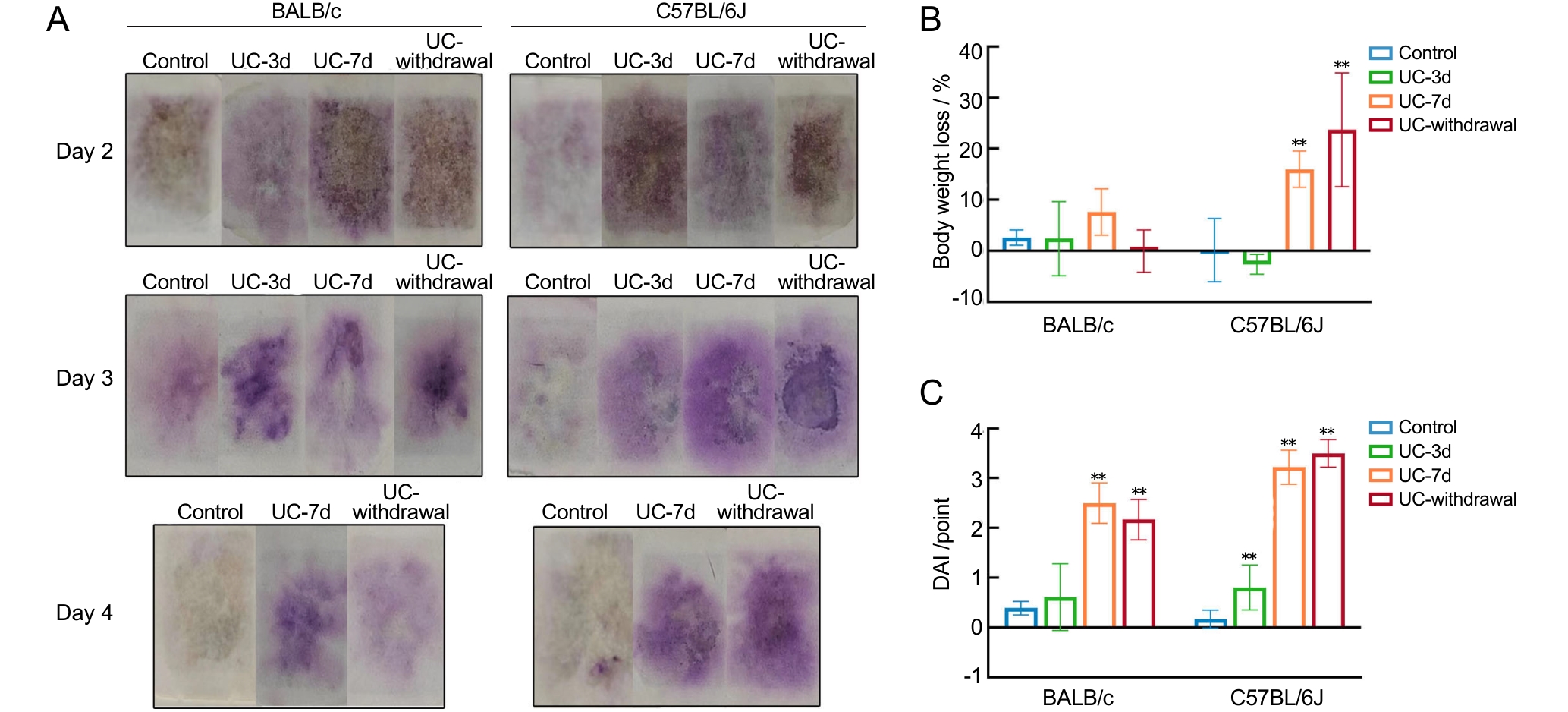
图1 DSS诱导的不同品系雌性小鼠溃疡性结肠炎模型一般病理指标
注:A,便隐血试纸检测;B,体重下降率;C,疾病活动指数(DAI)评分。对照组,小鼠自由饮用纯水;UC-3d组,小鼠自由饮用2.5%葡聚糖硫酸钠(DSS)共3 d,以建立溃疡性结肠炎(UC)模型;UC-7d组,小鼠自由饮用2.5% DSS共7 d;UC-停药组,小鼠先自由饮用2.5% DSS共7 d,然后更换饮用纯水3 d。每组6只小鼠;4组C57BL/6J小鼠体重下降率比较,F = 24.262;4组BALB/c小鼠体重下降率比较,F =7.004;4组C57BL/6J小鼠DAI评分比较,F = 156.742;4组BALB/c小鼠DAI评分比较,F = 34.255;与对照组相比较,**P<0.01。
Figure 1 General pathological parameters in female mice of different strains with the DSS-induced ulcerative colitis model
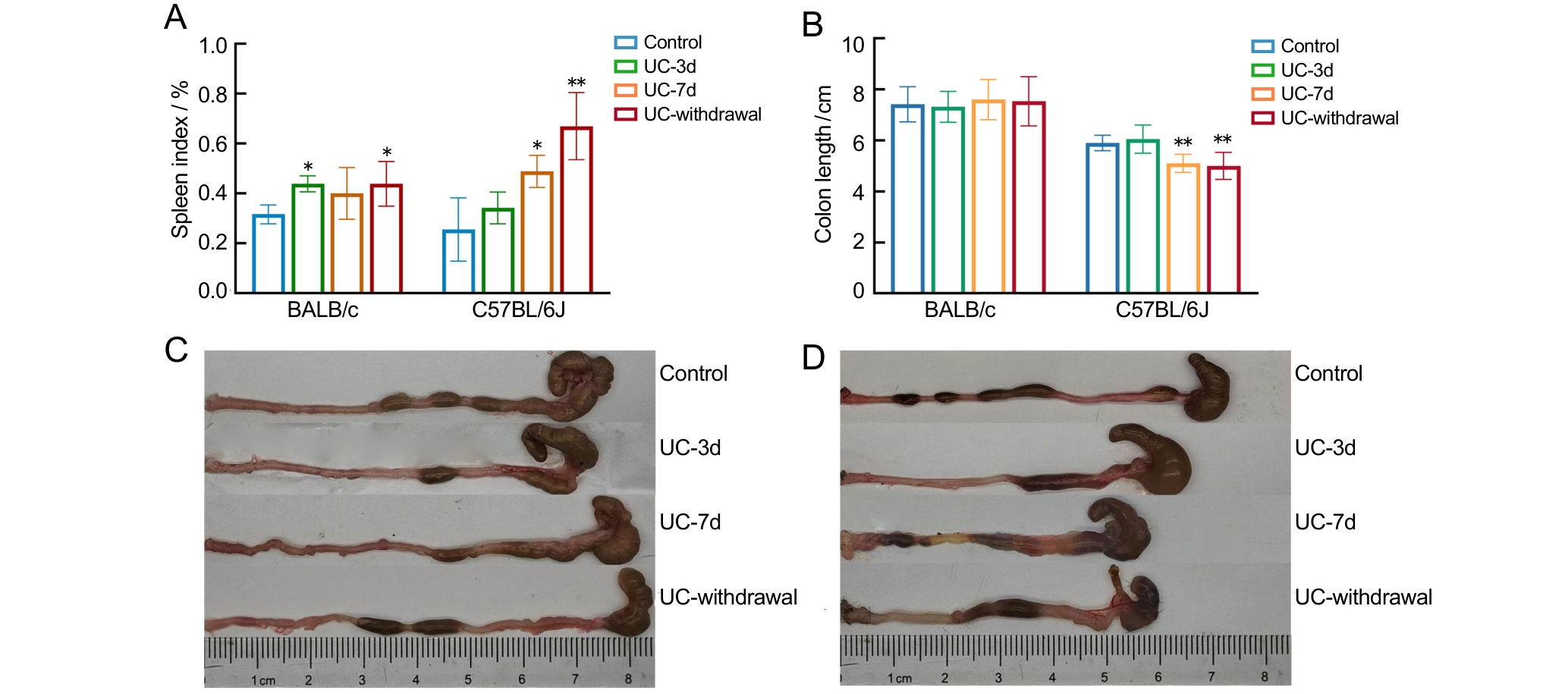
图2 DSS诱导的不同品系雌性小鼠溃疡性结肠炎模型脏器变化
注:A,脾脏系数;B,结肠长度;C,BALB/c小鼠结肠形态图;D,C57BL/6J结肠形态图。对照组,小鼠自由饮用纯水;UC-3d组,小鼠自由饮用2.5%葡聚糖硫酸钠(DSS)共3 d,以建立溃疡性结肠炎(UC)模型;UC-7d组,小鼠自由饮用2.5% DSS共7 d;UC-停药组,小鼠先自由饮用2.5% DSS共7 d,然后更换饮用纯水3 d。每组6只小鼠;4组C57BL/6J小鼠脾脏系数比较,F = 20.855,BALB/c小鼠脾脏系数比较,F = 3.954;4组C57BL/6J小鼠结肠比较,F = 8.361,BALB/c小鼠结肠比较,F = 0.159;与对照组相比较,*P<0.05,**P<0.01。
Figure 2 Organ Changes in female mice of different strains with the DSS-induced ulcerative colitis model
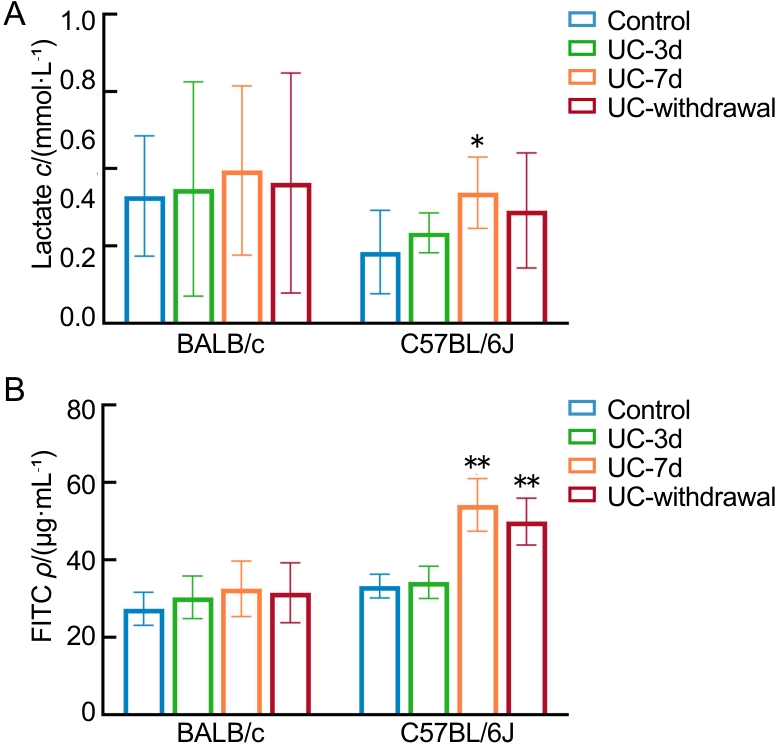
图3 DSS诱导的不同品系雌性小鼠溃疡性结肠炎(UC)模型肠道通透性变化
注:A,血清D-乳酸含量;B,血清中异硫氰酸荧光素(FITC)-葡聚糖浓度。对照组,小鼠自由饮用纯水;UC-3d组,小鼠自由饮用2.5%葡聚糖硫酸钠(DSS)共3 d;UC-7d组,小鼠自由饮用2.5% DSS共7 d;UC-停药组,小鼠先自由饮用2.5% DSS共7 d,然后更换饮用纯水3 d。每组6只小鼠;4组C57BL/6J小鼠FITC比较,F =25.237;BALB/c小鼠脾脏系数比较,F = 0.75;相较于对照组,*P<0.05,**P<0.01。
Figure 3 Intestinal permeability changes in female mice of different strains with the DSS-induced ulcerative colitis model
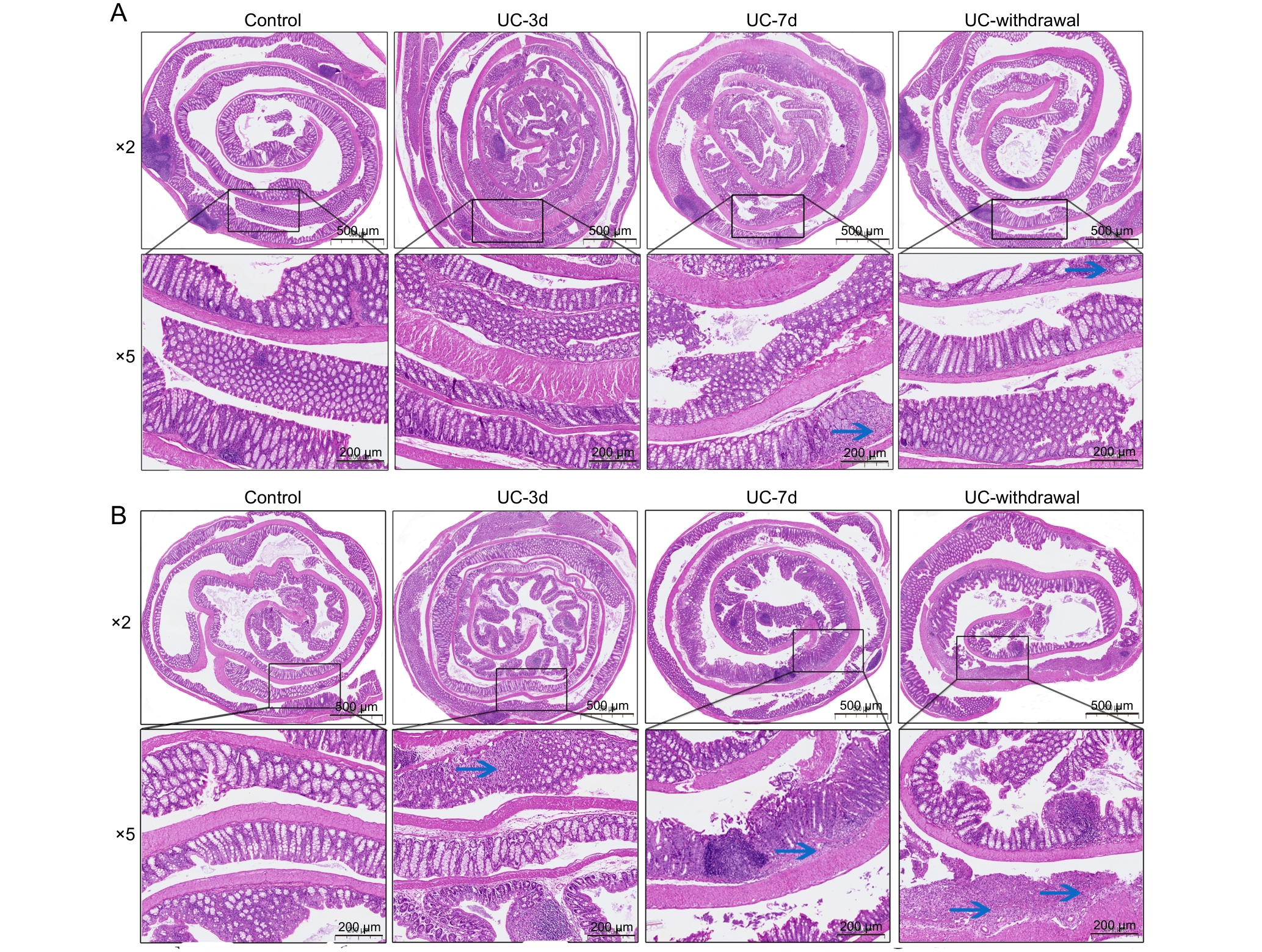
图 4 DSS诱导的不同品系雌性小鼠溃疡性结肠炎(UC)模型的结肠组织HE染色
注:A,BALB/c小鼠;B,C57BL/6J小鼠。对照组,小鼠自由饮用纯水;UC-3d组,小鼠自由饮用2.5%葡聚糖硫酸钠(DSS)共3 d;UC-7d组,小鼠自由饮用2.5% DSS共7 d;UC-停药组,小鼠先自由饮用2.5% DSS共7 d,然后更换饮用纯水3 d。HE染色图中第1行×2视野比例尺为500 μm,第2行×5视野比例尺为200 μm,蓝色箭头代表炎症细胞浸润。
Figure 4 HE staining of colon tissues from female mice of different strains in DSS-induced ulcerative colitis (UC) models
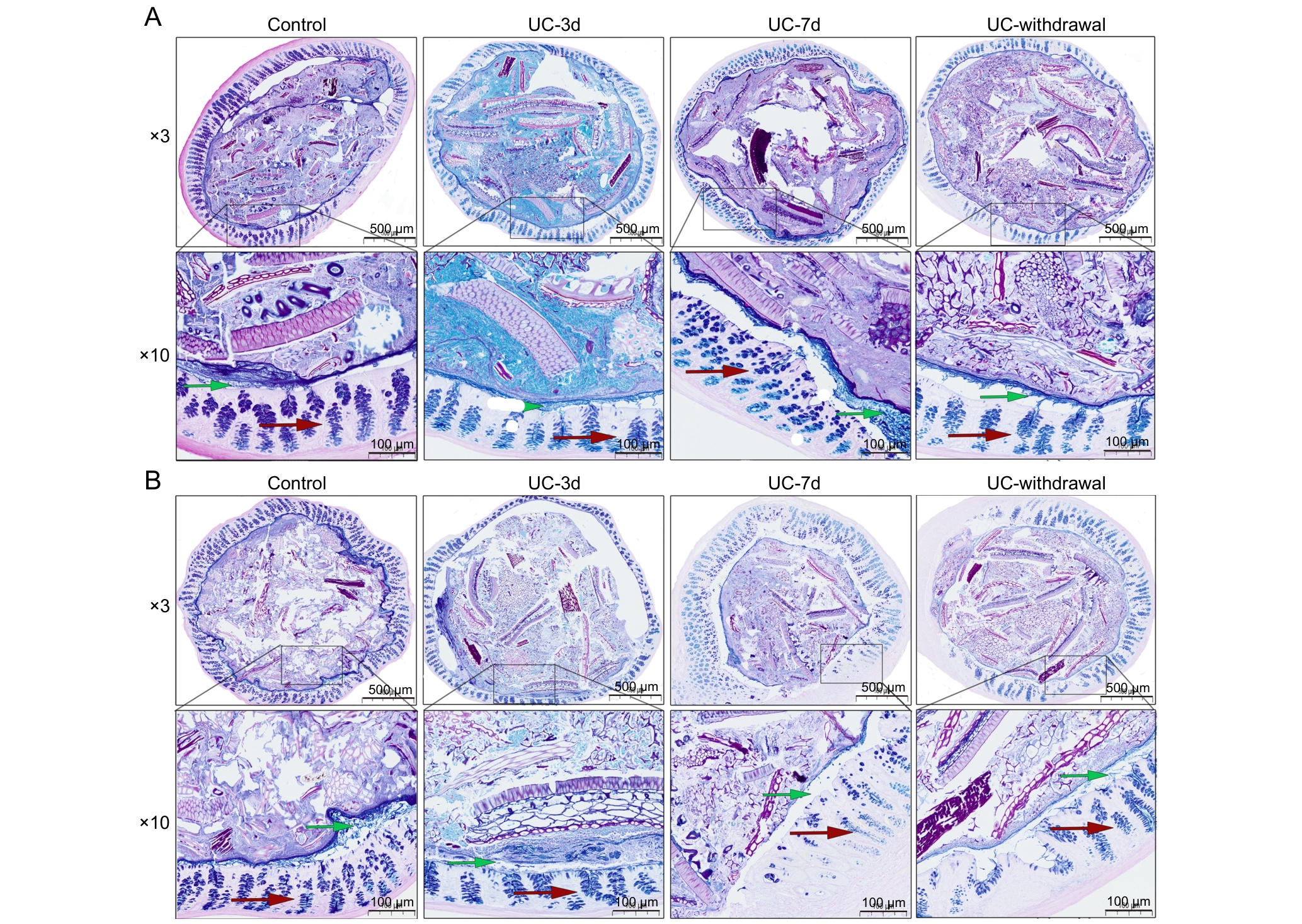
图 5 DSS诱导的不同品系雌性小鼠溃疡性结肠炎(UC)模型的结肠组织阿利新蓝-过碘酸希夫染色(AB-PAS)
注:A,BALB/c小鼠;B,C57BL/6J小鼠。对照组,小鼠自由饮用纯水;UC-3d组,小鼠自由饮用2.5%葡聚糖硫酸钠(DSS)共3 d;UC-7d组小鼠自由饮用2.5% DSS共7 d;UC-停药组,小鼠先自由饮用2.5% DSS共7 d,然后更换饮用纯水3 d。图中第1行×3视野比例尺为500 μm,第2行×10视野比例尺为100 μm。绿色箭头指示黏液层,红色箭头指示杯状细胞。
Figure 5 Alcian blue-periodic acid-Schiff staining (AB-PAS) of colon tissues from female mice of different strains in DSS-induced ulcerative colitis (UC) models
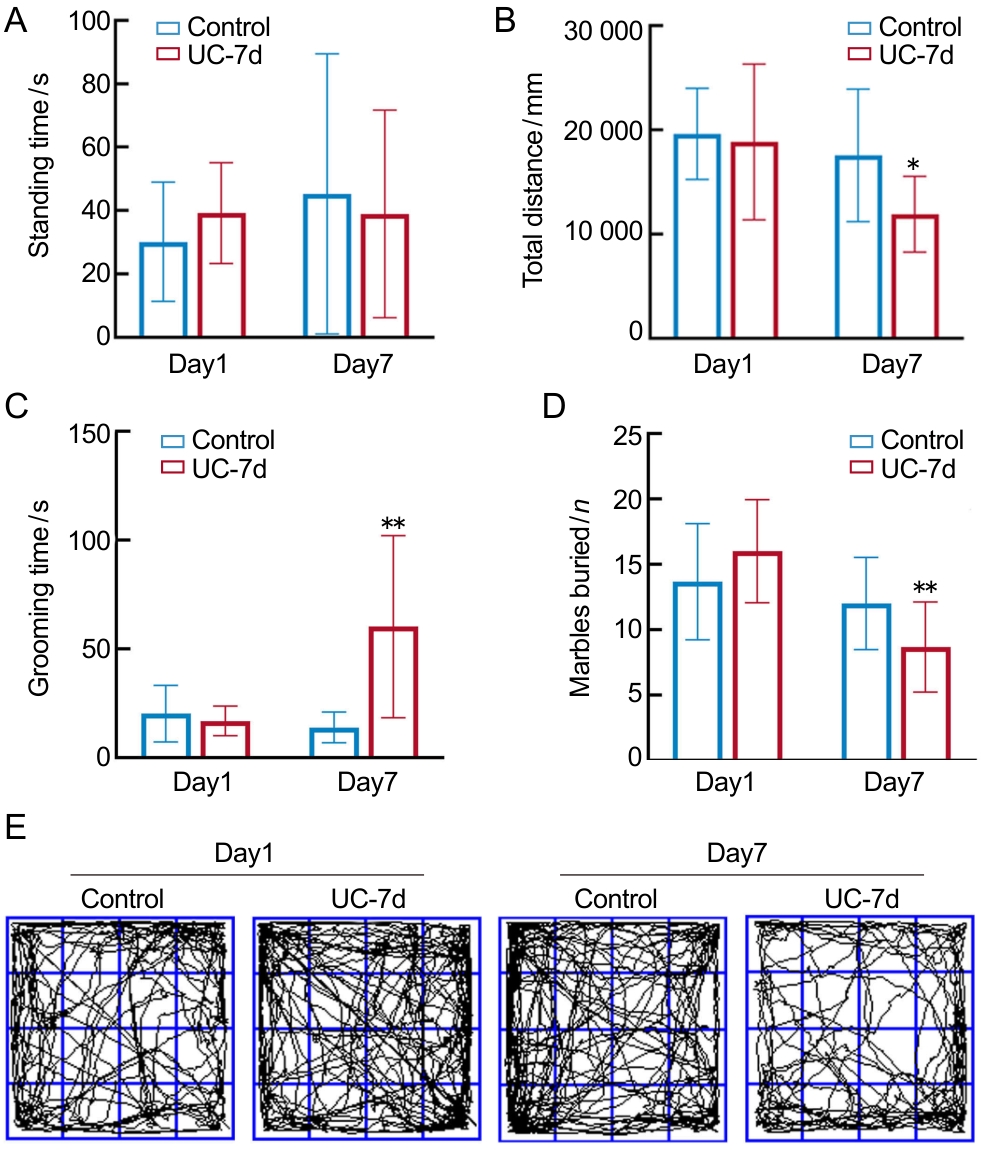
图 6 DSS诱导的C57BL/6J雌性小鼠溃疡性结肠炎(UC)模型的焦虑/抑郁样行为
注:A,旷场中央停留时间;B,旷场总路程;C,理毛时长;D,埋球个数;E,旷场轨迹图。对照组,小鼠自由饮用纯水;UC-7d组小鼠自由饮用2.5%葡聚糖硫酸钠(DSS)共7 d。每组6只小鼠;2组C57BL/6J小鼠前后总路程比较,F=2.277;2组C57BL/6J小鼠前后中央停留时间比较,F=0.254;2组C57BL/6J小鼠前后理毛时长比较,F=8.363;2组C57BL/6J小鼠前后埋球个数比较,F=3.821;与UC-7d组第1天相比较,*P<0.05,**P<0.01。
Figure 6 Anxiety/depression-like behaviors in DSS-induced ulcerative colitis (UC) models of female C57BL/6J mice
| [1] | 李文晓, 陈江, 何志成, 等. 加味薏苡附子败酱散对溃疡性结肠炎大鼠肠黏膜通透性和AQP3、AQP4表达的影响[J]. 中国中药杂志, 2025, 50(14): 3962-3968. DOI: 10.19540/j.cnki.cjcmm.20250311.401 . |
| LI W X, CHEN J, HE Z C, et al. Effect of modified Yiyi Fuzi Baijiang powder on intestinal mucosal permeability and expression of AQP3, AQP4 in ulcerative colitis rats[J]. China J Chin Mater Med, 2025, 50(14): 3962-3968. DOI: 10.19540/j.cnki.cjcmm.20250311.401 . | |
| [2] | 张新杰, 倪红, 楼鹏飞, 等. 基于真实世界研究中药物灌肠治疗后溃疡性结肠炎复发率的meta分析[J].中国中西医结合消化杂志,2026,34(01):51-58. DOI: 10.3969/j.issn.1671-038X.2026.01.09 . |
| ZHANG X J, NI H, LOU P F, et al. Real-world studies on the recurrence rate of ulcerative colitis after drug enema treatment: a meta-analysis[J]. Chin J Integr Tradit West Med Dig, 2026, 34(1): 51-58. DOI: 10.3969/j.issn.1671-038X.2026.01.09 . | |
| [3] | 张敬宜, 李林轩, 姜再勖, 等. 炎症性肠病动物模型的研发现状[J]. 中国实验诊断学, 2025, 29(5): 615-621. DOI: 10.3969/j.issn.1007-4287.2025.05.020 . |
| ZHANG J Y, LI L X, JIANG Z X, et al. Current situation and prospect of animal model of inflammatory bowel disease[J]. Chin J Lab Diagn, 2025, 29(5): 615-621. DOI: 10.3969/j.issn.1007-4287.2025.05.020 . | |
| [4] | 李萌, 马富智, 唐泽惟, 等. C57BL/6小鼠急性溃疡性结肠炎动物模型的对比及优化[J]. 河南师范大学学报(自然科学版), 2025, 53(4): 124-132. DOI: 10.16366/j.cnki.1000-2367.2024.03.27.0002 . |
| LI M, MA F Z, TANG Z W, et al. Comparison and optimization of acute ulcerative colitis animal models induced in C57BL/6 mice[J]. J Henan Norm Univ (Nat Sci Ed), 2025, 53(4): 124-132. DOI: 10.16366/j.cnki.1000-2367.2024.03.27.0002 . | |
| [5] | 吴志浩, 沈宸, 殷俊, 等. 肝螺杆菌感染对葡聚糖硫酸钠诱导小鼠慢性结肠炎模型的影响[J]. 实验动物与比较医学, 2021, 41(3): 226-231. DOI: 10.12300/j.issn.1674-5817.2020.136 . |
| WU Z H, SHEN C, YIN J, et al. Effect of Helicobacter hepaticus infection on chronic colitis induced by dextran sulfate sodium[J]. Lab Anim Comp Med, 2021, 41(3): 226-231. DOI: 10.12300/j.issn.1674-5817.2020.136 . | |
| [6] | 赵亚妮, 李瑶, 张妍, 等. 葡聚糖硫酸钠不同给药方式建立小鼠溃疡性结肠炎模型[J]. 实验动物与比较医学, 2021, 41(1): 33-39. DOI: 10.12300/j.issn.1674-5817.2020.090 . |
| ZHAO Y N, LI Y, ZHANG Y, et al. Establishment of ulcerative colitis model in mice by different drug delivery methods of dextran sodium sulfate[J]. Lab Anim Comp Med, 2021, 41(1): 33-39. DOI: 10.12300/j.issn.1674-5817.2020.090 . | |
| [7] | BÁBÍČKOVÁ J, TÓTHOVÁ Ľ, LENGYELOVÁ E, et al. Sex differences in experimentally induced colitis in mice: a role for estrogens[J]. Inflammation, 2015, 38(5): 1996-2006. DOI: 10.1007/s10753-015-0180-7 . |
| [8] | WIRTZ S, POPP V, KINDERMANN M, et al. Chemically induced mouse models of acute and chronic intestinal inflammation[J]. Nat Protoc, 2017, 12(7): 1295-1309. DOI: 10.1038/nprot.2017.044 . |
| [9] | BARBERIO B, ZAMANI M, BLACK C J, et al. Prevalence of symptoms of anxiety and depression in patients with inflammatory bowel disease: a systematic review and meta-analysis[J]. Lancet Gastroenterol Hepatol, 2021, 6(5): 359-370. DOI: 10.1016/S2468-1253(21)00014-5 . |
| [10] | YUAN X M, CHEN B Q, DUAN Z L, et al. Depression and anxiety in patients with active ulcerative colitis: crosstalk of gut microbiota, metabolomics and proteomics[J]. Gut Microbes, 2021, 13(1): 1987779. DOI: 10.1080/19490976. 2021.1987779 . |
| [11] | 赵鹏, 王弋, 刘若轩, 等. 肠炎清合剂通过抑制JNK信号通路防治大鼠溃疡性结肠炎的作用研究[J]. 中国中西医结合消化杂志, 2025, 33(4): 439-446. DOI: 10.3969/j.issn.1671-038X.2025.04.13 . |
| ZHAO P, WANG G, LIU R X, et al. The effect of Changyanqing mixture on preventing and treating ulcerative colitis in rats by inhibiting JNK signaling pathway[J]. Chin J Integr Tradit West Med Dig, 2025, 33(4): 439-446. DOI: 10.3969/j.issn.1671-038X.2025.04.13 . | |
| [12] | 胡佳艳, 李军祥, 王木源, 等. 临床运用对药、角药和串药治疗溃疡性结肠炎经验举隅[J]. 中国中西医结合消化杂志, 2025, 33(9): 849-854. DOI: 10.3969/j.issn.1671-038X.2025.09.06 . |
| HU J Y, LI J X, WANG M Y, et al. Clinical application of paired herbs, triangular herbs, and stringed herbs in the treatment of ulcerative colitis: a discussion of experiences[J]. Chin J Integr Tradit West Med Dig, 2025, 33(9): 849-854. DOI: 10.3969/j.issn.1671-038X.2025.09.06 . | |
| [13] | ZHAO M, FENG R, BEN-HORIN S, et al. Systematic review with meta-analysis: environmental and dietary differences of inflammatory bowel disease in Eastern and Western populations[J]. Aliment Pharmacol Ther, 2022, 55(3): 266-276. DOI: 10.1111/apt.16703 . |
| [14] | 杨翠萍, 陈平. 全球炎症性肠病的流行趋势分析及诊治现状[J]. 诊断学理论与实践, 2025, 24(4): 373-382. DOI: 10.16150/j.1671-2870.2025.04.003 . |
| YANG C P, CHEN P. Analysis of global trends and current status of diagnosis and treatment of inflammatory bowel diseas[J]. J Diagn Concepts Pract, 2025, 24(4): 373-382. DOI: 10.16150/j.1671-2870.2025.04.003 . | |
| [15] | TSHIKUDI D M, BERNSTEIN C N, MISHRA S, et al. Influence of biological sex in inflammatory bowel diseases[J]. Nat Rev Gastroenterol Hepatol, 2025, 22(6): 415-437. DOI: 10.1038/s41575-025-01038-y . |
| [16] | WITTIG R, ALBERS L, KOLETZKO S, et al. Pediatric chronic inflammatory bowel disease in a German statutory health INSURANCE-incidence rates from 2009 to 2012[J]. J Pediatr Gastroenterol Nutr, 2019, 68(2): 244-250. DOI: 10.1097/MPG.0000000000002162 . |
| [17] | EICHELE D D, KHARBANDA K K. Dextran sodium sulfate colitis murine model: an indispensable tool for advancing our understanding of inflammatory bowel diseases pathogenesis[J]. World J Gastroenterol, 2017, 23(33): 6016-6029. DOI: 10.3748/wjg.v23.i33.6016 . |
| [18] | 周欣欣, 刘茜茜, 任珍, 等. 溃疡性结肠炎动物模型的特点及应用分析[J]. 中国实验动物学报, 2023, 31(7): 896-904. |
| ZHOU X X, LIU X X, REN Z, et al. Characteristics and application analysis of animal models of ulcerative colitis[J]. Acta Lab Anim Sci Sin, 2023, 31(7): 896-904. | |
| [19] | KOSTAS-POLSTON E A, BEVANS M, SHEA T L, et al. Ensuring accountability for consideration of sex as a biological variable in research[J]. Nurs Outlook, 2024, 72(4): 102194. DOI: 10.1016/j.outlook.2024.102194 . |
| [20] | MÄHLER M, BRISTOL I J, LEITER E H, et al. Differential susceptibility of inbred mouse strains to dextran sulfate sodium-induced colitis[J]. Am J Physiol, 1998, 274(3): G544-G551. DOI: 10.1152/ajpgi.1998.274.3.G544 . |
| [21] | MELGAR S, KARLSSON A, MICHAËLSSON E. Acute colitis induced by dextran sulfate sodium progresses to chronicity in C57BL/6 but not in BALB/c mice: correlation between symptoms and inflammation[J]. Am J Physiol Gastrointest Liver Physiol, 2005, 288(6): G1328-G1338. DOI:10.1152/ajpgi. 00467.2004 . |
| [22] | 张博, 李勇, 董娟, 等. 基于线粒体功能障碍对肠道屏障的影响的炎症性肠病机制[J]. 中国组织化学与细胞化学杂志, 2025, 34(2): 184-189, 194. DOI: 10.16705/j.cnki.1004-1850.2025.02.013 . |
| ZHANG B, LI Y, DONG J, et al. Mechanism of inflammatory bowel disease based on the impact of mitochondrial dysfunction on the intestinal barrier[J]. Chin J Histochem Cytochem, 2025, 34(2): 184-189, 194. DOI: 10.16705/j.cnki.1004-1850.2025.02.013 . | |
| [23] | 胡子朝, 王睿, 李一芳, 等. 小檗碱治疗溃疡性结肠炎作用机制研究进展[J]. 甘肃中医药大学学报, 2025, 42(3): 73-79. DOI: 10.16841/j.issn1003-8450.2025.03.12 . |
| HU Z Z, WANG R, LI Y F, et al. Study on the mechanism of berberine in the treatment of ulcerative colitis[J]. J Gansu Univ Chin Med, 2025, 42(3): 73-79. DOI: 10.16841/j.issn1003-8450.2025.03.12 . | |
| [24] | PAONE P, CANI P D. Mucus barrier, mucins and gut microbiota: the expected slimy partners?[J]. Gut, 2020, 69(12): 2232-2243. DOI: 10.1136/gutjnl-2020-322260 . |
| [25] | CAMILLERI M, VELLA A. What to do about the leaky gut[J]. Gut, 2022, 71(2): 424-435. DOI: 10.1136/gutjnl-2021-325428 . |
| [26] | BISGAARD T H, ALLIN K H, KEEFER L, et al. Depression and anxiety in inflammatory bowel disease: epidemiology, mechanisms and treatment[J]. Nat Rev Gastroenterol Hepatol, 2022, 19(11): 717-726. DOI: 10.1038/s41575-022-00634-6 . |
| [27] | CARLONI S, BERTOCCHI A, MANCINELLI S, et al. Identification of a choroid plexus vascular barrier closing during intestinal inflammation[J]. Science, 2021, 374(6566): 439-448. DOI: 10.1126/science.abc6108 . |
| [28] | FRACAS E, COSTANTINO A, VECCHI M, et al. Depressive and anxiety disorders in patients with inflammatory bowel diseases: are there any gender differences?[J]. Int J Environ Res Public Health, 2023, 20(13): 6255. DOI: 10.3390/ijerph 20136255 . |
| [29] | 张雪, 蔡星辰, 王二嫚, 等. 炎症性肠病患者焦虑抑郁相关影响因素分析[J]. 中国实用医药, 2025, 20(4): 29-33. DOI: 10.14163/j.cnki.11-5547/r.2025.04.007 . |
| ZHANG X, CAI X C, WANG E M, et al. Analysis of related influencing factors of anxiety and depression in patients with inflammatory bowel diseases[J]. China Pract Med, 2025, 20(4): 29-33. DOI: 10.14163/j.cnki.11-5547/r.2025.04.007 . | |
| [30] | 徐靖宣, 时浩洋, 王栋, 等. 基于情志致病理论探讨从肝论治炎症性肠病的研究进展[J]. 中国中西医结合消化杂志, 2023, 31(12): 990-996. DOI: 10.3969/j.issn.1671-038X.2023.12.15 . |
| XU J X, SHI H Y, WANG D, et al. Research progress in the treatment of inflammatory bowel disease from the liver based on the theory of emotional pathogenesis[J]. Chin J Integr Tradit West Med Dig, 2023, 31(12): 990-996. DOI: 10.3969/j.issn.1671-038X.2023.12.15 . | |
| [31] | 贺冰洁, 刘志科, 沈鹏, 等. 2011—2020年宁波市鄞州区炎症性肠病发病的流行病学研究[J]. 北京大学学报(医学版), 2022, 54(3): 511-519. DOI: 10.19723/j.issn.1671-167X.2022.03.017 . |
| HE B J, LIU Z K, SHEN P, et al. Epidemiological study on the incidence of inflammatory bowel disease in Yinzhou District, Ningbo City from 2011 to 2020[J]. J Peking Univ (Health Sci), 2022, 54(3): 511-519. DOI: 10.19723/j.issn.1671-167X.2022.03.017 . | |
| [32] | BERCIK P, PARK A J, SINCLAIR D, et al. The anxiolytic effect of Bifidobacterium longum NCC3001 involves vagal pathways for gut-brain communication[J]. Neurogastroenterol Motil, 2011, 23(12): 1132-1139. DOI: 10.1111/j.1365-2982.2011.01796.x . |
| [1] | 艾秀峰, 张利棕, 方明笋, 吕东颖, 陈楚, 蔡兆伟, 王德军. 16S rRNA测序分析饮用含氯水对大鼠和小鼠肠道菌群的影响差异[J]. 实验动物与比较医学, 2026, 46(3): 437-445. |
| [2] | 吴宪文, 刘丽丽, 陈烨, 徐国恒. 繁育体系中育成期小鼠换笼周期及刨花垫料使用量的优化研究[J]. 实验动物与比较医学, 2026, 46(2): 251-260. |
| [3] | 徐英韬, 王蒙蒙, 林平, 迟海涛, 王怡, 白鹰. 外泌体通过NRF2/SLC7A11/GPX4通路调控铁死亡治疗小鼠缺血性脑卒中[J]. 实验动物与比较医学, 2026, 46(1): 20-31. |
| [4] | 张一粟, 刘欣茹, 武若杰, 刘睿, 欧阳红, 李晓红. 慢性不可预知性应激与完全弗氏佐剂、福尔马林诱导的妊娠期疼痛-抑郁共病小鼠模型的构建与评价[J]. 实验动物与比较医学, 2024, 44(3): 259-269. |
| [5] | 刘芸, 冯婷婷, 佟巍, 郭智, 李夏, 孔琪, 向志光. 甘草酸能减轻小鼠肺炎病毒引起的小鼠肺脏损伤[J]. 实验动物与比较医学, 2024, 44(3): 251-258. |
| [6] | 梁敏, 郭洋, 王津津, 朱梦妍, 池骏, 陈艳娟, 王成稷, 喻智澜, 沈如凌. Dmd基因突变小鼠构建及在肌肉及免疫系统的表型验证[J]. 实验动物与比较医学, 2024, 44(1): 42-51. |
| [7] | 王丹, 张晓璐, 王妍, 傅博, 王文栋, 刘京, 张甦寅, 武怡荷, 吴德国, 杜小燕, 战大伟, 章秀林, 李长龙. Big-BALB/c小鼠亚系选育前后的抗体制备效率比较研究[J]. 实验动物与比较医学, 2023, 43(6): 612-618. |
| [8] | 李晗, 张笑瑞, 张成芳. 间歇禁食法在改善奥氮平诱导小鼠代谢紊乱中的机制研究[J]. 实验动物与比较医学, 2023, 43(1): 3-10. |
| [9] | 胡宇, 兰昀羲, 陈晓晓, 熊伟, 唐宋琪, 贾波, 黄巍. 溃疡性结肠炎动物模型研究进展[J]. 实验动物与比较医学, 2022, 42(3): 220-228. |
| [10] | 李自发, 张浩, 任萌, 徐凯勇, 胡明会, 周苗苗, 王可洲. 槲皮素对镉致小鼠肝脏脂质代谢紊乱模型的保护效应[J]. 实验动物与比较医学, 2021, 41(4): 305-312. |
| [11] | 吴志浩, 沈宸, 殷俊, 朱立麒, 张泉. 肝螺杆菌感染对葡聚糖硫酸钠诱导小鼠慢性结肠炎模型的影响[J]. 实验动物与比较医学, 2021, 41(3): 226-231. |
| [12] | 赵亚妮, 李瑶, 张妍, 王四旺, 安军明. 葡聚糖硫酸钠不同给药方式建立小鼠溃疡性结肠炎模型[J]. 实验动物与比较医学, 2021, 41(1): 33-39. |
| [13] | 洪胜辉, 张旭亮, 王芊芊, 刘 平, 刘迪文. 抑制素基因敲除小鼠模型的构建及表型初步分析[J]. 实验动物与比较医学, 2020, 40(4): 306-. |
| [14] | 李雷斌, 许 佳, 方远书, 姜正前, 裘颖儿, 王文倩, 赵先哲. 基于自发糖尿病模型小鼠代谢组学的全植物蛋白配方饲料研究#br#[J]. 实验动物与比较医学, 2020, 40(3): 204-. |
| [15] | 崔畅婉, 于 淼, 王 爽, 吴 思, 孙峥嵘 . 骆驼奶对DSS诱导的小鼠急性肠炎的保护作用[J]. 实验动物与比较医学, 2020, 40(3): 218-. |
| 阅读次数 | ||||||
|
全文 |
|
|||||
|
摘要 |
|
|||||
