





实验动物与比较医学 ›› 2026, Vol. 46 ›› Issue (5): 750-758.DOI: 10.12300/j.issn.1674-5817.2026.069
张娇玲( ), 林阿萍, 许诗荧, 潘德全, 蔡毅君()(
 )
)
收稿日期:2026-04-17
修回日期:2026-08-05
出版日期:2026-10-25
发布日期:2026-10-16
通讯作者:
蔡毅君(1983—),女,硕士,高级工程师,研究方向:基因编辑、动物模型构建。E-mail: yjcai@xmu.edu.cn。ORCID: 0009-0006-8086-9073作者简介:基金资助:
ZHANG Jiaoling(), LIN Aping, XU Shiying, PAN Dequan, CAI Yijun()()
Received:2026-04-17
Revised:2026-08-05
Published:2026-10-25
Online:2026-10-16
Correspondence to:
摘要:
目的 优化小鼠胚胎移植的技术参数(包括输卵管开口方式、假孕受体体重、单只受体移植胚胎数量、单侧/双侧输卵管移植4项技术参数),提高胚胎移植效率(以胚胎移植后受体母鼠妊娠率作为评判指标),提高优质胚胎种质资源利用率(以胚胎移植后小鼠出生率作为评判指标)。 方法 以560只SPF级ICR小鼠和440只C57BL/6J小鼠为实验对象,通过体外受精获得2细胞胚胎,采用单因素控制变量法,系统探究输卵管开口方式、假孕受体体重、单只受体移植胚胎数量、单侧/双侧输卵管移植4种因素对小鼠胚胎移植妊娠率和出生率的影响。 结果 采用26G注射器针头打孔的输卵管开口方式,受体的妊娠率可达90%,显著高于维纳斯剪剪切开口组的43%(P<0.05)。体重29~35 g的假孕受体移植效果最优(受体妊娠率为90%、幼鼠出生率为44%,且无幼崽被母鼠压死的现象)。单只受体移植胚胎数量在16~25枚组的出生率达42%,为各组最高;26~35枚组的妊娠率达90%,且胚胎利用率达到最大;而胚胎数超过35枚后移植效率显著下降。单只受体的胚胎移植数量在24~26枚,可兼顾较高的妊娠率和出生率。小鼠胚胎经输卵管双侧移植的妊娠率和出生率较单侧移植略高,但差异无统计学意义(P>0.05)。 结论 选择体重29~35 g的假孕受体母鼠,采用26G注射器针头打孔的输卵管开口方式,单只受体移植胚胎的数量控制在24~26枚,能够有效提高胚胎移植成功率,实现优质胚胎种质资源的高效利用。
中图分类号:
张娇玲,林阿萍,许诗荧,等. 小鼠胚胎移植技术的优化及应用[J]. 实验动物与比较医学, 2026, 46(5): 750-758. DOI: 10.12300/j.issn.1674-5817.2026.069.
ZHANG Jiaoling,LIN Aping,XU Shiying,et al. Optimization and Application of Mouse Embryo Transfer Technology[J]. Laboratory Animal and Comparative Medicine, 2026, 46(5): 750-758. DOI: 10.12300/j.issn.1674-5817.2026.069.
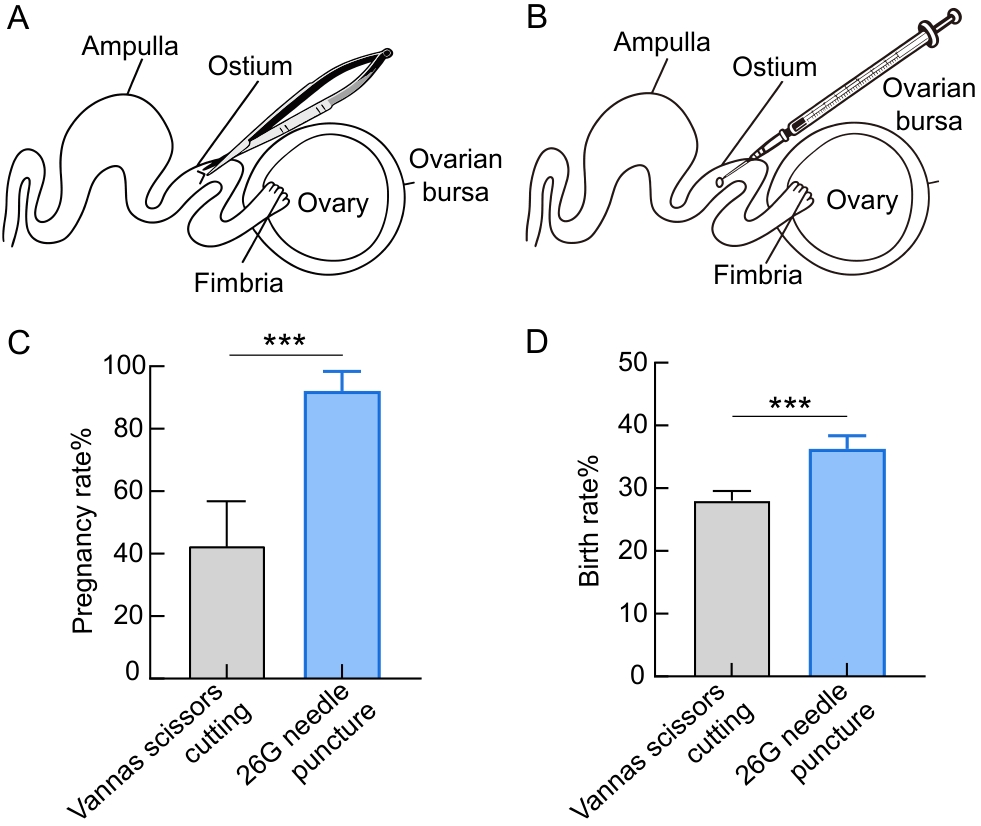
图1
Figure 1
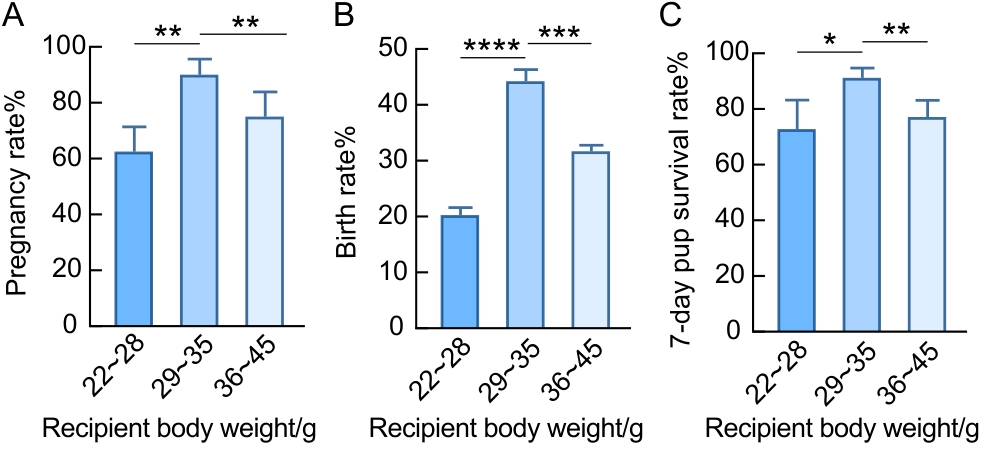
图2
Figure 2
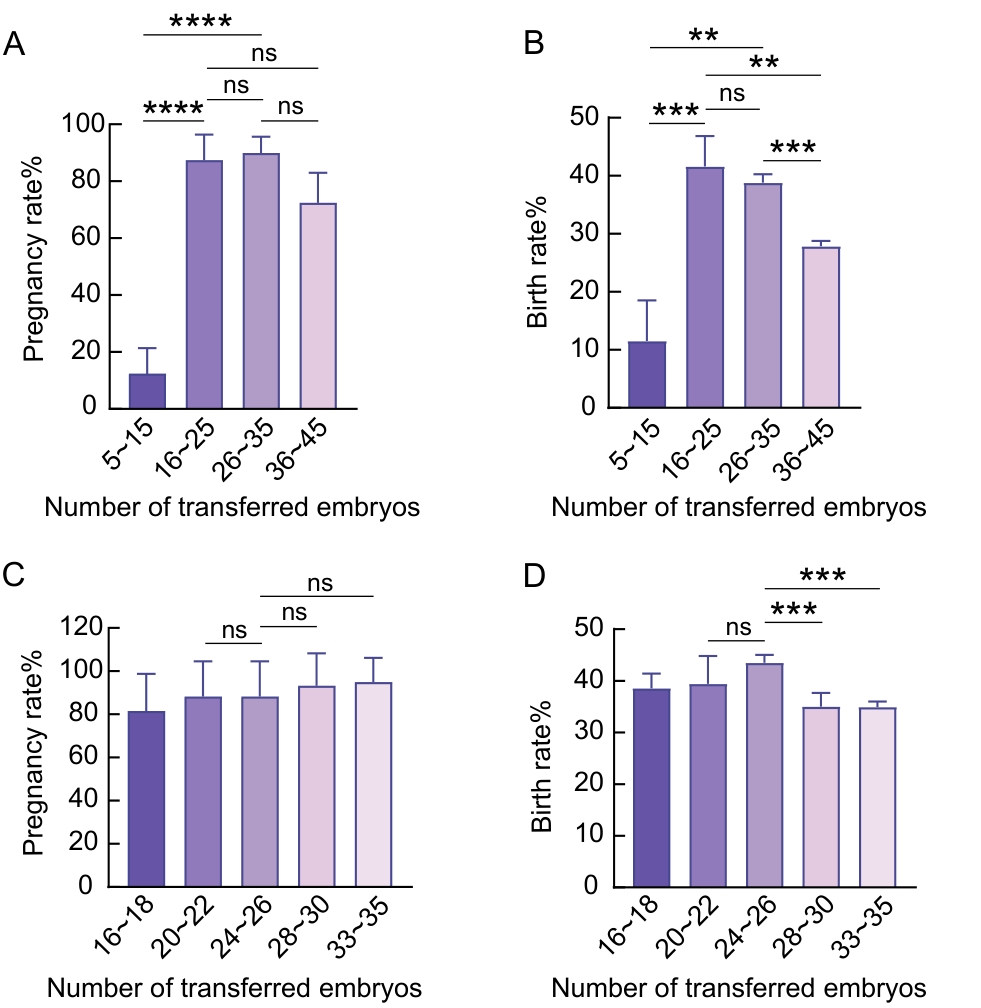
图3
Figure 3
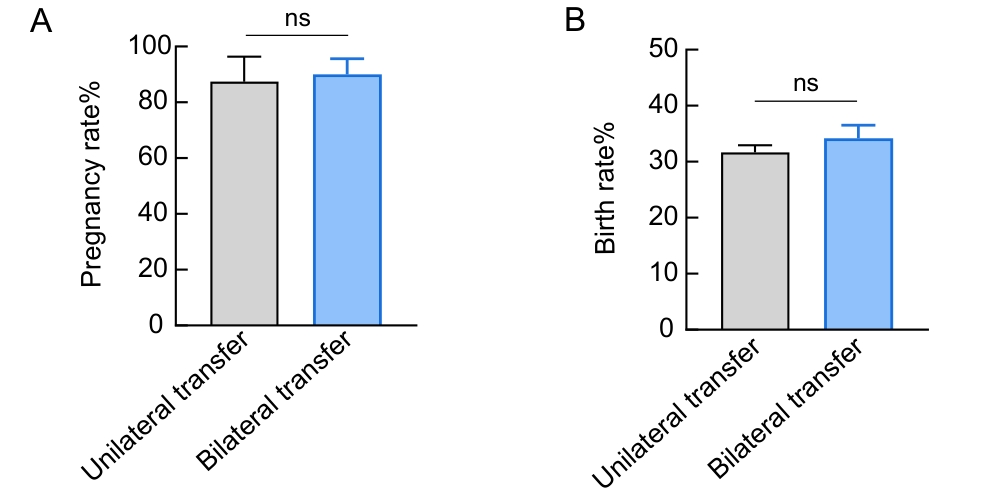
图4
Figure 4
| [1] |
TARKOWSKI A K. Experiments on the development of isolated blastomeres of mouse eggs[J]. Nature, 1959, 184: 1286-1287. DOI: 10.1038/1841286a0.
|
| [2] |
刘伟, 陶芳标, 黄德武, 等. 应用胚胎移植技术培育SPF级小鼠的研究进展[J]. 河北联合大学学报(医学版), 2013, 15(1): 30-32. DOI: 10.3969/j.issn.1008-6633.2013.01.018.
|
|
LIU W, TAO F B, HUANG D W, et al. Research progress in cultivating SPF mice by embryo transfer technology[J]. J Hebei United Univ (Health Sci), 2013, 15(1): 30-32. DOI: 10.3969/j.issn.1008-6633.2013.01.018.
|
|
| [3] |
王超. 基因修饰小鼠制备常用技术[M]. 北京: 中国农业大学出版社, 2013: 21.
|
|
WANG C. Common techniques for the preparation of genetically modified mice[M]. Beijing: China Agricultural University Press, 2013: 21.
|
|
| [4] |
XUE Y M, LING C, ZHENG H X, et al. Supplementation with oviductal EVs from the estrus, metestrus, and diestrus stages improved developmental competence of IVF mouse embryos[J]. Sci Rep, 2025, 15: 23376. DOI: 10.1038/s41598-025-07195-z.
|
| [5] |
KORCHIVAIA E, IVANOVA A, VOLODYAEV I, et al. Comparison of preimplantation mouse embryos with different genetic backgrounds as models for evaluating human embryo culture media composition[J]. Reprod Sci, 2024, 31(12): 3688-3696. DOI: 10.1007/s43032-024-01726-1.
|
| [6] |
YOSHIMI K, KUNO A, YAMAUCHI Y, et al. Genome editing using type I-E CRISPR-Cas3 in mice and rat zygotes[J]. Cell Rep Methods, 2024, 4(8): 100833. DOI: 10.1016/j.crmeth.2024. 100833.
|
| [7] |
SAKURAI T, TAKEI N, WEI Y X, et al. Efficient genome editing of two-cell mouse embryos via modified CRISPR/Cas electroporation[J]. Sci Rep, 2024, 14: 30347. DOI: 10.1038/s41598-024-81198-0.
|
| [8] |
MONCAUT N. Streamlining mouse genome editing by integrating AAV repair template delivery and CRISPR-Cas electroporation[J]. Lab Anim, 2024, 53(5): 115-116. DOI: 10. 1038/s41684-024-01363-w.
|
| [9] |
BOUCHAREB A, BIGGS D, ALGHADBAN S, et al. Increasing knockin efficiency in mouse zygotes by transient hypothermia[J]. CRISPR J, 2024, 7(2): 111-119. DOI: 10.1089/crispr.2023.0077.
|
| [10] |
IWATA S, NAGAHARA M, IDO R, et al. A Recql5 mutant facilitates complex CRISPR/Cas9-mediated chromosomal engineering in mouse zygotes[J]. Genetics, 2024, 227(2): iyae054. DOI: 10.1093/genetics/iyae054.
|
| [11] |
聂永强, 王朝霞. 高校基因编辑小鼠一站式服务平台建设的探索与实践: 以上海交通大学为例[J]. 实验动物与比较医学, 2025, 45(5): 642-648. DOI: 10.12300/j.issn.1674-5817.2025.036.
|
|
NIE Y Q, WANG Z X. Exploration and practice of building a one-stop service platform for gene-edited mice in university animal centers: a case study of Shanghai Jiao Tong University[J]. Lab Anim Comp Med, 2025, 45(5): 642-648. DOI: 10.12300/j.issn.1674-5817.2025.036.
|
|
| [12] |
王芊芊, 陶斯珏, 卫振, 等. 利用辅助生殖技术挽救基因修饰小鼠的实例分析[J]. 实验动物与比较医学, 2025, 45(1): 79-86. DOI: 10.12300/j.issn.1674-5817.2024.107.
|
|
WANG Q Q, TAO S J, WEI Z, et al. A case study of using assisted reproductive technology to rescue genetically modified mice with reproductive disorder phenotypes[J]. Lab Anim Comp Med, 2025, 45(1): 79-86. DOI: 10.12300/j.issn.1674-5817.2024.107.
|
|
| [13] |
PELTIER M, RASPA M, PUTTI S, et al. Cryopreservation at -80 ℃ impacts sperm integrity and fertility in a mouse strain-dependent manner[J]. Theriogenology, 2025, 245: 117523. DOI: 10.1016/j.theriogenology.2025.117523.
|
| [14] |
KOÇAK G, YILDIZ C. The effects of ferulic acid, tryptophan, and L-glutamine on the cryopreservation of mouse spermatozoa[J]. Biopreserv Biobank, 2024, 22(3): 286-293. DOI: 10.1089/bio.2023.0067.
|
| [15] |
IGONINA T N, RAKHMANOVA T A, OMELCHENKO A N, et al. Effects of stearic acid on the embryo cryopreservation in mouse[J]. Cryo Letters, 2024, 45(1): 28-35.
|
| [16] |
CRISPO M, MEIKLE M N, RÜLICKE T. Cryopreservation of valuable mouse and rat lines[M]//Rodent Quality Control: Genes and Bugs: Monitoring Health and Genetics of Laboratory Animals. Cham: Springer International Publishing, 2024:97-112. DOI: 10.1007/978-3-031-59103-7_6.
|
| [17] |
HODGSON T, LANE H, HORSLER H, et al. An improved vitrification protocol for the fast and safe storage of mouse oocytes[J]. Biol Reprod, 2025, 113(6): 1355-1363. DOI: 10.1093/biolre/ioaf215.
|
| [18] |
XU S Y, LEI Y, WEI M L, et al. Transparent alumina ceramics-based microfluidic chip enables on-chip cryopreservation for mouse oocyte[J]. Adv Funct Mater, 2025, 35(33): 2503296. DOI: 10.1002/adfm.202503296.
|
| [19] |
YANG L D, YANG Z S, GUO X M, et al. Research progress on novel bionic cryoprotectants in gamete and embryo cryopreservation[J]. Front Vet Sci, 2026, 13: 1797831. DOI: 10.3389/fvets.2026.1797831.
|
| [20] |
CHEN S Q, ZHANG M Z, LI L, et al. Loss of methylation of H19-imprinted gene derived from assisted reproductive technologies can be mitigated by cleavage-stage embryo transfer in mice[J]. J Assist Reprod Genet, 2019, 36(11): 2259-2269. DOI: 10.1007/s10815-019-01575-x.
|
| [21] |
李劲松, 孙强, 巢琴美, 等. HBV-C转基因小鼠快速胚胎冷冻方法的建立[J]. 中国实验动物学杂志, 2001, 11(1): 44-46. DOI: 10.3969/j.issn.1671-7856.2001.01.011.
|
|
LI J S, SUN Q, CHAO Q M, et al. A rapid method for HBV-C transgenic mouse embryo cryopreservation[J]. Chin J Lab Anim Sci, 2001, 11(1): 44-46. DOI: 10.3969/j.issn.1671-7856. 2001.01.011.
|
|
| [22] |
熊文静, 母丹丹, 任静, 等. C57BL/6J小鼠胚胎单侧和双侧移植的比较研究[J]. 实验动物科学, 2025, 42(6): 55-59. DOI: 10.3969/j.issn.1006-6179.2025.06.009.
|
|
XIONG W J, MU D D, REN J, et al. Comparison of unilateral and bilateral embryo transfer in C57BL/6J mice[J]. Lab Anim Sci, 2025, 42(6): 55-59. DOI: 10.3969/j.issn.1006-6179.2025.06.009.
|
|
| [23] |
王倩, 刘亮亮. 小鼠体外受精代孕鼠体重和饲料对其生产的影响[J]. 中南农业科技, 2023, 44(8): 251-253. DOI: 10.3969/j.issn.1007-273X.2023.08.058.
|
|
WANG Q, LIU L L. Effects of body weight and feed on the production of surrogate mice in vitro fertilization[J]. South Cent Agric Sci Technol, 2023, 44(8): 251-253. DOI: 10.3969/j.issn.1007-273X.2023.08.058.
|
|
| [24] |
桂飞, 杨伟伟, 孙筱品, 等. 小鼠胚胎移植影响因素的初步探索[J]. 实验动物与比较医学, 2020, 40(6): 483-488. DOI: 10.3969/j.issn.1674-5817.2020.06.004.
|
|
GUI F, YANG W W, SUN X P, et al. Preliminary study on the influencing factors of mouse embryo transfer[J]. Lab Anim Comp Med, 2020, 40(6): 483-488. DOI: 10.3969/j.issn.1674-5817.2020.06.004.
|
|
| [25] |
陈通克, 陈锡文. 利用体外受精-胚胎移植技术对ALK3基因敲除小鼠进行保种鉴定[J]. 江西畜牧兽医杂志, 2011(1): 11-13. DOI: 10.3969/j.issn.1004-2342.2011.01.005.
|
|
CHEN T K, CHEN X W. In vitro fertilization-embryo transfer technique was used to identify the species of ALK3 knockout mice[J]. Jiangxi J Anim Husb Vet Med, 2011(1): 11-13. DOI: 10.3969/j.issn.1004-2342.2011.01.005.
|
|
| [26] |
张景锋, 郝京京, 徐秋良, 等. 多种因素对小鼠卵母细胞体外受精效果影响的分析[J]. 家畜生态学报, 2021, 42(3): 38-42. DOI: 10.3969/j.issn.1673-1182.2021.03.007.
|
|
ZHANG J F, HAO J J, XU Q L, et al. Effect of various factors on mouse oocytes in vitro fertilization[J]. J Domest Anim Ecol, 2021, 42(3): 38-42. DOI: 10.3969/j.issn.1673-1182.2021.03.007.
|
|
| [27] |
NAGY A, GERTSENSTEIN M, VINTERSTEN K, et al. Manipulating the mouse embryo[M]. Cold Spring Harbor, NY: Cold Spring Harbor Laboratory Press, 2003.
|
| [28] |
于天飞, 徐兴军, 杨晓杰, 等. 动物胚胎工程研究进展[J]. 生物学教学, 2011, 36(8): 2-4. DOI: 10.3969/j.issn.1004-7549.2011.08.001.
|
|
YU T F, XU X J, YANG X J, et al. Research progress of animal embryo engineering[J]. Biol Teach, 2011, 36(8): 2-4. DOI: 10.3969/j.issn.1004-7549.2011.08.001.
|
|
| [29] |
杜凯, 李文光, 吴德国, 等. 小鼠胚胎移植技术优化及对巨细胞病毒净化研究[J]. 实验动物科学, 2019, 36(5): 31-34. DOI: 10.3969/j.issn.1006-6179.2019.05.006.
|
|
DU K, LI W G, WU D G, et al. Optimization of mouse embryo transfer technology and purification of cytomegalovirus[J]. Lab Anim Sci, 2019, 36(5): 31-34. DOI: 10.3969/j.issn.1006-6179.2019.05.006.
|
|
| [30] |
DORSCH M, WITTUR I, GARRELS W. Success of embryo transfer in mice with freshly collected and cryopreserved two-cell embryos with different genetic backgrounds correlated with the number of transferred embryos: a 5-year retrospective analysis[J]. Lab Anim, 2019, 53(6): 577-586. DOI: 10.1177/0023677219832922.
|
| [31] |
杜淼, 陈芳华, 战大伟. 不同遗传背景小鼠输卵管移植效率的研究[J]. 实验动物科学, 2022, 39(4): 44-46. DOI: 10.3969/j.issn.1006-6179.2022.04.009.
|
|
DU M, CHEN F H, ZHAN D W. Study on the efficiency of tubal transplantation in mice with different genetic backgrounds[J]. Lab Anim Sci, 2022, 39(4): 44-46. DOI: 10.3969/j.issn.1006-6179.2022.04.009.
|
| [1] | 占少琴, 方芳, 庄跃宏, 王燕亭. ROCK抑制剂Fasudil与Y27632促进血管新生及小鼠皮瓣存活的比较研究[J]. 实验动物与比较医学, 2026, 46(5): 689-699. |
| [2] | 江淼淼, 方金萍, 黄宗炫, 厉嘉敏, 廖欢, 张文强, 余佳颖, 杨燕燕, 连大卫. 葛根芩连汤缓解糖尿病小鼠心肌损伤的作用机制研究[J]. 实验动物与比较医学, 2026, 46(5): 629-639. |
| [3] | 许浩莀, 乐卿清, 何西文, 蔡兵, 杨隆河. 护眼复合配方对蓝光损伤模型小鼠视网膜的功效评估[J]. 实验动物与比较医学, 2026, 46(5): 650-659. |
| [4] | 钟秋明, 钱丽萍, 蔡媛媛, 刘德强, 林玮, 俞春英, 谢金东, 王训立, 吴胜, 陈碧茵, 黄镇. 环磷酰胺/紫杉醇诱导化疗脱发模型小鼠的性别间差异对比分析[J]. 实验动物与比较医学, 2026, 46(5): 677-688. |
| [5] | 王娟, 徐佳慧, 田韵远, 张萌萌, 李敏, 王四旺, 李瑶. 两种雌性小鼠溃疡性结肠炎模型的比较与行为学观察[J]. 实验动物与比较医学, 2026, 46(3): 332-343. |
| [6] | 艾秀峰, 张利棕, 方明笋, 吕东颖, 陈楚, 蔡兆伟, 王德军. 16S rRNA测序分析饮用含氯水对大鼠和小鼠肠道菌群的影响差异[J]. 实验动物与比较医学, 2026, 46(3): 437-445. |
| [7] | 吴宪文, 刘丽丽, 陈烨, 徐国恒. 繁育体系中育成期小鼠换笼周期及刨花垫料使用量的优化研究[J]. 实验动物与比较医学, 2026, 46(2): 251-260. |
| [8] | 徐英韬, 王蒙蒙, 林平, 迟海涛, 王怡, 白鹰. 外泌体通过NRF2/SLC7A11/GPX4通路调控铁死亡治疗小鼠缺血性脑卒中[J]. 实验动物与比较医学, 2026, 46(1): 20-31. |
| [9] | 徐波, 陈泰任, 方乾, 吴际. 脊髓压迫和半横断损伤小鼠模型的时空基因表达谱及修复机制研究[J]. 实验动物与比较医学, 2026, 46(1): 32-45. |
| [10] | 王芊芊, 陶斯珏, 卫振, 金晖晖, 刘平, 汪洌. 利用辅助生殖技术挽救基因修饰小鼠的实例分析[J]. 实验动物与比较医学, 2025, 45(1): 79-86. |
| [11] | 张一粟, 刘欣茹, 武若杰, 刘睿, 欧阳红, 李晓红. 慢性不可预知性应激与完全弗氏佐剂、福尔马林诱导的妊娠期疼痛-抑郁共病小鼠模型的构建与评价[J]. 实验动物与比较医学, 2024, 44(3): 259-269. |
| [12] | 梁敏, 郭洋, 王津津, 朱梦妍, 池骏, 陈艳娟, 王成稷, 喻智澜, 沈如凌. Dmd基因突变小鼠构建及在肌肉及免疫系统的表型验证[J]. 实验动物与比较医学, 2024, 44(1): 42-51. |
| [13] | 马婧威, 李根, 杨杨, 臧彩霞, 鲍秀琦, 张丹. 环磷酰胺诱导生精障碍小鼠模型不同恢复期的比较研究[J]. 实验动物与比较医学, 2023, 43(2): 112-123. |
| [14] | 李晗, 张笑瑞, 张成芳. 间歇禁食法在改善奥氮平诱导小鼠代谢紊乱中的机制研究[J]. 实验动物与比较医学, 2023, 43(1): 3-10. |
| [15] | 任晨吟, 高思琦, 李浩, 唐标, 杨华, 刘月环. 两株CRISPR工程大肠埃希菌在小鼠体内的定植实验研究[J]. 实验动物与比较医学, 2022, 42(6): 541-550. |
| 阅读次数 | ||||||
|
全文 |
|
|||||
|
摘要 |
|
|||||
