





实验动物与比较医学 ›› 2026, Vol. 46 ›› Issue (5): 677-688.DOI: 10.12300/j.issn.1674-5817.2026.094
钟秋明1, 钱丽萍2, 蔡媛媛2, 刘德强1, 林玮1, 俞春英1, 谢金东1, 王训立1, 吴胜2, 陈碧茵3, 黄镇1( )(
)( )
)
收稿日期:2026-05-19
修回日期:2026-09-07
出版日期:2026-10-25
发布日期:2026-10-16
通讯作者:
黄镇(1987—),男,博士,教授,研究方向:实验动物资源开发与利用。E-mail: zhuang@fjtcm.edu.cn。ORCID:0000-0002-8908-0355作者简介:基金资助:
ZHONG Qiuming1, QIAN Liping2, CAI Yuanyuan2, LIU Deqiang1, LIN Wei1, YU Chunying1, XIE Jindong1, WANG Xunli1, WU Sheng2, CHEN Biyin3, HUANG Zhen1()()
Received:2026-05-19
Revised:2026-09-07
Published:2026-10-25
Online:2026-10-16
Correspondence to:
摘要:
目的 评价性别因素对环磷酰胺(cyclophosphamide,CYP)和紫杉醇(paclitaxel,PTX)诱导性脱发(chemotherapy-induced alopecia,CIA)小鼠模型表型稳定性的影响,并推测雌性小鼠表型异质性的可能机制。 方法 选取28只6~8周龄野生型SPF级C57BL/6J小鼠(雌雄各半),进行背部同步脱毛;脱毛后第9天,将小鼠随机分为野生型雌性CYP组、野生型雄性CYP组、雌性阴性对照组和雄性阴性对照组;其中,CYP组单次腹腔注射120 mg/kg CYP,阴性对照组腹腔注射等体积生理盐水,随后连续观察并拍照记录CYP所致CIA模型的表型变化。选取11只6周龄SPF级雌性C57BL/6J小鼠进行双侧卵巢切除(OVX组),与5只四核心基因型种鼠繁育所得XY(Sry⁻)小鼠按相同方法构建CIA模型。对OVX组、野生型雌性和雄性CYP组的小鼠于给药后第7天采集血清进行甾体激素质谱检测,以评价性腺源雌激素和性染色体背景改变对CYP诱导雌性脱发表型稳定性的影响。取20只6~8周龄SPF级C57BL/6J小鼠(雌雄各半),随机分为PTX低剂量组和PTX高剂量组,分别在同步脱毛后第9天,单次腹腔注射80 mg/kg或120 mg/kg的PTX,进行连续观察拍照,以比较雌性、雄性小鼠表型的组内一致性;再选取6只6~8周龄SPF级C57BL/6J小鼠(雌雄各半)重复PTX低剂量组的构建方法,分别于给药后当日和给药后第4、7、14、21天进行毛囊组织学检测,以观察PTX对毛囊再生的损伤。 结果 CYP诱导的雄性CIA模型小鼠的表型稳定性和可重复性较高;而CYP诱导的雌性CIA模型小鼠在脱发表型上存在明显个体差异,处于动情周期的相关雌激素的组间差异可能是引发该现象的主要原因。OVX+CYP组和XY(Sry⁻)+CYP组小鼠的组间差异消失,提示卵巢来源激素及XY(Sry⁻)性染色体背景可能共同参与了雌性小鼠CYP诱导脱发表型异质性的形成。高剂量PTX组和低剂量PTX组小鼠表现出较为一致的脱发-再生过程,未见明显性别差异。 结论 CYP诱导CIA模型受性别因素影响明显,卵巢切除和性染色体背景改变可提高CYP诱导雌性小鼠模型脱发表型的一致性。PTX诱导的CIA模型在雌性、雄性小鼠中均具有较好的表型一致性和性别适用性。综上,在CIA动物模型的构建、机制研究及防脱发药物评价中,应结合化疗药物类型、研究目的和表型稳定性要求合理选择实验动物性别,并将性别作为模型标准化和结果解释的重要变量。
中图分类号:
钟秋明,钱丽萍,蔡媛媛,等. 环磷酰胺/紫杉醇诱导化疗脱发模型小鼠的性别间差异对比分析[J]. 实验动物与比较医学, 2026, 46(5): 677-688. DOI: 10.12300/j.issn.1674-5817.2026.094.
ZHONG Qiuming,QIAN Liping,CAI Yuanyuan,et al. Comparative Analysis of Sex Differences Between Cyclophosphamide- and Paclitaxel-Induced Mouse Models of Chemotherapy-Induced Alopecia[J]. Laboratory Animal and Comparative Medicine, 2026, 46(5): 677-688. DOI: 10.12300/j.issn.1674-5817.2026.094.
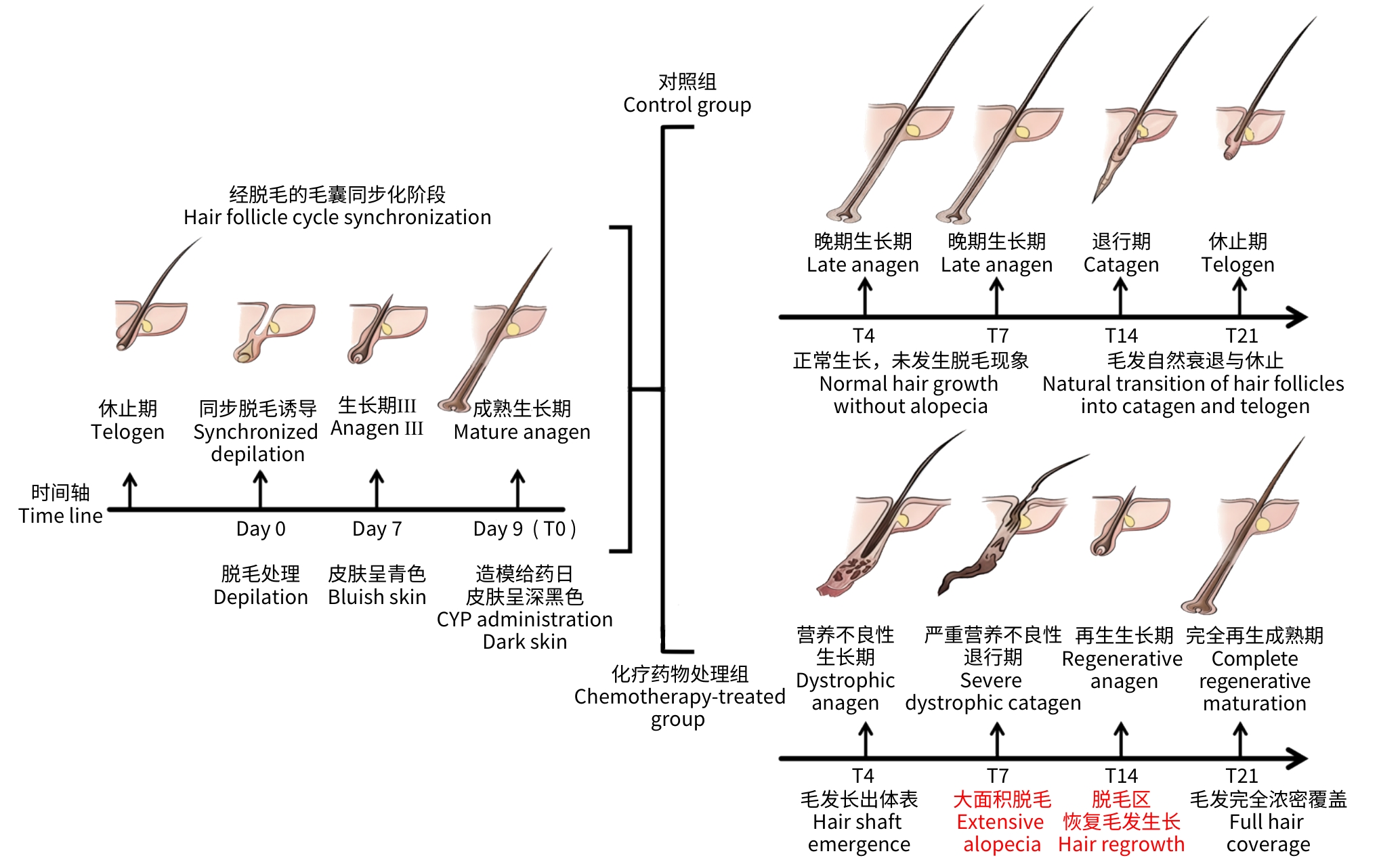
图1
Figure 1
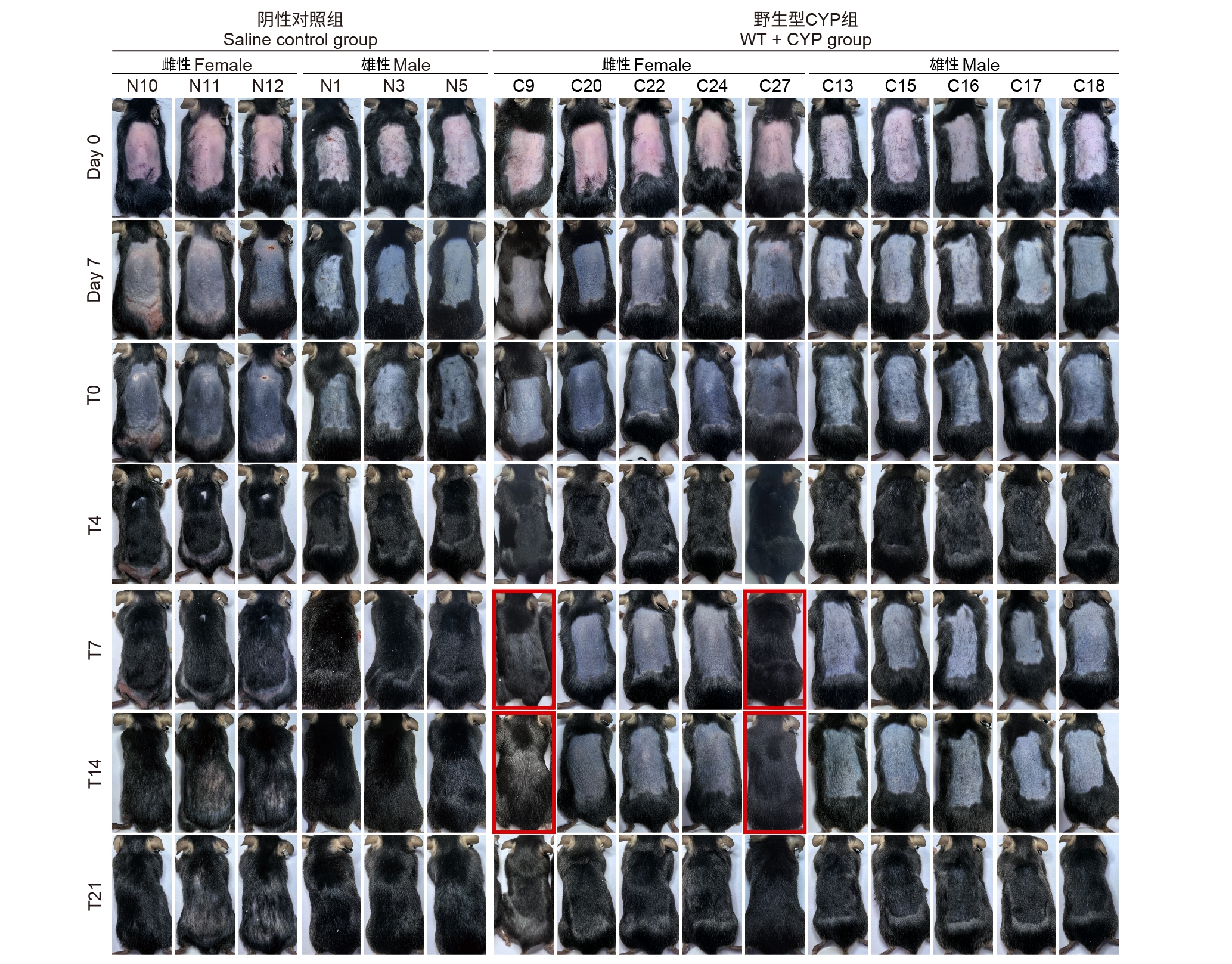
图2
Figure 2
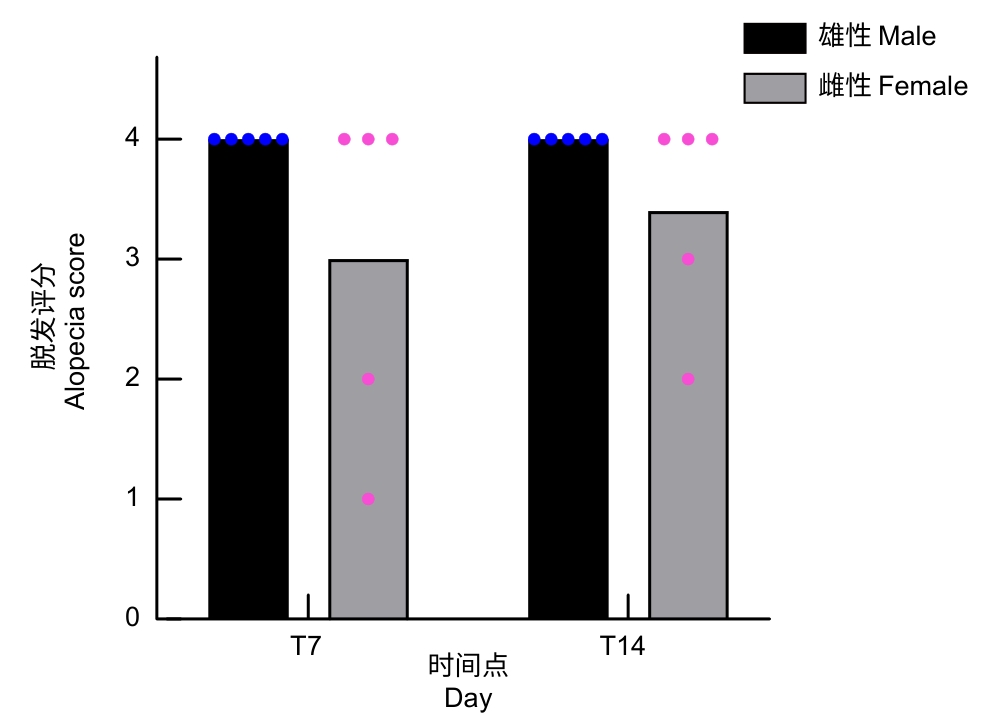
图3
Figure 3
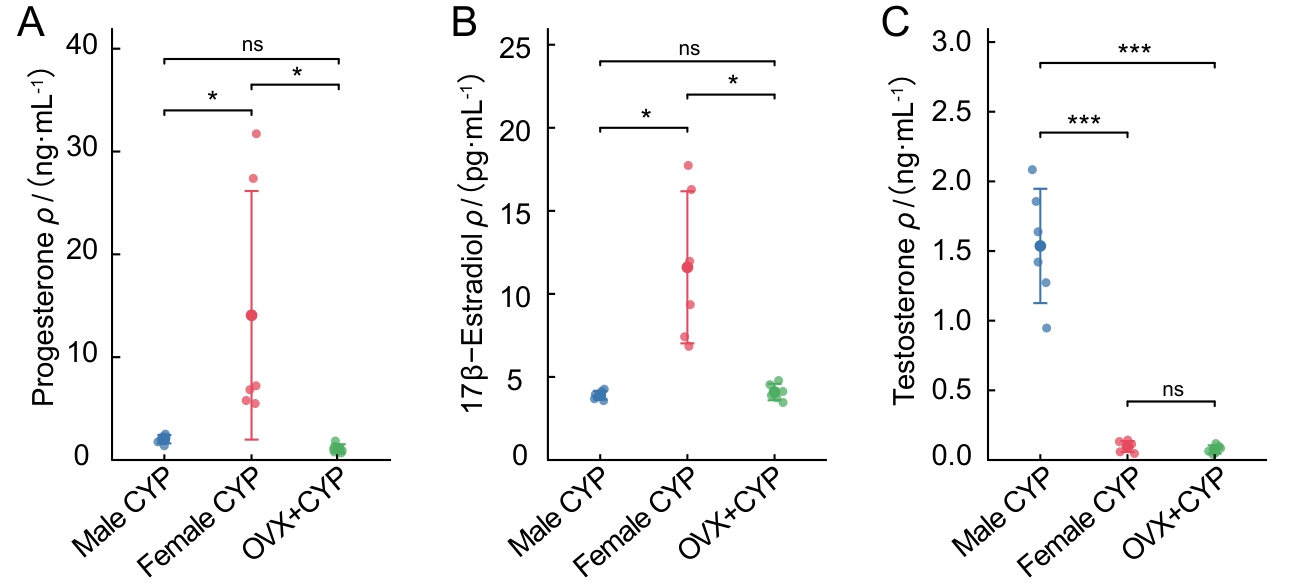
图4
Figure 4
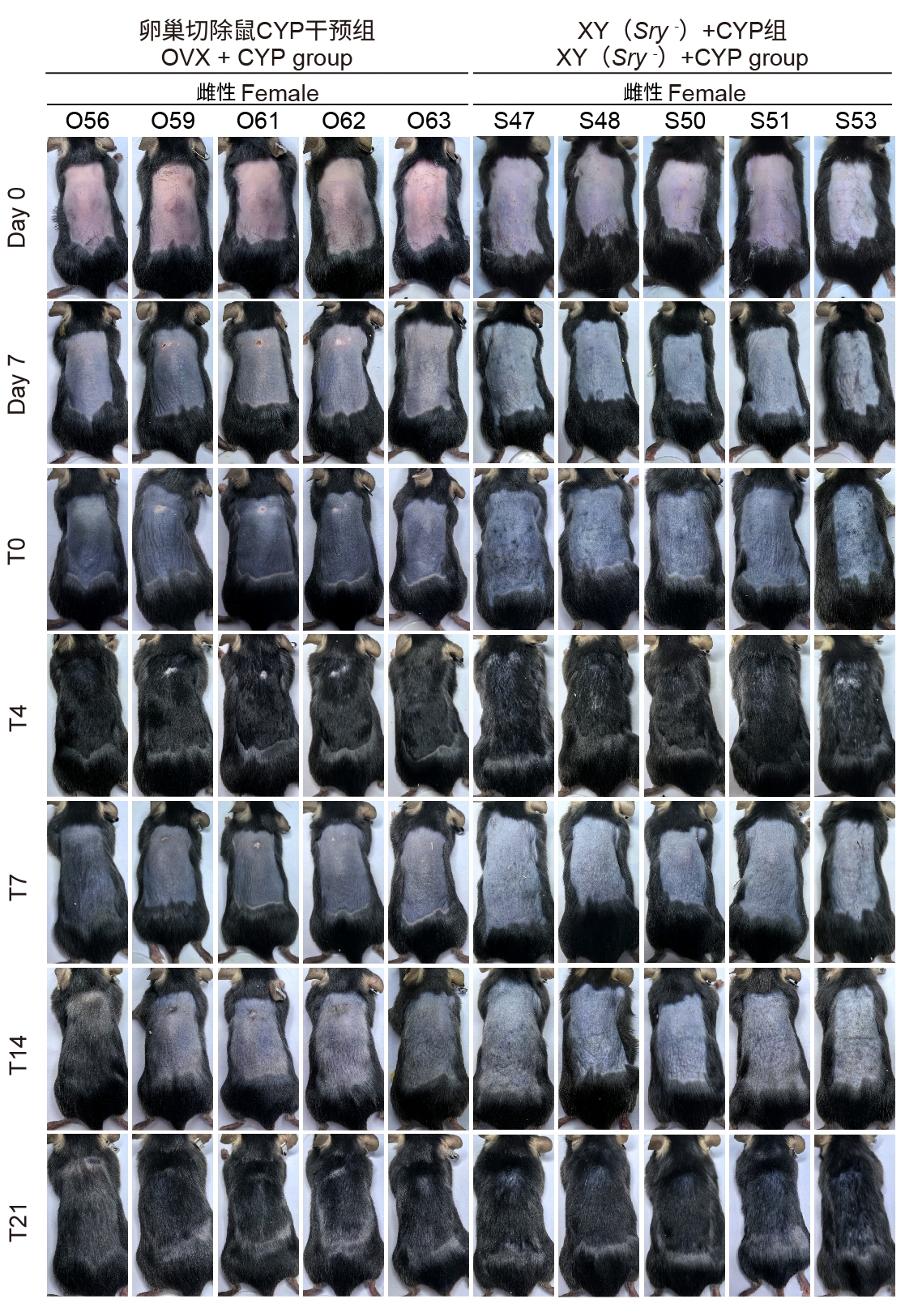
图5
Figure 5
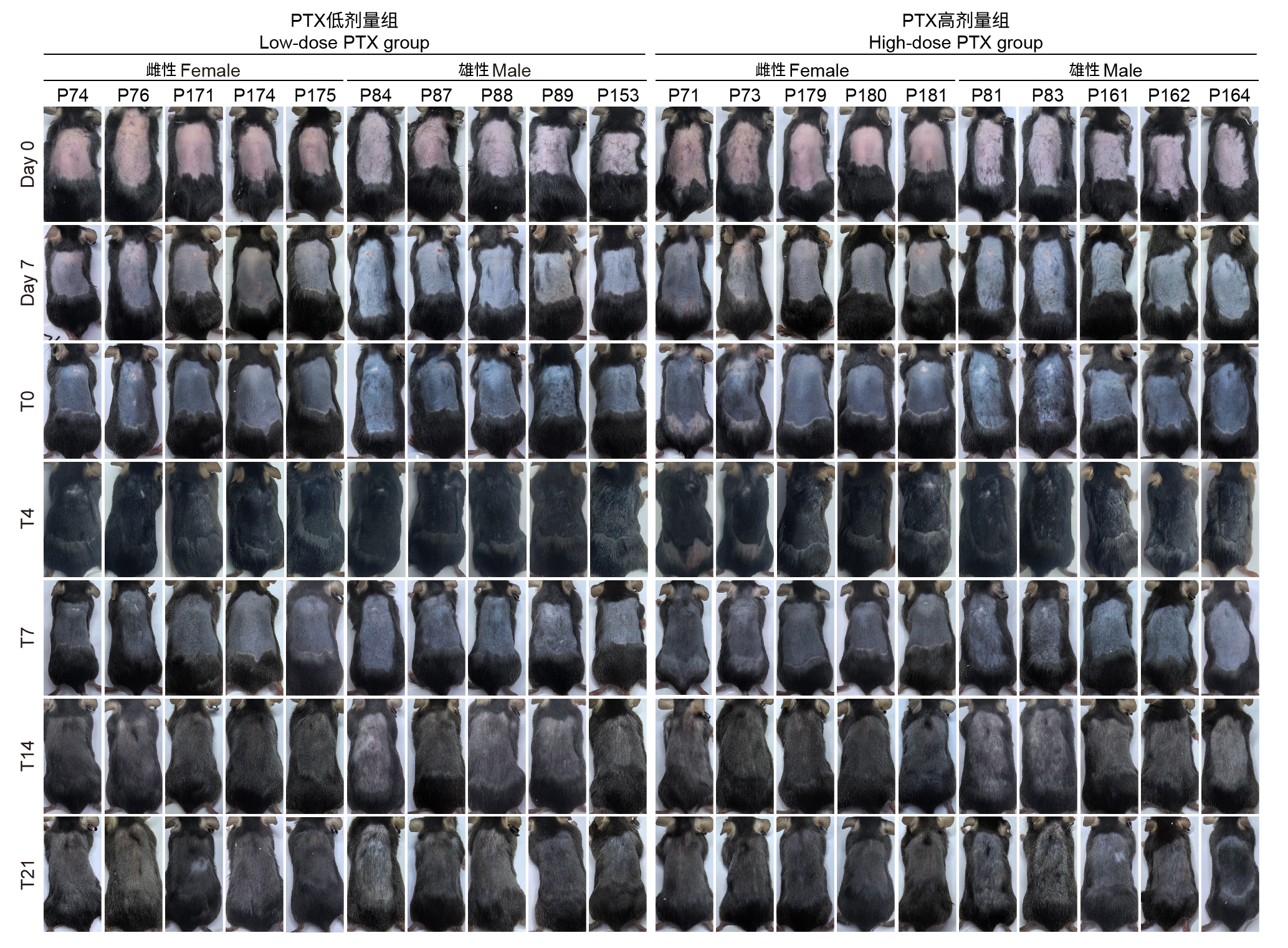
图6
Figure 6
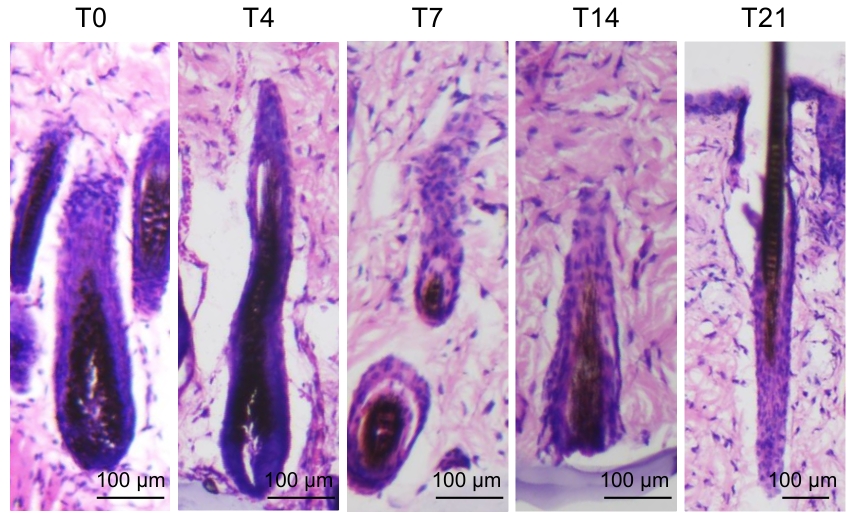
图7
Figure 7
| [1] |
WIKRAMANAYAKE T C, HABERLAND N I, AKHUNDLU A, et al. Prevention and treatment of chemotherapy-induced alopecia: what is available and what is coming?[J]. Curr Oncol, 2023, 30(4): 3609-3626. DOI: 10.3390/curroncol3004 0275.
|
| [2] |
LAMBERT K A, ALBRIGHT B B, ANASTASIO M K, et al. Scalp hypothermia to reduce chemotherapy-induced alopecia: a systematic review and meta-analysis[J]. Gynecol Oncol, 2024, 188: 71-80. DOI: 10.1016/j.ygyno.2024.06.012.
|
| [3] |
STENN K S, PAUS R. Controls of hair follicle cycling[J]. Physiol Rev, 2001, 81(1): 449-494. DOI: 10.1152/physrev. 2001. 81.1.449.
|
| [4] |
PAUS R, HANDJISKI B, EICHMÜLLER S, et al. Chemotherapy-induced alopecia in mice. Induction by cyclophosphamide, inhibition by cyclosporine A, and modulation by dexamethasone[J]. Am J Pathol, 1994, 144(4): 719-734.
|
| [5] |
LIN X Y, ZHU L, HE J. Morphogenesis, growth cycle and molecular regulation of hair follicles[J]. Front Cell Dev Biol, 2022, 10: 899095. DOI: 10.3389/fcell.2022.899095.
|
| [6] |
MÜLLER-RÖVER S, HANDJISKI B, VAN DER VEEN C, et al. A comprehensive guide for the accurate classification of murine hair follicles in distinct hair cycle stages[J]. J Invest Dermatol, 2001, 117(1): 3-15. DOI: 10.1046/j.0022-202x.2001.01377.x.
|
| [7] |
MAURER M, HANDJISKI B, PAUS R. Hair growth modulation by topical immunophilin ligands: induction of anagen, inhibition of massive catagen development, and relative protection from chemotherapy-induced alopecia[J]. Am J Pathol, 1997, 150(4): 1433-1441.
|
| [8] |
CERUTI J M, LEIRÓS G J, BALAÑÁ M E. Androgens and androgen receptor action in skin and hair follicles[J]. Mol Cell Endocrinol, 2018, 465: 122-133. DOI: 10.1016/j.mce.2017.09.009.
|
| [9] |
OWECKA B, TOMASZEWSKA A, DOBRZENIECKI K, et al. The hormonal background of hair loss in non-scarring alopecias[J]. Biomedicines, 2024, 12(3): 513. DOI: 10.3390/biomedicines 12030513.
|
| [10] |
AIBA T, KONO Y, ETOH T, et al. Efficacy of cooling therapy and α-lipoic acid derivative against chemotherapy-induced alopecia in an animal model[J]. Cancer Sci, 2023, 114(3): 1007-1014. DOI: 10.1111/cas.15639.
|
| [11] |
刘青青, 牛玉娜, 周正宇, 等. 小鼠生物净化中的动情周期判定及超数排卵[J]. 实验动物与比较医学, 2014, 34(1): 56-58. DOI: 10.3969/j.issn.1674-5817.2014.01.012.
|
|
LIU Q Q, NIU Y N, ZHOU Z Y, et al. Judgement of estrous cycle and superovulation in biological purification of mice[J]. Lab Anim Comp Med, 2014, 34(1): 56-58. DOI: 10.3969/j.issn.1674-5817.2014.01.012.
|
|
| [12] |
DELAHOUSSE J, WAGNER A D, BORCHMANN S, et al. Sex differences in the pharmacokinetics of anticancer drugs: a systematic review[J]. ESMO Open, 2024, 9(12): 104002. DOI: 10.1016/j.esmoop.2024.104002.
|
| [13] |
UNGER J M, VAIDYA R, ALBAIN K S, et al. Sex differences in risk of severe adverse events in patients receiving immunotherapy, targeted therapy, or chemotherapy in cancer clinical trials[J]. J Clin Oncol, 2022, 40(13): 1474-1486. DOI: 10.1200/JCO.21.02377.
|
| [14] |
GAO Q X, ZHOU G X, LIN S J, et al. How chemotherapy and radiotherapy damage the tissue: Comparative biology lessons from feather and hair models[J]. Exp Dermatol, 2019, 28(4): 413-418. DOI: 10.1111/exd.13846.
|
| [15] |
HENDRIX S, HANDJISKI B, PETERS E M J, et al. A guide to assessing damage response pathways of the hair follicle: lessons from cyclophosphamide-induced alopecia in mice[J]. J Invest Dermatol, 2005, 125(1): 42-51. DOI: 10.1111/j.0022-202X.2005.23787.x.
|
| [16] |
HASSAN Y F, SHABAAN D A. Effect of N-acetylcysteine on hair follicle changes in mouse model of cyclophosphamide-induced alopecia: histological and biochemical study[J]. Histochem Cell Biol, 2024, 161(6): 477-491. DOI: 10.1007/s00418-024-02282-0.
|
| [17] |
HASLAM I S, ZHOU G X, XIE G J, et al. Inhibition of shh signaling through MAPK activation controls chemotherapy-induced alopecia[J]. J Investig Dermatol, 2021, 141(2): 334-344. DOI: 10.1016/j.jid.2020.05.118.
|
| [18] |
PANTEN J, DEL PRETE S, CLELAND J P, et al. Four Core Genotypes mice harbour a 3.2MB X-Y translocation that perturbs Tlr7 dosage[J]. Nat Commun, 2024, 15: 8814. DOI: 10.1038/s41467-024-52640-8.
|
| [19] |
YANG L, LI Y, HONG H X, et al. Sex differences in the expression of drug-metabolizing and transporter genes in human liver[J]. J Drug Metab Toxicol, 2012, 3(3): 1000119. DOI: 10.4172/2157-7609.1000119.
|
| [20] |
HUANG Y B, SHAN Y T, ZHANG W J, et al. Deciphering genetic causes for sex differences in human health through drug metabolism and transporter genes[J]. Nat Commun, 2023, 14(1): 175. DOI: 10.1038/s41467-023-35808-6.
|
| [21] |
FASHE M M, MINER T A, COLLAZO V L, et al. Impact of sex and pregnancy on hepatic CYP3A4 expression and activity in a humanized mouse model[J]. Drug Metab Dispos, 2025, 53(2): 100025. DOI: 10.1016/j.dmd.2024.100025.
|
| [22] |
HAMADA S, NAKAJIMA K, NAMIKI C, et al. Sex differences in the chemical induction of micronuclei in the rat[J]. Environ Mutagen Res, 2003, 25(1): 33-37. DOI: 10.3123/jems.25.33.
|
| [23] |
WANG W J, WANG H L, LUO Y, et al. Discovery of petroleum ether extract of Eclipta targeting p53/Fas pathway for the treatment of chemotherapy-induced alopecia: Network pharmacology and experimental validation[J]. J Ethnopharmacol, 2024, 333: 118405. DOI: 10.1016/j.jep.2024.118405.
|
| [24] |
PURBA T S, NG'ANDU K, BRUNKEN L, et al. CDK4/6 inhibition mitigates stem cell damage in a novel model for taxane-induced alopecia[J]. EMBO Mol Med, 2019, 11(10): EMMM201911031. DOI: 10.15252/emmm.201911031.
|
| [25] |
YANG C P H, HORWITZ S. Taxol®: the first microtubule stabilizing agent[J]. Int J Mol Sci, 2017, 18(8): 1733. DOI: 10.3390/ijms18081733.
|
| [26] |
PICCINI I, BRUNKEN L, CHÉRET J, et al. Peroxisome proliferator-activated receptor-γ signalling protects hair follicle stem cells from chemotherapy-induced apoptosis and epithelial-mesenchymal transition[J]. Br J Dermatol, 2022, 186(1): 129-141. DOI: 10.1111/bjd.20745.
|
| [27] |
孙强. 动物实验中性别"歧视"的危害与反思[J]. 实验动物与比较医学, 2025, 45(2): 247-250. DOI: 10.12300/j.issn.1674-5817.2025.025.
|
|
SUN Q. The harm and reflection of gender discrimination in animal experiments[J]. Lab Anim Comp Med, 2025, 45(2): 247-250. DOI: 10.12300/j.issn.1674-5817.2025.025.
|
| [1] | 江淼淼, 方金萍, 黄宗炫, 厉嘉敏, 廖欢, 张文强, 余佳颖, 杨燕燕, 连大卫. 葛根芩连汤缓解糖尿病小鼠心肌损伤的作用机制研究[J]. 实验动物与比较医学, 2026, 46(5): 629-639. |
| [2] | 张娇玲, 林阿萍, 许诗荧, 潘德全, 蔡毅君. 小鼠胚胎移植技术的优化及应用[J]. 实验动物与比较医学, 2026, 46(5): 750-758. |
| [3] | 许浩莀, 乐卿清, 何西文, 蔡兵, 杨隆河. 护眼复合配方对蓝光损伤模型小鼠视网膜的功效评估[J]. 实验动物与比较医学, 2026, 46(5): 650-659. |
| [4] | 王娟, 徐佳慧, 田韵远, 张萌萌, 李敏, 王四旺, 李瑶. 两种雌性小鼠溃疡性结肠炎模型的比较与行为学观察[J]. 实验动物与比较医学, 2026, 46(3): 332-343. |
| [5] | 艾秀峰, 张利棕, 方明笋, 吕东颖, 陈楚, 蔡兆伟, 王德军. 16S rRNA测序分析饮用含氯水对大鼠和小鼠肠道菌群的影响差异[J]. 实验动物与比较医学, 2026, 46(3): 437-445. |
| [6] | 吴宪文, 刘丽丽, 陈烨, 徐国恒. 繁育体系中育成期小鼠换笼周期及刨花垫料使用量的优化研究[J]. 实验动物与比较医学, 2026, 46(2): 251-260. |
| [7] | 徐英韬, 王蒙蒙, 林平, 迟海涛, 王怡, 白鹰. 外泌体通过NRF2/SLC7A11/GPX4通路调控铁死亡治疗小鼠缺血性脑卒中[J]. 实验动物与比较医学, 2026, 46(1): 20-31. |
| [8] | 贡磊磊, 王晓霞, 封学伟, 李心蕾, 赵涵, 张雪艳, 冯欣. 不同浓度环磷酰胺诱导早发性卵巢功能不全小鼠模型及作用机制研究[J]. 实验动物与比较医学, 2025, 45(4): 403-410. |
| [9] | 沈黄奕, 黄宇飞, 杨云鹏. 实验动物肠道菌群特征分析及性别差异性的研究进展[J]. 实验动物与比较医学, 2025, 45(3): 349-359. |
| [10] | 张一粟, 刘欣茹, 武若杰, 刘睿, 欧阳红, 李晓红. 慢性不可预知性应激与完全弗氏佐剂、福尔马林诱导的妊娠期疼痛-抑郁共病小鼠模型的构建与评价[J]. 实验动物与比较医学, 2024, 44(3): 259-269. |
| [11] | 梁敏, 郭洋, 王津津, 朱梦妍, 池骏, 陈艳娟, 王成稷, 喻智澜, 沈如凌. Dmd基因突变小鼠构建及在肌肉及免疫系统的表型验证[J]. 实验动物与比较医学, 2024, 44(1): 42-51. |
| [12] | 马婧威, 李根, 杨杨, 臧彩霞, 鲍秀琦, 张丹. 环磷酰胺诱导生精障碍小鼠模型不同恢复期的比较研究[J]. 实验动物与比较医学, 2023, 43(2): 112-123. |
| [13] | 李晗, 张笑瑞, 张成芳. 间歇禁食法在改善奥氮平诱导小鼠代谢紊乱中的机制研究[J]. 实验动物与比较医学, 2023, 43(1): 3-10. |
| [14] | 李自发, 张浩, 任萌, 徐凯勇, 胡明会, 周苗苗, 王可洲. 槲皮素对镉致小鼠肝脏脂质代谢紊乱模型的保护效应[J]. 实验动物与比较医学, 2021, 41(4): 305-312. |
| [15] | 洪胜辉, 张旭亮, 王芊芊, 刘 平, 刘迪文. 抑制素基因敲除小鼠模型的构建及表型初步分析[J]. 实验动物与比较医学, 2020, 40(4): 306-. |
| 阅读次数 | ||||||
|
全文 |
|
|||||
|
摘要 |
|
|||||
