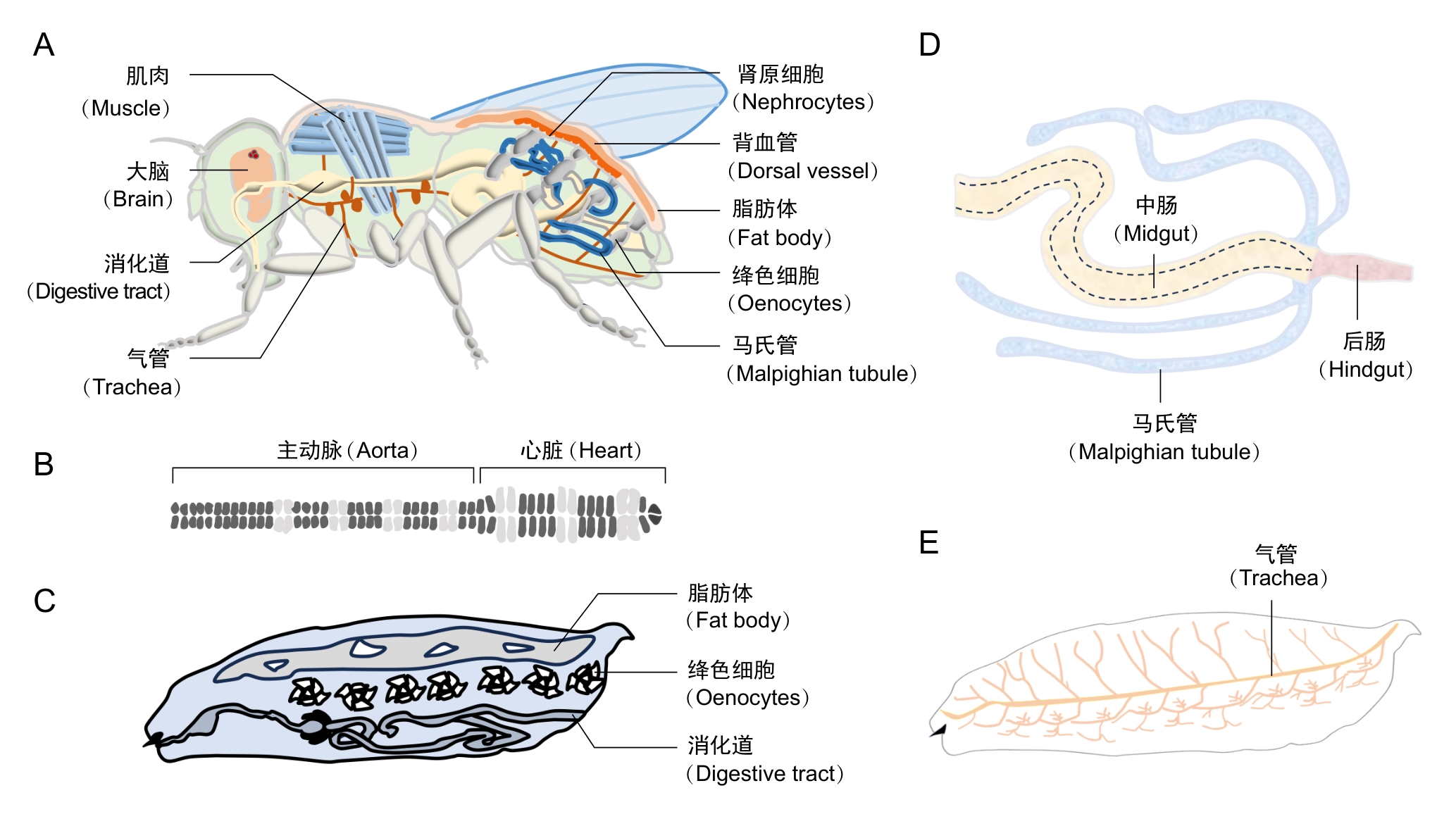
| [1] |
RUBIN G M, LEWIS E B. A brief history of Drosophila's contributions to genome research[J]. Science, 2000, 287(5461):2216-2218. DOI:10.1126/science.287.5461.2216 .
|
| [2] |
WANG M Y, HU Q N, TU Z C, et al. A Drosophila single-cell 3D spatiotemporal multi-omics atlas unveils panoramic key regulators of cell-type differentiation[J]. Cell, 2025, 188(17):4734-4753.e31. DOI:10.1016/j.cell.2025.05.047 .
|
| [3] |
LIU M, LI Y J, LIU A G, et al. The exon junction complex regulates the splicing of cell polarity gene dlg1 to control Wingless signaling in development[J]. eLife, 2016, 5: e17200. DOI:10.7554/eLife.17200 .
|
| [4] |
MCGINNIS W, GARBER R L, WIRZ J, et al. A homologous protein-coding sequence in Drosophila homeotic genes and its conservation in other metazoans[J]. Cell, 1984, 37(2):403-408. DOI:10.1016/0092-8674(84)90370-2 .
|
| [5] |
YANG C P, CHEN W L, CHEN Y B, et al. Smoothened transduces Hedgehog signal by forming a complex with Evc/Evc2[J]. Cell Res, 2012, 22(11):1593-1604. DOI:10.1038/cr. 2012.134 .
|
| [6] |
RUGENDORFF A, YOUNOSSI-HARTENSTEIN A, HARTENSTEIN V. Embryonic origin and differentiation of the Drosophila Heart[J]. Rouxs Arch Dev Biol, 1994, 203(5):266-280. DOI:10.1007/BF00360522 .
|
| [7] |
WU X, GOLDEN K, BODMER R. Heart development in Drosophila requires the segment polarity gene wingless [J]. Dev Biol, 1995, 169(2):619-628. DOI:10.1006/dbio.1995.1174 .
|
| [8] |
BODMER R. The gene tinman is required for specification of the heart and visceral muscles in Drosophila [J]. Development, 1993, 118(3):719-729. DOI:10.1242/dev.118.3.719 .
|
| [9] |
LOCKWOOD W K, BODMER R. The patterns of wingless, decapentaplegic, and tinman position the Drosophila heart[J]. Mech Dev, 2002, 114(1-2):13-26. DOI:10.1016/s0925-4773(02)00044-8 .
|
| [10] |
PARK M, WU X, GOLDEN K, et al. The wingless signaling pathway is directly involved in Drosophila heart development[J]. Dev Biol, 1996, 177(1):104-116. DOI:10.1006/dbio.1996.0149 .
|
| [11] |
KLINEDINST S L, BODMER R. Gata factor Pannier is required to establish competence for heart progenitor formation[J]. Development, 2003, 130(13):3027-3038. DOI:10.1242/dev.00517 .
|
| [12] |
QIAN L, BODMER R. Probing the polygenic basis of cardiomyopathies in Drosophila [J]. J Cell Mol Med, 2012, 16(5):972-977. DOI:10.1111/j.1582-4934.2012.01529.x .
|
| [13] |
HOWARD A M, MILNER H, HUPP M, et al. Akirin is critical for early tinman induction and subsequent formation of the heart in Drosophila melanogaster [J]. Dev Biol, 2021, 469:1-11. DOI:10.1016/j.ydbio.2020.09.001 .
|
| [14] |
BARTLETT H, VEENSTRA G J C, WEEKS D L. Examining the cardiac NK-2 genes in early heart development[J]. Pediatr Cardiol, 2010, 31(3):335-341. DOI:10.1007/s00246-009-9605-0 .
|
| [15] |
CLEVERS H. Wnt/beta-catenin signaling in development and disease[J]. Cell, 2006, 127(3):469-480. DOI:10.1016/j.cell.20 06.10.018 .
|
| [16] |
MESCHI E, DELANOUE R. Adipokine and fat body in flies: Connecting organs[J]. Mol Cell Endocrinol, 2021, 533:111339. DOI:10.1016/j.mce.2021.111339 .
|
| [17] |
HOSHIZAKI D K, BLACKBURN T, PRICE C, et al. Embryonic fat-cell lineage in Drosophila melanogaster [J]. Development, 1994, 120(9):2489-2499. DOI:10.1242/dev.120.9.2489 .
|
| [18] |
HAYES S A, MILLER J M, HOSHIZAKI D K. Serpent, a GATA-like transcription factor gene, induces fat-cell development in Drosophila melanogaster [J]. Development, 2001, 128(7):1193-1200. DOI:10.1242/dev.128.7.1193 .
|
| [19] |
BUTTERWORTH F M, EMERSON L, RASCH E M. Maturation and degeneration of the fat body in the Drosophila larva and pupa as revealed by morphometric analysis[J]. Tissue Cell, 1988, 20(2):255-268. DOI:10.1016/0040-8166(88)90047-x .
|
| [20] |
BRITTON J S, EDGAR B A. Environmental control of the cell cycle in Drosophila: nutrition activates mitotic and endore-plicative cells by distinct mechanisms[J]. Development, 1998, 125(11):2149-2158. DOI:10.1242/dev.125.11.2149 .
|
| [21] |
ZHENG H M, YANG X H, XI Y M. Fat body remodeling and homeostasis control in Drosophila [J]. Life Sci, 2016, 167:22-31. DOI:10.1016/j.lfs.2016.10.019 .
|
| [22] |
CINNAMON E, MAKKI R, SAWALA A, et al. Drosophila Spidey/Kar regulates oenocyte growth via PI3-Kinase signaling[J]. PLoS Genet, 2016, 12(8): e1006154. DOI:10.1371/journal.pgen. 1006154 .
|
| [23] |
GOULD A P, ELSTOB P R, BRODU V. Insect oenocytes: a model system for studying cell-fate specification by Hox genes[J]. J Anat, 2001, 199(Pt 1-2):25-33. DOI:10.1046/j.1469-7580.2001.19910025.x .
|
| [24] |
SUN X W, SHEN J, PERRIMON N, et al. The endoribonuclease Arlr is required to maintain lipid homeostasis by down-regulating lipolytic genes during aging[J]. Nat Commun, 2023, 14(1):6254. DOI:10.1038/s41467-023-42042-7 .
|
| [25] |
PSATHAKI O E, DEHNEN L, HARTLEY P S, et al. Drosophila pericardial nephrocyte ultrastructure changes during ageing[J]. Mech Ageing Dev, 2018, 173:9-20. DOI:10.1016/j.mad. 2018.04.006 .
|
| [26] |
HELMSTÄDTER M, HUBER T B, HERMLE T. Using the Drosophila nephrocyte to model podocyte function and disease[J]. Front Pediatr, 2017, 5:262. DOI:10.3389/fped. 2017. 00262 .
|
| [27] |
MILLER J, CHI T, KAPAHI P, et al. Drosophila melanogaster as an emerging translational model of human nephrolithiasis[J]. J Urol, 2013, 190(5):1648-1656. DOI:10.1016/j.juro.2013.03.010 .
|
| [28] |
LENZ J, LIEFKE R, FUNK J, et al. Ush regulates hemocyte-specific gene expression, fatty acid metabolism and cell cycle progression and cooperates with dNuRD to orchestrate hematopoiesis[J]. PLoS Genet, 2021, 17(2): e1009318. DOI:10.1371/journal.pgen.1009318 .
|
| [29] |
MAKKI R, CINNAMON E, GOULD A P. The development and functions of oenocytes[J]. Annu Rev Entomol, 2014, 59:405-425. DOI:10.1146/annurev-ento-011613-162056 .
|
| [30] |
SINGH S R, HOU S X. Lessons learned about adult kidney stem cells from the Malpighian tubules of Drosophila [J]. J Am Soc Nephrol, 2008, 19(4):660-666. DOI:10.1681/ASN.20 07121307 .
|
| [31] |
JUNG A C, DENHOLM B, SKAER H, et al. Renal tubule development in Drosophila: a closer look at the cellular level[J]. J Am Soc Nephrol, 2005, 16(2):322-328. DOI:10.1681/ASN.2004090729 .
|
| [32] |
SINGH S R, LIU W, HOU S X. The adult Drosophila Malpighian tubules are maintained by multipotent stem cells[J]. Cell Stem Cell, 2007, 1(2):191-203. DOI:10.1016/j.stem.2007.07.003 .
|
| [33] |
WAN S, CATO A M, SKAER H. Multiple signalling pathways establish cell fate and cell number in Drosophila Malpighian tubules[J]. Dev Biol, 2000, 217(1):153-165. DOI:10.1006/dbio.1 999.9499 .
|
| [34] |
DRESSLER G R. The cellular basis of kidney development[J]. Annu Rev Cell Dev Biol, 2006, 22:509-529. DOI:10.1146/annurev.cellbio.22.010305.104340 .
|
| [35] |
CARROLL T J, MCMAHON A P. Secreted molecules in metanephric induction[J]. J Am Soc Nephrol, 2000, 11(): S116-S119. DOI: 10.1681/ASN.V11suppl_2s116 .
|
| [36] |
GAUL U, WEIGEL D. Regulation of Krüppel expression in the anlage of the Malpighian tubules in the Drosophila embryo[J]. Mech Dev, 1990, 33(1):57-67. DOI:10.1016/0925-4773(90)90135-9 .
|
| [37] |
IVY J R, DRECHSLER M, CATTERSON J H, et al. Klf15 is critical for the development and differentiation of Drosophila nephrocytes[J]. PLoS One, 2015, 10(8): e0134620. DOI:10.1371/journal.pone.0134620 .
|
| [38] |
ZHANG F J, ZHAO Y, CHAO Y F, et al. Cubilin and amnionless mediate protein reabsorption in Drosophila nephrocytes[J]. J Am Soc Nephrol, 2013, 24(2):209-216. DOI:10.1681/ASN. 2012080795 .
|
| [39] |
ZHUANG S F, SHAO H J, GUO F L, et al. Sns and Kirre, the Drosophila orthologs of Nephrin and Neph1, direct adhesion, fusion and formation of a slit diaphragm-like structure in insect nephrocytes[J]. Development, 2009, 136(14):2335-2344. DOI:10.1242/dev.031609 .
|
| [40] |
GAMBERI C, HIPFNER D R, TRUDEL M, et al. Bicaudal C mutation causes myc and TOR pathway up-regulation and polycystic kidney disease-like phenotypes in Drosophila [J]. PLoS Genet, 2017, 13(4): e1006694. DOI:10.1371/journal.pgen. 1006694 .
|
| [41] |
KAMPF L L, SCHNEIDER R, GERSTNER L, et al. TBC1D8B mutations implicate RAB11-dependent vesicular trafficking in the pathogenesis of nephrotic syndrome[J]. J Am Soc Nephrol, 2019, 30(12):2338-2353. DOI:10.1681/ASN.2019040414 .
|
| [42] |
HAYASHI S, KONDO T. Development and function of the Drosophila Tracheal system[J]. Genetics, 2018, 209(2):367-380. DOI:10.1534/genetics.117.300167 .
|
| [43] |
GLAZER L, SHILO B Z. The Drosophila FGF-R homolog is expressed in the embryonic tracheal system and appears to be required for directed tracheal cell extension[J]. Genes Dev, 1991, 5(4):697-705. DOI:10.1101/gad.5.4.697 .
|
| [44] |
IBER D, MENSHYKAU D. The control of branching morphogenesis[J]. Open Biol, 2013, 3(9):130088. DOI:10.1098/rsob.130088 .
|
| [45] |
HACOHEN N, KRAMER S, SUTHERLAND D, et al. Sprouty encodes a novel antagonist of FGF signaling that patterns apical branching of the Drosophila airways[J]. Cell, 1998, 92(2):253-263. DOI:10.1016/s0092-8674(00)80919-8 .
|
| [46] |
LI Y, LU T F, DONG P Z, et al. A single-cell atlas of Drosophila trachea reveals glycosylation-mediated Notch signaling in cell fate specification[J]. Nat Commun, 2024, 15:2019. DOI:10.1038/s41467-024-46455-w .
|
| [47] |
JOANNES A, BRAYER S, BESNARD V, et al. FGF9 and FGF18 in idiopathic pulmonary fibrosis promote survival and migration and inhibit myofibroblast differentiation of human lung fibroblasts in vitro [J]. Am J Physiol Lung Cell Mol Physiol, 2016, 310(7): L615-L629. DOI:10.1152/ajplung.001 85.2015 .
|





 ), 吴薇(