



实验动物与比较医学 ›› 2026, Vol. 46 ›› Issue (4): 583-592.DOI: 10.12300/j.issn.1674-5817.2025.184
张丽丽1, 王振2( )
)
收稿日期:2025-11-10
修回日期:2026-04-20
出版日期:2026-08-25
发布日期:2026-07-02
作者简介:张丽丽(1988—),女,硕士,实验技术员,研究方向:非人灵长类动物兽医临床研究。E-mail: lilizhang@zju.edu.cn
ZHANG Lili1, WANG Zhen2()
Received:2025-11-10
Revised:2026-04-20
Published:2026-08-25
Online:2026-07-02
Correspondence to:
WANG Zhen (ORCID: 0009-0002-5548-4367), E-mail: wangzhen@hospital.westlake.edu.cn摘要:
普通狨猴(Callithrix jacchus)是一种叫声丰富、声音交流复杂且行为高度社会化的昼行性非人灵长类动物,具有繁殖能力强和发育周期短的特性,基因背景相似的多胞胎为研究内外因素对叫声发育的影响提供了理想的实验动物模型。普通狨猴出生首日即可发出该物种成年个体的大部分叫声,出生后2个月内幼猴叫声会发生显著变化。与父母有叫声互动的个体,其叫声发育速度快;而隔离饲养的个体则表现出叫声发育延迟。因此,遗传因素为普通狨猴叫声提供初始框架,而后天的社会互动则对其进行精细的校准和优化。此外,生态因素对普通狨猴母幼叫声交流具有重要塑造作用:栖息地特性影响声音传播,捕食风险促进警戒信号演化,社会结构和合作育幼模式为其声音交流提供复杂的社会环境,而资源可得性则直接影响声音信号的强度。作为目前应用最广泛的非人灵长类实验动物之一,普通狨猴在社会引导式声音学习模式上表现出更接近人类的特征,这为比较非人灵长类动物与人类在声音发育及交流机制上的异同,推动语言进化及发声障碍等医学问题的研究提供了宝贵的动物模型。本文聚焦普通狨猴叫声发育及其生态适应性演化,并强调其作为实验动物在医学研究中的独特价值,期望为非人灵长类动物声音交流的演化生物学研究及人类语言障碍的转化医学探索提供理论框架与实验参考。
中图分类号:
张丽丽,王振. 普通狨猴叫声发育和适应性演化[J]. 实验动物与比较医学, 2026, 46(4): 583-592. DOI: 10.12300/j.issn.1674-5817.2025.184.
ZHANG Lili,WANG Zhen. Vocal Development and Adaptive Evolution of Common Marmoset (Callithrix jacchus)[J]. Laboratory Animal and Comparative Medicine, 2026, 46(4): 583-592. DOI: 10.12300/j.issn.1674-5817.2025.184.
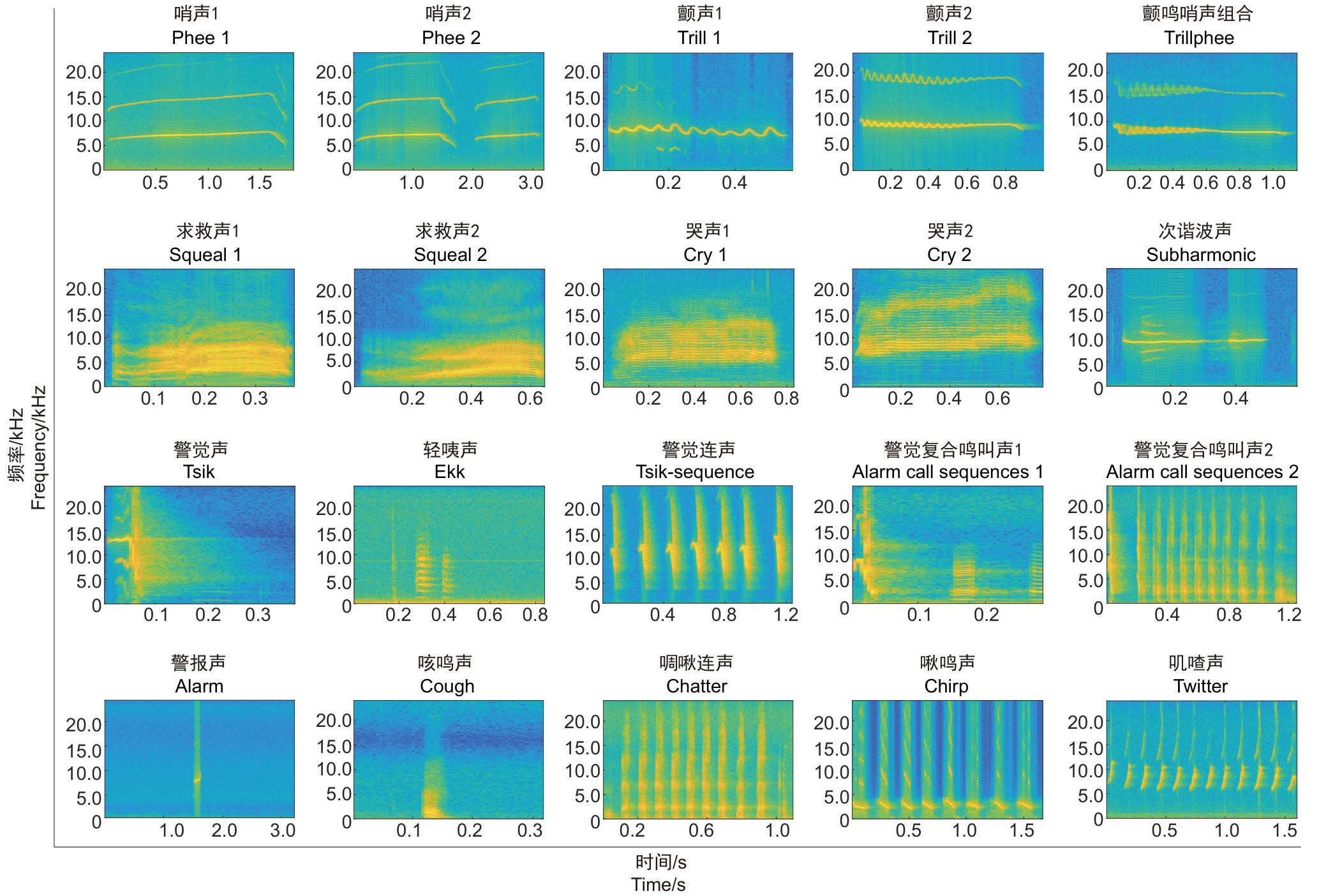
图1 普通狨猴多种叫声的声谱图
Figure 1 Spectrograms of various vocalizations of common marmosets
| [1] | GRIJSEELS D M, PRENDERGAST B J, GORMAN J C, et al. The neurobiology of vocal communication in marmosets[J]. Ann N Y Acad Sci, 2023, 1528(1): 13-28. DOI: 10.1111/nyas.15057 . |
| [2] | BURKART J M, ADRIAENSE J E C, BRÜGGER R K, et al. A convergent interaction engine: vocal communication among marmoset monkeys[J]. Philos Trans R Soc Lond B Biol Sci, 2022, 377(1859): 20210098. DOI: 10.1098/rstb.2021.0098 . |
| [3] | GULTEKIN Y B, HAGE S R. Limiting parental interaction during vocal development affects acoustic call structure in marmoset monkeys[J]. Sci Adv, 2018, 4(4): eaar4012. DOI: 10.1126/sciadv.aar4012 . |
| [4] | OREN G, SHAPIRA A, LIFSHITZ R, et al. Vocal labeling of others by nonhuman primates[J]. Science, 2024, 385(6712): 996-1003. DOI: 10.1126/science.adp3757 . |
| [5] | ZÜRCHER Y, WILLEMS E P, BURKART J M. Are dialects socially learned in marmoset monkeys? Evidence from translocation experiments[J]. PLoS One, 2019, 14(10): e0222486. DOI: 10.1371/journal.pone.0222486 . |
| [6] | CHEN Y F, MENEGAS W, ZHANG Q G, et al. Common marmoset: an emerging non-human primate model for translational applications in brain disorders[J]. Curr Opin Neurobiol, 2025, 92: 102998. DOI: 10.1016/j.conb.2025.102998 . |
| [7] | ROTHWELL E S, VIECHWEG S S, PROKAI L, et al. Oral administration of ethinyl estradiol and the brain-selective estrogen prodrug DHED in a female common marmoset model of menopause: Effects on cognition, thermoregulation, and sleep[J]. Horm Behav, 2025, 167: 105670. DOI: 10.1016/j.yhbeh.2024.105670 . |
| [8] | CERRITO P, GASCON E, ROBERTS A C, et al. Neurodevelopmental timing and socio-cognitive development in a prosocial cooperatively breeding primate (Callithrix jacchus)[J]. Sci Adv, 2024, 10(44): eado3486. DOI: 10.1126/sciadv.ado3486 . |
| [9] | HOLZSCHERER E J, ZANINI A, LIU C Y, et al. Resting-state functional connectivity of the marmoset claustrum[J]. Imaging Neurosci, 2025, 3: IMAG.a.109. DOI: 10.1162/IMAG.a.109 . |
| [10] | SCHIEL N, SOUTO A. The common marmoset: an overview of its natural history, ecology and behavior[J]. Dev Neurobiol, 2017, 77(3): 244-262. DOI: 10.1002/dneu.22458 . |
| [11] | PHANIRAJ N, BRÜGGER R K, BURKART J M. Marmosets mutually compensate for differences in rhythms when coordinating vigilance[J]. PLoS Comput Biol, 2024, 20(5): e1012104. DOI: 10.1371/journal.pcbi.1012104 . |
| [12] | DE LA FUENTE M F, SUEUR C, GARBER P A, et al. Foraging networks and social tolerance in a cooperatively breeding primate (Callithrix jacchus)[J]. J Anim Ecol, 2022, 91(1): 138-153. DOI: 10.1111/1365-2656.13609 . |
| [13] | BIAZZI R B, TAKAHASHI D Y, GHAZANFAR A A. Altricial brains and the evolution of infant vocal learning[J]. Proc Natl Acad Sci U S A, 2025, 122(34): e2421095122. DOI: 10.1073/pnas.2421095122 . |
| [14] | QI R Z, LIN Y X, LIU S S, et al. Vocal taking turns is premature at birth and improved by the postnatal phonetic environment in marmosets[J]. Natl Sci Rev, 2025, 12(7): nwaf162. DOI: 10.1093/nsr/nwaf162 . |
| [15] | SAMANDRA R, ROSA M G P, MANSOURI F A. How do common marmosets maintain the balance between response execution and action inhibition?[J]. Am J Primatol, 2025, 87(1): e23717. DOI: 10.1002/ajp.23717 . |
| [16] | BOSSHARD A B, BURKART J M, MERLO P, et al. Beyond bigrams: call sequencing in the common marmoset (Callithrix jacchus) vocal system[J]. R Soc Open Sci, 2024, 11(11): 240218. DOI: 10.1098/rsos.240218 . |
| [17] | RISUENO-SEGOVIA C, DOHMEN D, GULTEKIN Y B, et al. Linguistic law-like compression strategies emerge to maximize coding efficiency in marmoset vocal communication[J]. Proc Biol Sci, 2023, 290(2007): 20231503. DOI: 10.1098/rspb.2023.1503 . |
| [18] | AGAMAITE J A, CHANG C J, OSMANSKI M S, et al. A quantitative acoustic analysis of the vocal repertoire of the common marmoset (Callithrix jacchus)[J]. J Acoust Soc Am, 2015, 138(5): 2906-2928. DOI: 10.1121/1.4934268 . |
| [19] | SADAGOPAN S, KAR M, PARIDA S. Quantitative models of auditory cortical processing[J]. Hear Res, 2023, 429: 108697. DOI: 10.1016/j.heares.2023.108697 . |
| [20] | OSMANSKI M S, WANG X Q. Perceptual specializations for processing species-specific vocalizations in the common marmoset (Callithrix jacchus)[J]. Proc Natl Acad Sci U S A, 2023, 120(24): e2221756120. DOI: 10.1073/pnas.2221756120 . |
| [21] | LAMOTHE C, OBLIGER-DEBOUCHE M, BEST P, et al. A large annotated dataset of vocalizations by common marmosets[J]. Sci Data, 2025, 12: 782. DOI: 10.1038/s41597-025-04951-8 . |
| [22] | JOVANOVIC V, FISHBEIN A R, DE LA MOTHE L, et al. Behavioral context affects social signal representations within single primate prefrontal cortex neurons[J]. Neuron, 2022, 110(8): 1318-1326.e4. DOI: 10.1016/j.neuron. 2022.01.020 . |
| [23] | JAAKKOLA K. Do marmosets really have names?[J]. Learn Behav, 2025, 53(4): 317-318. DOI: 10.3758/s13420-024-00662-z . |
| [24] | YAMAGUCHI C, IZUMI A, NAKAMURA K. Time course of vocal modulation during isolation in common marmosets (Callithrix jacchus)[J]. Am J Primatol, 2010, 72(8): 681-688. DOI: 10.1002/ajp.20824 . |
| [25] | LANDMAN R, SHARMA J, HYMAN J B, et al. Close-range vocal interaction in the common marmoset (Callithrix jacchus)[J]. PLoS One, 2020, 15(4): e0227392. DOI: 10.1371/journal.pone.0227392 . |
| [26] | KATO Y, GOKAN H, OH-NISHI A, et al. Vocalizations associated with anxiety and fear in the common marmoset (Callithrix jacchus)[J]. Behav Brain Res, 2014, 275: 43-52. DOI: 10.1016/j.bbr.2014.08.047 . |
| [27] | ROGERS L J, STEWART L, KAPLAN G. Food calls in common marmosets, Callithrix jacchus, and evidence that one is functionally referential[J]. Animals, 2018, 8(7): 99. DOI: 10.3390/ani8070099 . |
| [28] | BASTOS M, MEDEIROS K, JONES G, et al. Small but wise: Common marmosets (Callithrix jacchus) use acoustic signals as cues to avoid interactions with blonde capuchin monkeys (Sapajus flavius)[J]. Am J Primatol, 2018, 80(3): e22744. DOI: 10.1002/ajp.22744 . |
| [29] | ELIADES S J, MILLER C T. Marmoset vocal communication: Behavior and neurobiology[J]. Dev Neurobiol, 2017, 77(3): 286-299. DOI: 10.1002/dneu.22464 . |
| [30] | NORCROSS J L, NEWMAN J D. Context and gender-specific differences in the acoustic structure of common marmoset (Callithrix jacchus) phee calls[J]. Am J Primatol, 1993, 30(1): 37-54. DOI: 10.1002/ajp.1350300104 . |
| [31] | ZHANG Y S, GHAZANFAR A A. Vocal development through morphological computation[J]. PLoS Biol, 2018, 16(2): e2003933. DOI: 10.1371/journal.pbio.2003933 . |
| [32] | TERAMOTO Y, TAKAHASHI D Y, HOLMES P, et al. Vocal development in a waddington landscape[J]. eLife, 2017, 6: e20782. DOI: 10.7554/elife.20782 . |
| [33] | TAKAHASHI D Y, FENLEY A R, TERAMOTO Y, et al. LANGUAGE DEVELOPMENT. The developmental dynamics of marmoset monkey vocal production[J]. Science, 2015, 349(6249): 734-738. DOI: 10.1126/science.aab1058 . |
| [34] | YANO-NASHIMOTO S, TRUZZI A, SHINOZUKA K, et al. Anxious about rejection, avoidant of neglect: Infant marmosets tune their attachment based on individual caregiver's parenting style[J]. Commun Biol, 2024, 7: 212. DOI: 10.1038/s42003-024-05875-6 . |
| [35] | NARAYANAN D Z, TAKAHASHI D Y, et al. Prenatal development of neonatal vocalizations[J]. eLife, 2022, 11: e78485. DOI: 10.7554/elife.78485 . |
| [36] | VAN DER KLIS A, ADRIAANS F, KAGER R. Infants' behaviours elicit different verbal, nonverbal, and multimodal responses from caregivers during early play[J]. Infant Behav Dev, 2023, 71: 101828. DOI: 10.1016/j.infbeh.2023.101828 . |
| [37] | GULTEKIN Y B, HAGE S R. Limiting parental feedback disrupts vocal development in marmoset monkeys[J]. Nat Commun, 2017, 8: 14046. DOI: 10.1038/ncomms14046 . |
| [38] | NAGARAJAN G, MATROV D, PEARSON A C, et al. Cingulate cortex shapes early postnatal development of social vocalizations[J]. eLife, 2025, 13: RP97125. DOI: 10.7554/elife. 97125 . |
| [39] | TSCHIDA K, MOONEY R. The role of auditory feedback in vocal learning and maintenance[J]. Curr Opin Neurobiol, 2012, 22(2): 320-327. DOI: 10.1016/j.conb.2011.11.006 . |
| [40] | ANDERSON K L, WHITNEY O. Integrative neural mechanisms for social communication of learned vocal behavior[J]. Front Integr Neurosci, 2025, 19: 1650323. DOI: 10.3389/fnint. 2025.1650323 . |
| [41] | TSUNADA J, ELIADES S J. Frontal-auditory cortical interactions and sensory prediction during vocal production in marmoset monkeys[J]. Curr Biol, 2025, 35(10): 2307-2322.e3. DOI: 10.1016/j.cub.2025.03.077 . |
| [42] | BARBOSA M N, SILVA MOTA M T DA, BARBOSA M N. The effect of infant vocalization in alloparental responsiveness of common marmosets (Callithrix jacchus)[J]. Am J Primatol, 2017, 79(9): e22682. DOI: 10.1002/ajp.22682 . |
| [43] | KURACHI T, SHINOZUKA K, YOSHIHARA C, et al. Distinct roles of amylin and oxytocin signaling in intrafamilial social behaviors at the medial preoptic area of common marmosets[J]. Commun Biol, 2023, 6: 1231. DOI: 10.1038/s42003-023-05593-5 . |
| [44] | ZHANG Y S, ALVAREZ J L, GHAZANFAR A A. Arousal elevation drives the development of oscillatory vocal output[J]. J Neurophysiol, 2022, 127(6): 1519-1531. DOI: 10.1152/jn. 00007.2022 . |
| [45] | TURK A Z, SHEIKHBAHAEI S. Morphometric analysis of astrocytes in vocal production circuits of common marmoset (Callithrix jacchus)[J]. J Comp Neurol, 2022, 530(2): 574-589. DOI: 10.1002/cne.25230 . |
| [46] | ELIADES S J, TSUNADA J. Auditory cortical activity drives feedback-dependent vocal control in marmosets [J]. Nat Commun, 2018, 9(1): 2540. DOI:10.1038/S41467-018-04961-8 . |
| [47] | SOLDATI A, FEDUREK P, DEZECACHE G, et al. Social and individual factors mediate chimpanzee vocal ontogeny[J]. Sci Rep, 2025, 15: 8529. DOI: 10.1038/s41598-025-93207-x . |
| [48] | WANG Y F, CHENG L Q, LI D Y, et al. Evolutionary convergence of the arcuate fasciculus in marmosets and humans[PP/OL]. bioRxiv(2025-06-17)[2025-11-01]. . |
| [49] | GULTEKIN Y B, HILDEBRAND D G C, HAMMERSCHMIDT K, et al. High plasticity in marmoset monkey vocal development from infancy to adulthood[J]. Sci Adv, 2021, 7(27): eabf2938. DOI: 10.1126/sciadv.abf2938 . |
| [50] | JAFARI A, DUREUX A, ZANINI A, et al. A vocalization-processing network in marmosets[J]. Cell Rep, 2023, 42(5): 112526. DOI: 10.1016/j.celrep.2023.112526 . |
| [51] | VARELLA T T, GHAZANFAR A A. Cooperative care and the evolution of the prelinguistic vocal learning[J]. Dev Psychobiol, 2021, 63(5): 1583-1588. DOI: 10.1002/dev.22108 . |
| [52] | ELMLINGER S L, LEVY J A, GOLDSTEIN M H. Immature vocalizations elicit simplified adult speech across multiple languages[J]. Curr Biol, 2025, 35(4): 871-881.e3. DOI: 10.1016/j.cub.2024.12.052 . |
| [53] | BRÜNDL A C, GIRARD-BUTTOZ C, BORTOLATO T, et al. Maternal effects on the development of vocal communication in wild chimpanzees[J]. iScience, 2022, 25(10): 105152. DOI: 10.1016/j.isci.2022.105152 . |
| [54] | CERKEVICH C M, RATHELOT J A, STRICK P L. Cortical basis for skilled vocalization[J]. Proc Natl Acad Sci U S A, 2022, 119(19): e2122345119. DOI: 10.1073/pnas.2122345119 . |
| [55] | FREITAS B, D'AMELIO P B, MILÁ B, et al. Meta-analysis of the acoustic adaptation hypothesis reveals no support for the effect of vegetation structure on acoustic signalling across terrestrial vertebrates[J]. Biol Rev, 2025, 100(2): 815-833. DOI: 10.1111/brv.13163 . |
| [56] | LÖSCHNER J, HAGE S R. Sound amongst the din: primate strategies against noise[J]. Trends Cogn Sci, 2025, 29(2): 111-113. DOI: 10.1016/j.tics.2024.11.007 . |
| [57] | RIONDATO I, GAMBA M, TAN C L, et al. Allometric escape and acoustic signal features facilitate high-frequency communication in an endemic Chinese primate[J]. J Comp Physiol A Neuroethol Sens Neural Behav Physiol, 2021, 207(3): 327-336. DOI: 10.1007/s00359-021-01465-7 . |
| [58] | DE GREGORIO C, VALENTE D, FERRARIO V, et al. Who you live with and what you duet for: a review of the function of primate duets in relation to their social organization[J]. J Comp Physiol A Neuroethol Sens Neural Behav Physiol, 2024, 210(2): 281-294. DOI: 10.1007/s00359-023-01689-9 . |
| [59] | PARIDA S, LIU S T, SADAGOPAN S. Adaptive mechanisms facilitate robust performance in noise and in reverberation in an auditory categorization model[J]. Commun Biol, 2023, 6: 456. DOI: 10.1038/s42003-023-04816-z . |
| [60] | MASSENET M, MATHEVON N, et al. Nonlinear phenomena in vertebrate vocalizations: mechanisms and communicative functions[J]. Philos Trans R Soc Lond B Biol Sci, 2025, 380(1923): 20240002. DOI: 10.1098/rstb.2024.0002 . |
| [61] | FITCH W T. Applying nonlinear dynamics to the voice: a historical perspective[J]. Philos Trans R Soc Lond B Biol Sci, 2025, 380(1923): 20240024. DOI: 10.1098/rstb.2024.0024 . |
| [62] | RENDALL D. Nonlinear phenomena in animal vocalizations: do they reflect alternative functional modes of voice control, 'leaked' cues to quality or condition, or both?[J]. Philos Trans R Soc Lond B Biol Sci, 2025, 380(1923): 20240010. DOI: 10.1098/rstb.2024.0010 . |
| [63] | MUIR J, HERBST C T, HAWES J E, et al. Nonlinear phenomena in mammalian vocal communication: an introduction and scoping review[J]. Philos Trans R Soc Lond B Biol Sci, 2025, 380(1923): 20240017. DOI: 10.1098/rstb.2024. 0017 . |
| [64] | GARLAND T Jr, DOWNS C J, IVES A R. Trade-offs (and constraints) in organismal biology[J]. Physiol Biochem Zool, 2022, 95(1): 82-112. DOI: 10.1086/717897 . |
| [65] | VARELLA T T, ZHANG Y S, TAKAHASHI D Y, et al. A mechanism for punctuating equilibria during mammalian vocal development[J]. PLoS Comput Biol, 2022, 18(6): e1010173. DOI: 10.1371/journal.pcbi.1010173 . |
| [66] | THOMPSON GONZÁLEZ N, FREEDBERG L, et al. Costs and constraints of cellular immune activity during development in an arboreal primate[J]. R Soc Open Sci, 2025, 12(4): 241659. DOI: 10.1098/rsos.241659 . |
| [67] | STODDARD P K. Predation enhances complexity in the evolution of electric fish signals[J]. Nature, 1999, 400(6741): 254-256. DOI: 10.1038/22301 . |
| [68] | SAHA K, JOSHI K, BALAKRISHNAN R. Multimodal duetting in katydids under bat predation risk: a winning strategy for both sexes[J]. Biol Lett, 2023, 19(5): 20230110. DOI: 10.1098/rsbl. 2023.0110 . |
| [69] | MEISNER O C, et al. Development of a Marmoset Apparatus for Automated Pulling to study cooperative behaviors[J]. eLife, 2024, 13: RP97088. DOI: 10.7554/elife. 97088 . |
| [70] | TAYLOR J H, CARP S B, FRENCH J A. Vasopressin, but not oxytocin, modulates responses to infant stimuli in marmosets providing care to dependent infants[J]. Dev Psychobiol, 2020, 62(7): 932-940. DOI: 10.1002/dev.21892 . |
| [71] | ZELMANOFF D D, BORNSTEIN R, KAUFMAN M, et al. Oxytocin signaling regulates maternally directed behavior during early life[J]. Science, 2025, 389(6765): eado5609. DOI: 10.1126/science.ado5609 . |
| [72] | TAKAHASHI D Y, LIAO D A, GHAZANFAR A A. Vocal learning via social reinforcement by infant marmoset monkeys[J]. Curr Biol, 2017, 27(12): 1844-1852.e6. DOI: 10.1016/j.cub.2017.05.004 . |
| [73] | 邢秀侠, 左西年. 基于清醒功能磁共振的狨猴与人脑网络功能分区映射[J]. 科学通报, 2025, 70(32): 5528-5537. |
| XING X X, ZUO X N. Marmoset-human parcellation mapping with wakeful fMRI-derived networks[J]. Chin Sci Bull, 2025, 70(32): 5528-5537. | |
| [74] | 王晨, 李学波, 贺东华, 等. 实验狨猴信息管理系统的设计与应用[J]. 实验动物与比较医学, 2026, 46(2): 231-241. DOI: 10.12300/j.issn.1674-5817.2025.089 . |
| WANG C, LI X B, HE D H, et al. Design and application of an information management system for experimental marmosets[J]. Lab Anim Comp Med, 2026, 46(2): 231-241. DOI: 10.12300/j.issn.1674-5817.2025.089 . |
| [1] | 李莉, 李学波, 樊永恒, 贺东华, 李剑洪, 常亮堂. 普通狨猴饲养繁育与遗传管理经验探讨[J]. 实验动物与比较医学, 2026, 46(1): 107-118. |
| [2] | 王晨娟, 杨玲焰, 王立鹏, 孙雪萍, 李静文, 郭连香, 荣荣, 时长军. 2019年某实验猴养殖场食蟹猴犬瘟热暴发的诊断[J]. 实验动物与比较医学, 2025, 45(3): 360-367. |
| [3] | 李倩, 陈佳琦, 李丽红, 张飞燕, 毛华明, 吕龙宝. 浅谈非人灵长类实验动物从业人员的职业健康管理措施[J]. 实验动物与比较医学, 2025, 45(2): 197-205. |
| [4] | 徐聖业, 黄俊锋, 陈一航, 常亮堂. 一套无抓捕应激的实验狨猴椅设计及其初步应用[J]. 实验动物与比较医学, 2025, 45(1): 67-72. |
| [5] | 肖文娴, 吕龙宝. 非人灵长类实验动物用于人类卵巢衰老研究进展[J]. 实验动物与比较医学, 2025, 45(1): 47-54. |
| [6] | 孙强. 中国实验猴产业的历史、现状、挑战与机遇[J]. 实验动物与比较医学, 2024, 44(4): 343-356. |
| [7] | 吴强, 任倩, 华晨, 周正宇. 高校实验动物设施维护保养采用社会化服务模式的实践与思考[J]. 实验动物与比较医学, 2022, 42(1): 81-85. |
| [8] | 李萌乾, 王青松, 张占恒, 刘晓龙, 王星童, 李婷婷, 尹海芳, 刘凤勇. 普通狨猴部分传染性疾病检疫指标的探讨[J]. 实验动物与比较医学, 2014, 34(4): 330-334. |
| [9] | 李健, 全琛宇, 施维, 周庆安, 张鸿满, 黄维义, 何国声. 广西地区人工驯繁猕猴、食蟹猴胃肠道寄生虫感染情况的初步调查[J]. 实验动物与比较医学, 2013, 33(4): 279-284. |
| [10] | 高建峰,谢莉萍,陈健东,黄俊华,覃菊艳. 非人灵长类实验动物福利与AAALAC认证[J]. 实验动物与比较医学, 2010, 30(6): 465-467. |
| [11] | 孙晓梅,叶尤松,仝品芬,代解杰. 非人灵长类动物人工繁殖种群的遗传学控制[J]. 实验动物与比较医学, 2007, 27(1): 67-70. |
| [12] | 程树军1,2,李海标1. 非人灵长类胚胎干细胞研究进展[J]. 实验动物与比较医学, 2004, 24(2): 114-118. |
| [13] | 朱钟麟, 沈志敏. 普通狨猴牙齿生长与年龄的关系[J]. 实验动物与比较医学, 1995, 15(4): 220-221. |
| [14] | 王胜昌, 朱钟麟, 沈志敏. 两种狨猴血红蛋白及血清乳酸脱氨酶同工酶的比较[J]. 实验动物与比较医学, 1995, 15(3): 173-175. |
| 阅读次数 | ||||||
|
全文 |
|
|||||
|
摘要 |
|
|||||
