实验动物与比较医学 ›› 2026, Vol. 46 ›› Issue (4): 467-475.DOI: 10.12300/j.issn.1674-5817.2026.122

• 人类疾病动物模型 •    下一篇

BMPR1BFecB 同源突变的食蟹猴与恒河猴模型构建

李春杨1, 刘星辰1, 李玉琢1, 陆勇1,2, 王燕1, 高长山1, 聂艳红1,2, 卞新颜1, 胡超4, 朱家桥4, 孙强1,2,3()   

  1. 1.中国科学院脑科学与智能技术卓越创新中心, 上海 200031
    2.中山大学香港高等研究院, 香港 999077
    3.中山大学中山医学院, 深圳 518107
    4.扬州大学兽医学院, 扬州 225009
  • 收稿日期:2026-06-25 修回日期:2026-07-24 出版日期:2026-08-25 发布日期:2026-08-22
  • 作者简介:李春杨(1995—),女,硕士,实验师,研究方向:显微操作与胚胎发育。E-mail: lichunyang@ion.ac.cn;
    刘星辰(1996—),女,博士,博士后,研究方向:非人灵长类生殖胚胎发育。E-mail: xcliu@ion.ac.cn;
    李玉琢(1986—),男,硕士,高级实验师,研究方向:基因编辑模型构建。E-mail: liyuzhuo@bsbii.cn
    孙强,研究员,博士生导师。现任中山大学香港高等研究院、中山大学中山医学院高级科学家;兼任中国实验动物学会理事、灵长类实验动物专业委员会常务理事,上海市实验动物学会理事、生物安全专业委员会委员。长期从事非人灵长类实验动物生殖生理研究工作:2007 年获得中国首批“试管食蟹猴”;随后基于慢病毒转染和基因编辑技术先后构建了多种实验猴疾病动物模型;2016 年建立了基于精巢异种移植和激素注射的实验猴成熟加速技术,2018 年在国际上首次得到体细胞克隆猴;2023 年获得胚胎干细胞高比例嵌合食蟹猴。相关成果发表于PNAS、Nature、Cell、Cell Research 等学术期刊,是国家杰出青年科学基金获得者、科技部中青年科技创新领军人才,并获得谈家桢生命科学创新奖、药明康德生命化学研究奖-学者奖、上海市自然科学奖一等奖等荣誉。此外,多年来坚持实验动物科普写作,是“实验动物那些事儿”公众号主要作者之一,发表科普文章100 余篇。(1973—),男,博士,教授,博士生导师,研究方向:非人灵长类生殖生理。E-mail: qsun@sysuias.hk。ORCID: 0000-0002-3359-9465
  • 基金资助:
    国家重点研发计划-基础科研条件与重大科学仪器设备研发专项课题“猴辅助生殖与人工输精技术建立及特色育种和遗传标记研究”(2022YFF0710901)

Generation of Cynomolgus and Rhesus Monkey Models Carrying the BMPR1BFecB Variant

LI Chunyang1, LIU Xingchen1, LI Yuzhuo1, LU Yong1,2, WANG Yan1, GAO Changshan1, NIE Yanhong1,2, BIAN Xinyan1, HU Chao4, ZHU Jiaqiao4, SUN Qiang1,2,3()   

  1. 1.Center for Excellence in Brain Science and Intelligence Technology, Chinese Academy of Sciences, Shanghai 200031, China
    2.Sun Yat-sen University Institute of Advanced Studies Hong Kong, Hong Kong SAR 999077, China
    3.Zhongshan School of Medicine, Sun Yat-sen University, Shenzhen 518107, China
    4.College of Veterinary Medicine, Yangzhou University, Yangzhou 225009, China
  • Received:2026-06-25 Revised:2026-07-24 Published:2026-08-25 Online:2026-08-22
  • Correspondence to: SUN Qiang (ORCID: 0000-0002-3359-9465), E-mail: qsun@sysuias.hk

摘要:

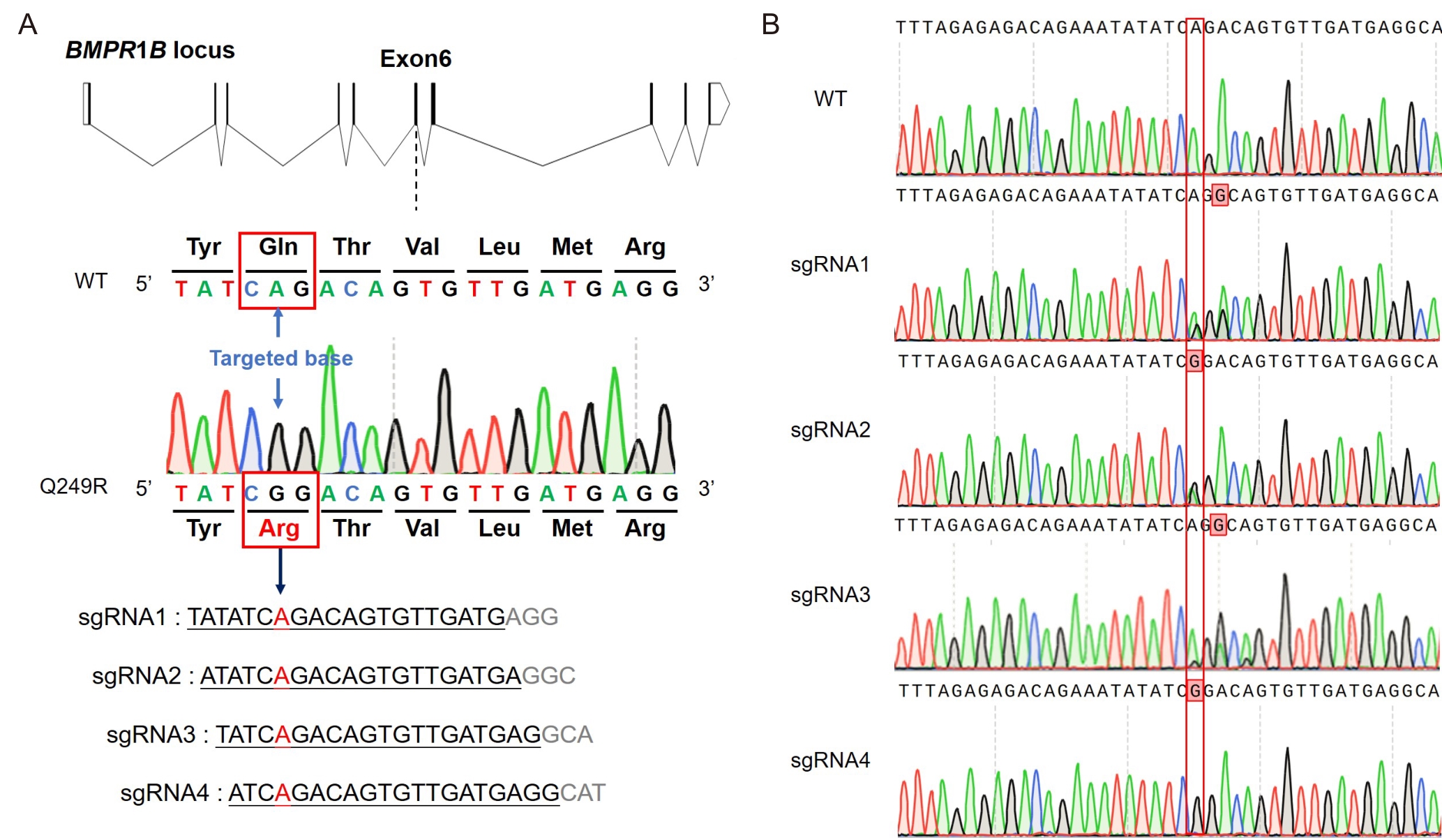
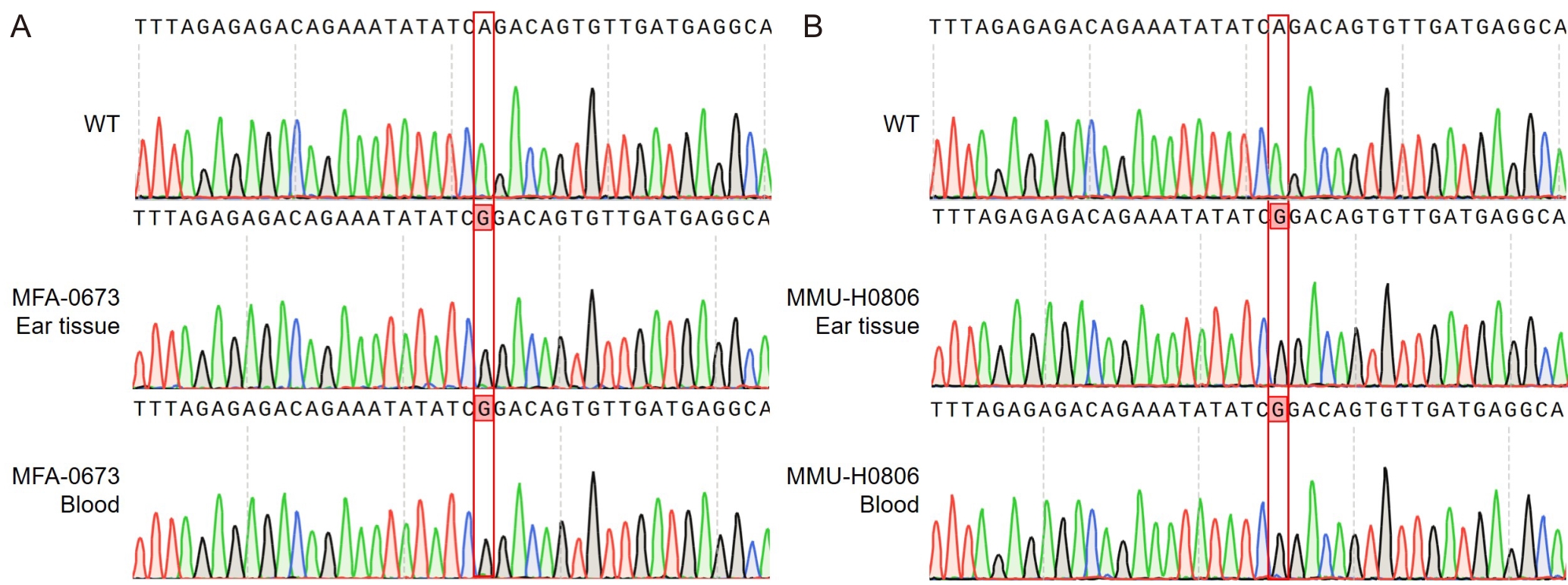
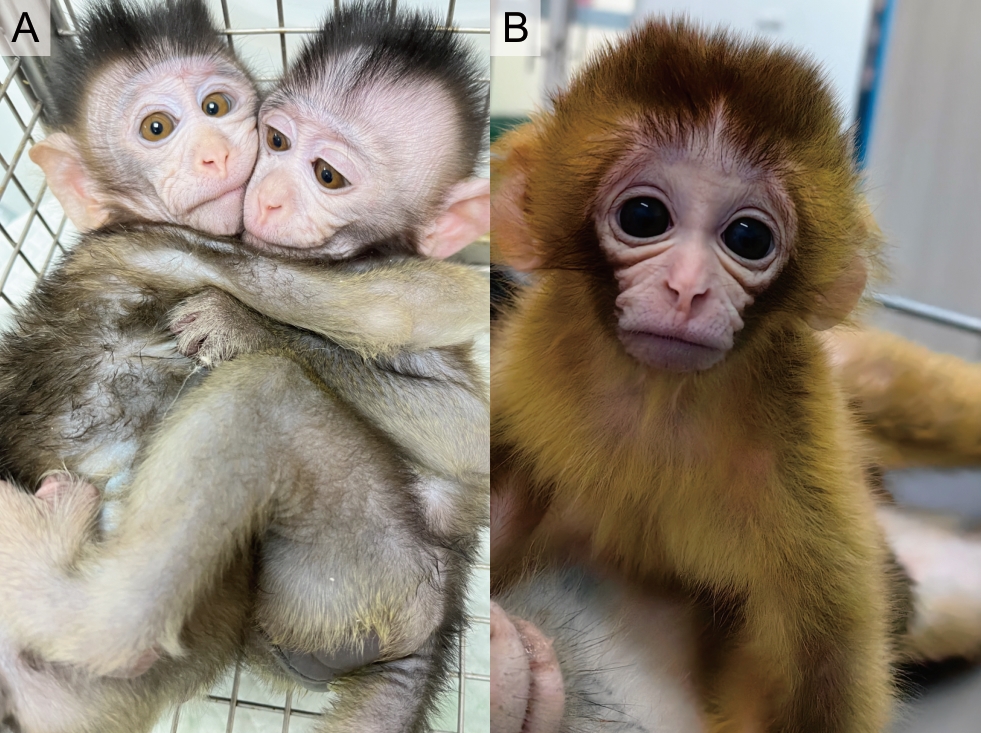
目的 利用腺嘌呤单碱基编辑技术构建携带绵羊多胎基因(Booroola fecundity,FecB)同源突变的骨形态发生蛋白受体1B(bone morphogenetic protein receptor type 1B,BMPR1B)基因(即BMPR1BFecB 同源突变)的食蟹猴和恒河猴模型,以探索提高实验猴繁殖性能的遗传改良策略。 方法 针对食蟹猴和恒河猴的BMPR1B基因c.746A>G位点设计4条单链向导RNA(single-guide RNAs,sgRNAs),同时结合ABE8e-SpRY单碱基编辑系统,将该编辑体系显微注射至两种猴的受精卵中。注射后的胚胎经体外培养,采用巢式PCR扩增检测目的位点碱基编辑效率,筛选高效率的sgRNA。随后将发育正常的基因编辑胚胎移植入代孕母猴输卵管内,待新生猴出生7 d后采集耳部皮肤和外周血液,进行基因型鉴定和嵌合率分析,并监测基因编辑猴的生长发育和健康状态。 结果 从4条候选sgRNAs中筛选到c.746A>G单碱基编辑效率达100%的sgRNA4,并通过胚胎移植获得存活仔猴17只,其中食蟹猴8只,恒河猴9只。基因型检测结果显示,8只新生食蟹猴均携带c.746A>G点突变,编辑效率为100%(8/8),其中嵌合体发生率为37.50%(3/8);9只新生恒河猴中8只携带c.746A>G突变,编辑效率为88.89%(8/9),其中嵌合体发生率为75.00%(6/8)。 结论 ABE8e-SpRY单碱基编辑系统可在食蟹猴和恒河猴胚胎中实现BMPR1B基因c.746A>G(p.Q249R)位点的定点编辑,成功建立了BMPR1BFecB 同源突变实验猴模型,为后续在非人灵长类动物水平研究BMPR1BFecB 同源突变对繁殖力的调控作用,以及探索实验猴繁殖性能遗传改良策略提供了重要的模型基础。

关键词: 骨形态发生蛋白受体1B, 单碱基编辑, BMPR1BFecB 同源突变, 食蟹猴, 恒河猴

Abstract:

Objective To generate cynomolgus and rhesus monkey models carrying the Booroola fecundity (FecB) variant of bone morphogenetic protein receptor type 1B (BMPR1B) gene (designated BMPR1BFecB ) using adenine base edit technology and to explore genetic improvement strategies for enhancing the reproductive performance of laboratory macaques. Methods Four single-guide RNAs (sgRNAs) were designed to target the BMPR1B c.746A>G locus in cynomolgus and rhesus monkeys. The sgRNAs were combined with the ABE8e-SpRY base editor, and the resulting editing complexes were microinjected into zygotes of both macaque species. Following in vitro culture of the injected embryos, nested PCR amplification was performed to detect the base-editing efficiency at the target site to screen for highly efficient sgRNAs. Subsequently, normally developing gene-edited embryos were transferred into the oviducts of surrogates. Seven days after birth, ear skin or peripheral blood samples were collected from the newborn monkeys for genotyping and mosaicism analysis, and the growth, development, and health status of the gene-edited monkeys were monitored. Results Among the four candidate sgRNAs, sgRNA4 was identified as achieving 100% editing efficiency at the c.746A>G site. A total of 17 live monkey offspring were obtained via embryo transfer, including 8 cynomolgus monkeys and 9 rhesus monkeys. Genotyping results showed that all 8 newborn cynomolgus monkeys carried the c.746A>G point mutation, with an editing efficiency of 100% (8/8), of which 37.50% (3/8) were mosaics. Among the 9 newborn rhesus monkeys, 8 individuals carried the c.746A>G mutation, with an editing efficiency of 88.89% (8/9), of which 75.00% (6/8) were mosaics. Conclusion The ABE8e-SpRY base-editing system enables precise editing at the c.746A>G (p.Q249R) locus of the BMPR1B gene in both cynomolgus and rhesus monkey embryos, resulting in the successful establishment of laboratory monkey models carrying the BMPR1BFecB variant. These models provide a valuable foundation for future studies of the regulatory role of the BMPR1BFecB variant in reproductive performance at the non‑human primate level, as well as for exploring genetic improvement strategies to enhance reproductive performance in laboratory monkeys.

Key words: Bone morphogenetic protein receptor type 1B, Base editing, BMPR1BFecB variant, Cynomolgus monkey, Rhesus monkey

中图分类号: