





实验动物与比较医学 ›› 2026, Vol. 46 ›› Issue (5): 616-628.DOI: 10.12300/j.issn.1674-5817.2025.145
张海涛1,2,3, 魏雅岚1,3, 范晓静1,2,3, 陈璐1,3, 庄旭东1,3, 王心睿1,2,3( )(
)( )
)
收稿日期:2025-09-03
修回日期:2025-10-17
出版日期:2026-10-25
发布日期:2026-10-16
通讯作者:
王心睿(1990—),男,博士,副研究员,主要从事复杂疾病系统生物学研究。E-mail:wanxinru@sjtu.edu.cn。ORCID: 0000-0002-7383-9128作者简介:基金资助:
ZHANG Haitao1,2,3, WEI Yalan1,3, FAN Xiaojing1,2,3, CHEN Lu1,3, ZHUANG Xudong1,3, WANG Xinrui1,2,3()()
Received:2025-09-03
Revised:2025-10-17
Published:2026-10-25
Online:2026-10-16
Correspondence to:
摘要:
目的 观察畲药十二时辰的三萜皂苷富集组分Fr.B4对苯酚诱导宫颈炎模型大鼠的体内抗炎作用,并初步探讨其作用途径。 方法 将30只6~8周龄的SPF级雌性SD大鼠随机分为对照组、模型组及十二时辰治疗组,每组10只。模型组及十二时辰治疗组采用25%苯酚胶阴道注射法造模(每2 d 1次,共3次),观察大鼠外阴及宫颈以判断造模效果;造模成功后,十二时辰治疗组每日灌胃290 mg/kg的三萜皂苷富集组分Fr.B4(溶于生理盐水),模型组给予等体积生理盐水,均持续2周;对照组未经造模处理且给予生理盐水2周。各组大鼠末次干预后,采集新鲜粪便、尿液,给予40 mg/kg舒泰-50麻醉后安乐死,采集血清及宫颈组织,采用ELISA法检测血清及宫颈组织中肿瘤坏死因子-α(tumor necrosis factor-α,TNF-α)、白细胞介素(interleukin,IL)-1β和IL-6含量;HE染色观察宫颈组织病理变化;液相色谱-质谱联用法分析粪便及尿液中差异代谢物,并进行KEGG通路富集与核心代谢物分析;16S rDNA测序分析各组大鼠的肠道菌群结构及多样性;采用GraphPad Prism 9.0进行统计学分析。 结果 与对照组相比,模型组大鼠出现宫颈红肿、糜烂,血清及宫颈组织中TNF-α、IL-1β、IL-6水平均显著升高(P<0.05或P<0.01),宫颈组织病理显示鳞状上皮增厚、炎症细胞浸润及水肿。与模型组相比,十二时辰Fr.B4治疗后,大鼠宫颈炎症状明显缓解,血清及宫颈组织中促炎因子水平显著降低(P<0.05或P<0.01),宫颈组织水肿减轻,炎症细胞减少,鳞状上皮增厚情况改善。代谢组学分析显示,模型组与对照组的粪便、尿液分别存在346、564个差异代谢物;十二时辰Fr.B4治疗后,粪便、尿液分别有236、451个代谢物水平显著回调,涉及环磷酸腺苷(cyclic adenosine monophosphate,cAMP)、腺苷酸活化蛋白激酶(AMP-activated protein kinase,AMPK)、谷胱甘肽代谢等通路,其中乳香酸、齐墩果酸等抗炎代谢物显著增加(P<0.01或P<0.001)。肠道菌群分析显示,模型组的菌群结构紊乱,厚壁菌门/拟杆菌门比值失衡;十二时辰Fr.B4可重塑菌群结构,α多样性向正常组逆转,且特定菌属与代谢物关联显著(P<0.05或P<0.01)。 结论 十二时辰三萜皂苷富集组分Fr.B4可能通过降低促炎因子水平、调节肠道菌群平衡及代谢重塑发挥抗宫颈炎作用。
中图分类号:
张海涛,魏雅岚,范晓静,等. 畲药十二时辰的三萜皂苷富集组分对宫颈炎模型大鼠的抗炎作用及其机制探索[J]. 实验动物与比较医学, 2026, 46(5): 616-628. DOI: 10.12300/j.issn.1674-5817.2025.145.
ZHANG Haitao,WEI Yalan,FAN Xiaojing,et al. Anti-Inflammatory Effects of the Triterpenoid Saponin-Enriched Fraction from She Medicine Clematis florida and Exploration of Its Mechanisms in a Rat Model of Cervicitis[J]. Laboratory Animal and Comparative Medicine, 2026, 46(5): 616-628. DOI: 10.12300/j.issn.1674-5817.2025.145.
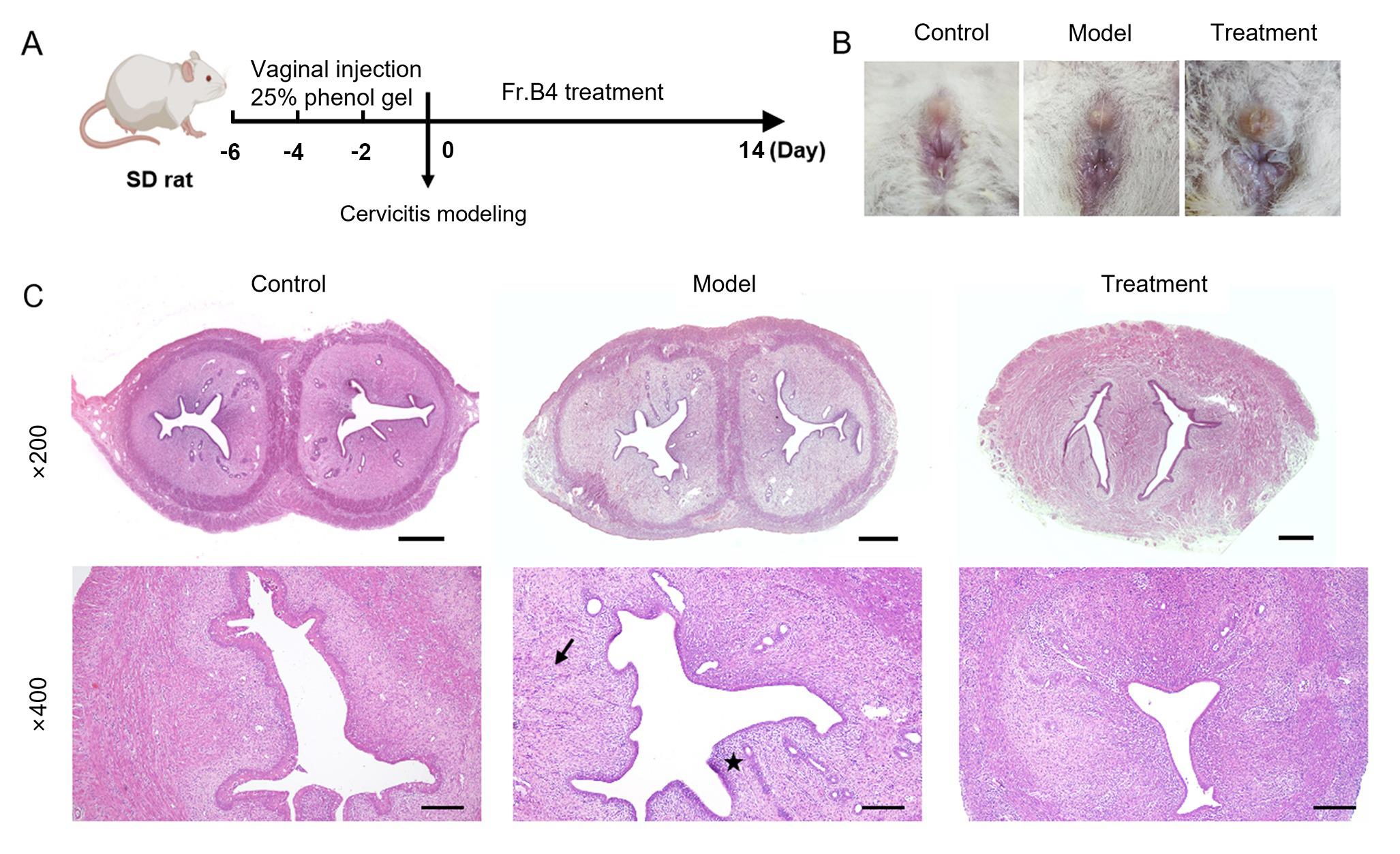
图1
Figure 1
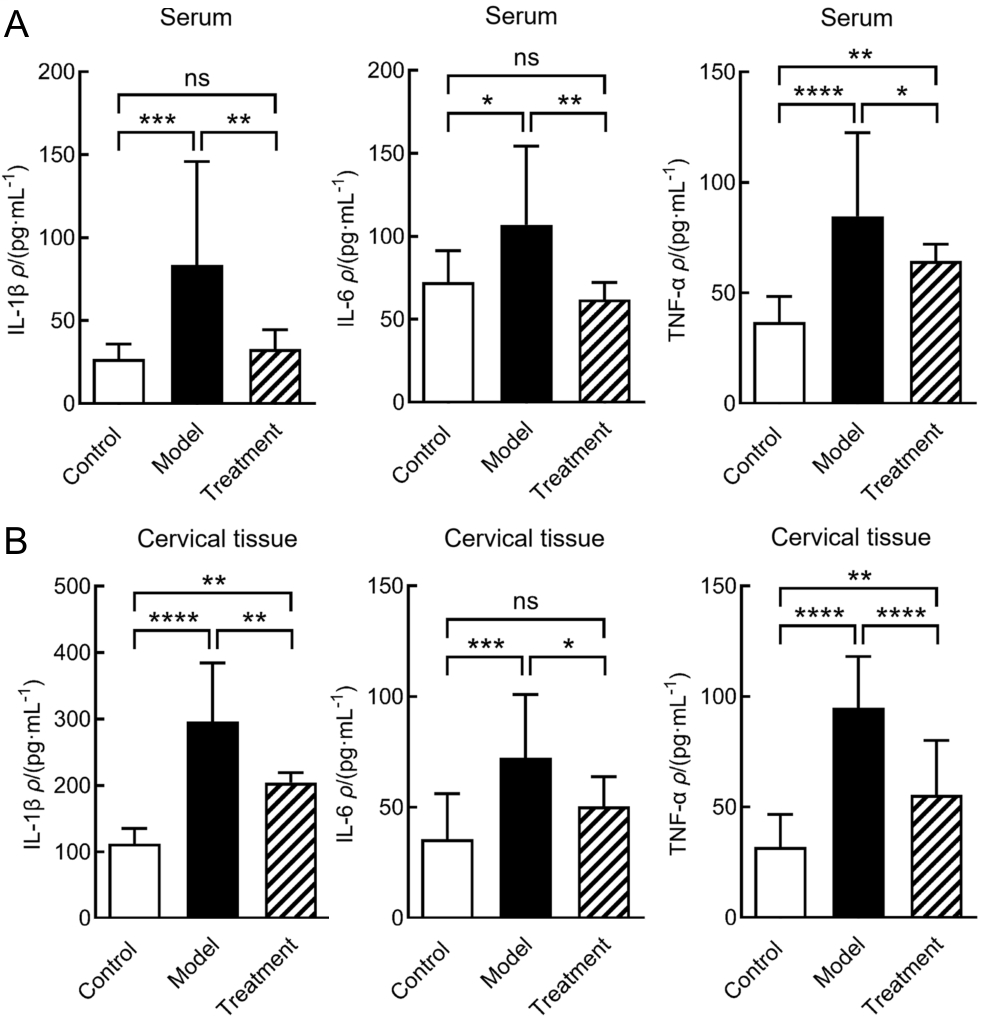
图2
Figure 2
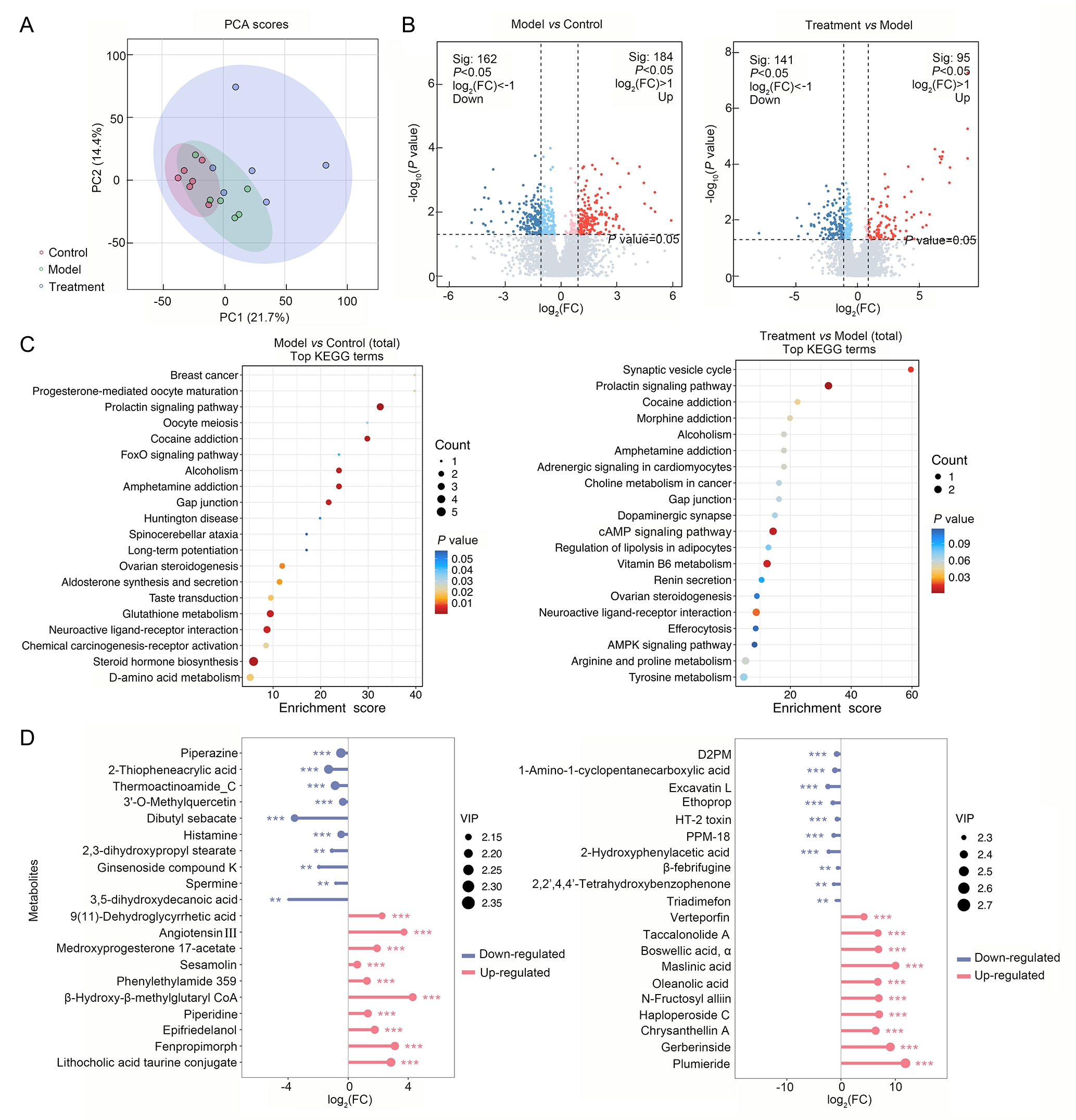
图3
Figure 3
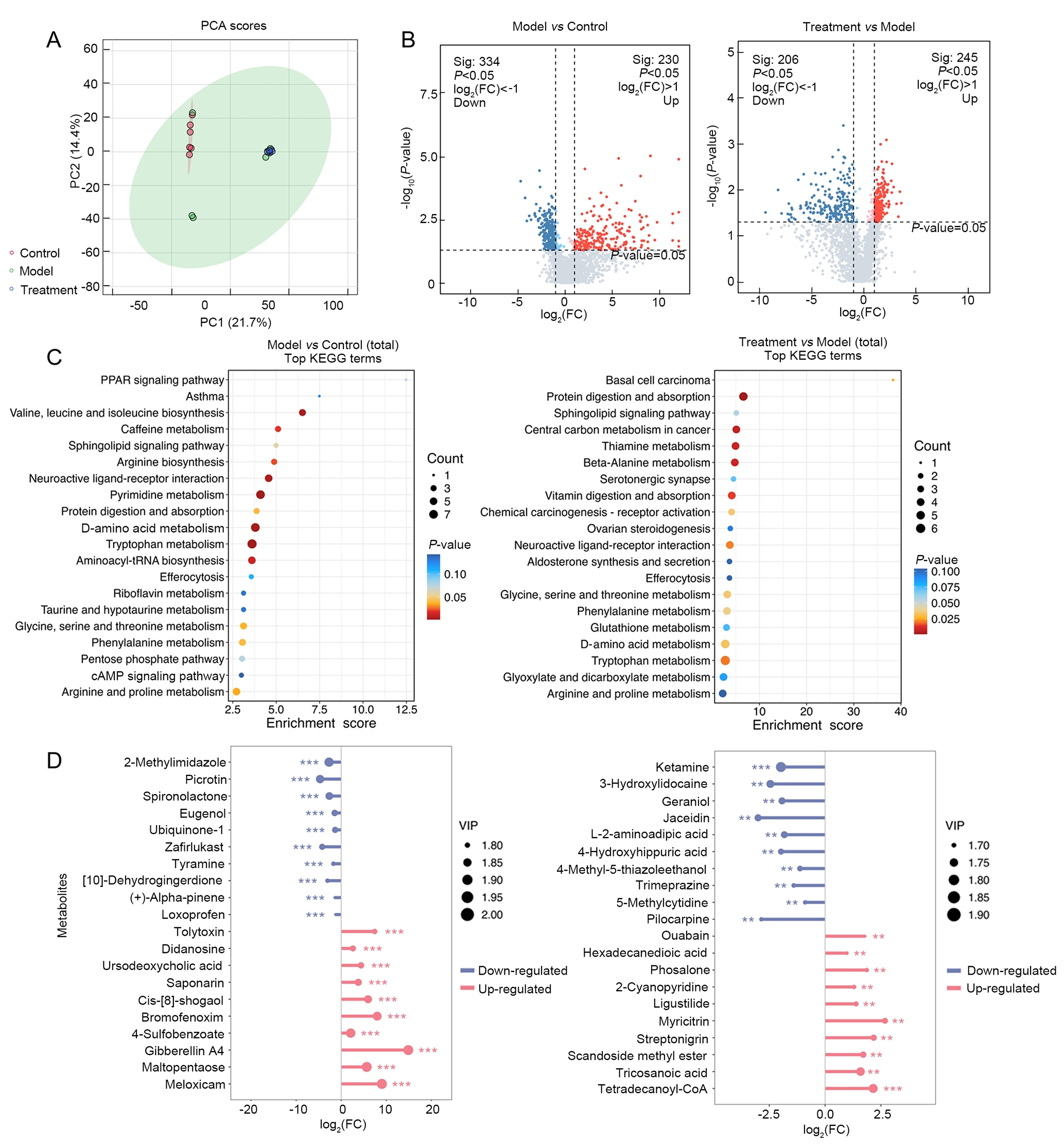
图4
Figure 4
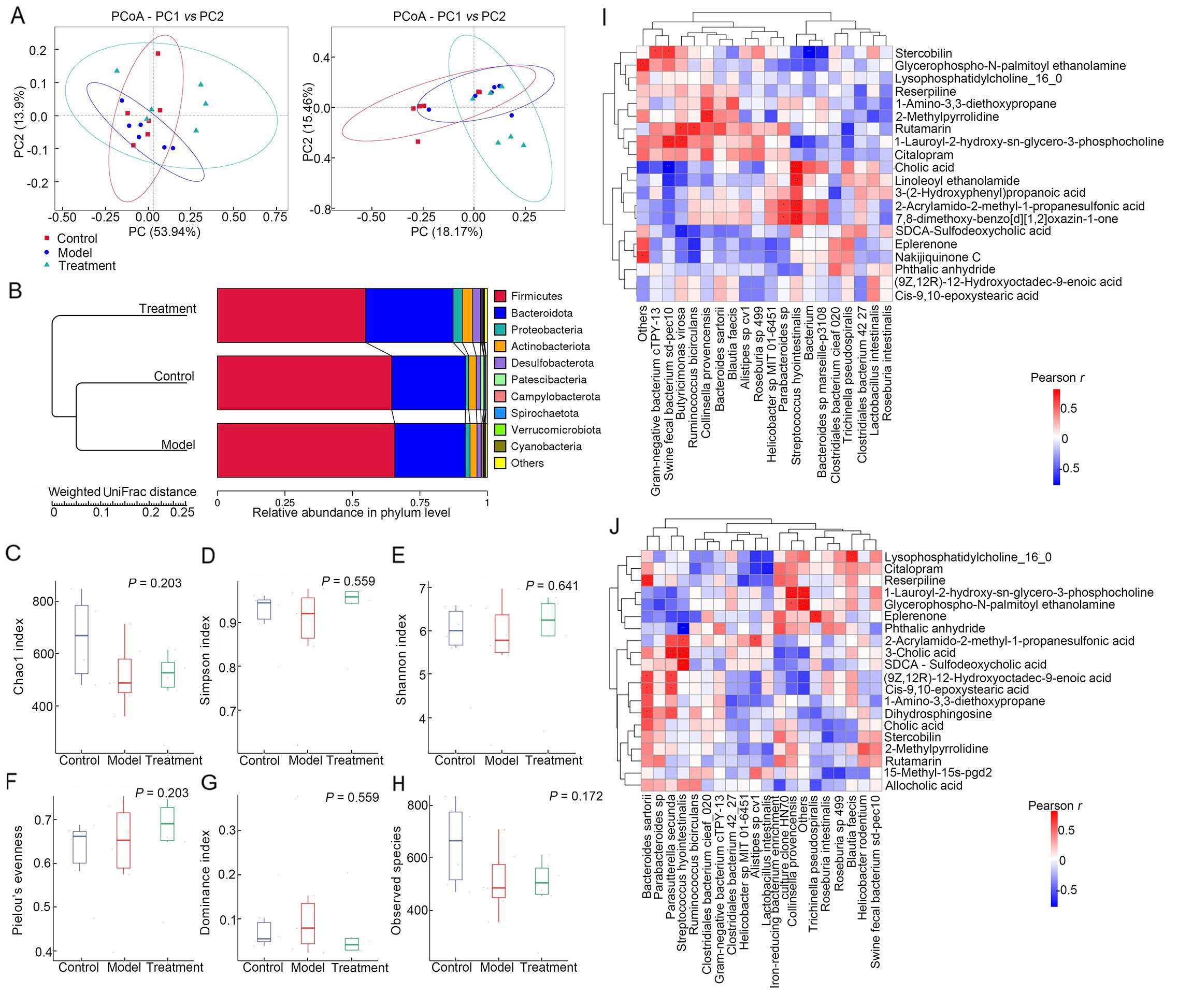
图5
Figure 5
| [1] |
董梦婷, 李佳, 李会阳, 等. 美国疾病控制和预防中心«子宫颈炎诊治指南(2021版)»解读[J]. 中国实用妇科与产科杂志, 2021, 37(10):1032-1033. DOI:10.19538/j.fk2021100112.
|
|
DONG M T, LI J, LI H Y, et al. Interpretation of diagnosis and treatment guidelines for cervicitis by American centers for disease control and prevention(2021 edition)[J]. Chin J Pract Gynecol Obstet, 2021, 37(10):1032-1033. DOI:10.19538/j.fk2021100112.
|
|
| [2] |
董梦婷, 薛凤霞. 急性子宫颈炎的诊断及鉴别诊断[J]. 中国实用妇科与产科杂志, 2024, 40(7):676-679. DOI:10.19538/j.fk2024070102.
|
|
DONG M T, XUE F X. Diagnosis and differential diagnosis of acute cervicitis[J]. Chin J Pract Gynecol Obstet, 2024, 40(7):676-679. DOI:10.19538/j.fk2024070102.
|
|
| [3] |
徐龙辰, 卢斯琪, 周佳孟, 等. 妇科千金胶囊联合抗菌药治疗慢性宫颈炎的Meta分析[J]. 药物评价研究, 2023, 46(6):1313-1322. DOI:10.7501/j.issn.1674-6376.2023.06.020.
|
|
XU L C, LU S Q, ZHOU J M, et al. Meta-analysis of Fuke Qianjin Capsule combined with antibiotics in treatment of chronic cervicitis[J]. Drug Eval Res, 2023, 46(6):1313-1322. DOI:10.7501/j.issn.1674-6376.2023.06.020.
|
|
| [4] |
SHROFF S. Infectious vaginitis, cervicitis, and pelvic inflammatory disease[J]. Med Clin North Am, 2023, 107(2):299-315. DOI:10.1016/j.mcna.2022.10.009.
|
| [5] |
叶任, 张滨, 沈珑慧, 等. 慢性宫颈炎解脲脲原体和人型支原体检出状况及其对常用抗菌药物耐药性[J]. 中华医院感染学杂志, 2025, 35(14):2140-2144. DOI:10.11816/cn.ni.2025-242114.
|
|
YE R, ZHANG B, SHEN L H, et al. Detection and drug resistance to commonly used antibiotics of Ureaplasma urealyticum and Mycoplasma hominis in chronic cervicitis patients[J]. Chin J Nosocomiology, 2025, 35(14):2140-2144. DOI:10.11816/cn.ni.2025-242114.
|
|
| [6] |
中国医学科学院皮肤病医院, 中国疾病预防控制中心性病控制中心, 中华医学会皮肤性病学分会性病学组, 等. 中国生殖支原体感染诊疗专家共识(2024)[J]. 中华皮肤科杂志, 2024, 57(3):201-208. DOI:10.35541/cjd.20230711.
|
|
China Academy of Medical Sciences Dermatology Hospital, China CDC Center for STD Control, Chinese Medical Association Dermatology and Venereology Branch STD Group. Expert consensus on diagnosis and treatment of Mycoplasma genitalium infection in China (2024)[J]. Chin J Dermatol, 2024, 57(3):201-208. DOI:10.35541/cjd.20230711.
|
|
| [7] |
甘隆莺. 保妇康栓联合人干扰素α-2b阴道泡腾片对慢性宫颈炎合并HPV感染的疾病控制效果[J]. 中国现代药物应用, 2025, 19(17):21-24. DOI:10.14164/j.cnki.cn11-5581/r.2025.17.005.
|
|
GAN L Y. The disease control effect of Baofukang suppository combined with human interferon α-2b vaginal effervescent tablets on chronic cervicitis complicated with HPV infection[J]. Chin J Mod Drug Appl, 2025, 19(17):21-24. DOI:10.14164/j.cnki.cn11-5581/r.2025.17.005.
|
|
| [8] |
盛雅倩, 魏乔. 龙胆泻肝汤加减联合保妇康栓治疗宫颈炎合并HPV感染的临床效果[J]. 临床合理用药, 2025, 18(19):29-33. DOI:10.15887/j.cnki.13-1389/r.2025.19.007.
|
|
SHENG Y Q, WEI Q. Clinical effect of modified Longdan Xiegan decoction combined with Baofukang suppository in the treatment of cervicitis complicated with HPV infection[J]. Chin J Clin Ration Drug Use, 2025, 18(19):29-33. DOI:10.15887/j.cnki.13-1389/r.2025.19.007.
|
|
| [9] |
沈廷明, 陈懿冲, 林立, 等. 畲药十二时辰(重瓣铁线莲)的研究进展[J]. 海峡药学, 2024, 36(12):25-27. DOI:10.3969/j.issn.1006-3765.2024.12.007.
|
|
SHEN T M, CHEN Y C, LIN L, et al. Research progress on the she medicine Clematis florida var. flore-pleno[J]. Strait Pharm J, 2024, 36(12):25-27. DOI:10.3969/j.issn.1006-3765.2024.12.007.
|
|
| [10] |
YANG N N, ZHANG Y F, ZHANG H T, et al. The in vitro and in vivo anti-inflammatory activities of triterpene saponins from Clematis florida[J]. Nat Prod Res, 2021, 35(24):6180-6183. DOI:10.1080/14786419.2020.1833203.
|
| [11] |
周春权, 雷婷, 赵立, 等. 畲药十二时辰醇提物外用对大鼠佐剂性关节炎的抗炎作用研究[J]. 中国民族民间医药, 2024, 33(17):23-26. DOI:10.3969/j.issn.1007-8517.2024.17.zgmzmjyyzz2024 17007.
|
|
ZHOU C Q, LEI T, ZHAO L, et al. Research on the anti-inflammatory effect of external application of the ethanol extract of Clematis florida on adjuvant-induced arthritis in rats[J]. Chin J Ethnomed Ethnopharmacy, 2024, 33(17):23-26. DOI:10.3969/j.issn.1007-8517.2024.17.zgmzmjyyzz202417007.
|
|
| [12] |
SHEN J H, WU Y, CAO F, et al. Effects of huzhangoside C on dextran sodium sulfate-stimulated colitis in mice[J]. J Med Food, 2024, 27(1):35-46. DOI:10.1089/jmf.2023.K.0154.
|
| [13] |
FU Q, ZAN K, ZHAO M B, et al. Triterpene saponins from Clematis chinensis and their potential anti-inflammatory activity[J]. J Nat Prod, 2010, 73(7):1234-1239. DOI:10.1021/np100057y.
|
| [14] |
FU Q, YANG M, MA Y, et al. Novel triterpene saponins isolated from Clematis mandshurica and their inhibitory activities on NO production[J]. Chin J Nat Med, 2018, 16(2):131-138. DOI:10.1016/S1875-5364(18)30039-6.
|
| [15] |
CHENG L, SHI L, WU J, et al. A hederagenin saponin isolated from Clematis ganpiniana induces apoptosis in breast cancer cells via the mitochondrial pathway[J]. Oncol Lett, 2018, 15(2):1737-1743. DOI:10.3892/ol.2017.7494.
|
| [16] |
SUN K H, MA X H, ZENG X M, et al. A new indole-type alkaloid from the roots of Clematis florida var. plena[J]. Nat Prod Res, 2019, 33(20):2925-2931. DOI:10.1080/14786419.2018.1510396.
|
| [17] |
张永红, 孙凯慧, 马新华, 等. 一种畲药十二时辰的提取物FrB4及其制备方法和运用: CN108837009B[P]. 2022-03-18.
|
|
ZHANG Y H, SUN K H, MA X H, et al. FrB4, an extract from the traditional Chinese medicine Twelve-Hour System, and its preparation method and applications: CN108837009B[P]. 2022-03-18.
|
|
| [18] |
谢俊大. 宫炎净片防治宫颈炎的药效学研究及机理初探[D]. 北京: 北京中医药大学, 2006.
|
|
XIE J D. Pharmacodynamic study and mechanism of Gongyanjing tablets in the prevention and treatment of cervicitis[D]. Beijing: Beijing University of Chinese Medicine, 2006.
|
|
| [19] |
王广龙, 张锁. 苯酚胶浆在妇科疾病动物模型中的应用[J]. 中国实验动物学报, 2025, 33(5):770-778. DOI:10.3969/j.issn.1005-4847.2025.05.014.
|
|
WANG G L, ZHANG S. Application of phenolic adhesive slurry in animal models of gynecological diseases[J]. Acta Lab Anim Sci Sin, 2025, 33(5):770-778. DOI:10.3969/j.issn.1005-4847.2025.05.014.
|
|
| [20] |
许涵, 王静, 孙丽妍, 等. 槲皮素对宫颈炎大鼠阴道微生态、局部细胞因子及PI3K、Akt蛋白的影响[J]. 检验医学与临床, 2025, 22(8):1061-1066, 1076. DOI:10.3969/j.issn.1672-9455.2025.08.011.
|
|
XU H, WANG J, SUN L Y, et al. Effects of quercetin on vaginal microecology, local cytokines, PI3K and Akt in cervicitis rats[J]. Lab Med Clin, 2025, 22(8):1061-1066, 1076. DOI:10.3969/j.issn.1672-9455.2025.08.011.
|
|
| [21] |
LIU T C, WANG R Q, LIU C P, et al. Active substances from Callicarpa nudiflora exert anti-cervicitis effects and regulate NLRP3-associated inflammation[J]. Molecules, 2021, 26(20):6217. DOI:10.3390/molecules26206217.
|
| [22] |
梁潇, 王文敏, 袁岭, 等. 迷迭香酸抗宫颈炎作用及机制研究[J]. 江西中医药, 2025, 56(6):61-64, 68. DOI:10.20141/j.0411-9584.2025.06.17.
|
|
LIANG X, WANG W M, YUAN L, et al. Study on the anti-cervicitis effect and mechanism of rosmarinic acid[J]. Jiangxi J Tradit Chin Med, 2025, 56(6):61-64, 68. DOI:10.20141/j.0411-9584.2025.06.17.
|
|
| [23] |
ZHU B, TAO Z, EDUPUGANTI L, et al. Roles of the microbiota of the female reproductive tract in gynecological and reproductive health[J]. Microbiol Mol Biol Rev, 2022, 86(4): 1-25. DOI:10.1128/mmbr.00181-21.
|
| [24] |
HE C, LI B, GONG Z, et al. Polyphosphate kinase 1 is involved in formation, the morphology and ultramicrostructure of biofilm of Mycobacterium smegmatis and its survivability in macrophage[J]. Heliyon, 2023, 9(3): e14513. DOI:10.1016/j.heliyon.2023.e14513.
|
| [25] |
LIN X B, AN X F, WANG L L, et al. Ainsliaea fragrans champ. Extract prevents cervicitis in BALB/c mice and regulates MyD88-NF-κB signaling pathway in MALP-2-stimulated RAW264.7 cells[J]. J Ethnopharmacol, 2021, 269:113684. DOI:10.1016/j.jep.2020.113684.
|
| [26] |
ZHANG X Y, HE M Z, LEI S X, et al. An integrative investigation of the therapeutic mechanism of Ainsliaea fragrans Champ. in cervicitis using liquid chromatography tandem mass spectrometry based on a rat plasma metabolomics strategy[J]. J Pharm Biomed Anal, 2018, 156:221-231. DOI:10.1016/j.jpba.2018.04.048.
|
| [27] |
LI A, LI F, SONG W, et al. Gut microbiota-bile acid-vitamin D axis plays an important role in determining oocyte quality and embryonic development[J]. Clin Transl Med, 2023, 13: e1236. DOI:10.1002/ctm2.1236.
|
| [28] |
ASHONIBARE V J, AKOREDE B A, ASHONIBARE P J, et al. Gut microbiota-gonadal axis: the impact of gut microbiota on reproductive functions[J]. Front Immunol, 2024, 15:1346035. DOI:10.3389/fimmu.2024.1346035.
|
| [29] |
ZHAO Y N, YUAN M Y, SUN X D, et al. The Chinese herbal prescription Kang-Gong-Yan alleviates cervicitis by modulating metabolites and gut microbiota[J]. Pharm Biol, 2024, 62(1):341-355. DOI:10.1080/13880209.2024.2318791.
|
| [30] |
SONG G Y, XIE Y X, YI L L, et al. Bile acids affect intestinal barrier function through FXR and TGR5[J]. Front Med, 2025, 12:1-10. DOI:10.3389/fmed.2025.1607899.
|
| [31] |
MA P, OU Y. Correlation between the dopaminergic system and inflammation disease: a review[J]. Mol Biol Rep, 2023, 50(8):7043-7053. DOI:10.1007/s11033-023-08610-2.
|
| [1] | 田艳, 赖冬, 赖飞, 姬长甫. 脓毒症大鼠模型肝素结合蛋白含量变化与凝血功能紊乱和血管内皮损伤的关系[J]. 实验动物与比较医学, 2026, 46(5): 700-706. |
| [2] | 李杨锦, 吴珍红, 黄宗锈. 灵芝孢子油对大鼠28天经口毒性试验研究[J]. 实验动物与比较医学, 2026, 46(5): 660-667. |
| [3] | 陈婉琳, 董庆睿, 李孟淘, 林楠, 赵虎, 张再重, 曾令军, 李佩, 杨劲, 王瑜, 黄爱文. 纳米碳-二氧化锰注射液在大鼠和猪胃肠道染色标记定位中的应用[J]. 实验动物与比较医学, 2026, 46(5): 727-739. |
| [4] | 张攀攀, 许金森, 程佑民, 吴华嵩, 林静瑜. 一种痰湿证慢性阻塞性肺疾病大鼠模型的建立与评价[J]. 实验动物与比较医学, 2026, 46(5): 668-676. |
| [5] | 练荣贵, 廖乃顺. 稀土下转换纳米颗粒标记脂肪间充质干细胞治疗亚急性肝损伤的活体示踪研究[J]. 实验动物与比较医学, 2026, 46(5): 716-726. |
| [6] | 艾秀峰, 张利棕, 方明笋, 吕东颖, 陈楚, 蔡兆伟, 王德军. 16S rRNA测序分析饮用含氯水对大鼠和小鼠肠道菌群的影响差异[J]. 实验动物与比较医学, 2026, 46(3): 437-445. |
| [7] | 秦超, 李双星, 赵婷婷, 蒋晨晨, 赵晶, 杨艳伟, 林志, 王三龙, 文海若. 药物安全评价用SD大鼠90 d喂养试验的背景数据研究[J]. 实验动物与比较医学, 2025, 45(4): 439-448. |
| [8] | 潘颐聪, 蒋汶洪, 胡明, 覃晓. 慢性肾脏病大鼠主动脉钙化模型的术式优化及效果评价[J]. 实验动物与比较医学, 2025, 45(3): 279-289. |
| [9] | 沈黄奕, 黄宇飞, 杨云鹏. 实验动物肠道菌群特征分析及性别差异性的研究进展[J]. 实验动物与比较医学, 2025, 45(3): 349-359. |
| [10] | 方茜, 敖青青, 李春宏, 欧阳轶强, 郭松超, 胡冰. 树鼩乳腺肿瘤模型的代谢组学分析[J]. 实验动物与比较医学, 2024, 44(1): 52-61. |
| [11] | 陆涛峰, 张慧, 周洁, 李倩, 吴曙光, 吴延军. 广藿香对贵州小型猪血清代谢组的影响及其机制探讨[J]. 实验动物与比较医学, 2023, 43(3): 253-261. |
| [12] | 葛健, 孙静芬, 吴永杰. 牛磺酸对苯扎氯铵损伤大鼠眼角膜内皮细胞无保护作用[J]. 实验动物与比较医学, 2023, 43(1): 39-43. |
| [13] | 许琴, 倪艳, 是文辉, 李建瑛, 刘江伟, 赵红琼, 徐新明. SPF级雄性SD大鼠回肠与结肠菌群结构比较分析[J]. 实验动物与比较医学, 2023, 43(1): 53-60. |
| [14] | 张笑瑞, 曹静, 吴倩倩, 刘季俊, 陈国元, 吴宝金. 不同剂型普罗布考对大鼠肠系膜淋巴转运及药代动力学的影响[J]. 实验动物与比较医学, 2022, 42(4): 275-283. |
| [15] | 赵斯佳, 何新宇, 景泉, 马林, 郭春岚, 万阔. 大鼠急性牙髓炎痛敏模型的疼痛效应评价[J]. 实验动物与比较医学, 2022, 42(4): 333-341. |
| 阅读次数 | ||||||
|
全文 |
|
|||||
|
摘要 |
|
|||||
