


实验动物与比较医学 ›› 2026, Vol. 46 ›› Issue (1): 107-118.DOI: 10.12300/j.issn.1674-5817.2025.049
李莉, 李学波, 樊永恒, 贺东华, 李剑洪, 常亮堂( )
)
收稿日期:2025-03-25
修回日期:2025-07-14
出版日期:2026-02-25
发布日期:2026-02-14
通讯作者:
常亮堂(1982—),男,硕士,高级实验师,研究方向:灵长类行为实验研究。E-mail: changliangtang@ion.ac.cn。ORCID: 0009-0000-5308-3792作者简介:李莉(1996—),女,硕士,实验师,研究方向:实验动物医学。E-mail: lil@ion.ac.cn
LI Li, LI Xuebo, FAN Yongheng, HE Donghua, LI Jianhong, CHANG Liangtang()
Received:2025-03-25
Revised:2025-07-14
Published:2026-02-25
Online:2026-02-14
Correspondence to:
CHANG Liangtang (ORCID: 0009-0000-5308-3792), E-mail: changliangtang@ion.ac.cn摘要:
普通狨猴(common marmoset,Callithrix jacchus)是灵长目狨科狨属动物。普通狨猴是研究神经科学、医学、药学的重要科研资源,普通狨猴动物资源的饲养繁育是重要的科研支撑。目前,中国普通狨猴资源正处于发展的重要阶段。本文以中国科学院脑科学与智能技术卓越创新中心(以下简称本中心)为例,深入探讨普通狨猴饲养繁育与遗传管理经验。在饲养环境及设施方面,在国家标准基础上对环境温度、相对湿度、换气次数、沉降菌平均浓度执行更为严格的环境参数标准,设计了普通狨猴繁殖和实验的2种饲养笼具;依据设施和人力条件的不同,介绍了“干养”和“湿养”结合的清洁维护模式。在饲喂管理方面,为满足普通狨猴高营养需求自制特殊日粮,介绍了普通狨猴由自制日粮和颗粒料混合食物向纯商品粮饲喂的过渡方法,严格把控自制普通狨猴日粮的操作环节并积累一系列预防普通狨猴营养代谢病的方法。在动物健康管理方面,通过定期检疫、隔离治疗和流行病预防等措施保障普通狨猴健康,详细说明了普通狨猴健康检查流程,随后依据普通狨猴体况进行分级分类管理,并简要介绍了普通狨猴常见的腹泻和肺炎的治疗方法。在繁育管理方面,涵盖种猴挑选、配种合笼、分笼管理及仔猴人工饲养,并从动物福利角度介绍了人工饲养仔猴回归亲代的饲养方法。在遗传管理方面,本中心普通狨猴为封闭群,采用的是非近亲繁殖法,开发了近亲筛查系统,在动物配对前查询近亲信息以避免近亲繁殖;本中心在不从外部引入新个体的条件下,已连续繁殖5代,遗传组成具有杂合性。本文仅探讨普通狨猴的饲养繁育及遗传管理,以期为其他饲养普通狨猴的机构提供有益借鉴。
中图分类号:
李莉,李学波,樊永恒,等. 普通狨猴饲养繁育与遗传管理经验探讨[J]. 实验动物与比较医学, 2026, 46(1): 107-118. DOI: 10.12300/j.issn.1674-5817.2025.049.
LI Li,LI Xuebo,FAN Yongheng,et al. Experience Discussion on Feeding, Breeding and Genetic Management of Common Marmosets (Callithrix jacchus)[J]. Laboratory Animal and Comparative Medicine, 2026, 46(1): 107-118. DOI: 10.12300/j.issn.1674-5817.2025.049.
项目 Program | 《实验动物 环境及设施》(GB 14925—2023) Laboratory Animal─Environment and Housing Facilities: GB 14925─2023 | 执行标准(本中心) Implemented standards (Center for Excellence in Brain Science and Intelligence Technology, Chinese Academy of Sciences) |
|---|---|---|
环境类别 Environmental category | 普通环境 | 普通环境 |
温度/℃ Temperature/℃ | 16~28 | 25~28 |
日温差/℃ Daily temperature difference/℃ | ≤4 | ≤4 |
换气次数/(次·h-1) Air change rate/(air changes per hour, ACH) | ≥8 | ≥12 |
相对湿度/% Relative humidity/% | 30~70 | ≤60 |
动物笼具周边处气流速度/(m·s-1) Airflow velocity around animal cages/(m·s-1) | ≤0.20 | ≤0.20 |
噪声/dB(A) Noise/dB(A) | ≤60 | ≤60 |
工作照度/lx Working illuminance/lx | ≥150 | ≥200 |
动物照度/lx Animal illuminance/lx | 100~200 | 100~200 |
与相通区域的静压差/Pa Static pressure difference relative to adjacent area/Pa | — | — |
空气洁净度/级别 Air cleanliness/level | — | — |
沉降菌平均浓度/CFU·(皿·0.5 h)-1 Average concentration of sedimentation bacteria/CFU(plate·0.5 h)-1 | — | ≤30 |
氨浓度/(mg·m-3) Ammonia concentration/(mg·m-3) | ≤14 | ≤14 |
光照周期(明暗交替)/h Light cycle (light-dark cycle)/h | 12~14/12~10 | 12/12 |
表1 普通狨猴饲养环境参数指标
Table 1 Environmental parameter indicators for raising common marmosets
项目 Program | 《实验动物 环境及设施》(GB 14925—2023) Laboratory Animal─Environment and Housing Facilities: GB 14925─2023 | 执行标准(本中心) Implemented standards (Center for Excellence in Brain Science and Intelligence Technology, Chinese Academy of Sciences) |
|---|---|---|
环境类别 Environmental category | 普通环境 | 普通环境 |
温度/℃ Temperature/℃ | 16~28 | 25~28 |
日温差/℃ Daily temperature difference/℃ | ≤4 | ≤4 |
换气次数/(次·h-1) Air change rate/(air changes per hour, ACH) | ≥8 | ≥12 |
相对湿度/% Relative humidity/% | 30~70 | ≤60 |
动物笼具周边处气流速度/(m·s-1) Airflow velocity around animal cages/(m·s-1) | ≤0.20 | ≤0.20 |
噪声/dB(A) Noise/dB(A) | ≤60 | ≤60 |
工作照度/lx Working illuminance/lx | ≥150 | ≥200 |
动物照度/lx Animal illuminance/lx | 100~200 | 100~200 |
与相通区域的静压差/Pa Static pressure difference relative to adjacent area/Pa | — | — |
空气洁净度/级别 Air cleanliness/level | — | — |
沉降菌平均浓度/CFU·(皿·0.5 h)-1 Average concentration of sedimentation bacteria/CFU(plate·0.5 h)-1 | — | ≤30 |
氨浓度/(mg·m-3) Ammonia concentration/(mg·m-3) | ≤14 | ≤14 |
光照周期(明暗交替)/h Light cycle (light-dark cycle)/h | 12~14/12~10 | 12/12 |
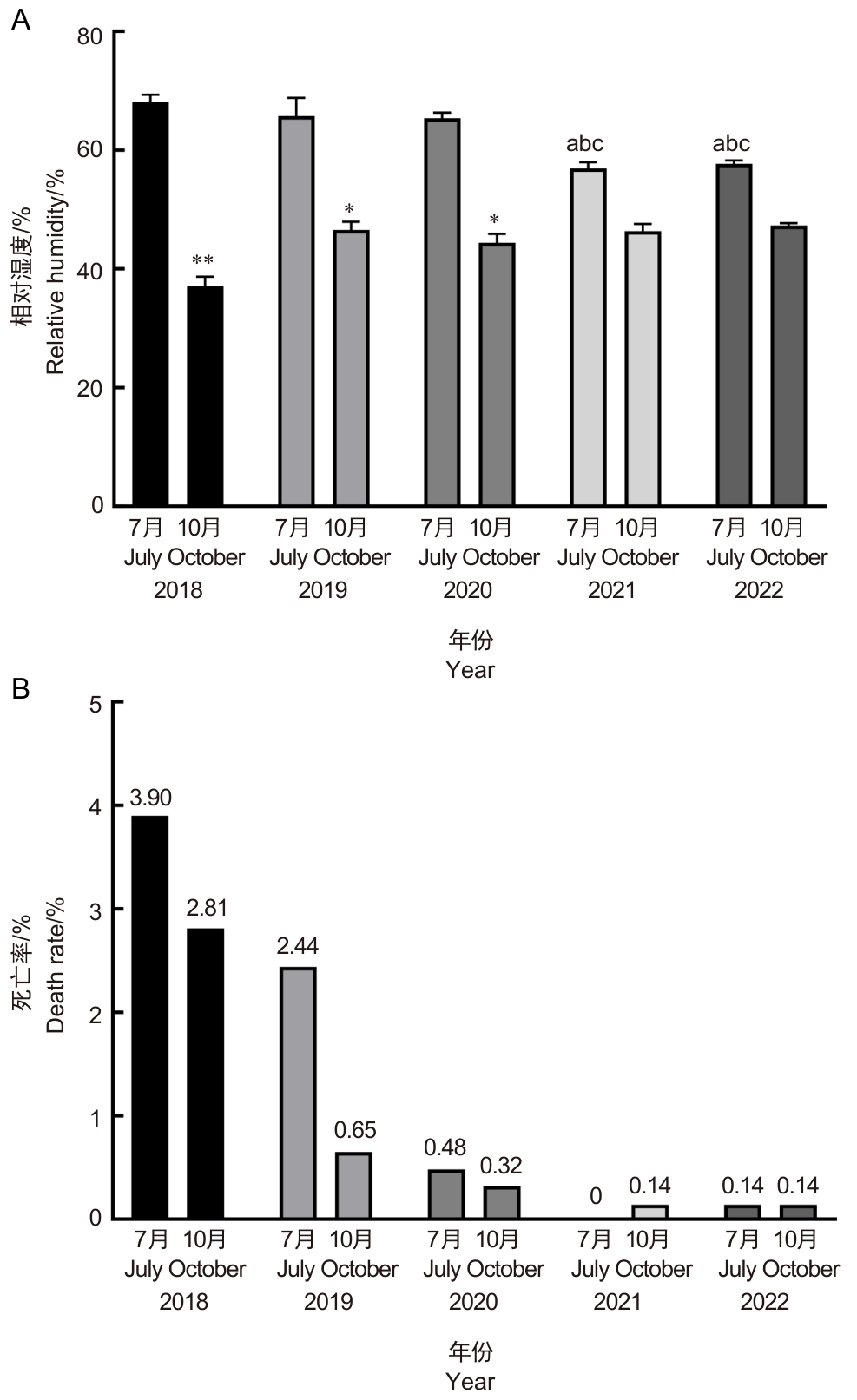
图1 2018—2022年中国科学院脑科学与智能技术卓越创新中心7月和10月普通狨猴房相对湿度与动物死亡率
Figure 1 Relative humidity and animal mortality in the common marmoset room at the Center for Excellence in Brain Science and Intelligence Technology, Chinese Academy of Sciences(July and October, 2018–2022)
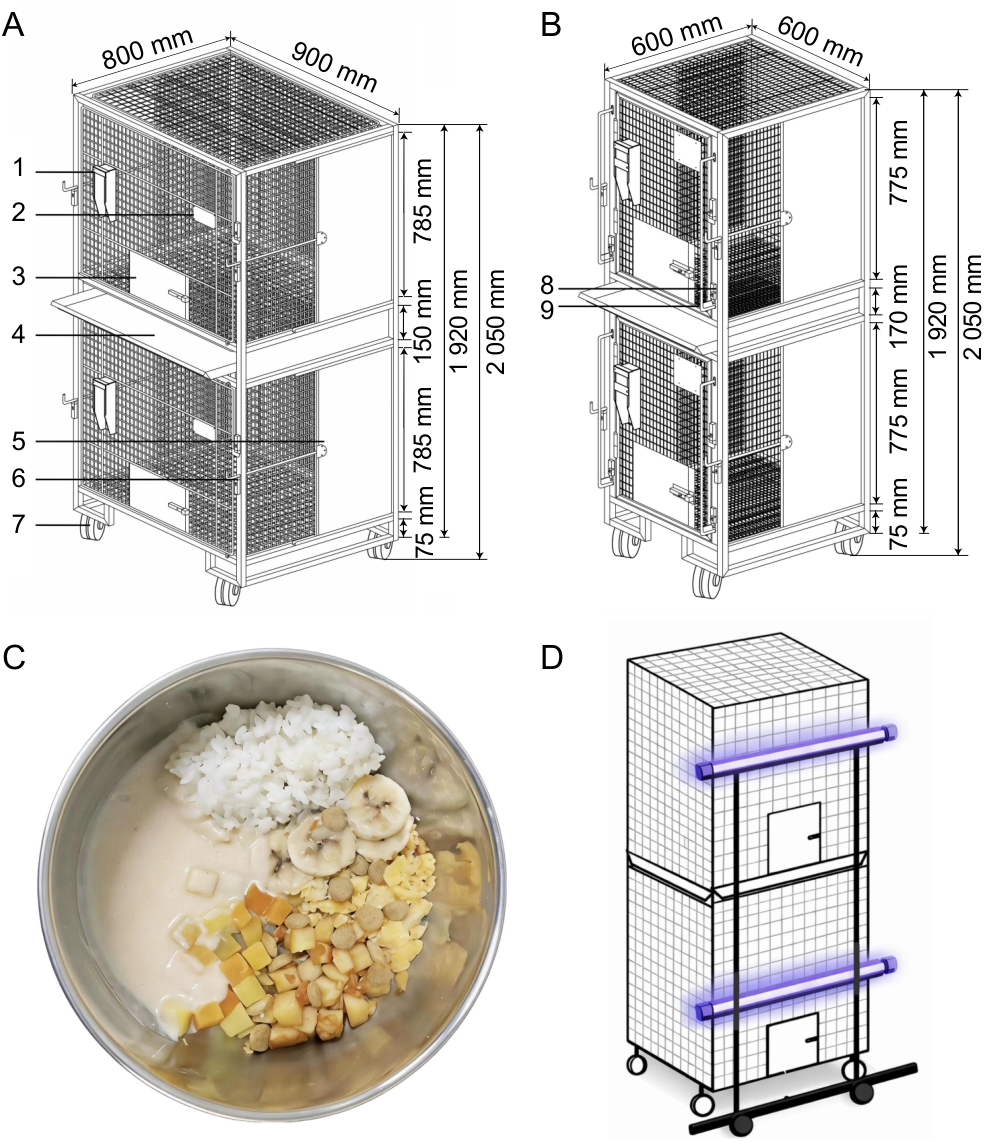
图2 普通狨猴饲养笼、自制日粮和308 nm紫外线灯照射方式
Figure 2 Common marmoset feeding cage, formulated diets, and 308 nm ultraviolet lamp irradiation methods
位置/物体 Location/Object | 清洁方式 Cleaning method | 清洁频次 Cleaning frequency | 消毒类型 Disinfection type | 消毒剂(浓度) Disinfectant (concentration) | 消毒频次 Disinfection frequency |
|---|---|---|---|---|---|
笼具表面、粪盘、笼具食盒和玩具(笼内有动物) Cage surfaces, fecal trays, food containers and toys (with animals inside cages) | 高压水枪冲洗晾干 | 1次/周 | 喷洒 | 消毒剂轮换使用:派斯德百毒杀(1∶600)、BCL百卫士(1∶200)、二氧化氯(2 mg/L) | 2次/周 |
笼具彻底清洁(笼内无动物) Thorough cleaning of cages (without animals inside cages) | 高压水枪冲洗烘干 | 3次/年(湿养), 1次/周(干养) | 喷洒 | 消毒剂轮换使用:派斯德百毒杀(1∶600)、84消毒液(1∶400)、苯扎溴铵(0.1%)、二氧化氯(50 mg/L)、BCL百卫士(1∶200) | 2次/周 |
非饲养间 Non-animal rooms | 扫拖/ 擦拭 | 1次/d | 喷雾/ 紫外线 | 消毒剂轮换使用:84消毒液(1∶400)、苯扎溴铵(0.1%)、二氧化氯(50 mg/L) | 1次/d |
饲养间 Animal rooms | 高压水枪冲洗 | 1~2次/周 | 喷洒 | 消毒剂轮换使用:派斯德百毒杀(1∶600)、苯扎溴铵(0.1%)、二氧化氯(50 mg/L) | 2次/周 |
空调和换气扇 Air conditioners and ventilation fans | 擦拭 | 2次/年 | 喷洒 | 消毒剂轮换使用:派斯德百毒杀(1∶600)、苯扎溴铵(0.1%)、二氧化氯(50 mg/L) | 2次/年 |
消毒垫 Disinfection mats | 冲洗 | 1次/周 | 浸泡 | 消毒剂轮换使用:84消毒液(1∶400)、二氧化氯(50 mg/L) | 1次/d |
垫料(纸质) Disposable paper bedding | 一次性 使用 | 更换 3次/周 | 紫外线 | 紫外线照射30 min | 使用前 |
碗具 Bowls | 浸泡清洗 | 1次/d | 浸泡+高温 消毒 | 消毒剂轮换使用:84消毒液(1∶200)、派斯德百毒杀(1∶600)、苯扎溴铵(0.1%)、二氧化氯(50 mg/L)、BCL百卫士(1∶200) | 1次/d |
饮水瓶 Water bottles | 浸泡清洗 | 1次/周 | 浸泡+高温 消毒 | 消毒剂轮换使用:84消毒液(1∶200)、派斯德百毒杀(1∶600)、苯扎溴铵(0.1%)、二氧化氯(50 mg/L)、苯扎溴铵(0.1%) | 1次/周 |
抓捕工具 Capture tools | 清水冲洗 | 1次/月 | 喷洒/浸泡 | 消毒剂轮换使用:75%乙醇溶液、派斯德百毒杀(1∶600)、二氧化氯(50 mg/L)、苯扎溴铵(0.1%) | 1次/月 |
苹果 Apples | 清水冲洗 | 每次日粮 制作前 | 浸泡 | 84消毒液(1∶400) | 每次日粮制作前 |
表2 普通狨猴饲养设施及物料清洁与消毒
Table 2 Cleaning and disinfection of facilities and equipment for raising common marmosets
位置/物体 Location/Object | 清洁方式 Cleaning method | 清洁频次 Cleaning frequency | 消毒类型 Disinfection type | 消毒剂(浓度) Disinfectant (concentration) | 消毒频次 Disinfection frequency |
|---|---|---|---|---|---|
笼具表面、粪盘、笼具食盒和玩具(笼内有动物) Cage surfaces, fecal trays, food containers and toys (with animals inside cages) | 高压水枪冲洗晾干 | 1次/周 | 喷洒 | 消毒剂轮换使用:派斯德百毒杀(1∶600)、BCL百卫士(1∶200)、二氧化氯(2 mg/L) | 2次/周 |
笼具彻底清洁(笼内无动物) Thorough cleaning of cages (without animals inside cages) | 高压水枪冲洗烘干 | 3次/年(湿养), 1次/周(干养) | 喷洒 | 消毒剂轮换使用:派斯德百毒杀(1∶600)、84消毒液(1∶400)、苯扎溴铵(0.1%)、二氧化氯(50 mg/L)、BCL百卫士(1∶200) | 2次/周 |
非饲养间 Non-animal rooms | 扫拖/ 擦拭 | 1次/d | 喷雾/ 紫外线 | 消毒剂轮换使用:84消毒液(1∶400)、苯扎溴铵(0.1%)、二氧化氯(50 mg/L) | 1次/d |
饲养间 Animal rooms | 高压水枪冲洗 | 1~2次/周 | 喷洒 | 消毒剂轮换使用:派斯德百毒杀(1∶600)、苯扎溴铵(0.1%)、二氧化氯(50 mg/L) | 2次/周 |
空调和换气扇 Air conditioners and ventilation fans | 擦拭 | 2次/年 | 喷洒 | 消毒剂轮换使用:派斯德百毒杀(1∶600)、苯扎溴铵(0.1%)、二氧化氯(50 mg/L) | 2次/年 |
消毒垫 Disinfection mats | 冲洗 | 1次/周 | 浸泡 | 消毒剂轮换使用:84消毒液(1∶400)、二氧化氯(50 mg/L) | 1次/d |
垫料(纸质) Disposable paper bedding | 一次性 使用 | 更换 3次/周 | 紫外线 | 紫外线照射30 min | 使用前 |
碗具 Bowls | 浸泡清洗 | 1次/d | 浸泡+高温 消毒 | 消毒剂轮换使用:84消毒液(1∶200)、派斯德百毒杀(1∶600)、苯扎溴铵(0.1%)、二氧化氯(50 mg/L)、BCL百卫士(1∶200) | 1次/d |
饮水瓶 Water bottles | 浸泡清洗 | 1次/周 | 浸泡+高温 消毒 | 消毒剂轮换使用:84消毒液(1∶200)、派斯德百毒杀(1∶600)、苯扎溴铵(0.1%)、二氧化氯(50 mg/L)、苯扎溴铵(0.1%) | 1次/周 |
抓捕工具 Capture tools | 清水冲洗 | 1次/月 | 喷洒/浸泡 | 消毒剂轮换使用:75%乙醇溶液、派斯德百毒杀(1∶600)、二氧化氯(50 mg/L)、苯扎溴铵(0.1%) | 1次/月 |
苹果 Apples | 清水冲洗 | 每次日粮 制作前 | 浸泡 | 84消毒液(1∶400) | 每次日粮制作前 |
名称 Names | 添加量 Supplement amounts | 频次 Frequency |
|---|---|---|
21金维他®多维元素片(100片/瓶) 21 SUPER-VITA® multivitamin with multimineral tablets (100 tablets per bottle) | 2片/100只 | 1次/d |
东北制药™维生素C片(100 mg/片) Northeast Pharmaceutical™ Vitamin C Tablets (100 mg per tablet) | 5片/100只 | 1次/d |
星鲨™维生素D滴剂(400 IU/粒) Xingsha™ vitamin D drops (400 IU per capsule) | 2粒/100只 | 1次/d |
修正™维生素E(500 mg/粒) Xiuzheng™ vitamin E capsules (500 mg per capsule) | 2粒/100只 | 1次/d |
小宠™肠胃宝(5 g/袋) Xiaochong™ enteroguard probiotic powder (5 g per sachet) | 1袋/100只 | 1次/周 |
利宝™乳酸钙(0.5 g/袋) Libao™ calcium lactate granules (0.5 g per sachet) | 1.5袋/100只 | 2次/周 |
表3 中国科学院脑科学与智能技术卓越创新中心普通狨猴日粮营养元素的添加量
Table 3 Nutritional element supplements in the diet of common marmosets at Center for Excellence in Brain Science and Intelligence Technology, Chinese Academy of Sciences
名称 Names | 添加量 Supplement amounts | 频次 Frequency |
|---|---|---|
21金维他®多维元素片(100片/瓶) 21 SUPER-VITA® multivitamin with multimineral tablets (100 tablets per bottle) | 2片/100只 | 1次/d |
东北制药™维生素C片(100 mg/片) Northeast Pharmaceutical™ Vitamin C Tablets (100 mg per tablet) | 5片/100只 | 1次/d |
星鲨™维生素D滴剂(400 IU/粒) Xingsha™ vitamin D drops (400 IU per capsule) | 2粒/100只 | 1次/d |
修正™维生素E(500 mg/粒) Xiuzheng™ vitamin E capsules (500 mg per capsule) | 2粒/100只 | 1次/d |
小宠™肠胃宝(5 g/袋) Xiaochong™ enteroguard probiotic powder (5 g per sachet) | 1袋/100只 | 1次/周 |
利宝™乳酸钙(0.5 g/袋) Libao™ calcium lactate granules (0.5 g per sachet) | 1.5袋/100只 | 2次/周 |
项目 Programs | 频次 Frequency | 方法 Methods |
|---|---|---|
猴疱疹病毒Ⅰ型(抽检) Macacine herpesvirus type Ⅰ (spot check) | 3个月1次 | 采集血清送检 |
弓形虫(抽检) Toxoplasma gondii (spot check) | 3个月1次 | 采集血清送检 |
沙门菌(全部) Salmonella (all) | 半年1次 | 采集肛拭子 |
志贺菌(全部) Shigella (all) | 半年1次 | 采集肛拭子 |
结核分枝杆菌(全部) Mycobacterium tuberculosis (all) | 半年1次 | 眼睑皮试 |
皮肤病原真菌(抽检) Skin pathogenic fungi (spot check) | 3个月1次 | 皮肤毛发取样 镜检 |
体外寄生虫(抽检) External parasites (spot check) | 3个月1次 | 皮肤毛发取样 镜检 |
体内驱虫(全部) Internal deworming (all) | 半年1次 | 口服阿苯达唑 |
表4 中国科学院脑科学与智能技术卓越创新中心普通狨猴检疫项目
Table 4 Quarantine items for common marmosets at Center for Excellence in Brain Science and Intelligence Technology, Chinese Academy of Sciences
项目 Programs | 频次 Frequency | 方法 Methods |
|---|---|---|
猴疱疹病毒Ⅰ型(抽检) Macacine herpesvirus type Ⅰ (spot check) | 3个月1次 | 采集血清送检 |
弓形虫(抽检) Toxoplasma gondii (spot check) | 3个月1次 | 采集血清送检 |
沙门菌(全部) Salmonella (all) | 半年1次 | 采集肛拭子 |
志贺菌(全部) Shigella (all) | 半年1次 | 采集肛拭子 |
结核分枝杆菌(全部) Mycobacterium tuberculosis (all) | 半年1次 | 眼睑皮试 |
皮肤病原真菌(抽检) Skin pathogenic fungi (spot check) | 3个月1次 | 皮肤毛发取样 镜检 |
体外寄生虫(抽检) External parasites (spot check) | 3个月1次 | 皮肤毛发取样 镜检 |
体内驱虫(全部) Internal deworming (all) | 半年1次 | 口服阿苯达唑 |
分级 Grades | 体型 Body types | 外观 Appearances | 其他缺陷(如有) Other defects (if any) | 疾病 Diseases | 家族病史 Family medical histories | 管理措施 Management measures |
|---|---|---|---|---|---|---|
健康种猴 Healthy breeding common marmosets | 正常 | 良好或短尾 | 无 | 无疾病史或非腹泻疾病预后良好 | 无 | 信息加入繁殖猴挑选库 |
健康非种猴 Healthy non-breeding common marmosets | 正常/偏瘦/偏胖 | 良好或阴唇融合 | 育幼行为低/父性低/不孕不育 | 无疾病史或康复预后良好 | 无 | 信息加入实验猴挑选库 |
Ⅰ类退休猴 Class Ⅰ retired common marmosets | 偏瘦 | 毛发杂乱或有脱毛 | 发育或关节异常 | 偶发,预后一般 | 有或无 | 信息加入退休猴挑选库 |
Ⅱ类退休猴 Class Ⅱ retired common marmosets | 消瘦,体型偏小 | 毛发杂乱或有脱毛 | 发育异常或 行动受限 | 长期发病,预后不良 | 有或无 | 信息加入退休猴挑选库 |
表5 中国科学院脑科学与智能技术卓越创新中心成年普通狨猴状态评估分级分类标准
Table 5 Grading criteria for status assessment of adult common marmosets at Center for Excellence in Brain Science and Intelligence Technology, Chinese Academy of Sciences
分级 Grades | 体型 Body types | 外观 Appearances | 其他缺陷(如有) Other defects (if any) | 疾病 Diseases | 家族病史 Family medical histories | 管理措施 Management measures |
|---|---|---|---|---|---|---|
健康种猴 Healthy breeding common marmosets | 正常 | 良好或短尾 | 无 | 无疾病史或非腹泻疾病预后良好 | 无 | 信息加入繁殖猴挑选库 |
健康非种猴 Healthy non-breeding common marmosets | 正常/偏瘦/偏胖 | 良好或阴唇融合 | 育幼行为低/父性低/不孕不育 | 无疾病史或康复预后良好 | 无 | 信息加入实验猴挑选库 |
Ⅰ类退休猴 Class Ⅰ retired common marmosets | 偏瘦 | 毛发杂乱或有脱毛 | 发育或关节异常 | 偶发,预后一般 | 有或无 | 信息加入退休猴挑选库 |
Ⅱ类退休猴 Class Ⅱ retired common marmosets | 消瘦,体型偏小 | 毛发杂乱或有脱毛 | 发育异常或 行动受限 | 长期发病,预后不良 | 有或无 | 信息加入退休猴挑选库 |
| [1] | OKANO H. Current status of and perspectives on the application of marmosets in neurobiology[J]. Annu Rev Neurosci, 2021, 44:27-48. DOI:10.1146/annurev-neuro-030520-101844 . |
| [2] | YAMAZAKI Y, WATANABE S. Marmosets as a next-generation model of comparative cognition[J]. Jpn Psychol Res, 2009, 51(3):182-196. DOI:10.1111/j.1468-5884.2009.00398.x . |
| [3] | MILLER C T, FREIWALD W A, LEOPOLD D A, et al. Marmosets: a neuroscientific model of human social behavior[J]. Neuron, 2016, 90(2):219-233. DOI:10.1016/j.neuron. 2016.03.018 . |
| [4] | WU Y H, MISHRA A, QIU Z F, et al. Nonhuman primate induced pluripotent stem cells in regenerative medicine[J]. Stem Cells Int, 2012, 2012:767195. DOI:10.1155/2012/767195 . |
| [5] | KROPP J, DI MARZO A, GOLOS T. Assisted reproductive technologies in the common marmoset: an integral species for developing nonhuman primate models of human diseases[J]. Biol Reprod, 2017, 96(2):277-287. DOI:10.1095/biolreprod.116.146514 . |
| [6] | 陈天培, 潘振业, 马东林. 狨猴的研究: (Ⅰ)饲养与管理[J]. 上海实验动物科学, 1985, 5(4):250-252. DOI:CNKI:SUN:SHSY.0.1985-04-013 . |
| CHEN T P, PAN Z Y, MA D L. Studies on marmosets (Ⅰ) feeding and management[J]. Shanghai Lab Anim Sci, 1985, 5(4):250-252. DOI:CNKI:SUN:SHSY.0.1985-04-013 . | |
| [7] | 北京市质量技术监督局. 实验动物 繁育与遗传监测 第4部分: 实验用狨猴: [S/OL]. (2018-09-28)[2025-07-14]. . |
| Beijing Municipal Bureau of Quality and Technology Supervision. Laboratory animal—Breeding and genetic control (Part 4: Experimental marmoset): [S/OL]. (2018-09-28)[2025-07-14]. . | |
| [8] | GENOUD M, MARTIN R D, GLASER D. Rate of metabolism in the smallest Simian primate, the pygmy marmoset (Cebuella pygmaea)[J]. Am J Primatol, 1997, 41(3):229-245. DOI:10.1002/(SICI)1098-2345(1997)41:3229::AID-AJP5>3.0.CO;2-Z . |
| [9] | MARINI R, WACHTMAN L, TARDIF S, MANSFIELD K, et al. The common marmoset in captivity and biomedical research[M]. New York: Academic Press, 2019. DOI: 10.1016/C2016-0-00861-6 . |
| [10] | HENDERSON M E T, HALSEY L G. The metabolic upper critical temperature of the human thermoneutral zone[J]. J Therm Biol, 2022, 110:103380. DOI:10.1016/j.jtherbio.2022.103380 . |
| [11] | 魏薇, 金荣花, 肖天贵, 等. 江淮梅雨季副高特征及降水特征分析[J]. 成都信息工程大学学报, 2022, 37(1):103-110. DOI: 10.16836/j.cnki.jcuit.2022.01.017 . |
| WEI W, JIN R H, XIAO T G, et al. Analysis on characteristics of subtropical high and precipitation in Jianghuai Meiyu season[J]. J Chengdu Univ Inf Technol, 2022, 37(1):103-110. DOI: 10.16836/j.cnki.jcuit.2022.01.017 . | |
| [12] | EPPLE G. The role of pheromones in the social communication of marmoset monkeys (Callithricidae)[J]. J Reprod Fertil Suppl, 1973, 19:447-454. |
| [13] | ZIEGLER T E. Social effects via olfactory sensory stimuli on reproductive function and dysfunction in cooperative breeding marmosets and tamarins[J]. Am J Primatol, 2013, 75(3):202-211. DOI:10.1002/ajp.22061 . |
| [14] | FERRARI S F, LOPES FERRARI M A. A re-evaluation of the social organisation of the Callitrichidae, with reference to the ecological differences between Genera[J]. Folia Primatol, 1989, 52(3-4):132-147. DOI:10.1159/000156392 . |
| [15] | DE BOER R A, OVERDUIN-DE VRIES A M, LOUWERSE A L, et al. The behavioral context of visual displays in common marmosets (Callithrix jacchus)[J]. Am J Primatol, 2013, 75(11):1084-1095. DOI:10.1002/ajp.22167 . |
| [16] | GARBER P A. Vertical clinging, small body size, and the evolution of feeding adaptations in the Callitrichinae[J]. Am J Phys Anthropol, 1992, 88(4):469-482. DOI:10.1002/ajpa.1330880404 . |
| [17] | NICOLOSI R J, HUNT R D. Dietary allowances for nutrients in nonhuman primates[M]//Primates in nutritional research. Amsterdam: Elsevier, 1979:11-37. DOI:10.1016/b978-0-12-334250-8.50007-5 . |
| [18] | ROSS C N, COLMAN R, POWER M, et al. Marmoset metabolism, nutrition, and obesity[J]. ILAR J, 2020, 61(2-3):179-187. DOI:10.1093/ilar/ilab014 . |
| [19] | GOLTSTEIN P M, REINERT S, GLAS A, et al. Food and water restriction lead to differential learning behaviors in a head-fixed two-choice visual discrimination task for mice[J]. PLoS One, 2018, 13(9): e0204066. DOI:10.1371/journal.pone.0204066 . |
| [20] | LUNN S F. Systems for collection of urine in the captive common marmoset, Callithrix jacchus [J]. Lab Anim, 1989, 23(4):353-356. DOI:10.1258/002367789780745935 . |
| [21] | SHINKI T, SHIINA Y, TAKAHASHI N, et al. Extremely high circulating levels of 1α, 25-dihydroxyvitamin D3 in the marmoset, a new world monkey[J]. Biochem Biophys Res Commun, 1983, 114(2):452-457. DOI:10.1016/0006-291x(83)90801-x . |
| [22] | PRIME D. Harmful effects of ultraviolet radiation from sunray lamps[J]. J R Soc Health, 1983, 103(5):161-164. DOI:10.1177/146642408310300501 . |
| [23] | POWER M L, TARDIF S D, LAYNE D G, et al. Ingestion of calcium solutions by common marmosets (Callithrix jacchus)[J]. Am J Primatol, 1999, 47(3):255-261. DOI:10.1002/(SICI)1098-2345(1999)47:3255::AID-AJP7>3.0.CO;2-W . |
| [24] | FITZ C, GOODROE A, WIERENGA L, et al. Clinical management of gastrointestinal disease in the common marmoset (Callithrix jacchus)[J]. ILAR J, 2020, 61(2-3):199-217. DOI:10.1093/ilar/ilab012 . |
| [25] | 贾艳, 孙长江, 韩文瑜, 等. 肺炎克雷伯菌研究进展[J]. 微生物学杂志, 2006, 26(5):75-78. DOI: 10.3969/j.issn.1005-7021.2006.05.021 . |
| JIA Y, SUN C J, HAN W Y, et al. Progress in Klebsiella pneumoniae [J]. J Microbiol, 2006, 26(5):75-78. DOI: 10.3969/j.issn.1005-7021.2006.05.021 . | |
| [26] | 王爱, 康京花, 段丽丽, 等. 医院内泛耐药肺炎克雷伯菌定植及感染风险因素调查与控制[J]. 中国急救复苏与灾害医学杂志, 2012, 7(10):929-932. DOI: 10.3969/j.issn.1673-6966.2012.10.012 . |
| WANG A, KANG J H, DUAN L L, et al. Colonization and infection of pandrug resistant Klebsiella pneumoniae and risk factors thereof in in-patients[J]. China J Emerg Resusc Disaster Med, 2012, 7(10):929-932. DOI: 10.3969/j.issn.1673-6966.2012.10.012 . | |
| [27] | BOX H O. A social developmental study of young monkeys (Callithrix jacchus) within a captive family group[J]. Primates, 1975, 16(4):419-435. DOI:10.1007/BF02382740 . |
| [28] | 项建梅, 陈祖培, 金孟珏, 等. 狨猴生殖与繁育的观察[J]. 中国实验动物学杂志, 1997, 7(2): 92-96. DOI: CNKI:SUN:ZGDX.0.1997-02-008 . |
| XIANG J M, CHEN Z P, JIN M J, et al. Observation on reproduction and breeding of marmosets[J]. Chin J Lab Anim Sci, 1997, 7(2): 92-96. DOI: CNKI:SUN:ZGDX.0.1997-02-008 . | |
| [29] | BARRETT J, ABBOTT D H, GEORGE L M. Extension of reproductive suppression by pheromonal cues in subordinate female marmoset monkeys, Callithrix jacchus [J]. J Reprod Fertil, 1990, 90(2):411-418. DOI:10.1530/jrf.0.0900411 . |
| [30] | ABBOTT D H, BARNETT D K, COLMAN R J, et al. Aspects of common marmoset basic biology and life history important for biomedical research[J]. Comp Med, 2003, 53(4):339-350. DOI:10.1053/svms.2003.YSVMS27 . |
| [1] | 张丽丽, 王振. 普通狨猴叫声发育和适应性演化[J]. 实验动物与比较医学, 2026, 46(4): 583-592. |
| [2] | 李虹漫, 陈昱彤, 石英培, 王伊静, 潘言, 许童, 周艺, 邓其跃, 刘雪. 实验动物精神健康评估新视角:基于毛发特征的应激反应监测[J]. 实验动物与比较医学, 2026, 46(4): 553-563. |
| [3] | 徐聖业, 黄俊锋, 陈一航, 常亮堂. 一套无抓捕应激的实验狨猴椅设计及其初步应用[J]. 实验动物与比较医学, 2025, 45(1): 67-72. |
| [4] | 任琦, 李艳东, 孙强. 普通环境设施内微屏障笼具饲养和维持清洁级小鼠初探[J]. 实验动物与比较医学, 2022, 42(5): 440-447. |
| [5] | 刘城秀, 李娜, 仝品芬, 王文广, 陆彩霞, 罕园园, 匡德宣, 孙晓梅, 代解杰. 封闭群树鼩的微卫星遗传特性分析[J]. 实验动物与比较医学, 2018, 38(1): 1-9. |
| [6] | 陆嘉琦, 李宁, 葛立军, 刘吉宏, 朱凤仙, 王建飞. 浅谈实验动物饲养管理和使用机构如何避免“自我管理负担”[J]. 实验动物与比较医学, 2016, 36(1): 61-65. |
| [7] | 李娜, 王文誉, 何巍, 丁爽爽, 奚剑飞, 徐皓, 张周. 普通棉耳狨猴腹泻、消瘦的病例分析及处理[J]. 实验动物与比较医学, 2014, 34(6): 476-480. |
| [8] | 李萌乾, 王青松, 张占恒, 刘晓龙, 王星童, 李婷婷, 尹海芳, 刘凤勇. 普通狨猴部分传染性疾病检疫指标的探讨[J]. 实验动物与比较医学, 2014, 34(4): 330-334. |
| [9] | 郭中坤, 王可洲, 吕素军. SPF级实验兔研究进展[J]. 实验动物与比较医学, 2014, 34(3): 249-254. |
| [10] | 常嘉, 潘学营, 陆亮, 常艳, 马璟. 斑马鱼饲养管理操作与动物福利[J]. 实验动物与比较医学, 2013, 33(6): 452-457. |
| [11] | 孙汉英, 刘文励. (NZB×NZW)F1小鼠的饲养管理和生长发育观察[J]. 实验动物与比较医学, 1996, 16(1): 43-44. |
| [12] | 朱钟麟, 沈志敏. 普通狨猴牙齿生长与年龄的关系[J]. 实验动物与比较医学, 1995, 15(4): 220-221. |
| [13] | 王胜昌, 朱钟麟, 沈志敏. 两种狨猴血红蛋白及血清乳酸脱氨酶同工酶的比较[J]. 实验动物与比较医学, 1995, 15(3): 173-175. |
| 阅读次数 | ||||||
|
全文 |
|
|||||
|
摘要 |
|
|||||
