





Laboratory Animal and Comparative Medicine
• XXXX XXXX •
WU Jianfeng( ), SHAO Zhiqiang, HE Ying(), WU Suqin()
Online:2026-07-30
Correspondence to:
HE Ying, WU Suqin
CLC Number:
WU Jianfeng,SHAO Zhiqiang,HE Ying,et al. The Evolution of Genetic Engineering Strategies for Mouse Model Generation and Applications of Emerging Genome Editing Technologies[J]. Laboratory Animal and Comparative Medicine. DOI: 10.12300/j.issn.1674-5817.2026.028.
Add to citation manager EndNote|Ris|BibTeX
URL: https://www.slarc.org.cn/dwyx/EN/10.12300/j.issn.1674-5817.2026.028
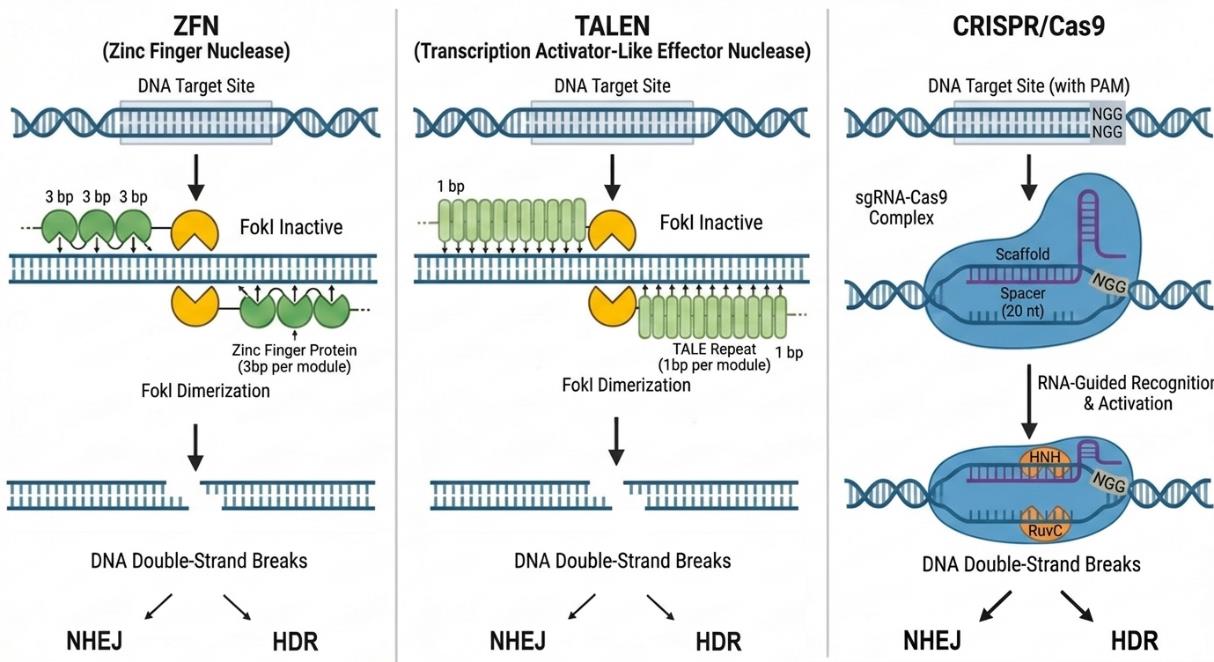
Figure 1 Schematic illustration of the mechanisms of three genome editing technologies
技术类型 Technology | 编辑原理 Editing principle | 是否依赖DSBs Dependence on DSBs | 可实现突变类型 Types of mutations achievable | 编辑效率 Editing efficiency | 构建周期 Model generation time | 成本水平 Cost | 品系适应性 Strain compatibility | 多基因编辑能力 Multiplex editing capability | 脱靶风险 Off-target risk | 主要优势 Key advantage | 主要局限 Key limitation | 适用场景 Typical application |
|---|---|---|---|---|---|---|---|---|---|---|---|---|
胚胎干细胞同源重组 ESC-based Homologous Recombination | 同源重组介导靶位点定向替换 | 否 | KO、KI、点突变等均可实现 | 低 | 长(6~12月) | 高 | 受限(前期主要为129等品系) | 低 | 低 | 精确性高,遗传结果稳定 | 周期长、成本高 | 精确遗传修饰、经典敲除/敲入模型 |
ENU/转座子诱变 ENU/Transposon Mutagenesis | ENU诱导碱基烷基化引起点突变;转座子在基因组中随机或偏好性插入导致基因功能破坏 | 否 | 点突变(ENU)、插入突变(转座子) | 高(突变率高) | 长 | 中 | 高 | 高(但随机性强) | 不适用于传统脱靶概念,但存在随机突变背景 | 无需预设靶点,可进行正向遗传筛选 | 位点鉴定困难、表型归因复杂 | 正向遗传筛选、新基因发现 |
| 锌指核酸酶Zinc finger nucleases | 蛋白识别DNA序列并由FokI诱导DSBs | 是 | KO、KI、点突变等均可实现 | 中 | 中 | 高 | 高 | 低 | 中 | 开创性定点编辑工具 | 设计复杂、成本高、专利限制 | 特定靶点编辑或既有体系延续 |
转录激活因子样效应物核酸酶 Transcription activator-like effector nuclease | 转录激活因子样效应物识别DNA序列并由FokI诱导DSBs | 是 | KO、KI、点突变等均可实现 | 中–高 | 中 | 中~高 | 高 | 低 | 低 | 特异性较高、识别规则明确 | 构建复杂、递送受限 | 高特异性需求或复杂靶点编辑 |
成簇规律间隔短回文重复序列/CRISPR相关蛋白系统 Clustered regularly interspaced short palindromic repeats/CRISPR-associated proteins | sgRNA引导Cas9在靶位点产生DSBs | 是 | KO、KI、点突变等均可实现 | 高 | 短(2~3月) | 低 | 高 | 高(多条sgRNA实现多靶向) | 中 | 灵活、高效、适于多基因编辑 | 存在脱靶及嵌合性风险 | 常规基因工程小鼠构建首选 |
| 碱基编辑Base editing | 脱氨酶介导碱基转换 | 否 | 主要为点突变 | 高 | 短 | 中 | 高 | 中 | 低–中 | 无DSBs、高精度 | 编辑窗口受限 | 单碱基突变疾病模型 |
| 引导编辑Prime editing | 逆转录酶介导靶序列定向写入 | 否 | 片段序列精准插入/缺失/替换 | 中 | 短~中 | 中 | 高 | 中 | 低 | 突变类型多样、灵活性高 | 编辑效率相对较低 | 复杂突变或非编码区精细编辑模型 |
Table 1 Comparison of key features of genome editing technologies for genetically engineered mouse model generation
技术类型 Technology | 编辑原理 Editing principle | 是否依赖DSBs Dependence on DSBs | 可实现突变类型 Types of mutations achievable | 编辑效率 Editing efficiency | 构建周期 Model generation time | 成本水平 Cost | 品系适应性 Strain compatibility | 多基因编辑能力 Multiplex editing capability | 脱靶风险 Off-target risk | 主要优势 Key advantage | 主要局限 Key limitation | 适用场景 Typical application |
|---|---|---|---|---|---|---|---|---|---|---|---|---|
胚胎干细胞同源重组 ESC-based Homologous Recombination | 同源重组介导靶位点定向替换 | 否 | KO、KI、点突变等均可实现 | 低 | 长(6~12月) | 高 | 受限(前期主要为129等品系) | 低 | 低 | 精确性高,遗传结果稳定 | 周期长、成本高 | 精确遗传修饰、经典敲除/敲入模型 |
ENU/转座子诱变 ENU/Transposon Mutagenesis | ENU诱导碱基烷基化引起点突变;转座子在基因组中随机或偏好性插入导致基因功能破坏 | 否 | 点突变(ENU)、插入突变(转座子) | 高(突变率高) | 长 | 中 | 高 | 高(但随机性强) | 不适用于传统脱靶概念,但存在随机突变背景 | 无需预设靶点,可进行正向遗传筛选 | 位点鉴定困难、表型归因复杂 | 正向遗传筛选、新基因发现 |
| 锌指核酸酶Zinc finger nucleases | 蛋白识别DNA序列并由FokI诱导DSBs | 是 | KO、KI、点突变等均可实现 | 中 | 中 | 高 | 高 | 低 | 中 | 开创性定点编辑工具 | 设计复杂、成本高、专利限制 | 特定靶点编辑或既有体系延续 |
转录激活因子样效应物核酸酶 Transcription activator-like effector nuclease | 转录激活因子样效应物识别DNA序列并由FokI诱导DSBs | 是 | KO、KI、点突变等均可实现 | 中–高 | 中 | 中~高 | 高 | 低 | 低 | 特异性较高、识别规则明确 | 构建复杂、递送受限 | 高特异性需求或复杂靶点编辑 |
成簇规律间隔短回文重复序列/CRISPR相关蛋白系统 Clustered regularly interspaced short palindromic repeats/CRISPR-associated proteins | sgRNA引导Cas9在靶位点产生DSBs | 是 | KO、KI、点突变等均可实现 | 高 | 短(2~3月) | 低 | 高 | 高(多条sgRNA实现多靶向) | 中 | 灵活、高效、适于多基因编辑 | 存在脱靶及嵌合性风险 | 常规基因工程小鼠构建首选 |
| 碱基编辑Base editing | 脱氨酶介导碱基转换 | 否 | 主要为点突变 | 高 | 短 | 中 | 高 | 中 | 低–中 | 无DSBs、高精度 | 编辑窗口受限 | 单碱基突变疾病模型 |
| 引导编辑Prime editing | 逆转录酶介导靶序列定向写入 | 否 | 片段序列精准插入/缺失/替换 | 中 | 短~中 | 中 | 高 | 中 | 低 | 突变类型多样、灵活性高 | 编辑效率相对较低 | 复杂突变或非编码区精细编辑模型 |
| [1] | MONTOLIU L. Transgenesis and genome engineering: a historical review[J]. Methods Mol Biol, 2023, 2631: 1-32. DOI: 10.1007/978-1-0716-2990-1_1 . |
| [2] | KIM H S, KWEON J, KIM Y. Recent advances in CRISPR-based functional genomics for the study of disease-associated genetic variants[J]. Exp Mol Med, 2024, 56(4): 861-869. DOI: 10.1038/s12276-024-01212-3 . |
| [3] | VARSHNEY G K, BURGESS S M. CRISPR-based functional genomics tools in vertebrate models[J]. Exp Mol Med, 2025, 57(7): 1355-1372. DOI: 10.1038/s12276-025-01514-0 . |
| [4] | SHAMSHIRGARAN Y, LIU J, SUMER H, et al. Tools for efficient genome editing; ZFN, TALEN, and CRISPR[M]//VERMA P J, SUMER H, LIU J. Applications of genome modulation and editing. New York: Humana Press, 2022: 29-46. DOI: 10.1007/978-1-0716-2301-5_2 . |
| [5] | LIU D Q, CAO D, HAN R Z. Recent advances in therapeutic gene-editing technologies[J]. Mol Ther, 2025, 33(6): 2619-2644. DOI: 10.1016/j.ymthe.2025.03.026 . |
| [6] | HARBERS K, JÄHNER D, JAENISCH R. Microinjection of cloned retroviral genomes into mouse zygotes: integration and expression in the animal[J]. Nature, 1981, 293(5833): 540-542. DOI: 10.1038/293540a0 . |
| [7] | DOETSCHMAN T, GREGG R G, MAEDA N, et al. Targetted correction of a mutant HPRT gene in mouse embryonic stem cells[J]. Nature, 1987, 330(6148): 576-578. DOI: 10.1038/330576a0 . |
| [8] | THOMAS K R, CAPECCHI M R. Site-directed mutagenesis by gene targeting in mouse embryo-derived stem cells[J]. Cell, 1987, 51(3): 503-512. DOI: 10.1016/0092-8674(87)90646-5 . |
| [9] | NGUYEN N, JUDD L M, KALANTZIS A, et al. Random mutagenesis of the mouse genome: a strategy for discovering gene function and the molecular basis of disease[J]. Am J Physiol Gastrointest Liver Physiol, 2011, 300(1): G1-G11. DOI: 10.1152/ajpgi.00343.2010 . |
| [10] | LEBLANC D P M, ZHOU G, WILLIAMS A, et al. Duplex sequencing identifies unique characteristics of ENU-induced mutations in male mouse germ cells[J]. Biol Reprod, 2025, 112(5): 1015-1027. DOI: 10.1093/biolre/ioaf029 . |
| [11] | LUO X X, LIU L F, RONG H W, et al. ENU-based dominant genetic screen identifies contractile and neuronal gene mutations in congenital heart disease[J]. Genome Med, 2024, 16(1): 97. DOI: 10.1186/s13073-024-01372-x . |
| [12] | BECKMANN P J, LARGAESPADA D A. Transposon insertion mutagenesis in mice for modeling human cancers: critical insights gained and new opportunities[J]. Int J Mol Sci, 2020, 21(3): 1172. DOI: 10.3390/ijms21031172 . |
| [13] | KOVAČ A, MISKEY C, IVICS Z. Sleeping beauty transposon insertions into nucleolar DNA by an engineered transposase localized in the nucleolus[J]. Int J Mol Sci, 2023, 24(19): 14978. DOI: 10.3390/ijms241914978 . |
| [14] | NUTTLE X, BURT N D, CURRALL B, et al. Parallelized engineering of mutational models using piggyBac transposon delivery of CRISPR libraries[J]. Cell Rep Methods, 2024, 4(1): 100672. DOI: 10.1016/j.crmeth.2023.100672 . |
| [15] | SATOH Y, ASAKAWA J I, NISHIMURA M, et al. Characteristics of induced mutations in offspring derived from irradiated mouse spermatogonia and mature oocytes[J]. Sci Rep, 2020, 10: 37. DOI: 10.1038/s41598-019-56881-2 . |
| [16] | HAN M, PERKINS M H, NOVAES L S, et al. Advances in transposable elements: from mechanisms to applications in mammalian genomics[J]. Front Genet, 2023, 14: 1290146. DOI: 10.3389/fgene.2023.1290146 . |
| [17] | LIAO H Y, WU J H, VANDUSEN N J, et al. CRISPR-Cas9-mediated homology-directed repair for precise gene editing[J]. Mol Ther Nucleic Acids, 2024, 35(4): 102344. DOI: 10.1016/j.omtn.2024.102344 . |
| [18] | PHAN H T L, KIM K, LEE H, et al. Progress in and prospects of genome editing tools for human disease model development and therapeutic applications[J]. Genes, 2023, 14(2): 483. DOI: 10.3390/genes14020483 . |
| [19] | DURAI S, MANI M, KANDAVELOU K, et al. Zinc finger nucleases: custom-designed molecular scissors for genome engineering of plant and mammalian cells[J]. Nucleic Acids Res, 2005, 33(18): 5978-5990. DOI: 10.1093/nar/gki912 . |
| [20] | CARBERY I D, JI D A, HARRINGTON A, et al. Targeted genome modification in mice using zinc-finger nucleases[J]. Genetics, 2010, 186(2): 451-459. DOI: 10.1534/genetics.110.117002 . |
| [21] | MEYER M, DE ANGELIS M H, WURST W, et al. Gene targeting by homologous recombination in mouse zygotes mediated by zinc-finger nucleases[J]. Proc Natl Acad Sci U S A, 2010, 107(34): 15022-15026. DOI: 10.1073/pnas.1009424107 . |
| [22] | MAHATA B, BISWAS K. Generation of stable knockout mammalian cells by TALEN-mediated locus-specific gene editing[M]//REEVES A. In vitro mutagenesis: methods and protocols. New York: Humana Press, 2017: 107-120. DOI: 10.1007/978-1-4939-6472-7_7 . |
| [23] | LI C L, QI R, SINGLETERRY R, et al. Simultaneous gene editing by injection of mRNAs encoding transcription activator-like effector nucleases into mouse zygotes[J]. Mol Cell Biol, 2014, 34(9): 1649-1658. DOI: 10.1128/MCB.00023-14 . |
| [24] | MUSSOLINO C, ALZUBI J, FINE E J, et al. TALENs facilitate targeted genome editing in human cells with high specificity and low cytotoxicity[J]. Nucleic Acids Res, 2014, 42(10): 6762-6773. DOI: 10.1093/nar/gku305 . |
| [25] | JINEK M, CHYLINSKI K, FONFARA I, et al. A programmable dual-RNA–guided DNA endonuclease in adaptive bacterial immunity[J]. Science, 2012, 337(6096): 816-821. DOI: 10.1126/science.1225829 . |
| [26] | WANG H Y, YANG H, SHIVALILA C S, et al. One-step generation of mice carrying mutations in multiple genes by CRISPR/cas-mediated genome engineering[J]. Cell, 2013, 153(4): 910-918. DOI: 10.1016/j.cell.2013.04.025 . |
| [27] | YANG H, WANG H Y, SHIVALILA C S, et al. One-step generation of mice carrying reporter and conditional alleles by CRISPR/cas-mediated genome engineering[J]. Cell, 2013, 154(6): 1370-1379. DOI: 10.1016/j.cell.2013.08.022 . |
| [28] | KARVELIS T, BIGELYTE G, YOUNG J K, et al. PAM recognition by miniature CRISPR–Cas12f nucleases triggers programmable double-stranded DNA target cleavage[J]. Nucleic Acids Res, 2020, 48(9): 5016-5023. DOI: 10.1093/nar/gkaa208 . |
| [29] | ZETSCHE B, GOOTENBERG J S, ABUDAYYEH O O, et al. Cpf1 is a single RNA-guided endonuclease of a class 2 CRISPR-cas system[J]. Cell, 2015, 163(3): 759-771. DOI: 10.1016/j.cell.2015.09.038 . |
| [30] | PACESA M, PELEA O, JINEK M. Past, present, and future of CRISPR genome editing technologies[J]. Cell, 2024, 187(5): 1076-1100. DOI: 10.1016/j.cell.2024.01.042 . |
| [31] | CETIN B, ERENDOR F, EKSI Y E, et al. Advancing CRISPR genome editing into gene therapy clinical trials: progress and future prospects[J]. Expert Rev Mol Med, 2025, 27: e16. DOI: 10.1017/erm.2025.10 . |
| [32] | RAN F A, HSU P D, LIN C Y, et al. Double nicking by RNA-guided CRISPR Cas9 for enhanced genome editing specificity[J]. Cell, 2013, 154(6): 1380-1389. DOI: 10.1016/j.cell.2013.08.021 . |
| [33] | KLEINSTIVER B P, PATTANAYAK V, PREW M S, et al. High-fidelity CRISPR-Cas9 nucleases with no detectable genome-wide off-target effects[J]. Nature, 2016, 529(7587): 490-495. DOI: 10.1038/nature16526 . |
| [34] | JONES I R, REN X J, SHEN Y. High-throughput CRISPRi and CRISPRa technologies in 3D genome regulation for neuropsychiatric diseases[J]. Hum Mol Genet, 2022, 31(R1): R47-R53. DOI: 10.1093/hmg/ddac193 . |
| [35] | LIU B, JING Z Y, ZHANG X M, et al. Large-scale multiplexed mosaic CRISPR perturbation in the whole organism[J]. Cell, 2022, 185(16): 3008-3024.e16. DOI: 10.1016/j.cell.2022.06.039 . |
| [36] | LIANG Y H, CHEN F B, WANG K P, et al. Base editors: development and applications in biomedicine[J]. Front Med, 2023, 17(3): 359-387. DOI: 10.1007/s11684-023-1013-y . |
| [37] | LEE S, LEE H, BAEK G, et al. Enhanced mitochondrial DNA editing in mice using nuclear-exported TALE-linked deaminases and nucleases[J]. Genome Biol, 2022, 23(1): 211. DOI: 10.1186/s13059-022-02782-z . |
| [38] | MOK B Y, KOTRYS A V, RAGURAM A, et al. CRISPR-free base editors with enhanced activity and expanded targeting scope in mitochondrial and nuclear DNA[J]. Nat Biotechnol, 2022, 40(9): 1378-1387. DOI: 10.1038/s41587-022-01256-8 . |
| [39] | KIM K, RYU S M, KIM S T, et al. Highly efficient RNA-guided base editing in mouse embryos[J]. Nat Biotechnol, 2017, 35(5): 435-437. DOI: 10.1038/nbt.3816 . |
| [40] | SHELKE P, TRIBHUVAN S, AGRAHARI A K, et al. The evolving landscape of mitochondrial base editing: advances in precision, modeling, and therapeutic potential[J]. Mitochondrion, 2026, 86: 102093. DOI: 10.1016/j.mito.2025.102093 . |
| [41] | YI Z Y, ZHANG X X, TANG W, et al. Strand-selective base editing of human mitochondrial DNA using mitoBEs[J]. Nat Biotechnol, 2024, 42(3): 498-509. DOI: 10.1038/s41587-023-01791-y . |
| [42] | WEI Y H, JIN M, HUANG S H, et al. Enhanced C-to-T and A-to-G base editing in mitochondrial DNA with engineered DdCBE and TALED[J]. Adv Sci, 2024, 11(3): 2304113. DOI: 10.1002/advs.202304113 . |
| [43] | BRETTMANN E, CHEN F Q, BEISHIR S, et al. Cytosine base editor-DNA binding domain fusions for editing window modulation in the RNP format[J]. BMC Biotechnol, 2025, 25(1): 92. DOI: 10.1186/s12896-025-01020-1 . |
| [44] | KISSLING L, MOLLAYSA A, JANJUHA S, et al. Predicting adenine base editing efficiencies in different cellular contexts by deep learning[J]. Genome Biol, 2025, 26(1): 115. DOI: 10.1186/s13059-025-03586-7 . |
| [45] | TANG J L, DU K Z. Mitochondrial base editing: from principle, optimization to application[J]. Cell Biosci, 2025, 15(1): 9. DOI: 10.1186/s13578-025-01351-8 . |
| [46] | LUE N Z, LIAU B B. Base editor screens for in situ mutational scanning at scale[J]. Mol Cell, 2023, 83(13): 2167-2187. DOI: 10.1016/j.molcel.2023.06.009 . |
| [47] | ANZALONE A V, RANDOLPH P B, DAVIS J R, et al. Search-and-replace genome editing without double-strand breaks or donor DNA[J]. Nature, 2019, 576(7785): 149-157. DOI: 10.1038/s41586-019-1711-4 . |
| [48] | ELY Z A, MATHEY-ANDREWS N, NARANJO S, et al. A prime editor mouse to model a broad spectrum of somatic mutations in vivo [J]. Nat Biotechnol, 2024, 42(3): 424-436. DOI: 10.1038/s41587-023-01783-y . |
| [49] | KIM-YIP R P, MCNULTY R, JOYCE B, et al. Efficient prime editing in two-cell mouse embryos using PEmbryo[J]. Nat Biotechnol, 2024, 42(12): 1822-1830. DOI: 10.1038/s41587-023-02106-x . |
| [50] | LIU Y, LI X Y, HE S T, et al. Efficient generation of mouse models with the prime editing system[J]. Cell Discov, 2020, 6: 27. DOI: 10.1038/s41421-020-0165-z . |
| [51] | ZHANG W T, PETRI K, MA J Y, et al. Enhancing CRISPR prime editing by reducing misfolded pegRNA interactions[J]. eLife, 2024, 12: RP90948. DOI: 10.7554/elife.90948 . |
| [52] | AI X L, TANG Z. Aptazyme-directed A-to-I RNA editing[J]. Methods Enzymol, 2025, 710: 267-283. DOI: 10.1016/bs.mie.2024.11.022 . |
| [53] | KASENIIT K E, KATZ N, KOLBER N S, et al. Modular, programmable RNA sensing using ADAR editing in living cells[J]. Nat Biotechnol, 2023, 41(4): 482-487. DOI: 10.1038/s41587-022-01493-x . |
| [54] | RAVICHANDRAN K, KHARGONKAR T, SAMADDAR S, et al. CRISPR based programmable RNA editing in primary hippocampal neurons[J]. Curr Protoc, 2023, 3(9): e886. DOI: 10.1002/cpz1.886 . |
| [55] | YU J, SHIN J, YU J, et al. Programmable RNA base editing with photoactivatable CRISPR-Cas13[J]. Nat Commun, 2024, 15: 673. DOI: 10.1038/s41467-024-44867-2 . |
| [56] | COX D B T, GOOTENBERG J S, ABUDAYYEH O O, et al. RNA editing with CRISPR-cas13[J]. Science, 2017, 358(6366): 1019-1027. DOI: 10.1126/science.aaq0180 . |
| [57] | YI Z Y, QU L, TANG H X, et al. Engineered circular ADAR-recruiting RNAs increase the efficiency and fidelity of RNA editing in vitro and in vivo [J]. Nat Biotechnol, 2022, 40(6): 946-955. DOI: 10.1038/s41587-021-01180-3 . |
| [58] | 赖梭梅, 丁一夫, 李劲松. 复杂疾病小鼠模型构建新策略: 类精子单倍体胚胎干细胞介导的半克隆技术[J]. 实验动物与比较医学, 2021, 41(5): 369-383. DOI: 10.12300/j.issn.1674-5817.2021.143 . |
| LAI S M, DING Y F, LI J S. A new strategy for constructing mouse models of complex diseases: semi-cloning technology based on sperm-like haploid embryonic stem cells[J]. Lab Anim Comp Med, 2021, 41(5): 369-383. DOI: 10.12300/j.issn.1674-5817.2021.143 . | |
| [59] | SHEN B, ZHANG W S, ZHANG J, et al. Efficient genome modification by CRISPR-Cas9 nickase with minimal off-target effects[J]. Nat Meth, 2014, 11(4): 399-402. DOI: 10.1038/nmeth.2857 . |
| [60] | GUO C T, MA X T, GAO F, et al. Off-target effects in CRISPR/Cas9 gene editing[J]. Front Bioeng Biotechnol, 2023, 11: 1143157. DOI: 10.3389/fbioe.2023.1143157 . |
| [1] | LI Qiuju, JIA Liujun, LI Yue, PENG Peng, WANG Peihe, YUE Guangxin. Establishment and Key Points Summary of Sheep Animal Model with Peripheral Kannulation Cardiopulmonary Bypass [J]. Laboratory Animal and Comparative Medicine, 2026, (): 1-7. |
| [2] | XU Jingru, FAN Sisi, QIU Shuqi, YAN Nana, FAN Kewei. Research Progress on Animal Models of Four Staphylococcus aureus Infection [J]. Laboratory Animal and Comparative Medicine, 2026, (): 1-9. |
| [3] | XU Haochen, LE Qingqing, HE Xiwen, CAI Bing, YANG Longhe. Evaluation of the Efficacy of an Eye-Protective Compound Formulation on the Retina of Mice with Blue Light-Induced Damage [J]. Laboratory Animal and Comparative Medicine, 2026, (): 1-11. |
| [4] | DU Hongzhi, FAN Jin, WEI Xiaolu, WANG Lianmei, LIU Yan, CHEN Weiya, CHEN Tengfei, GAO Yunhang, SONG Ling, ZHANG Guangping, HOU Hongping. Multimodal Assessment of a Hypoxic Pulmonary Hypertension Mouse Model [J]. Laboratory Animal and Comparative Medicine, 2026, 46(4): 476-486. |
| [5] | HE Miao, ZHANG Xuxing, WU Gang, ZHOU Yi, RAO Hao, HU Xiangyu. Analysis of Animal Models of Lumbar Spinal Stenosis Based on Clinical Characteristics of Traditional Chinese and Western Medicine [J]. Laboratory Animal and Comparative Medicine, 2026, 46(4): 541-552. |
| [6] | LI Desheng, ZHAO Yanguang. Research Progress in the Construction and Evaluation of Pig Depression Models [J]. Laboratory Animal and Comparative Medicine, 2026, 46(4): 515-530. |
| [7] | GONG Tiantian, WANG Xinpei, GUO Tiange, AN Yang, MENG Zihao, YAO Minghui, ZHANG He. Pathophysiological Effects of Cold Environment on Gastrointestinal Blast Combined Injury in Beagle Dogs [J]. Laboratory Animal and Comparative Medicine, 2026, 46(4): 507-514. |
| [8] | ZHAO Yulei, HAN Bingbing, WANG Xingxin, YANG Guangjian, WANG Yajie, TANG Xiaoyong. Progress in Disease-Syndrome-Integrated Mouse Models of Lung Cancer [J]. Laboratory Animal and Comparative Medicine, 2026, 46(4): 531-540. |
| [9] | LEI Jianjun, SUO Chenhao, ZHANG He. Resveratrol Alleviates Blood‑Brain Barrier Damage in Cerebral Ischemia‑Reperfusion Rat Models through Modulation of the CCL3/CCR5 Signaling Pathway [J]. Laboratory Animal and Comparative Medicine, 2026, 46(4): 487-497. |
| [10] | ZHANG Lili, WANG Zhen. Vocal Development and Adaptive Evolution of Common Marmoset (Callithrix jacchus) [J]. Laboratory Animal and Comparative Medicine, 2026, 46(4): 583-592. |
| [11] | WANG Lu, WANG Qingjie, YANG Chunhong, ZHANG Yijian. Application of New Approach Methodologies in Biomedical Field and Their Implementation of "3R" Principle [J]. Laboratory Animal and Comparative Medicine, 2026, 46(4): 573-582. |
| [12] | GONG Zhiqun, RAO Xiwu, ZHANG Tianyi, WU Rongchen, YE Mingnan, JIANG Chunxi, WANG Sumei, ZHU Yanjuan, CHAI Xiaoshu. Construction and Evaluation of Mouse Models Simulating Immune Checkpoint Inhibitor-Associated Pneumonitis [J]. Laboratory Animal and Comparative Medicine, 2026, 46(4): 498-506. |
| [13] | MENG Feibiao, WANG Linyi, ZHANG Wenqiang, TANG Ruixin, HUANG Xueying, FANG Meirong, YANG Wei, GUO Jianmin. Establishment and Validation of a Guinea Pig Model of Ear Psoriasis Induced by Propranolol Hydrochloride [J]. Laboratory Animal and Comparative Medicine, 2026, (): 1-10. |
| [14] | LI Limei, HUANG Xueping, CHEN Jianqing, HE Xiukui. Comparison of Five Methods for Induction of Model Rat with Diminished Ovarian Reserve [J]. Laboratory Animal and Comparative Medicine, 2026, (): 1-10. |
| [15] | WEN Fuli, XU Yongjun, FU Yunfeng, XUE Laien, CUI Linlin, WANG Junzhu, LU Jun, ZHENG Heping. Effectiveness Evaluation of Pre-Service Training for Laboratory Animal Practitioners Based on the "Three-Segmentation" Model [J]. Laboratory Animal and Comparative Medicine, 2026, (): 1-8. |
| Viewed | ||||||
|
Full text |
|
|||||
|
Abstract |
|
|||||
