





实验动物与比较医学 ›› 2026, Vol. 46 ›› Issue (5): 640-649.DOI: 10.12300/j.issn.1674-5817.2026.003
李燕平1,2( ), 黄姗1,2, 姚政源1,2, 石怡敏2, 隋华秀1,2, 黄侯丹2, 俞燕萍2, 米燕1,2, 林大晖1,2()(
 )
)
收稿日期:2026-01-04
修回日期:2026-06-04
出版日期:2026-10-25
发布日期:2026-10-16
通讯作者:
林大晖(1980—),男,博士,副教授,研究方向:免疫微环境与药物偶联。E-mail:tahui.lin@foxmail.com。ORCID:0000-0001-7627-6095作者简介:基金资助:
LI Yanping1,2(), HUANG Shan1,2, YAO Jengyuan1,2, SHI Yimin2, SUI Huaxiu1,2, HUANG Houtan2, YU Yanping2, MI Yan1,2, LIN Tahui1,2()()
Received:2026-01-04
Revised:2026-06-04
Published:2026-10-25
Online:2026-10-16
Correspondence to:
摘要:
目的 探讨艾黄素(artemitin)对臭氧暴露诱发的小鼠肺部炎症是否具有保护作用及其潜在机制。 方法 将32只雄性SPF级C57BL/6小鼠随机分为空白对照组、艾黄素对照组、模型组、艾黄素治疗组,每组8只。艾黄素治疗组每日先腹腔注射艾黄素(20 mg/kg),再持续吸入0.000 25%臭氧1 h;艾黄素对照组每日先腹腔注射艾黄素(20 mg/kg),再吸入洁净空气;模型组每日先腹腔注射等体积生理盐水,再吸入0.000 25%臭氧1 h;空白对照组每日先注射等体积生理盐水,再吸入洁净空气;以上各组均连续处理7 d。采用全身体积描记检测系统检测各组小鼠的肺功能指标;采用ELISA检测支气管肺泡灌洗液中肿瘤坏死因子-α(tumor necrosis factor-α,TNF-α)、白细胞介素-1β(interleukin-1β,IL-1β)水平;采用HE染色观察肺组织病理学变化;并采用超高效液相色谱质谱联用对血浆中整体代谢通路的变化进行非靶向代谢组学分析。 结果 与模型组相比,艾黄素治疗能显著改善臭氧引起的肺功能损伤(P<0.05)、降低支气管肺泡灌洗液中TNF-α、IL-1β的蛋白水平(P<0.05)、减轻肺组织炎症细胞浸润和结构破坏。代谢组学结果提示,艾黄素治疗可代偿性增强能量供给和氧化脂质信号,抑制嘌呤代谢与色氨酸衍生通路。 结论 艾黄素对臭氧暴露诱发的小鼠肺部炎症具有明显的保护作用,其通过协同调控色氨酸代谢、能量代谢和脂质炎症介质,从代谢层面改善代谢紊乱,进而抑制下游炎症反应与气道高反应性。本研究不仅揭示了艾黄素治疗气道炎症的多效性机制,还为其临床转化提供了潜在的代谢生物标志物和理论依据。
中图分类号:
李燕平,黄姗,姚政源,等. 艾黄素对臭氧暴露诱发小鼠肺部炎症的保护作用及机制研究[J]. 实验动物与比较医学, 2026, 46(5): 640-649. DOI: 10.12300/j.issn.1674-5817.2026.003.
LI Yanping,HUANG Shan,YAO Jengyuan,et al. Protective Effect and Mechanism of Artemitin on Ozone-Induced Pulmonary Inflammation in Mice[J]. Laboratory Animal and Comparative Medicine, 2026, 46(5): 640-649. DOI: 10.12300/j.issn.1674-5817.2026.003.
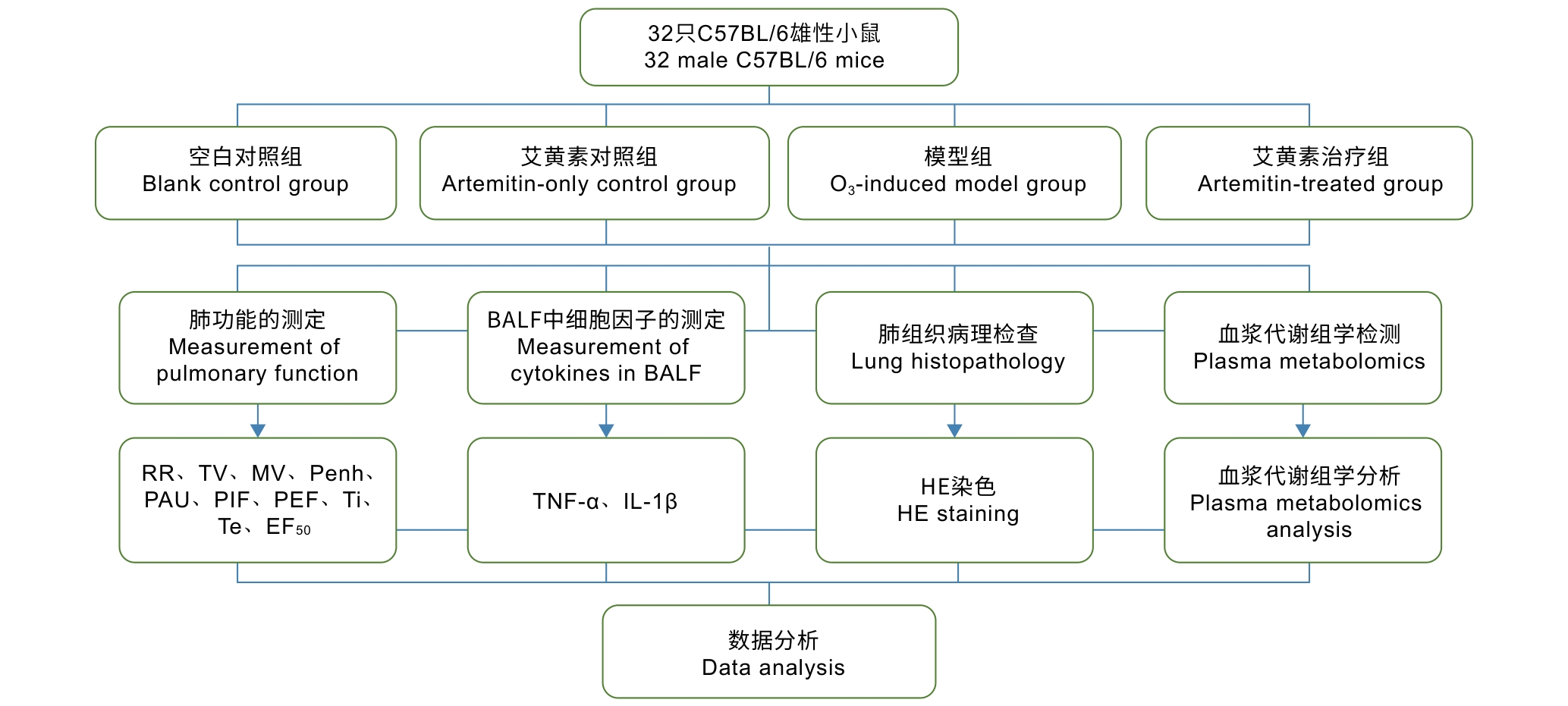
图1
Figure 1
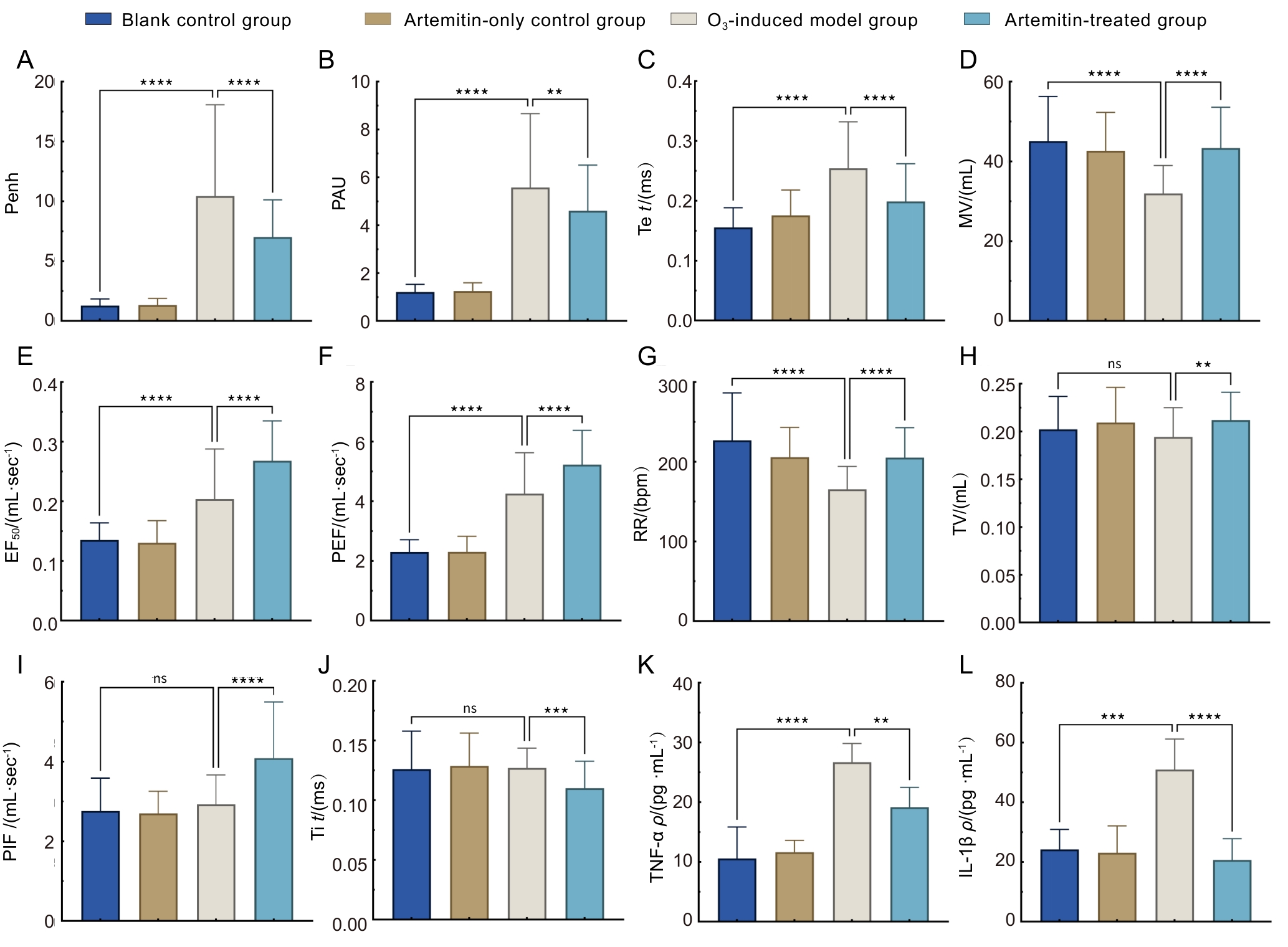
图2
Figure 2

图3
Figure 3
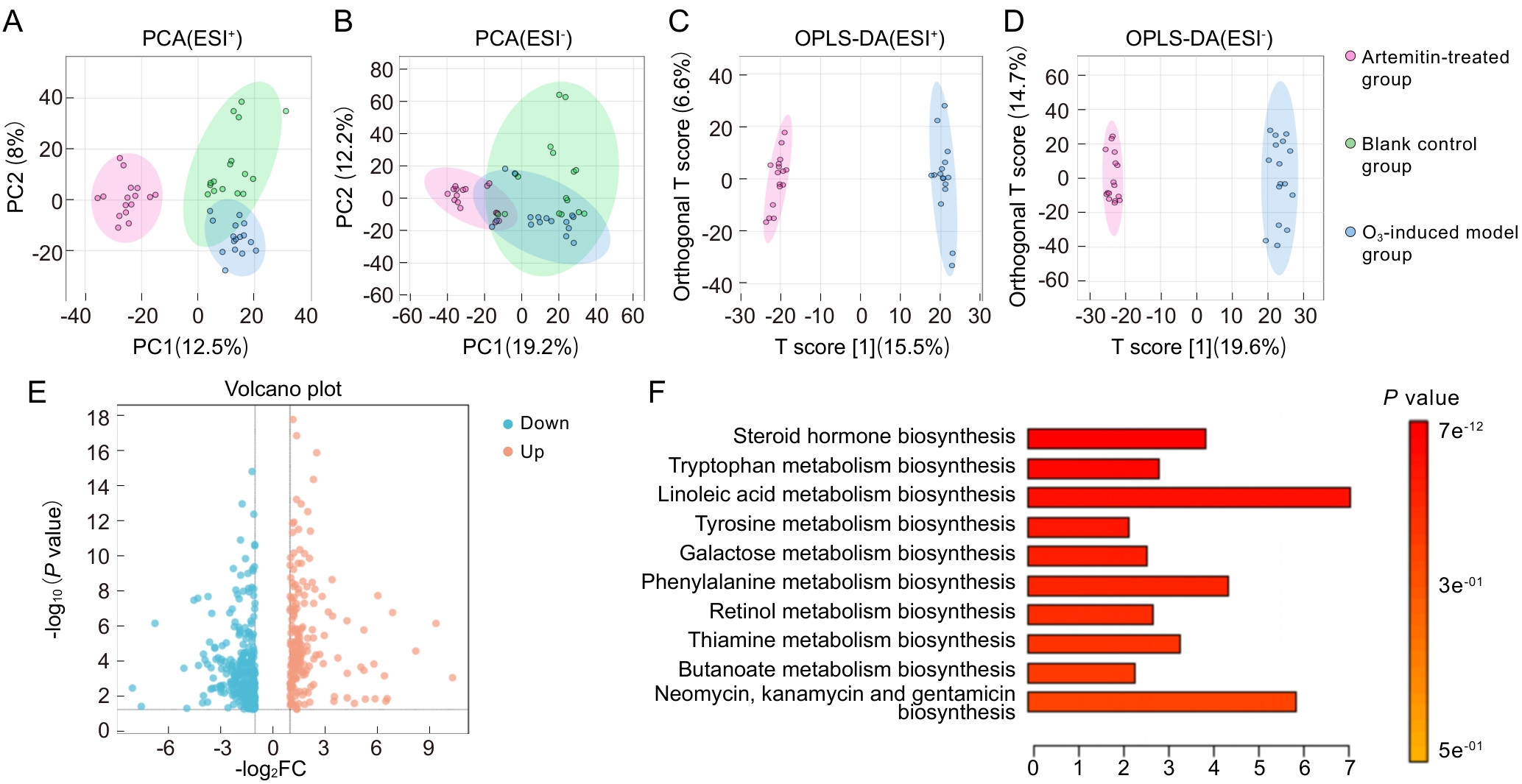
图 4
Figure 4
艾黄素治疗组与模型组血浆中的差异代谢物
Differential metabolites in plasma between the artemitin-treated group and the O3-induced model group
| 序号No. | 质荷比 m/z | 化合物 Compound | KEGG编号 KEGG ID | HMDB编号 HMDB ID | log2FC | -log10 P | AUC | 保留时间/min Retention time/min | 离子化模式 Ionization mode |
|---|---|---|---|---|---|---|---|---|---|
| 1 | 103.040 818 5 | 3-Hydroxybutyric acid | C01089 | HMDB0000011 | 1.8 | 10.1 | 1.00 | 0.76 | negative |
| 2 | 361.203 087 3 | Cortisol | C00735 | HMDB0000063 | 2.4 | 7.3 | 1.00 | 1.08 | negative |
| 3 | 363.218 000 8 | Leukotriene A4 | C00909 | HMDB0001337 | 3.2 | 6.8 | 1.00 | 1.34 | negative |
| 4 | 160.077 502 2 | Phenylacetaldehyde | C00601 | HMDB0006236 | -2.2 | 6.0 | 0.98 | 0.93 | negative |
| 5 | 307.115 643 5 | Adenosine | C00212 | HMDB0000050 | -2.0 | 7.8 | 0.97 | 0.77 | negative |
| 6 | 160.041 370 6 | Quinoline-4,8-diol | C05637 | HMDB0060289 | -1.2 | 6.2 | 0.97 | 0.90 | negative |
| 7 | 131.048 605 8 | N1-Acetyl-N2-formyl-5-methoxykynuramine | C05642 | HMDB0004259 | -1.6 | 5.6 | 0.96 | 0.94 | positive |
| 8 | 496.274 317 6 | Taurocholic acid | C05122 | HMDB0000036 | 1.7 | 4.6 | 0.95 | 3.07 | negative |
| 9 | 311.224 870 9 | 12,13-EpOME | C14826 | HMDB0004702 | 1.0 | 5.2 | 0.95 | 3.25 | negative |
| 10 | 360.071 196 1 | N-Glycolylneuraminic acid | C03410 | HMDB0000833 | -2.7 | 5.1 | 0.93 | 0.87 | negative |
| 11 | 283.083 160 1 | 6-Hydroxymelatonin | C05643 | HMDB0004081 | 2.0 | 4.6 | 0.95 | 0.80 | negative |
| 12 | 235.083 009 7 | 5-Formiminotetrahydrofolic acid | C00664 | HMDB0001534 | 1.8 | 7.3 | 0.95 | 0.77 | negative |
| 13 | 147.012 513 4 | Oxoglutaric acid | C00026 | HMDB0000208 | 2.1 | 3.8 | 0.89 | 8.24 | positive |
| 14 | 187.008 039 0 | 3-Fumarylpyruvate | C02514 | HMDB0060371 | 1.5 | 4.0 | 0.86 | 0.84 | negative |
| 15 | 208.062 677 7 | Homogentisic acid | C00544 | HMDB0000130 | 1.5 | 3.8 | 0.82 | 0.77 | negative |
表 1
艾黄素治疗组与模型组血浆中的差异代谢物
Table 1
Differential metabolites in plasma between the artemitin-treated group and the O3-induced model group
| 序号No. | 质荷比 m/z | 化合物 Compound | KEGG编号 KEGG ID | HMDB编号 HMDB ID | log2FC | -log10 P | AUC | 保留时间/min Retention time/min | 离子化模式 Ionization mode |
|---|---|---|---|---|---|---|---|---|---|
| 1 | 103.040 818 5 | 3-Hydroxybutyric acid | C01089 | HMDB0000011 | 1.8 | 10.1 | 1.00 | 0.76 | negative |
| 2 | 361.203 087 3 | Cortisol | C00735 | HMDB0000063 | 2.4 | 7.3 | 1.00 | 1.08 | negative |
| 3 | 363.218 000 8 | Leukotriene A4 | C00909 | HMDB0001337 | 3.2 | 6.8 | 1.00 | 1.34 | negative |
| 4 | 160.077 502 2 | Phenylacetaldehyde | C00601 | HMDB0006236 | -2.2 | 6.0 | 0.98 | 0.93 | negative |
| 5 | 307.115 643 5 | Adenosine | C00212 | HMDB0000050 | -2.0 | 7.8 | 0.97 | 0.77 | negative |
| 6 | 160.041 370 6 | Quinoline-4,8-diol | C05637 | HMDB0060289 | -1.2 | 6.2 | 0.97 | 0.90 | negative |
| 7 | 131.048 605 8 | N1-Acetyl-N2-formyl-5-methoxykynuramine | C05642 | HMDB0004259 | -1.6 | 5.6 | 0.96 | 0.94 | positive |
| 8 | 496.274 317 6 | Taurocholic acid | C05122 | HMDB0000036 | 1.7 | 4.6 | 0.95 | 3.07 | negative |
| 9 | 311.224 870 9 | 12,13-EpOME | C14826 | HMDB0004702 | 1.0 | 5.2 | 0.95 | 3.25 | negative |
| 10 | 360.071 196 1 | N-Glycolylneuraminic acid | C03410 | HMDB0000833 | -2.7 | 5.1 | 0.93 | 0.87 | negative |
| 11 | 283.083 160 1 | 6-Hydroxymelatonin | C05643 | HMDB0004081 | 2.0 | 4.6 | 0.95 | 0.80 | negative |
| 12 | 235.083 009 7 | 5-Formiminotetrahydrofolic acid | C00664 | HMDB0001534 | 1.8 | 7.3 | 0.95 | 0.77 | negative |
| 13 | 147.012 513 4 | Oxoglutaric acid | C00026 | HMDB0000208 | 2.1 | 3.8 | 0.89 | 8.24 | positive |
| 14 | 187.008 039 0 | 3-Fumarylpyruvate | C02514 | HMDB0060371 | 1.5 | 4.0 | 0.86 | 0.84 | negative |
| 15 | 208.062 677 7 | Homogentisic acid | C00544 | HMDB0000130 | 1.5 | 3.8 | 0.82 | 0.77 | negative |
| [1] |
ROJAS-RUEDA D, MORALES-ZAMORA E, ALSUFYANI W A, et al. Environmental risk factors and health: an umbrella review of meta-analyses[J]. Int J Environ Res Public Health, 2021, 18(2): 704. DOI: 10.3390/ijerph18020704.
|
| [2] |
TIOTIU A I, NOVAKOVA P, NEDEVA D, et al. Impact of air pollution on asthma outcomes[J]. Int J Environ Res Public Health, 2020, 17(17): 6212. DOI: 10.3390/ijerph17176212.
|
| [3] |
MANISALIDIS I, STAVROPOULOU E, STAVROPOULOS A, et al. Environmental and health impacts of air pollution: a review[J]. Front Public Health, 2020, 8: 14. DOI: 10.3389/fpubh. 2020. 00014.
|
| [4] |
FANG X Y, PAN B, XIE Y T, et al. Mechanistic insights into ozone-induced asthma exacerbation: role of oxidative stress and IL-33[J]. J Hazard Mater, 2025, 494: 138760. DOI: 10.1016/j.jhazmat.2025.138760.
|
| [5] |
HO K, WEIMAR D, TORRES-MATIAS G, et al. Ozone impairs endogenous compensatory responses in allergic asthma[J]. Toxicol Appl Pharmacol, 2023, 459: 116341. DOI: 10.1016/j.taap. 2022.116341.
|
| [6] |
宋艺兰, 李莉, 王重阳, 等. 艾黄素在制备治疗气道炎症和线粒体功能障碍药物中的应用: CN119015273A[P]. 2024-11-26.
|
|
SONG Y L, Li L, WANG C Y, et al. Use of artemitin in the preparation of drugs for treating airway inflammation and mitochondrial dysfunction: CN119015273A [P]. 2024-11-26.
|
|
| [7] |
王月霞, 张钰, 张亮, 等. 血管紧张素转化酶2参与臭氧暴露导致的小鼠肺部炎症及气道重塑[J]. 南方医科大学学报, 2022,42(6):860-867. DOI: 10.12122/j.issn.1673-4254.2022.06.09.
|
|
WANG Y X, ZHANG Y, ZHANG L, et al. Angiotensin-converting enzyme 2 participates in ozone-induced lung inflammation and airway remodeling in mice[J]. J South Med Univ. 2022, 42(6):860-867. DOI: 10.12122/j.issn.1673-4254.2022.06.09.
|
|
| [8] |
LAMICHHANE R, CHOUDHARY I, SINGAMSETTY D, et al. Tristetraprolin protects against ozone-induced acute lung injury and inflammation in mice[J]. J Immunol, 2026, 215(1): vkaf221. DOI: 10.1093/jimmun/vkaf221.
|
| [9] |
MOORE M, NGUYEN H, SCHLADWEILER M, et al. Alterations in lung injury and gene expression following 2 weeks of episodic ozone exposure[C]//Society of Toxicology, Nashville, TN, March 19-23, 2023.
|
| [10] |
SMITH L C, ABRAMOVA E, VAYAS K, et al. Transcriptional profiling of lung macrophages following ozone exposure in mice identifies signaling pathways regulating immunometabolic activation[J]. Toxicol Sci, 2024, 201(1): 103-117. DOI: 10.1093/toxsci/kfae081.
|
| [11] |
曾梓淇, 张宇博, 刘绍慧, 等. 急性臭氧暴露对小鼠肺功能及肺部炎症的影响[J]. 广西医科大学学报, 2025, 42(4): 552-560. DOI: 10.16190/j.cnki.45-1211/r.2025.04.009.
|
|
ZENG Z Q, ZHANG Y B, LIU S H, et al. Effects of acute ozone exposure on pulmonary function and inflammation in mice[J]. J Guangxi Med Univ, 2025, 42(4): 552-560. DOI: 10.16190/j.cnki.45-1211/r.2025.04.009.
|
|
| [12] |
李树民,张敏,王朋, 等. 小鼠无创性肺功能的测定及其意义[J]. 广西医科大学学报, 2018, 26(5): 548-553. DOI: 10.3969/j. issn.1005-4847.2018.05.002.
|
|
Li S M, ZHANG M, WANG P, et al. Determination of non-invasive lung function in mice and its significance[J]. Journal of Guangxi Medical University, 2018, 26(5): 548-553. DOI: 10.3969/j.issn.1005-4847.2018.05.002.
|
|
| [13] |
RUSSO R C, TOGBE D, COUILLIN I, et al. Ozone-induced lung injury and inflammation: Pathways and therapeutic targets for pulmonary diseases caused by air pollutants[J]. Environ Int, 2025, 198: 109391. DOI: 10.1016/j.envint.2025.109391.
|
| [14] |
LI Z Q, LI X N, QIN P, et al. Outdoor ozone exposure at workplace and pro-inflammatory cytokine levels: a cross-sectional study in a physical examination population[J]. Environ Pollut, 2025, 384: 126978. DOI: 10.1016/j.envpol. 2025.126978.
|
| [15] |
KARAMARKOVIC LAZARUSIC N, POPOVIC-GRLE S, TOLIC E, et al. The value of body plethysmography (sGaw) in the assessment of airway hyperreactivity in cough variant asthma[J]. J Clin Med, 2025, 14(1): 74. DOI: 10.3390/jcm 14010074.
|
| [16] |
MEDEIROS L, ANDRELLO A C, BELO L F, et al. Association of airway resistance measured by body plethysmography with clinical outcomes in COPD[J]. R Fisioter S Fun, 2024, 11(2): 13-19. DOI: 10.36517/rfsf.v11i2.93936.
|
| [17] |
WONG Y C, HSU W C, WU T C, et al. Effects of coffee intake on airway hypersensitivity and immunomodulation: an in vivo murine study[J]. Nutr Res Pract, 2023, 17(4): 631-640. DOI: 10.4162/nrp.2023.17.4.631.
|
| [18] |
GARLANDA C, DI CEGLIE I, JAILLON S. IL-1 family cytokines in inflammation and immunity[J]. Cell Mol Immunol, 2025, 22(11): 1345-1362. DOI: 10.1038/s41423-025-01358-8.
|
| [19] |
CELIK M, KOCA M, HALICI Z, et al. The effect of inhaled ozone therapy in two-hit rat model of lipopolysaccharides-induced acute lung injury and bleomycin-induced pulmonary fibrosis[J]. Protein J, 2025, 44(3): 325-339. DOI: 10.1007/s10930-024-10247-4.
|
| [20] |
YUE J N, WANG Q, ZHAO W X, et al. Long non-coding RNA Snhg16 Lessens Ozone Curative Effect on Chronic Constriction Injury mice via microRNA-719/SCN1A axis[J]. Mol Biotechnol, 2024, 66(9): 2273-2286. DOI: 10.1007/s12033-023-00847-3.
|
| [21] |
孙小宁, 苏德奇, 杨浩峰, 等. 臭氧急性暴露对大鼠肺组织损伤的影响[J]. 癌变·畸变·突变, 2024(3): 219-223. DOI: 10.3969/j.issn.1004-616x.2024.03.008.
|
|
SUN X N, SU D Q, YANG H F, et al. Effects of acute exposure to ozone on lung tissue injury in rats[J]. Carcinog Teratog Mutagen, 2024(3): 219-223. DOI: 10.3969/j.issn.1004-616x.2024.03.008.
|
|
| [22] |
DEHHAGHI M, HEYDARI M, PANAHI H K S, et al. The roles of the kynurenine pathway in COVID-19 neuropathogenesis[J]. Infection, 2024, 52(5): 2043-2059. DOI: 10.1007/s15010-024-02293-y.
|
| [23] |
BOCHEVA G, BAKALOV D, ILIEV P, et al. The vital role of melatonin and its metabolites in the neuroprotection and retardation of brain aging[J]. Int J Mol Sci, 2024, 25(10): 5122. DOI: 10.3390/ijms25105122.
|
| [24] |
ZHOU T T, CHENG X, HE Y Q, et al. Function and mechanism of histone β-hydroxybutyrylation in health and disease[J]. Front Immunol, 2022, 13: 981285. DOI: 10.3389/fimmu. 2022.981285.
|
| [25] |
NAVAKKODE S, KENNEDY B K. Alpha-ketoglutarate ameliorates synaptic plasticity deficits in APP/PS1 mice model of Alzheimer's disease[J]. Aging Cell, 2025, 24(11): e70235. DOI: 10.1111/acel.70235.
|
| [26] |
WENG J L, LIU Q, LI C F, et al. TRPA1-PI3K/Akt-OPA1-ferroptosis axis in ozone-induced bronchial epithelial cell and lung injury[J]. Sci Total Environ, 2024, 918: 170668. DOI: 10.1016/j.scitotenv.2024.170668.
|
| [27] |
SERHAN C N. Pro-resolving lipid mediators are leads for resolution physiology[J]. Nature, 2014, 510(7503): 92-101. DOI: 10.1038/nature13479.
|
| [28] |
SERHAN C N, LEVY B D. Resolvins in inflammation: emergence of the pro-resolving superfamily of mediators[J]. J Clin Invest, 2018, 128(7): 2657-2669. DOI: 10.1172/JCI97943.
|
| [29] |
BAE M J, SHIN H S, SEE H J, et al. Baicalein induces CD4+Foxp3+ T cells and enhances intestinal barrier function in a mouse model of food allergy[J]. Sci Rep, 2016, 6: 32225. DOI: 10.1038/srep32225.
|
| [30] |
XU X Z, LI R, CHEN G Z, et al. The role of cytochrome P450 epoxygenases, soluble epoxide hydrolase, and epoxyeicosatrienoic acids in metabolic diseases[J]. Adv Nutr, 2016, 7(6): 1122-1128. DOI: 10.3945/an.116.012245.
|
| [31] |
AUGER J P, ZIMMERMANN M, FAAS M, et al. Metabolic rewiring promotes anti-inflammatory effects of glucocorticoids[J]. Nature, 2024, 629(8010): 184-192. DOI: 10.1038/s41586-024-07282-7.
|
| [32] |
BUDDEN K F, GELLATLY S L, WOOD D L A, et al. Emerging pathogenic links between microbiota and the gut–lung axis[J]. Nat Rev Microbiol, 2017, 15(1): 55-63. DOI: 10.1038/nrmicro. 2016.142.
|
| [1] | 张攀攀, 许金森, 程佑民, 吴华嵩, 林静瑜. 一种痰湿证慢性阻塞性肺疾病大鼠模型的建立与评价[J]. 实验动物与比较医学, 2026, 46(5): 668-676. |
| [2] | 朱彦兵, 白帆, 陶少鑫, 潘雨花蕾, 王欢, 赵羽商, 王崧, 于艳. 抑制磷脂酶D1活性可促进缺血性脑卒中模型小鼠神经功能恢复[J]. 实验动物与比较医学, 2022, 42(4): 322-332. |
| [3] | 税云华, 张兰, 雷光磊, 诸源江, 李培玉. 臭氧大自血法对睡眠剥夺大鼠褪黑素及氧化应激指标的影响[J]. 实验动物与比较医学, 2020, 40(2): 110-115. |
| [4] | 梁永俊, 张鹏, 王月倩, 高黎黎, 曹婷, 乔正东. 高脂饲料诱发C57BL/6小鼠肥胖性II型糖尿病[J]. 实验动物与比较医学, 2016, 36(5): 361-364. |
| [5] | 林丽芳, 赵懿宁, 赵善民, 汤球, 孙伟, 张璐, 袁子彦, 徐晨, 崔淑芳. 裸鼹鼠与C57BL/6小鼠自噬调节的比较研究[J]. 实验动物与比较医学, 2013, 33(4): 301-305. |
| [6] | 汤家铭,张超超,米金霞,孙晓琴,蒋秀琴. 用臭氧对大、小鼠笼盒和垫料灭菌初探[J]. 实验动物与比较医学, 2009, 29(3): 198-200. |
| [7] | 李长征,郑敏麟,张文光,张家栋. 大鼠全身动脉铸型标本的制作[J]. 实验动物与比较医学, 2009, 29(3): 196-197. |
| 阅读次数 | ||||||
|
全文 |
|
|||||
|
摘要 |
|
|||||
