





Laboratory Animal and Comparative Medicine ›› 2026, Vol. 46 ›› Issue (5): 759-770.DOI: 10.12300/j.issn.1674-5817.2026.028
• Animal Experimental Techniques and Methods • Previous Articles Next Articles
WU Jianfeng1,2( ), SHAO Zhiqiang1, HE Ying1()(
 ), WU Suqin1()
Received:2026-01-28
Revised:2026-04-24
Online:2026-10-25
Published:2026-10-16
Correspondence to:
HE Ying
CLC Number:
WU Jianfeng,SHAO Zhiqiang,HE Ying,et al. Evolution, Applications, and Perspectives of Technologies for Genetically Engineered Mouse Generation[J]. Laboratory Animal and Comparative Medicine, 2026, 46(5): 759-770. DOI: 10.12300/j.issn.1674-5817.2026.028.
Add to citation manager EndNote|Ris|BibTeX
URL: https://www.slarc.org.cn/dwyx/EN/10.12300/j.issn.1674-5817.2026.028
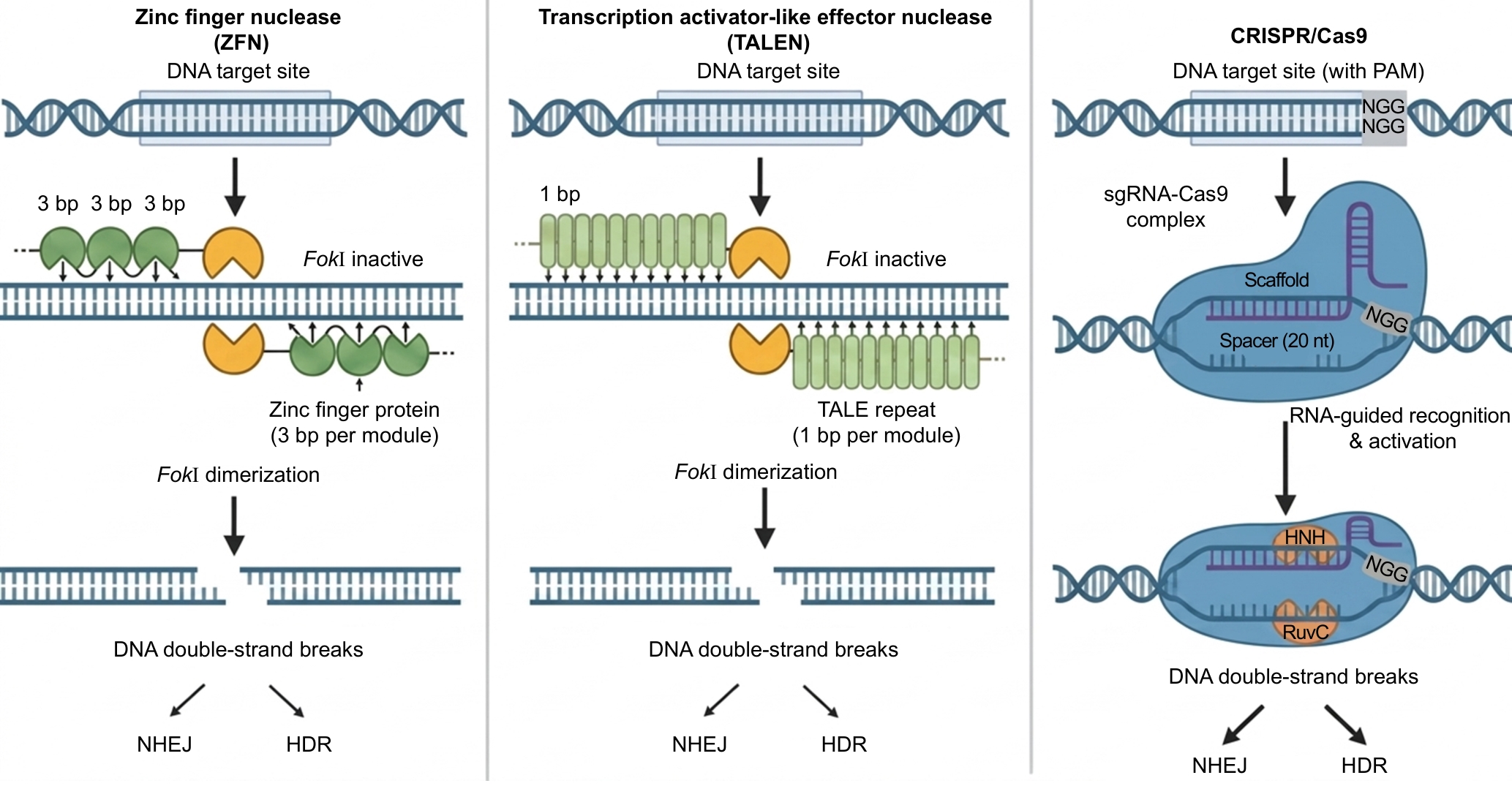
Figure 1
Comparison of key features of genome editing technologies for genetically engineered mouse generation
| 技术类型 Technology | 编辑原理 Editing principle | 是否依赖DSB Depen-dence on DSB | 可实现的突变类型 Types of mutations achievable | 编辑效率 Editing efficiency | 构建周期 Model genera-tion time | 构建成本 Cost | 品系适应性 Strain compat-ibility | 多基因编辑能力 Multiplex editing capability | 脱靶风险 Off-target risk | 主要优势 Key advantage | 主要局限 Key limitation | 典型应用 Typical application |
|---|---|---|---|---|---|---|---|---|---|---|---|---|
| 胚胎干细胞同源重组 ESC-based homologous recombination | 同源重组介导靶位点定向替换 | 否 | KO、KI、点突变等均可实现 | 低 | 长(6~12个月) | 高 | 受限(前期主要为129等品系) | 低 | 低 | 精确性高,遗传结果稳定 | 周期长、成本高 | 精确遗传修饰、经典KO/KI模型 |
| ENU/转座子诱变 ENU/Transposon mutagenesis | ENU诱导碱基烷基化引起点突变;转座子在基因组中随机或偏好性插入导致基因功能破坏 | 否 | 点突变(ENU)、插入突变(转座子) | 高(突变率高) | 长 | 中 | 高 | 高(但随机性强) | 不适用于传统脱靶概念,且存在随机突变背景 | 无须预设靶点,可进行正向遗传筛选 | 位点鉴定困难、表型归因复杂 | 正向遗传筛选、新基因发现 |
| 锌指核酸酶 Zinc finger nucleases | 蛋白识别DNA序列并由FokⅠ诱导产生DSB | 是 | KO、KI、点突变等均可实现 | 中 | 中 | 高 | 高 | 低 | 中 | 开创性定点编辑工具 | 设计复杂、成本高、专利限制 | 特定靶点编辑或已有体系延续 |
| 转录激活因子样效应物核酸酶 Transcription activator-like effector nuclease | 转录激活因子样效应物识别DNA序列并由FokⅠ诱导产生DSB | 是 | KO、KI、点突变等均可实现 | 中~高 | 中 | 中~高 | 高 | 低 | 低 | 特异性较高、识别规则明确 | 构建复杂、递送受限 | 高特异性需求或复杂靶点编辑 |
| CRISPR/Cas系统 CRISPR/Cas system | sgRNA引导Cas9在靶位点产生DSB | 是 | KO、KI、点突变等均可实现 | 高 | 短(2~3个月) | 低 | 高 | 高(多条sgRNA实现多靶向) | 中 | 灵活、高效、适用于多基因编辑 | 存在脱靶及嵌合性风险 | 常规基因工程小鼠构建首选 |
| 碱基编辑 Base editing | 脱氨酶介导碱基转换 | 否 | 主要为点突变 | 高 | 短 | 中 | 高 | 中 | 低~中 | 无DSB、高精度 | 编辑窗口受限 | 单碱基突变疾病模型 |
| 引导编辑 Prime editing | 逆转录酶介导的靶位点序列改写 | 否 | 片段序列精准插入/缺失/替换 | 中 | 短~中 | 中 | 高 | 中 | 低 | 突变类型多样、灵活性高 | 编辑效率相对较低 | 复杂突变或非编码区精细编辑模型 |
Table 1
Comparison of key features of genome editing technologies for genetically engineered mouse generation
| 技术类型 Technology | 编辑原理 Editing principle | 是否依赖DSB Depen-dence on DSB | 可实现的突变类型 Types of mutations achievable | 编辑效率 Editing efficiency | 构建周期 Model genera-tion time | 构建成本 Cost | 品系适应性 Strain compat-ibility | 多基因编辑能力 Multiplex editing capability | 脱靶风险 Off-target risk | 主要优势 Key advantage | 主要局限 Key limitation | 典型应用 Typical application |
|---|---|---|---|---|---|---|---|---|---|---|---|---|
| 胚胎干细胞同源重组 ESC-based homologous recombination | 同源重组介导靶位点定向替换 | 否 | KO、KI、点突变等均可实现 | 低 | 长(6~12个月) | 高 | 受限(前期主要为129等品系) | 低 | 低 | 精确性高,遗传结果稳定 | 周期长、成本高 | 精确遗传修饰、经典KO/KI模型 |
| ENU/转座子诱变 ENU/Transposon mutagenesis | ENU诱导碱基烷基化引起点突变;转座子在基因组中随机或偏好性插入导致基因功能破坏 | 否 | 点突变(ENU)、插入突变(转座子) | 高(突变率高) | 长 | 中 | 高 | 高(但随机性强) | 不适用于传统脱靶概念,且存在随机突变背景 | 无须预设靶点,可进行正向遗传筛选 | 位点鉴定困难、表型归因复杂 | 正向遗传筛选、新基因发现 |
| 锌指核酸酶 Zinc finger nucleases | 蛋白识别DNA序列并由FokⅠ诱导产生DSB | 是 | KO、KI、点突变等均可实现 | 中 | 中 | 高 | 高 | 低 | 中 | 开创性定点编辑工具 | 设计复杂、成本高、专利限制 | 特定靶点编辑或已有体系延续 |
| 转录激活因子样效应物核酸酶 Transcription activator-like effector nuclease | 转录激活因子样效应物识别DNA序列并由FokⅠ诱导产生DSB | 是 | KO、KI、点突变等均可实现 | 中~高 | 中 | 中~高 | 高 | 低 | 低 | 特异性较高、识别规则明确 | 构建复杂、递送受限 | 高特异性需求或复杂靶点编辑 |
| CRISPR/Cas系统 CRISPR/Cas system | sgRNA引导Cas9在靶位点产生DSB | 是 | KO、KI、点突变等均可实现 | 高 | 短(2~3个月) | 低 | 高 | 高(多条sgRNA实现多靶向) | 中 | 灵活、高效、适用于多基因编辑 | 存在脱靶及嵌合性风险 | 常规基因工程小鼠构建首选 |
| 碱基编辑 Base editing | 脱氨酶介导碱基转换 | 否 | 主要为点突变 | 高 | 短 | 中 | 高 | 中 | 低~中 | 无DSB、高精度 | 编辑窗口受限 | 单碱基突变疾病模型 |
| 引导编辑 Prime editing | 逆转录酶介导的靶位点序列改写 | 否 | 片段序列精准插入/缺失/替换 | 中 | 短~中 | 中 | 高 | 中 | 低 | 突变类型多样、灵活性高 | 编辑效率相对较低 | 复杂突变或非编码区精细编辑模型 |
| [1] |
MONTOLIU L. Transgenesis and genome engineering: a historical review[J]. Methods Mol Biol, 2023, 2631: 1-32. DOI: 10.1007/978-1-0716-2990-1_1.
|
| [2] |
KIM H S, KWEON J, KIM Y. Recent advances in CRISPR-based functional genomics for the study of disease-associated genetic variants[J]. Exp Mol Med, 2024, 56(4): 861-869. DOI: 10.1038/s12276-024-01212-3.
|
| [3] |
VARSHNEY G K, BURGESS S M. CRISPR-based functional genomics tools in vertebrate models[J]. Exp Mol Med, 2025, 57(7): 1355-1372. DOI: 10.1038/s12276-025-01514-0.
|
| [4] |
SHAMSHIRGARAN Y, LIU J, SUMER H, et al. Tools for efficient genome editing; ZFN, TALEN, and CRISPR[M]//VERMA P J, SUMER H, LIU J. Applications of genome modulation and editing. New York: Humana Press, 2022: 29-46. DOI: 10.1007/978-1-0716-2301-5_2.
|
| [5] |
LIU D Q, CAO D, HAN R Z. Recent advances in therapeutic gene-editing technologies[J]. Mol Ther, 2025, 33(6): 2619-2644. DOI: 10.1016/j.ymthe.2025.03.026.
|
| [6] |
HARBERS K, JÄHNER D, JAENISCH R. Microinjection of cloned retroviral genomes into mouse zygotes: integration and expression in the animal[J]. Nature, 1981, 293(5833): 540-542. DOI: 10.1038/293540a0.
|
| [7] |
EVANS M J, KAUFMAN M H. Establishment in culture of pluripotential cells from mouse embryos[J]. Nature, 1981, 292(5819): 154-156. DOI: 10.1038/292154a0.
|
| [8] |
MARTIN G R. Isolation of a pluripotent cell line from early mouse embryos cultured in medium conditioned by teratocarcinoma stem cells[J]. Proc Natl Acad Sci U S A, 1981, 78(12): 7634-7638. DOI: 10.1073/pnas.78.12.7634.
|
| [9] |
DOETSCHMAN T, GREGG R G, MAEDA N, et al. Targetted correction of a mutant HPRT gene in mouse embryonic stem cells[J]. Nature, 1987, 330(6148): 576-578. DOI: 10.1038/330576a0.
|
| [10] |
THOMAS K R, CAPECCHI M R. Site-directed mutagenesis by gene targeting in mouse embryo-derived stem cells[J]. Cell, 1987, 51(3): 503-512. DOI: 10.1016/0092-8674(87)90646-5.
|
| [11] |
NGUYEN N, JUDD L M, KALANTZIS A, et al. Random mutagenesis of the mouse genome: a strategy for discovering gene function and the molecular basis of disease[J]. Am J Physiol Gastrointest Liver Physiol, 2011, 300(1): G1-G11. DOI: 10.1152/ajpgi.00343.2010.
|
| [12] |
LEBLANC D P M, ZHOU G, WILLIAMS A, et al. Duplex sequencing identifies unique characteristics of ENU-induced mutations in male mouse germ cells[J]. Biol Reprod, 2025, 112(5): 1015-1027. DOI: 10.1093/biolre/ioaf029.
|
| [13] |
LUO X X, LIU L F, RONG H W, et al. ENU-based dominant genetic screen identifies contractile and neuronal gene mutations in congenital heart disease[J]. Genome Med, 2024, 16(1): 97. DOI: 10.1186/s13073-024-01372-x.
|
| [14] |
BEUTLER B, JIANG Z F, GEORGEL P, et al. Genetic analysis of host resistance: Toll-like receptor signaling and immunity at large[J]. Annu Rev Immunol, 2006, 24: 353-389. DOI: 10.1146/annurev.immunol.24.021605.090552.
|
| [15] |
PAPATHANASIOU P, GOODNOW C C. Connecting mammalian genome with phenome by ENU mouse mutagenesis: gene combinations specifying the immune system[J]. Annu Rev Genet, 2005, 39: 241-262.DOI: 10.1146/annurev.genet.39. 110304.095817.
|
| [16] |
BECKMANN P J, LARGAESPADA D A. Transposon insertion mutagenesis in mice for modeling human cancers: critical insights gained and new opportunities[J]. Int J Mol Sci, 2020, 21(3): 1172. DOI: 10.3390/ijms21031172.
|
| [17] |
KOVAČ A, MISKEY C, IVICS Z. Sleeping beauty transposon insertions into nucleolar DNA by an engineered transposase localized in the nucleolus[J]. Int J Mol Sci, 2023, 24(19): 14978. DOI: 10.3390/ijms241914978.
|
| [18] |
DING S, WU X H, LI G, et al. Efficient transposition of the piggyBac (PB) transposon in mammalian cells and mice[J]. Cell, 2005, 122(3): 473-483. DOI: 10.1016/j.cell.2005.07.013.
|
| [19] |
NUTTLE X, BURT N D, CURRALL B, et al. Parallelized engineering of mutational models using piggyBac transposon delivery of CRISPR libraries[J]. Cell Rep Methods, 2024, 4(1): 100672. DOI: 10.1016/j.crmeth.2023.100672.
|
| [20] |
SATOH Y, ASAKAWA J I, NISHIMURA M, et al. Characteristics of induced mutations in offspring derived from irradiated mouse spermatogonia and mature oocytes[J]. Sci Rep, 2020, 10: 37. DOI: 10.1038/s41598-019-56881-2.
|
| [21] |
HAN M, PERKINS M H, NOVAES L S, et al. Advances in transposable elements: from mechanisms to applications in mammalian genomics[J]. Front Genet, 2023, 14: 1290146. DOI: 10.3389/fgene.2023.1290146.
|
| [22] |
LIAO H Y, WU J H, VANDUSEN N J, et al. CRISPR-Cas9-mediated homology-directed repair for precise gene editing[J]. Mol Ther Nucleic Acids, 2024, 35(4): 102344. DOI: 10.1016/j.omtn.2024.102344.
|
| [23] |
PHAN H T L, KIM K, LEE H, et al. Progress in and prospects of genome editing tools for human disease model development and therapeutic applications[J]. Genes, 2023, 14(2): 483. DOI: 10.3390/genes14020483.
|
| [24] |
DURAI S, MANI M, KANDAVELOU K, et al. Zinc finger nucleases: custom-designed molecular scissors for genome engineering of plant and mammalian cells[J]. Nucleic Acids Res, 2005, 33(18): 5978-5990. DOI: 10.1093/nar/gki912.
|
| [25] |
CARBERY I D, JI D A, HARRINGTON A, et al. Targeted genome modification in mice using zinc-finger nucleases[J]. Genetics, 2010, 186(2): 451-459. DOI: 10.1534/genetics.110.117002.
|
| [26] |
MEYER M, DE ANGELIS M H, WURST W, et al. Gene targeting by homologous recombination in mouse zygotes mediated by zinc-finger nucleases[J]. Proc Natl Acad Sci U S A, 2010, 107(34): 15022-15026. DOI: 10.1073/pnas.1009424107.
|
| [27] |
MAHATA B, BISWAS K. Generation of stable knockout mammalian cells by TALEN-mediated locus-specific gene editing[M]//REEVES A. In vitro mutagenesis: methods and protocols. New York: Humana Press, 2017: 107-120. DOI: 10. 1007/978-1-4939-6472-7_7.
|
| [28] |
LI C L, QI R, SINGLETERRY R, et al. Simultaneous gene editing by injection of mRNAs encoding transcription activator-like effector nucleases into mouse zygotes[J]. Mol Cell Biol, 2014, 34(9): 1649-1658. DOI: 10.1128/MCB.00023-14.
|
| [29] |
MUSSOLINO C, ALZUBI J, FINE E J, et al. TALENs facilitate targeted genome editing in human cells with high specificity and low cytotoxicity[J]. Nucleic Acids Res, 2014, 42(10): 6762-6773. DOI: 10.1093/nar/gku305.
|
| [30] |
JINEK M, CHYLINSKI K, FONFARA I, et al. A programmable dual-RNA–guided DNA endonuclease in adaptive bacterial immunity[J]. Science, 2012, 337(6096): 816-821. DOI: 10.1126/science.1225829.
|
| [31] |
WANG H Y, YANG H, SHIVALILA C S, et al. One-step generation of mice carrying mutations in multiple genes by CRISPR/Cas-mediated genome engineering[J]. Cell, 2013, 153(4): 910-918. DOI: 10.1016/j.cell.2013.04.025.
|
| [32] |
YANG H, WANG H Y, SHIVALILA C S, et al. One-step generation of mice carrying reporter and conditional alleles by CRISPR/Cas-mediated genome engineering[J]. Cell, 2013, 154(6): 1370-1379. DOI: 10.1016/j.cell.2013.08.022.
|
| [33] |
ZETSCHE B, GOOTENBERG J S, ABUDAYYEH O O, et al. Cpf1 is a single RNA-guided endonuclease of a class 2 CRISPR-Cas system[J]. Cell, 2015, 163(3): 759-771. DOI: 10.1016/j.cell.2015. 09.038.
|
| [34] |
KARVELIS T, BIGELYTE G, YOUNG J K, et al. PAM recognition by miniature CRISPR–Cas12f nucleases triggers programmable double-stranded DNA target cleavage[J]. Nucleic Acids Res, 2020, 48(9): 5016-5023. DOI: 10.1093/nar/gkaa208.
|
| [35] |
PACESA M, PELEA O, JINEK M. Past, present, and future of CRISPR genome editing technologies[J]. Cell, 2024, 187(5): 1076-1100. DOI: 10.1016/j.cell.2024.01.042.
|
| [36] |
CETIN B, ERENDOR F, EKSI Y E, et al. Advancing CRISPR genome editing into gene therapy clinical trials: progress and future prospects[J]. Expert Rev Mol Med, 2025, 27: e16. DOI: 10.1017/erm.2025.10.
|
| [37] |
RAN F A, HSU P D, LIN C Y, et al. Double nicking by RNA-guided CRISPR Cas9 for enhanced genome editing specificity[J]. Cell, 2013, 154(6): 1380-1389. DOI: 10.1016/j.cell.2013.08.021.
|
| [38] |
KLEINSTIVER B P, PATTANAYAK V, PREW M S, et al. High-fidelity CRISPR-Cas9 nucleases with no detectable genome-wide off-target effects[J]. Nature, 2016, 529(7587): 490-495. DOI: 10.1038/nature16526.
|
| [39] |
JONES I R, REN X J, SHEN Y. High-throughput CRISPRi and CRISPRa technologies in 3D genome regulation for neuropsychiatric diseases[J]. Hum Mol Genet, 2022, 31(R1): R47-R53. DOI: 10.1093/hmg/ddac193.
|
| [40] |
LIU B, JING Z Y, ZHANG X M, et al. Large-scale multiplexed mosaic CRISPR perturbation in the whole organism[J]. Cell, 2022, 185(16): 3008-3024.e16. DOI: 10.1016/j.cell.2022.06.039.
|
| [41] |
LIANG Y H, CHEN F B, WANG K P, et al. Base editors: development and applications in biomedicine[J]. Front Med, 2023, 17(3): 359-387. DOI: 10.1007/s11684-023-1013-y.
|
| [42] |
LEE S, LEE H, BAEK G, et al. Enhanced mitochondrial DNA editing in mice using nuclear-exported TALE-linked deaminases and nucleases[J]. Genome Biol, 2022, 23(1): 211. DOI: 10.1186/s13059-022-02782-z.
|
| [43] |
MOK B Y, KOTRYS A V, RAGURAM A, et al. CRISPR-free base editors with enhanced activity and expanded targeting scope in mitochondrial and nuclear DNA[J]. Nat Biotechnol, 2022, 40(9): 1378-1387. DOI: 10.1038/s41587-022-01256-8.
|
| [44] |
KIM K, RYU S M, KIM S T, et al. Highly efficient RNA-guided base editing in mouse embryos[J]. Nat Biotechnol, 2017, 35(5): 435-437. DOI: 10.1038/nbt.3816.
|
| [45] |
SHELKE P, TRIBHUVAN S, AGRAHARI A K, et al. The evolving landscape of mitochondrial base editing: advances in precision, modeling, and therapeutic potential[J]. Mitochondrion, 2026, 86: 102093. DOI: 10.1016/j.mito.2025.102093.
|
| [46] |
YI Z Y, ZHANG X X, TANG W, et al. Strand-selective base editing of human mitochondrial DNA using mitoBEs[J]. Nat Biotechnol, 2024, 42(3): 498-509. DOI: 10.1038/s41587-023-01791-y.
|
| [47] |
WEI Y H, JIN M, HUANG S H, et al. Enhanced C-to-T and A-to-G base editing in mitochondrial DNA with engineered DdCBE and TALED[J]. Adv Sci, 2024, 11(3): 2304113. DOI: 10.1002/advs. 202304113.
|
| [48] |
BRETTMANN E, CHEN F Q, BEISHIR S, et al. Cytosine base editor-DNA binding domain fusions for editing window modulation in the RNP format[J]. BMC Biotechnol, 2025, 25(1): 92. DOI: 10.1186/s12896-025-01020-1.
|
| [49] |
KISSLING L, MOLLAYSA A, JANJUHA S, et al. Predicting adenine base editing efficiencies in different cellular contexts by deep learning[J]. Genome Biol, 2025, 26(1): 115. DOI: 10.1186/s13059-025-03586-7.
|
| [50] |
TANG J L, DU K Z. Mitochondrial base editing: from principle, optimization to application[J]. Cell Biosci, 2025, 15(1): 9. DOI: 10.1186/s13578-025-01351-8.
|
| [51] |
LUE N Z, LIAU B B. Base editor screens for in situ mutational scanning at scale[J]. Mol Cell, 2023, 83(13): 2167-2187. DOI: 10.1016/j.molcel.2023.06.009.
|
| [52] |
ANZALONE A V, RANDOLPH P B, DAVIS J R, et al. Search-and-replace genome editing without double-strand breaks or donor DNA[J]. Nature, 2019, 576(7785): 149-157. DOI: 10.1038/s41586-019-1711-4.
|
| [53] |
ELY Z A, MATHEY-ANDREWS N, NARANJO S, et al. A prime editor mouse to model a broad spectrum of somatic mutations in vivo[J]. Nat Biotechnol, 2024, 42(3): 424-436. DOI: 10.1038/s41587-023-01783-y.
|
| [54] |
KIM-YIP R P, MCNULTY R, JOYCE B, et al. Efficient prime editing in two-cell mouse embryos using PEmbryo[J]. Nat Biotechnol, 2024, 42(12): 1822-1830. DOI: 10.1038/s41587-023-02106-x.
|
| [55] |
LIU Y, LI X Y, HE S T, et al. Efficient generation of mouse models with the prime editing system[J]. Cell Discov, 2020, 6: 27. DOI: 10.1038/s41421-020-0165-z.
|
| [56] |
ZHANG W T, PETRI K, MA J Y, et al. Enhancing CRISPR prime editing by reducing misfolded pegRNA interactions[J]. eLife, 2024, 12: RP90948. DOI: 10.7554/elife.90948.
|
| [57] |
AI X L, TANG Z. Aptazyme-directed A-to-I RNA editing[J]. Methods Enzymol, 2025, 710: 267-283. DOI: 10.1016/bs.mie. 2024.11.022.
|
| [58] |
KASENIIT K E, KATZ N, KOLBER N S, et al. Modular, programmable RNA sensing using ADAR editing in living cells[J]. Nat Biotechnol, 2023, 41(4): 482-487. DOI: 10.1038/s41587-022-01493-x.
|
| [59] |
RAVICHANDRAN K, KHARGONKAR T, SAMADDAR S, et al. CRISPR based programmable RNA editing in primary hippocampal neurons[J]. Curr Protoc, 2023, 3(9): e886. DOI: 10.1002/cpz1.886.
|
| [60] |
YU J, SHIN J, YU J, et al. Programmable RNA base editing with photoactivatable CRISPR-Cas13[J]. Nat Commun, 2024, 15: 673. DOI: 10.1038/s41467-024-44867-2.
|
| [61] |
COX D B T, GOOTENBERG J S, ABUDAYYEH O O, et al. RNA editing with CRISPR-Cas13[J]. Science, 2017, 358(6366): 1019-1027. DOI: 10.1126/science.aaq0180.
|
| [62] |
YI Z Y, QU L, TANG H X, et al. Engineered circular ADAR-recruiting RNAs increase the efficiency and fidelity of RNA editing in vitro and in vivo[J]. Nat Biotechnol, 2022, 40(6): 946-955. DOI: 10.1038/s41587-021-01180-3.
|
| [63] |
赖梭梅, 丁一夫, 李劲松. 复杂疾病小鼠模型构建新策略: 类精子单倍体胚胎干细胞介导的半克隆技术[J]. 实验动物与比较医学, 2021, 41(5): 369-383. DOI: 10.12300/j.issn.1674-5817.2021.143.
|
|
LAI S M, DING Y F, LI J S. A new strategy for constructing mouse models of complex diseases: semi-cloning technology based on sperm-like haploid embryonic stem cells[J]. Lab Anim Comp Med, 2021, 41(5): 369-383. DOI: 10.12300/j.issn.1674-5817.2021.143.
|
|
| [64] |
SHEN B, ZHANG W S, ZHANG J, et al. Efficient genome modification by CRISPR-Cas9 nickase with minimal off-target effects[J]. Nat Methods, 2014, 11(4): 399-402. DOI: 10.1038/nmeth.2857.
|
| [65] |
GUO C T, MA X T, GAO F, et al. Off-target effects in CRISPR/Cas9 gene editing[J]. Front Bioeng Biotechnol, 2023, 11: 1143157. DOI: 10.3389/fbioe.2023.1143157.
|
| [1] | ZHANG Haitao, WEI Yalan, FAN Xiaojing, CHEN Lu, ZHUANG Xudong, WANG Xinrui. Anti-Inflammatory Effects of the Triterpenoid Saponin-Enriched Fraction from She Medicine Clematis florida and Exploration of Its Mechanisms in a Rat Model of Cervicitis [J]. Laboratory Animal and Comparative Medicine, 2026, 46(5): 616-628. |
| [2] | ZHAN Shaoqin, FANG Fang, ZHUANG Yuehong, WANG Yanting. A Comparative Study of ROCK Inhibitors Fasudil and Y27632 on Promoting Angiogenesis and Flap Survival in Mice [J]. Laboratory Animal and Comparative Medicine, 2026, 46(5): 689-699. |
| [3] | JIANG Miaomiao, FANG Jinping, HUANG Zongxuan, LI Jiamin, LIAO Huan, ZHANG Wenqiang, YU Jiaying, YANG Yanyan, LIAN Dawei. Study on the Mechanism of Gegen Qinlian Decoction in Improving Diabetic Myocardial Injury [J]. Laboratory Animal and Comparative Medicine, 2026, 46(5): 629-639. |
| [4] | TIAN Yan, LAI Dong, LAI Fei, JI Changfu. Study on the Relationship Between Changes in Heparin-Binding Protein Levels and Coagulation Disorders and Vascular Endothelial Injury in a Rat Model of Sepsis [J]. Laboratory Animal and Comparative Medicine, 2026, 46(5): 700-706. |
| [5] | WEN Fuli, XU Yongjun, FU Yunfeng, XUE Laien, CUI Linlin, WANG Junzhu, LU Jun, ZHENG Heping. Effectiveness Evaluation of Pre-Service Training for Laboratory Animal Practitioners Based on the "Three-Separation" Model [J]. Laboratory Animal and Comparative Medicine, 2026, 46(5): 771-778. |
| [6] | XU Jingru, FAN Sisi, QIU Shuqi, YAN Nana, FAN Kewei. Research Progress on Animal Models of Staphylococcus aureus Infection [J]. Laboratory Animal and Comparative Medicine, 2026, 46(5): 707-715. |
| [7] | XU Haochen, LE Qingqing, HE Xiwen, CAI Bing, YANG Longhe. Evaluation of the Efficacy of an Eye-Protective Compound Formula on the Retina in a Mouse Model of Blue Light-Induced Damage [J]. Laboratory Animal and Comparative Medicine, 2026, 46(5): 650-659. |
| [8] | ZHANG Panpan, XU Jinsen, CHENG Youmin, WU Huasong, LIN Jingyu. Establishment and Evaluation of a Rat Model of Chronic Obstructive Pulmonary Disease with Phlegm-Dampness Syndrome [J]. Laboratory Animal and Comparative Medicine, 2026, 46(5): 668-676. |
| [9] | ZHONG Qiuming, QIAN Liping, CAI Yuanyuan, LIU Deqiang, LIN Wei, YU Chunying, XIE Jindong, WANG Xunli, WU Sheng, CHEN Biyin, HUANG Zhen. Comparative Analysis of Sex Differences Between Cyclophosphamide- and Paclitaxel-Induced Mouse Models of Chemotherapy-Induced Alopecia [J]. Laboratory Animal and Comparative Medicine, 2026, 46(5): 677-688. |
| [10] | LIAN Ronggui, LIAO Naishun. In Vivo Tracking of Adipose-Derived Mesenchymal Stem Cell Therapy for Subacute Liver Injury Using Rare-Earth Down-Conversion Nanoparticles [J]. Laboratory Animal and Comparative Medicine, 2026, 46(5): 716-726. |
| [11] | LI Yanping, HUANG Shan, YAO Jengyuan, SHI Yimin, SUI Huaxiu, HUANG Houtan, YU Yanping, MI Yan, LIN Tahui. Protective Effect and Mechanism of Artemitin on Ozone-Induced Pulmonary Inflammation in Mice [J]. Laboratory Animal and Comparative Medicine, 2026, 46(5): 640-649. |
| [12] | LI Qiuju, JIA Liujun, LI Yue, PENG Peng, WANG Peihe, YUE Guangxin. Establishment and Key Points Summary of Sheep Animal Model with Peripheral Kannulation Cardiopulmonary Bypass [J]. Laboratory Animal and Comparative Medicine, 2026, (): 1-7. |
| [13] | ZHAO Yulei, HAN Bingbing, WANG Xingxin, YANG Guangjian, WANG Yajie, TANG Xiaoyong. Progress in Disease-Syndrome-Integrated Mouse Models of Lung Cancer [J]. Laboratory Animal and Comparative Medicine, 2026, 46(4): 531-540. |
| [14] | GONG Tiantian, WANG Xinpei, GUO Tiange, AN Yang, MENG Zihao, YAO Minghui, ZHANG He. Pathophysiological Effects of Cold Environment on Gastrointestinal Blast Combined Injury in Beagle Dogs [J]. Laboratory Animal and Comparative Medicine, 2026, 46(4): 507-514. |
| [15] | GONG Zhiqun, RAO Xiwu, ZHANG Tianyi, WU Rongchen, YE Mingnan, JIANG Chunxi, WANG Sumei, ZHU Yanjuan, CHAI Xiaoshu. Construction and Evaluation of Mouse Models Simulating Immune Checkpoint Inhibitor-Associated Pneumonitis [J]. Laboratory Animal and Comparative Medicine, 2026, 46(4): 498-506. |
| Viewed | ||||||
|
Full text |
|
|||||
|
Abstract |
|
|||||
