


Laboratory Animal and Comparative Medicine ›› 2026, Vol. 46 ›› Issue (1): 107-118.DOI: 10.12300/j.issn.1674-5817.2025.049
• Quality Control of Laboratory Animals • Previous Articles Next Articles
LI Li, LI Xuebo, FAN Yongheng, HE Donghua, LI Jianhong, CHANG Liangtang( )
)
Received:2025-03-25
Revised:2025-07-14
Online:2026-02-25
Published:2026-02-14
Correspondence to:
CHANG Liangtang
CLC Number:
LI Li,LI Xuebo,FAN Yongheng,et al. Experience Discussion on Feeding, Breeding and Genetic Management of Common Marmosets (Callithrix jacchus)[J]. Laboratory Animal and Comparative Medicine, 2026, 46(1): 107-118. DOI: 10.12300/j.issn.1674-5817.2025.049.
Add to citation manager EndNote|Ris|BibTeX
URL: https://www.slarc.org.cn/dwyx/EN/10.12300/j.issn.1674-5817.2025.049
项目 Program | 《实验动物 环境及设施》(GB 14925—2023) Laboratory Animal─Environment and Housing Facilities: GB 14925─2023 | 执行标准(本中心) Implemented standards (Center for Excellence in Brain Science and Intelligence Technology, Chinese Academy of Sciences) |
|---|---|---|
环境类别 Environmental category | 普通环境 | 普通环境 |
温度/℃ Temperature/℃ | 16~28 | 25~28 |
日温差/℃ Daily temperature difference/℃ | ≤4 | ≤4 |
换气次数/(次·h-1) Air change rate/(air changes per hour, ACH) | ≥8 | ≥12 |
相对湿度/% Relative humidity/% | 30~70 | ≤60 |
动物笼具周边处气流速度/(m·s-1) Airflow velocity around animal cages/(m·s-1) | ≤0.20 | ≤0.20 |
噪声/dB(A) Noise/dB(A) | ≤60 | ≤60 |
工作照度/lx Working illuminance/lx | ≥150 | ≥200 |
动物照度/lx Animal illuminance/lx | 100~200 | 100~200 |
与相通区域的静压差/Pa Static pressure difference relative to adjacent area/Pa | — | — |
空气洁净度/级别 Air cleanliness/level | — | — |
沉降菌平均浓度/CFU·(皿·0.5 h)-1 Average concentration of sedimentation bacteria/CFU(plate·0.5 h)-1 | — | ≤30 |
氨浓度/(mg·m-3) Ammonia concentration/(mg·m-3) | ≤14 | ≤14 |
光照周期(明暗交替)/h Light cycle (light-dark cycle)/h | 12~14/12~10 | 12/12 |
Table 1 Environmental parameter indicators for raising common marmosets
项目 Program | 《实验动物 环境及设施》(GB 14925—2023) Laboratory Animal─Environment and Housing Facilities: GB 14925─2023 | 执行标准(本中心) Implemented standards (Center for Excellence in Brain Science and Intelligence Technology, Chinese Academy of Sciences) |
|---|---|---|
环境类别 Environmental category | 普通环境 | 普通环境 |
温度/℃ Temperature/℃ | 16~28 | 25~28 |
日温差/℃ Daily temperature difference/℃ | ≤4 | ≤4 |
换气次数/(次·h-1) Air change rate/(air changes per hour, ACH) | ≥8 | ≥12 |
相对湿度/% Relative humidity/% | 30~70 | ≤60 |
动物笼具周边处气流速度/(m·s-1) Airflow velocity around animal cages/(m·s-1) | ≤0.20 | ≤0.20 |
噪声/dB(A) Noise/dB(A) | ≤60 | ≤60 |
工作照度/lx Working illuminance/lx | ≥150 | ≥200 |
动物照度/lx Animal illuminance/lx | 100~200 | 100~200 |
与相通区域的静压差/Pa Static pressure difference relative to adjacent area/Pa | — | — |
空气洁净度/级别 Air cleanliness/level | — | — |
沉降菌平均浓度/CFU·(皿·0.5 h)-1 Average concentration of sedimentation bacteria/CFU(plate·0.5 h)-1 | — | ≤30 |
氨浓度/(mg·m-3) Ammonia concentration/(mg·m-3) | ≤14 | ≤14 |
光照周期(明暗交替)/h Light cycle (light-dark cycle)/h | 12~14/12~10 | 12/12 |
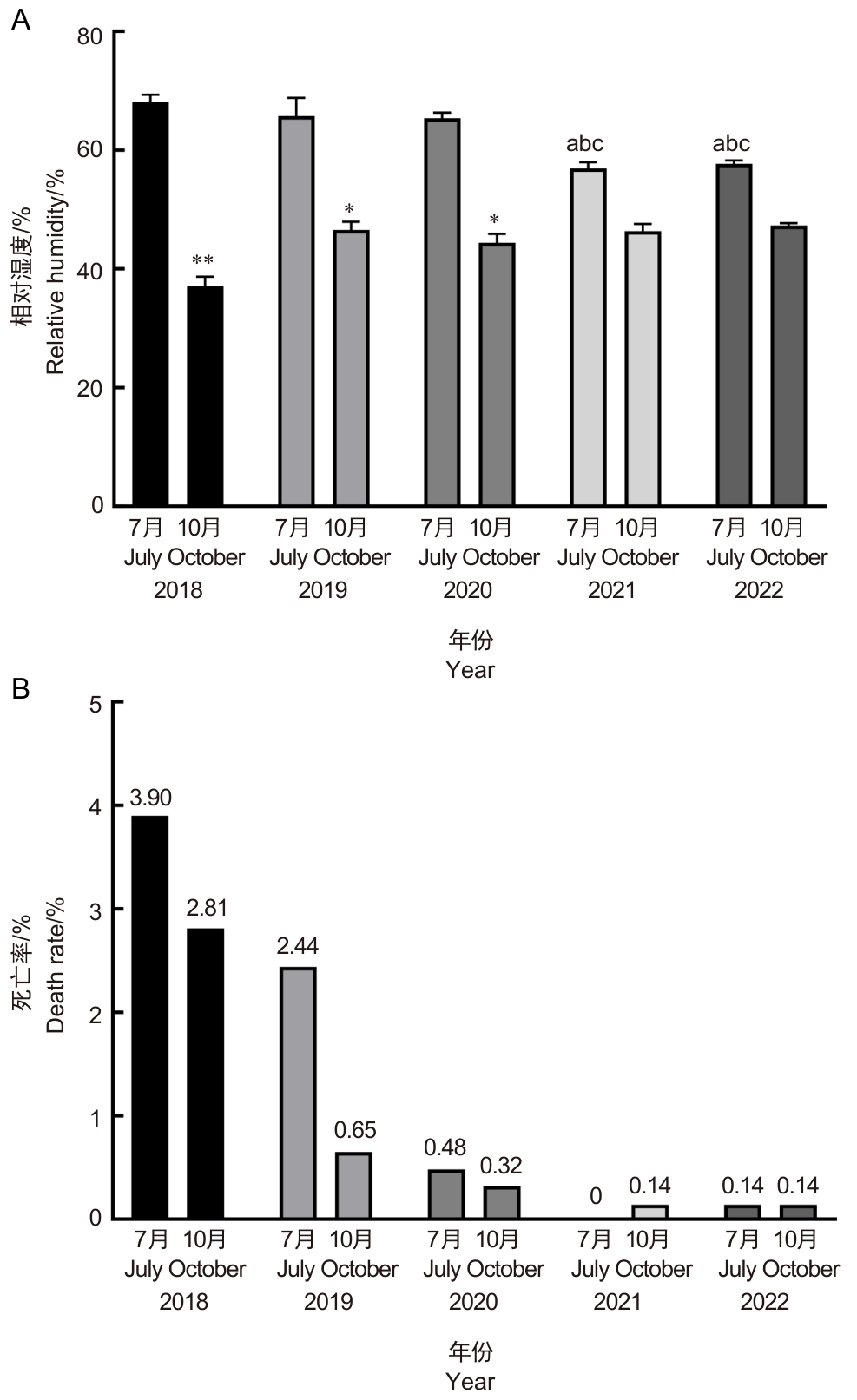
Figure 1 Relative humidity and animal mortality in the common marmoset room at the Center for Excellence in Brain Science and Intelligence Technology, Chinese Academy of Sciences(July and October, 2018–2022)
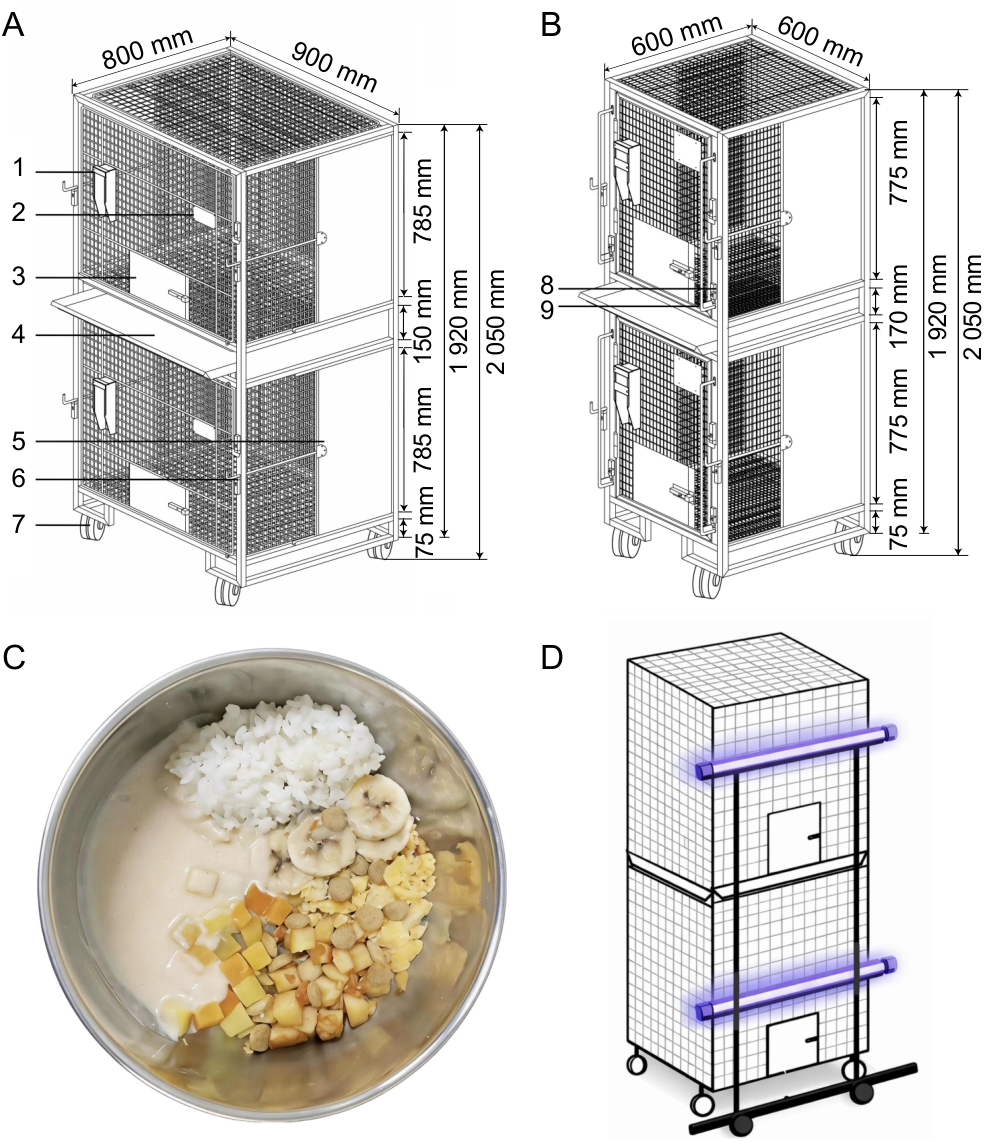
Figure 2 Common marmoset feeding cage, formulated diets, and 308 nm ultraviolet lamp irradiation methods
位置/物体 Location/Object | 清洁方式 Cleaning method | 清洁频次 Cleaning frequency | 消毒类型 Disinfection type | 消毒剂(浓度) Disinfectant (concentration) | 消毒频次 Disinfection frequency |
|---|---|---|---|---|---|
笼具表面、粪盘、笼具食盒和玩具(笼内有动物) Cage surfaces, fecal trays, food containers and toys (with animals inside cages) | 高压水枪冲洗晾干 | 1次/周 | 喷洒 | 消毒剂轮换使用:派斯德百毒杀(1∶600)、BCL百卫士(1∶200)、二氧化氯(2 mg/L) | 2次/周 |
笼具彻底清洁(笼内无动物) Thorough cleaning of cages (without animals inside cages) | 高压水枪冲洗烘干 | 3次/年(湿养), 1次/周(干养) | 喷洒 | 消毒剂轮换使用:派斯德百毒杀(1∶600)、84消毒液(1∶400)、苯扎溴铵(0.1%)、二氧化氯(50 mg/L)、BCL百卫士(1∶200) | 2次/周 |
非饲养间 Non-animal rooms | 扫拖/ 擦拭 | 1次/d | 喷雾/ 紫外线 | 消毒剂轮换使用:84消毒液(1∶400)、苯扎溴铵(0.1%)、二氧化氯(50 mg/L) | 1次/d |
饲养间 Animal rooms | 高压水枪冲洗 | 1~2次/周 | 喷洒 | 消毒剂轮换使用:派斯德百毒杀(1∶600)、苯扎溴铵(0.1%)、二氧化氯(50 mg/L) | 2次/周 |
空调和换气扇 Air conditioners and ventilation fans | 擦拭 | 2次/年 | 喷洒 | 消毒剂轮换使用:派斯德百毒杀(1∶600)、苯扎溴铵(0.1%)、二氧化氯(50 mg/L) | 2次/年 |
消毒垫 Disinfection mats | 冲洗 | 1次/周 | 浸泡 | 消毒剂轮换使用:84消毒液(1∶400)、二氧化氯(50 mg/L) | 1次/d |
垫料(纸质) Disposable paper bedding | 一次性 使用 | 更换 3次/周 | 紫外线 | 紫外线照射30 min | 使用前 |
碗具 Bowls | 浸泡清洗 | 1次/d | 浸泡+高温 消毒 | 消毒剂轮换使用:84消毒液(1∶200)、派斯德百毒杀(1∶600)、苯扎溴铵(0.1%)、二氧化氯(50 mg/L)、BCL百卫士(1∶200) | 1次/d |
饮水瓶 Water bottles | 浸泡清洗 | 1次/周 | 浸泡+高温 消毒 | 消毒剂轮换使用:84消毒液(1∶200)、派斯德百毒杀(1∶600)、苯扎溴铵(0.1%)、二氧化氯(50 mg/L)、苯扎溴铵(0.1%) | 1次/周 |
抓捕工具 Capture tools | 清水冲洗 | 1次/月 | 喷洒/浸泡 | 消毒剂轮换使用:75%乙醇溶液、派斯德百毒杀(1∶600)、二氧化氯(50 mg/L)、苯扎溴铵(0.1%) | 1次/月 |
苹果 Apples | 清水冲洗 | 每次日粮 制作前 | 浸泡 | 84消毒液(1∶400) | 每次日粮制作前 |
Table 2 Cleaning and disinfection of facilities and equipment for raising common marmosets
位置/物体 Location/Object | 清洁方式 Cleaning method | 清洁频次 Cleaning frequency | 消毒类型 Disinfection type | 消毒剂(浓度) Disinfectant (concentration) | 消毒频次 Disinfection frequency |
|---|---|---|---|---|---|
笼具表面、粪盘、笼具食盒和玩具(笼内有动物) Cage surfaces, fecal trays, food containers and toys (with animals inside cages) | 高压水枪冲洗晾干 | 1次/周 | 喷洒 | 消毒剂轮换使用:派斯德百毒杀(1∶600)、BCL百卫士(1∶200)、二氧化氯(2 mg/L) | 2次/周 |
笼具彻底清洁(笼内无动物) Thorough cleaning of cages (without animals inside cages) | 高压水枪冲洗烘干 | 3次/年(湿养), 1次/周(干养) | 喷洒 | 消毒剂轮换使用:派斯德百毒杀(1∶600)、84消毒液(1∶400)、苯扎溴铵(0.1%)、二氧化氯(50 mg/L)、BCL百卫士(1∶200) | 2次/周 |
非饲养间 Non-animal rooms | 扫拖/ 擦拭 | 1次/d | 喷雾/ 紫外线 | 消毒剂轮换使用:84消毒液(1∶400)、苯扎溴铵(0.1%)、二氧化氯(50 mg/L) | 1次/d |
饲养间 Animal rooms | 高压水枪冲洗 | 1~2次/周 | 喷洒 | 消毒剂轮换使用:派斯德百毒杀(1∶600)、苯扎溴铵(0.1%)、二氧化氯(50 mg/L) | 2次/周 |
空调和换气扇 Air conditioners and ventilation fans | 擦拭 | 2次/年 | 喷洒 | 消毒剂轮换使用:派斯德百毒杀(1∶600)、苯扎溴铵(0.1%)、二氧化氯(50 mg/L) | 2次/年 |
消毒垫 Disinfection mats | 冲洗 | 1次/周 | 浸泡 | 消毒剂轮换使用:84消毒液(1∶400)、二氧化氯(50 mg/L) | 1次/d |
垫料(纸质) Disposable paper bedding | 一次性 使用 | 更换 3次/周 | 紫外线 | 紫外线照射30 min | 使用前 |
碗具 Bowls | 浸泡清洗 | 1次/d | 浸泡+高温 消毒 | 消毒剂轮换使用:84消毒液(1∶200)、派斯德百毒杀(1∶600)、苯扎溴铵(0.1%)、二氧化氯(50 mg/L)、BCL百卫士(1∶200) | 1次/d |
饮水瓶 Water bottles | 浸泡清洗 | 1次/周 | 浸泡+高温 消毒 | 消毒剂轮换使用:84消毒液(1∶200)、派斯德百毒杀(1∶600)、苯扎溴铵(0.1%)、二氧化氯(50 mg/L)、苯扎溴铵(0.1%) | 1次/周 |
抓捕工具 Capture tools | 清水冲洗 | 1次/月 | 喷洒/浸泡 | 消毒剂轮换使用:75%乙醇溶液、派斯德百毒杀(1∶600)、二氧化氯(50 mg/L)、苯扎溴铵(0.1%) | 1次/月 |
苹果 Apples | 清水冲洗 | 每次日粮 制作前 | 浸泡 | 84消毒液(1∶400) | 每次日粮制作前 |
名称 Names | 添加量 Supplement amounts | 频次 Frequency |
|---|---|---|
21金维他®多维元素片(100片/瓶) 21 SUPER-VITA® multivitamin with multimineral tablets (100 tablets per bottle) | 2片/100只 | 1次/d |
东北制药™维生素C片(100 mg/片) Northeast Pharmaceutical™ Vitamin C Tablets (100 mg per tablet) | 5片/100只 | 1次/d |
星鲨™维生素D滴剂(400 IU/粒) Xingsha™ vitamin D drops (400 IU per capsule) | 2粒/100只 | 1次/d |
修正™维生素E(500 mg/粒) Xiuzheng™ vitamin E capsules (500 mg per capsule) | 2粒/100只 | 1次/d |
小宠™肠胃宝(5 g/袋) Xiaochong™ enteroguard probiotic powder (5 g per sachet) | 1袋/100只 | 1次/周 |
利宝™乳酸钙(0.5 g/袋) Libao™ calcium lactate granules (0.5 g per sachet) | 1.5袋/100只 | 2次/周 |
Table 3 Nutritional element supplements in the diet of common marmosets at Center for Excellence in Brain Science and Intelligence Technology, Chinese Academy of Sciences
名称 Names | 添加量 Supplement amounts | 频次 Frequency |
|---|---|---|
21金维他®多维元素片(100片/瓶) 21 SUPER-VITA® multivitamin with multimineral tablets (100 tablets per bottle) | 2片/100只 | 1次/d |
东北制药™维生素C片(100 mg/片) Northeast Pharmaceutical™ Vitamin C Tablets (100 mg per tablet) | 5片/100只 | 1次/d |
星鲨™维生素D滴剂(400 IU/粒) Xingsha™ vitamin D drops (400 IU per capsule) | 2粒/100只 | 1次/d |
修正™维生素E(500 mg/粒) Xiuzheng™ vitamin E capsules (500 mg per capsule) | 2粒/100只 | 1次/d |
小宠™肠胃宝(5 g/袋) Xiaochong™ enteroguard probiotic powder (5 g per sachet) | 1袋/100只 | 1次/周 |
利宝™乳酸钙(0.5 g/袋) Libao™ calcium lactate granules (0.5 g per sachet) | 1.5袋/100只 | 2次/周 |
项目 Programs | 频次 Frequency | 方法 Methods |
|---|---|---|
猴疱疹病毒Ⅰ型(抽检) Macacine herpesvirus type Ⅰ (spot check) | 3个月1次 | 采集血清送检 |
弓形虫(抽检) Toxoplasma gondii (spot check) | 3个月1次 | 采集血清送检 |
沙门菌(全部) Salmonella (all) | 半年1次 | 采集肛拭子 |
志贺菌(全部) Shigella (all) | 半年1次 | 采集肛拭子 |
结核分枝杆菌(全部) Mycobacterium tuberculosis (all) | 半年1次 | 眼睑皮试 |
皮肤病原真菌(抽检) Skin pathogenic fungi (spot check) | 3个月1次 | 皮肤毛发取样 镜检 |
体外寄生虫(抽检) External parasites (spot check) | 3个月1次 | 皮肤毛发取样 镜检 |
体内驱虫(全部) Internal deworming (all) | 半年1次 | 口服阿苯达唑 |
Table 4 Quarantine items for common marmosets at Center for Excellence in Brain Science and Intelligence Technology, Chinese Academy of Sciences
项目 Programs | 频次 Frequency | 方法 Methods |
|---|---|---|
猴疱疹病毒Ⅰ型(抽检) Macacine herpesvirus type Ⅰ (spot check) | 3个月1次 | 采集血清送检 |
弓形虫(抽检) Toxoplasma gondii (spot check) | 3个月1次 | 采集血清送检 |
沙门菌(全部) Salmonella (all) | 半年1次 | 采集肛拭子 |
志贺菌(全部) Shigella (all) | 半年1次 | 采集肛拭子 |
结核分枝杆菌(全部) Mycobacterium tuberculosis (all) | 半年1次 | 眼睑皮试 |
皮肤病原真菌(抽检) Skin pathogenic fungi (spot check) | 3个月1次 | 皮肤毛发取样 镜检 |
体外寄生虫(抽检) External parasites (spot check) | 3个月1次 | 皮肤毛发取样 镜检 |
体内驱虫(全部) Internal deworming (all) | 半年1次 | 口服阿苯达唑 |
分级 Grades | 体型 Body types | 外观 Appearances | 其他缺陷(如有) Other defects (if any) | 疾病 Diseases | 家族病史 Family medical histories | 管理措施 Management measures |
|---|---|---|---|---|---|---|
健康种猴 Healthy breeding common marmosets | 正常 | 良好或短尾 | 无 | 无疾病史或非腹泻疾病预后良好 | 无 | 信息加入繁殖猴挑选库 |
健康非种猴 Healthy non-breeding common marmosets | 正常/偏瘦/偏胖 | 良好或阴唇融合 | 育幼行为低/父性低/不孕不育 | 无疾病史或康复预后良好 | 无 | 信息加入实验猴挑选库 |
Ⅰ类退休猴 Class Ⅰ retired common marmosets | 偏瘦 | 毛发杂乱或有脱毛 | 发育或关节异常 | 偶发,预后一般 | 有或无 | 信息加入退休猴挑选库 |
Ⅱ类退休猴 Class Ⅱ retired common marmosets | 消瘦,体型偏小 | 毛发杂乱或有脱毛 | 发育异常或 行动受限 | 长期发病,预后不良 | 有或无 | 信息加入退休猴挑选库 |
Table 5 Grading criteria for status assessment of adult common marmosets at Center for Excellence in Brain Science and Intelligence Technology, Chinese Academy of Sciences
分级 Grades | 体型 Body types | 外观 Appearances | 其他缺陷(如有) Other defects (if any) | 疾病 Diseases | 家族病史 Family medical histories | 管理措施 Management measures |
|---|---|---|---|---|---|---|
健康种猴 Healthy breeding common marmosets | 正常 | 良好或短尾 | 无 | 无疾病史或非腹泻疾病预后良好 | 无 | 信息加入繁殖猴挑选库 |
健康非种猴 Healthy non-breeding common marmosets | 正常/偏瘦/偏胖 | 良好或阴唇融合 | 育幼行为低/父性低/不孕不育 | 无疾病史或康复预后良好 | 无 | 信息加入实验猴挑选库 |
Ⅰ类退休猴 Class Ⅰ retired common marmosets | 偏瘦 | 毛发杂乱或有脱毛 | 发育或关节异常 | 偶发,预后一般 | 有或无 | 信息加入退休猴挑选库 |
Ⅱ类退休猴 Class Ⅱ retired common marmosets | 消瘦,体型偏小 | 毛发杂乱或有脱毛 | 发育异常或 行动受限 | 长期发病,预后不良 | 有或无 | 信息加入退休猴挑选库 |
| [1] | OKANO H. Current status of and perspectives on the application of marmosets in neurobiology[J]. Annu Rev Neurosci, 2021, 44:27-48. DOI:10.1146/annurev-neuro-030520-101844 . |
| [2] | YAMAZAKI Y, WATANABE S. Marmosets as a next-generation model of comparative cognition[J]. Jpn Psychol Res, 2009, 51(3):182-196. DOI:10.1111/j.1468-5884.2009.00398.x . |
| [3] | MILLER C T, FREIWALD W A, LEOPOLD D A, et al. Marmosets: a neuroscientific model of human social behavior[J]. Neuron, 2016, 90(2):219-233. DOI:10.1016/j.neuron. 2016.03.018 . |
| [4] | WU Y H, MISHRA A, QIU Z F, et al. Nonhuman primate induced pluripotent stem cells in regenerative medicine[J]. Stem Cells Int, 2012, 2012:767195. DOI:10.1155/2012/767195 . |
| [5] | KROPP J, DI MARZO A, GOLOS T. Assisted reproductive technologies in the common marmoset: an integral species for developing nonhuman primate models of human diseases[J]. Biol Reprod, 2017, 96(2):277-287. DOI:10.1095/biolreprod.116.146514 . |
| [6] | 陈天培, 潘振业, 马东林. 狨猴的研究: (Ⅰ)饲养与管理[J]. 上海实验动物科学, 1985, 5(4):250-252. DOI:CNKI:SUN:SHSY.0.1985-04-013 . |
| CHEN T P, PAN Z Y, MA D L. Studies on marmosets (Ⅰ) feeding and management[J]. Shanghai Lab Anim Sci, 1985, 5(4):250-252. DOI:CNKI:SUN:SHSY.0.1985-04-013 . | |
| [7] | 北京市质量技术监督局. 实验动物 繁育与遗传监测 第4部分: 实验用狨猴: [S/OL]. (2018-09-28)[2025-07-14]. . |
| Beijing Municipal Bureau of Quality and Technology Supervision. Laboratory animal—Breeding and genetic control (Part 4: Experimental marmoset): [S/OL]. (2018-09-28)[2025-07-14]. . | |
| [8] | GENOUD M, MARTIN R D, GLASER D. Rate of metabolism in the smallest Simian primate, the pygmy marmoset (Cebuella pygmaea)[J]. Am J Primatol, 1997, 41(3):229-245. DOI:10.1002/(SICI)1098-2345(1997)41:3229::AID-AJP5>3.0.CO;2-Z . |
| [9] | MARINI R, WACHTMAN L, TARDIF S, MANSFIELD K, et al. The common marmoset in captivity and biomedical research[M]. New York: Academic Press, 2019. DOI: 10.1016/C2016-0-00861-6 . |
| [10] | HENDERSON M E T, HALSEY L G. The metabolic upper critical temperature of the human thermoneutral zone[J]. J Therm Biol, 2022, 110:103380. DOI:10.1016/j.jtherbio.2022.103380 . |
| [11] | 魏薇, 金荣花, 肖天贵, 等. 江淮梅雨季副高特征及降水特征分析[J]. 成都信息工程大学学报, 2022, 37(1):103-110. DOI: 10.16836/j.cnki.jcuit.2022.01.017 . |
| WEI W, JIN R H, XIAO T G, et al. Analysis on characteristics of subtropical high and precipitation in Jianghuai Meiyu season[J]. J Chengdu Univ Inf Technol, 2022, 37(1):103-110. DOI: 10.16836/j.cnki.jcuit.2022.01.017 . | |
| [12] | EPPLE G. The role of pheromones in the social communication of marmoset monkeys (Callithricidae)[J]. J Reprod Fertil Suppl, 1973, 19:447-454. |
| [13] | ZIEGLER T E. Social effects via olfactory sensory stimuli on reproductive function and dysfunction in cooperative breeding marmosets and tamarins[J]. Am J Primatol, 2013, 75(3):202-211. DOI:10.1002/ajp.22061 . |
| [14] | FERRARI S F, LOPES FERRARI M A. A re-evaluation of the social organisation of the Callitrichidae, with reference to the ecological differences between Genera[J]. Folia Primatol, 1989, 52(3-4):132-147. DOI:10.1159/000156392 . |
| [15] | DE BOER R A, OVERDUIN-DE VRIES A M, LOUWERSE A L, et al. The behavioral context of visual displays in common marmosets (Callithrix jacchus)[J]. Am J Primatol, 2013, 75(11):1084-1095. DOI:10.1002/ajp.22167 . |
| [16] | GARBER P A. Vertical clinging, small body size, and the evolution of feeding adaptations in the Callitrichinae[J]. Am J Phys Anthropol, 1992, 88(4):469-482. DOI:10.1002/ajpa.1330880404 . |
| [17] | NICOLOSI R J, HUNT R D. Dietary allowances for nutrients in nonhuman primates[M]//Primates in nutritional research. Amsterdam: Elsevier, 1979:11-37. DOI:10.1016/b978-0-12-334250-8.50007-5 . |
| [18] | ROSS C N, COLMAN R, POWER M, et al. Marmoset metabolism, nutrition, and obesity[J]. ILAR J, 2020, 61(2-3):179-187. DOI:10.1093/ilar/ilab014 . |
| [19] | GOLTSTEIN P M, REINERT S, GLAS A, et al. Food and water restriction lead to differential learning behaviors in a head-fixed two-choice visual discrimination task for mice[J]. PLoS One, 2018, 13(9): e0204066. DOI:10.1371/journal.pone.0204066 . |
| [20] | LUNN S F. Systems for collection of urine in the captive common marmoset, Callithrix jacchus [J]. Lab Anim, 1989, 23(4):353-356. DOI:10.1258/002367789780745935 . |
| [21] | SHINKI T, SHIINA Y, TAKAHASHI N, et al. Extremely high circulating levels of 1α, 25-dihydroxyvitamin D3 in the marmoset, a new world monkey[J]. Biochem Biophys Res Commun, 1983, 114(2):452-457. DOI:10.1016/0006-291x(83)90801-x . |
| [22] | PRIME D. Harmful effects of ultraviolet radiation from sunray lamps[J]. J R Soc Health, 1983, 103(5):161-164. DOI:10.1177/146642408310300501 . |
| [23] | POWER M L, TARDIF S D, LAYNE D G, et al. Ingestion of calcium solutions by common marmosets (Callithrix jacchus)[J]. Am J Primatol, 1999, 47(3):255-261. DOI:10.1002/(SICI)1098-2345(1999)47:3255::AID-AJP7>3.0.CO;2-W . |
| [24] | FITZ C, GOODROE A, WIERENGA L, et al. Clinical management of gastrointestinal disease in the common marmoset (Callithrix jacchus)[J]. ILAR J, 2020, 61(2-3):199-217. DOI:10.1093/ilar/ilab012 . |
| [25] | 贾艳, 孙长江, 韩文瑜, 等. 肺炎克雷伯菌研究进展[J]. 微生物学杂志, 2006, 26(5):75-78. DOI: 10.3969/j.issn.1005-7021.2006.05.021 . |
| JIA Y, SUN C J, HAN W Y, et al. Progress in Klebsiella pneumoniae [J]. J Microbiol, 2006, 26(5):75-78. DOI: 10.3969/j.issn.1005-7021.2006.05.021 . | |
| [26] | 王爱, 康京花, 段丽丽, 等. 医院内泛耐药肺炎克雷伯菌定植及感染风险因素调查与控制[J]. 中国急救复苏与灾害医学杂志, 2012, 7(10):929-932. DOI: 10.3969/j.issn.1673-6966.2012.10.012 . |
| WANG A, KANG J H, DUAN L L, et al. Colonization and infection of pandrug resistant Klebsiella pneumoniae and risk factors thereof in in-patients[J]. China J Emerg Resusc Disaster Med, 2012, 7(10):929-932. DOI: 10.3969/j.issn.1673-6966.2012.10.012 . | |
| [27] | BOX H O. A social developmental study of young monkeys (Callithrix jacchus) within a captive family group[J]. Primates, 1975, 16(4):419-435. DOI:10.1007/BF02382740 . |
| [28] | 项建梅, 陈祖培, 金孟珏, 等. 狨猴生殖与繁育的观察[J]. 中国实验动物学杂志, 1997, 7(2): 92-96. DOI: CNKI:SUN:ZGDX.0.1997-02-008 . |
| XIANG J M, CHEN Z P, JIN M J, et al. Observation on reproduction and breeding of marmosets[J]. Chin J Lab Anim Sci, 1997, 7(2): 92-96. DOI: CNKI:SUN:ZGDX.0.1997-02-008 . | |
| [29] | BARRETT J, ABBOTT D H, GEORGE L M. Extension of reproductive suppression by pheromonal cues in subordinate female marmoset monkeys, Callithrix jacchus [J]. J Reprod Fertil, 1990, 90(2):411-418. DOI:10.1530/jrf.0.0900411 . |
| [30] | ABBOTT D H, BARNETT D K, COLMAN R J, et al. Aspects of common marmoset basic biology and life history important for biomedical research[J]. Comp Med, 2003, 53(4):339-350. DOI:10.1053/svms.2003.YSVMS27 . |
| [1] | LI Hongman, CHEN Yutong, SHI Yingpei, WANG Yijing, PAN Yan, XU Tong, ZHOU Yi, DENG Qiyue, LIU Xue. A New Perspective on Mental Health Assessment in Laboratory Animals: Stress Response Monitoring Based on Hair Characteristics [J]. Laboratory Animal and Comparative Medicine, 2026, 46(4): 553-563. |
| [2] | XU Shengye, HUANG Junfeng, CHEN Yihang, CHANG Liangtang. Design of a Capture Stress-Free Marmoset Monkey Chair Device for Experiments and Its Preliminary Application [J]. Laboratory Animal and Comparative Medicine, 2025, 45(1): 67-72. |
| [3] | LIU Cheng-xiu, LI Na, TONG Pin-fen, WANG Wen-guang, LU Cai-xia, HAN Yuan-yuan, KUANG De-xuan, SUN Xiao-mei, DAI Jie-jie. Analysis of Microsatellite Genetic Characteristics in of Closed Colony of Tree Shrews [J]. Laboratory Animal and Comparative Medicine, 2018, 38(1): 1-9. |
| [4] | LI Na, WANG Wen-yu, HE Wei, DING Shuang-shuang, XI Jian-fei, XU Hao, ZHANG Zhou. Analysis and Disposal of Diarrhea and Wasting in Common Marmosets [J]. Laboratory Animal and Comparative Medicine, 2014, 34(6): 476-480. |
| [5] | LI Meng-qian, WANG Qing-song, ZHANG Zhan-heng, LIU Xiao-long, WANG Xing-tong, LI Ting-ting, YIN Hai-fang, LIU Feng-yong. The Preliminary Analysis of Quarantine Parameters in Common Marmosets' Infectious Diseases [J]. Laboratory Animal and Comparative Medicine, 2014, 34(4): 330-334. |
| [6] | YANG Na, LIU Xiao-shuai, ZHOU Liang, ZENG Dai-wen. Genetic Analysis of Rhesus Macaques(Macaca mulatta) Using Microsatellite Markers [J]. Laboratory Animal and Comparative Medicine, 2014, 34(2): 131-135. |
| Viewed | ||||||
|
Full text |
|
|||||
|
Abstract |
|
|||||
