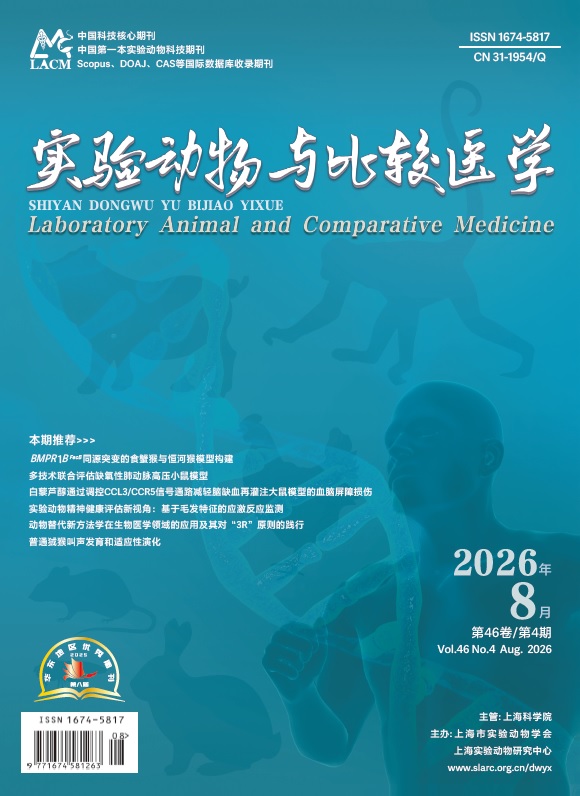


Laboratory Animal and Comparative Medicine (LACM, CN 31-1954/Q, ISSN 1674-5817) was first published in 1981 and is the first professional academic journal in the field of laboratory animal science in China. The journal balances the dissemination of knowledge with the advancement of science, publishing new research achievements, recent developments, and information in the fields of laboratory animal science and comparative medicine. The content mainly covers the establishment and application of animal models of human diseases, development and utilization of laboratory animal resources, management of laboratory animal facilities, quality control of laboratory animals, laboratory animal welfare and ethics, animal experimentation and alternative technologies, laboratory animal medicine, comparative medicine methodologies, as well as basic and applied research on the application of laboratory animals in various fields of biomedicine. Currently, the journal is a Chinese-language bimonthly publication, supervised by the Shanghai Academy of Science &Technology, and co-sponsored by the Shanghai Society for Laboratory Animal Science and the Shanghai Laboratory Animal Research Center. The target audience includes scientific researchers, educators, and medical professionals engaged in the production, breeding, testing, and management of laboratory animals, as well as those applying laboratory animals in comparative medicine research across various fields such as biology, medicine, pharmacy, zoology, and agronomy. Authors from all sectors are welcome to submit manuscripts.
1. Manuscript Writing Requirements and Considerations
1.1 General Requirements: The content of research articles must be well-conceived, with rigorous design, standard materials, reliable methods, accurate data, and appropriate statistical analysis. They should represent a development based on previous work and provide new knowledge. For specific requirements, please refer to the "Guideline Checklist for Publishing Research Papers on Animal Experimentation and Comparative Medicine in China (2024 Edition)" published by the journal. Literature reviews or practice exploration manuscripts should be written by relevant research teams based on their own research achievements or practical experience in recent years, and should offer a strong forward-looking perspective and provide practical guidance.
1.2 Manuscript Structure: The content of the manuscript should generally be arranged in the following order. Bilingual (Chinese and English) title, author names, affiliations (including city and postal code), structured abstract and keywords, introduction, materials and methods, results, discussion, and references. Information on funding sources, and biographies of the first author and corresponding author (including E-mail and ORCID) should be placed in the footnote on the first page. Acknowledgements, medical ethics statements, author contributions, and declarations of interests should be placed after the discussion. Section headings within the main text should be arranged in the format 1, 1.1, 1.1.1, ...
1.3 Title and Abstract: The title should be concise, specific, and accurate, summarizing the main point of the article. Chinese titles should generally be less than 20 characters, and unfamiliar abbreviations should be avoided. The English title should correspond to the Chinese version, with the first letter of each substantive word capitalized. The Chinese and English abstracts should be independent and self-explanatory, presenting the main content of the paper as completely and accurately as possible, with a length of over 500 Chinese characters. For research articles, systematic reviews, and meta-analyses, the abstract should adopt the IMRAD structure, i.e., four sections: Objective, Methods, Results, and Conclusions. These abstracts should generally be long abstracts of more than 800 Chinese characters with self-explanatory content. For keywords, MeSH terms from the U.S. National Library of Medicine should be used whenever possible, with 3-5 keywords corresponding between the Chinese and English versions.
1.4 Key Points of the Main Text: The introduction section should explain the background and innovation of the study. The methods section should clearly describe the research protocol and its key information, including the number of study subjects, inclusion and exclusion criteria, key welfare and ethical requirements such as anesthesia and euthanasia for laboratory animals, improved and innovative methods and operational steps, detection indicators, and primary and secondary outcomes of the study, to ensure the reproducibility of the research. In addition, reagents used should be identified by manufacturer and batch number, and instruments by manufacturer and model number. Experimental groupings should be described in detail, and blank controls, negative controls, and positive controls should be established. The results section should correspond to the methods section and contain specific statistical analysis data. Discussion of the results should be placed in the discussion section, which should provide an in-depth discussion and critical comparison with relevant domestic and international research literature, as well as present future prospects.
1.5 Statistical Requirements: Appropriate statistical methods should be applied for quantitative analysis, and the name and version number of the statistical analysis software should be provided. Statistical symbols should follow the relevant provisions of GB/T 3358-2009 "Statistics - Vocabulary and Symbols", for example: (1) Normally distributed measurement data are expressed as ±s, and non-normally distributed data as M (interquartile range); (2) The chi-square test for categorical data should provide the χ2 value; (3) The independent samples t-test for comparison between two groups should provide the t value; (4) Analysis of variance for comparison of multiple groups should provide the F value, and then pairwise comparisons within groups should use the LSD-t test or SNK-q test, providing the corresponding t or q values; (5) Correlation analysis should provide the correlation coefficient r value; (6) The specific P value range should be provided to indicate statistical significance.
1.6 Requirements for Figures and Tables: Figures and tables should be numbered consecutively in the order they appear in the text. Each figure and table should have a bilingual (Chinese and English) title, headings, and explanatory notes. The entire figure or table and its annotations should be self-explanatory. Photographs should have sufficient clarity and contrast, and high-definition composite images should be arranged in the order in which they appear in the text. Micrographs should also indicate the magnification (or provide a scale bar) and staining method. Non-original figures and tables must provide proof of authorization for use.
1.7 Units, Numbers, and Symbols: Units of measurement should be written in accordance with the "Legal Units of Measurement of the People's Republic of China" and expressed using unit symbols. The use of numbers should follow the relevant provisions of GB/T 15835-2011 "General Rules for Writing Numerals in Public Texts". Centuries, decades, years, months, days, times, counts, and measurements in the Gregorian calendar should be expressed using Arabic numerals.
1.8 Nomenclature and Terminology: Scientific and technical terms should use correct standardized terminology (refer to "Term Online", https://www.termonline.cn). Generic names (non-trade names) should be used for drugs. Latin scientific names should be provided for uncommon species. Common abbreviations used by the journal (see the journal's official website) can be used directly. Uncommon abbreviations should be introduced at first appearance in the format "Chinese full name (English full name, English abbreviation)".
1.9 References: All manuscripts, whether reviews, research articles, or experience exchanges, should cite an adequate number of references. New and representative original literature should be cited whenever possible. Retracted articles, conference abstracts, and AI-generated material should be avoided. For review articles, references from the last three years should generally account for more than 50%; for research articles, more than 30%. The citation format should follow the requirements of GB/T 7714-2025 "Information and Documentation - Rules for Bibliographical References", using the sequential coding system. That is, references should be cited in superscript Arabic numerals in square brackets after the corresponding text in the order they appear in the text (including in figures and tables). The corresponding references at the end of the manuscript should provide complete information including author names, article title, source, year, volume, issue, page numbers, and permanent identifiers. Chinese references should also provide an English translation. Common reference identifiers include: Books [M], Journal articles [J], Newspapers [N], Dissertations [D], Conference proceedings [C], Reports [R], Standards [S], Patents [P], Websites/Webpages [EB], Archives (including notices/proclamations, regulations/laws, etc.) [A], Datasets [DS], Preprints [PP].
2. Submission Requirements and Considerations
2.1 Submission Method: Please submit manuscripts through the online submission system on the journal's official website (http://www.slarc.org.cn/dwyx) (click "Author Submission" at the top left of the homepage). Before submitting, please carefully read the relevant instructions under "Journal Policies" and "Before Submission" on the homepage. When submitting, please follow the required steps in the system and fill in all correct information.
2.2 Submission Materials: The following supplementary materials must be uploaded during submission:
(1) Word manuscript file; (2) Submission checklist (tick each item); (3) Official institutional cover letter (with official seal); (4) Proof of funding (if any); (5) "Three certificates and one form" related to laboratory animals and animal experiments (if applicable), including Laboratory Animal Production License, Laboratory Animal Quality Certificate, Laboratory Animal Use License, and Animal Welfare and Ethics Review Form; (6) Human research ethics approval documentation (if applicable); (7) Author Contribution Statement; (8) Conflict of Interest Statement; (9) Copyright Transfer Agreement; (10) Other supplementary materials (e.g., high-definition original images, raw data, videos, audio, etc.). Electronic versions of all the above materials are sufficient.
2.3 Academic Integrity: Submissions must be original work independently obtained by the author(s), free from issues such as plagiarism, misappropriation, confidentiality breaches, multiple submissions, authorship disputes, etc. All statements in the manuscript regarding experimental materials, methods, results (including data) must be truthful and credible. The journal prohibits third-party submission, writing, and revision services. AI-generated manuscripts (including images) are not accepted. If AI assistance has been used, the relevant parts and tools used must be stated at the time of submission. If academic misconduct is found, the manuscript will be retracted, and the author's institution will be notified.
2.4 Authorship: Authorship and affiliation information (including order) must be confirmed at the time of submission. For multi-center collaborative papers, there must be no intellectual property disputes. For papers with collective (team) authorship, the principal responsible author must be designated as the corresponding author. When submitting online, please provide the complete information of each named author, and state the specific contributions and conflicts of interest of all named authors at the end of the manuscript. Authorship implies that the author has been fully informed of the work and is able to take responsibility for its content. The first author or corresponding author is responsible for contacting the journal and responding to reader queries.
2.5 Medical Ethics: The use of laboratory animals must comply with national regulations and standards such as the "Regulations for the Administration of Laboratory Animals" and the "Guidelines for Ethical Review of Laboratory Animal Welfare" (GB/T 35892-2018), as well as international standards such as ARRIVE 2.0 and IGP 2012. Animal experiments must adhere to the "3R" principle and obtain approval from the Institutional Animal Care and Use Committee (or relevant body). Requirements regarding anesthesia, euthanasia, and tumor burden must all comply with animal welfare and ethical standards. Human clinical trials must be registered first (providing registration number) and approved by the institutional medical ethics committee. Informed consent must be obtained for study procedures and for specimen collection.
2.6 Review Policies: The journal implements a strict three-stage review and three-stage proofreading system and adheres to relevant domestic and international publication ethics standards, including the COPE and ICMJE recommendations. All submissions will go through three review stages: editorial initial review, external peer review, and final approval by the Editor-in-Chief at the finalization meeting (during which pre-publication confidentiality is maintained). Only after these three stages will a decision on acceptance be made. Authors can check the review progress online after submission. If there are questions or urgent requests, authors may contact the editorial office directly. If a revised manuscript is not returned within one month of the request for revision, and no request for an extension has been made, it will be considered automatically withdrawn.
2.7 Editing and Proofreading: In accordance with the "Copyright Law of the People's Republic of China" and based on the principle that authors are responsible for their own content, the journal reserves the right to make editorial changes (modifications or deletions) to accepted manuscripts. Any changes that alter the original meaning will be sent to the authors for confirmation. Before printing, authors will be asked to carefully proofread the galley proofs. Failure to respond by the deadline will be considered acceptance of the changes and publication. If an erratum is needed after publication, a formal application process must be followed.
2.8 Copyright Statement: This journal is an open-access journal using the CC BY-NC-ND 4.0 license. All articles, once published, are permanently available for readers to download and read for free. By submitting a manuscript to this journal, authors agree to grant the journal the property rights of the article (including but not limited to reproduction rights, distribution rights, translation rights, compilation rights, adaptation rights, and information network dissemination rights), and the journal has the right to sublicense these rights to third parties. All manuscripts require the signed Copyright Transfer Agreement from the named authors.
2.9 Related Fees: The journal does not charge review fees for any manuscripts. After a manuscript is accepted, a publication fee (including color plate production fees) is required (200 RMB per thousand characters, and 1000 RMB for color plates). High-quality manuscripts may be eligible for a waiver or reduction of the publication fee. After the manuscript is published, the editorial office will pay a one-time honorarium (including all copyright transfer fees) and send two copies of the current issue to the authors.
2.10 Digital Promotion: This journal is a source journal for Chinese scientific and technical papers and citations (i.e., Chinese Core Scientific and Technical Journal), and is indexed in several major international databases, including SCOPUS, DOAJ, CA (Chemical Abstracts), Ulrichsweb, and WPRIM. The journal offers an online-first publication service; once accepted, manuscripts can be published online in advance through CNKI and the journal's official website. After formal publication, readers can access the journal's articles for literature retrieval on the journal's official website, CNKI, Wanfang, CQVIP, Chaoxing, and other domestic digital platforms, as well as international databases. Additionally, all archived issues and related materials on the journal's official website are available for free download.
2.11 Contact Information: Address: Editorial Office of Laboratory Animal and Comparative Medicine, No. 3577 Jinke Road, Pudong New Area, Shanghai 201203, China. Tel: +86-21-50793657. E-mail: lacm_bjb@slarc.org.cn. QQ group for submission inquiries: 750879769.
Editorial Office of LACM