基于miRNA测序分析清肺排毒汤防治小鼠急性肺损伤的分子机制研究
李龙雪1( ), 万崇凡2, 张琦2, 雷茹婷2, 王潇玥3, 程乐妍2, 赖琦2, 刘荣华4()(
 ), 刘漩1()(), 徐铁龙5()()
), 万崇凡2, 张琦2, 雷茹婷2, 王潇玥3, 程乐妍2, 赖琦2, 刘荣华4()(), 刘漩1()(), 徐铁龙5()()
Molecular Mechanisms of Qingfei Paidu Decoction in the Prevention and Treatment of Acute Lung Injury in Mice Based on miRNA Sequencing
LI Longxue1(), WAN Chongfan2, ZHANG Qi2, LEI Ruting2, WANG Xiaoyue3, CHENG Leyan2, LAI Qi2, LIU Ronghua4()(), LIU Xuan1()(), XU Tielong5()()
), WAN Chongfan2, ZHANG Qi2, LEI Ruting2, WANG Xiaoyue3, CHENG Leyan2, LAI Qi2, LIU Ronghua4()(), LIU Xuan1()(), XU Tielong5()()
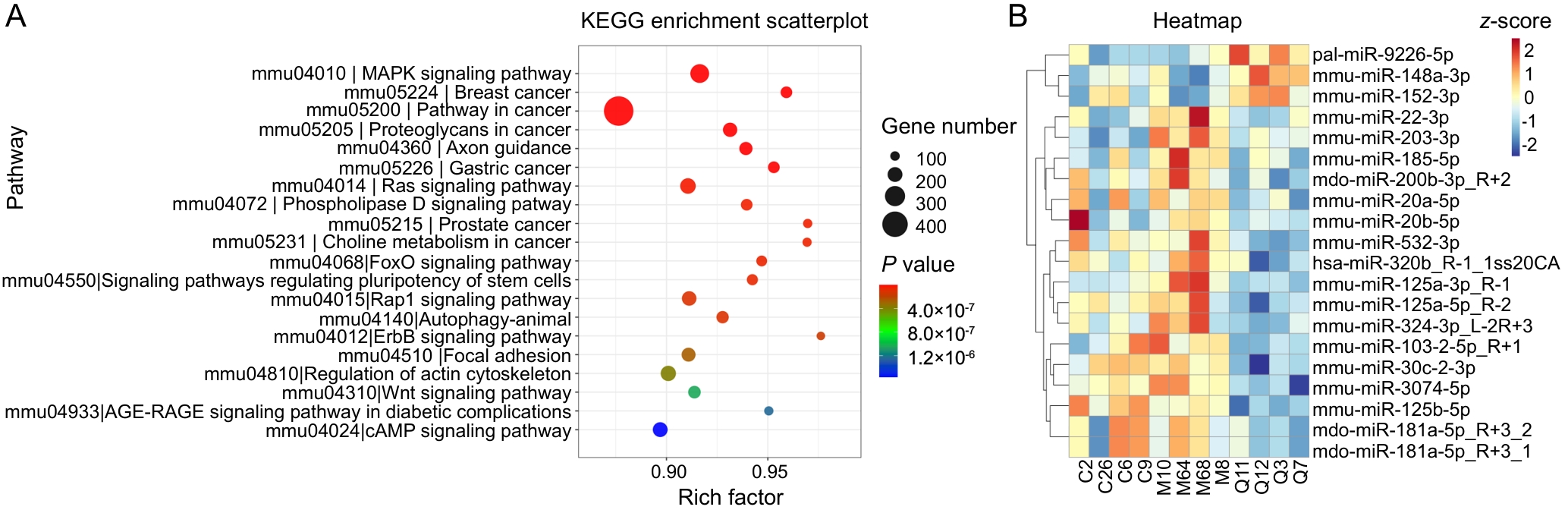
图 4. 差异表达 miRNA的靶基因KEGG富集分析
注:A,QFPDD组和模型组相比,具有显著变化的miRNA靶基因的KEGG富集分析;B,靶向丝裂原活化蛋白激酶(MAPK)信号通路的前20位miRNA表达热图。C2、C6、C9和C26为对照组;M8、M10、M64和M68为模型组;Q3、Q7、Q11和Q12为清肺排毒汤组。
Figure 4. KEGG enrichment analysis of target genes for differentially expressed miRNAs