脊髓压迫和半横断损伤小鼠模型的时空基因表达谱及修复机制研究
|
|
徐波, 陈泰任, 方乾, 吴际
|
Research on Spatiotemporal Gene Expression Profiles and Repair Mechanisms of Spinal Cord Compression and Hemisection Spinal Cord Injury Mouse Models
|
|
XU Bo, CHEN Tairen, FANG Qian, WU Ji
|
|
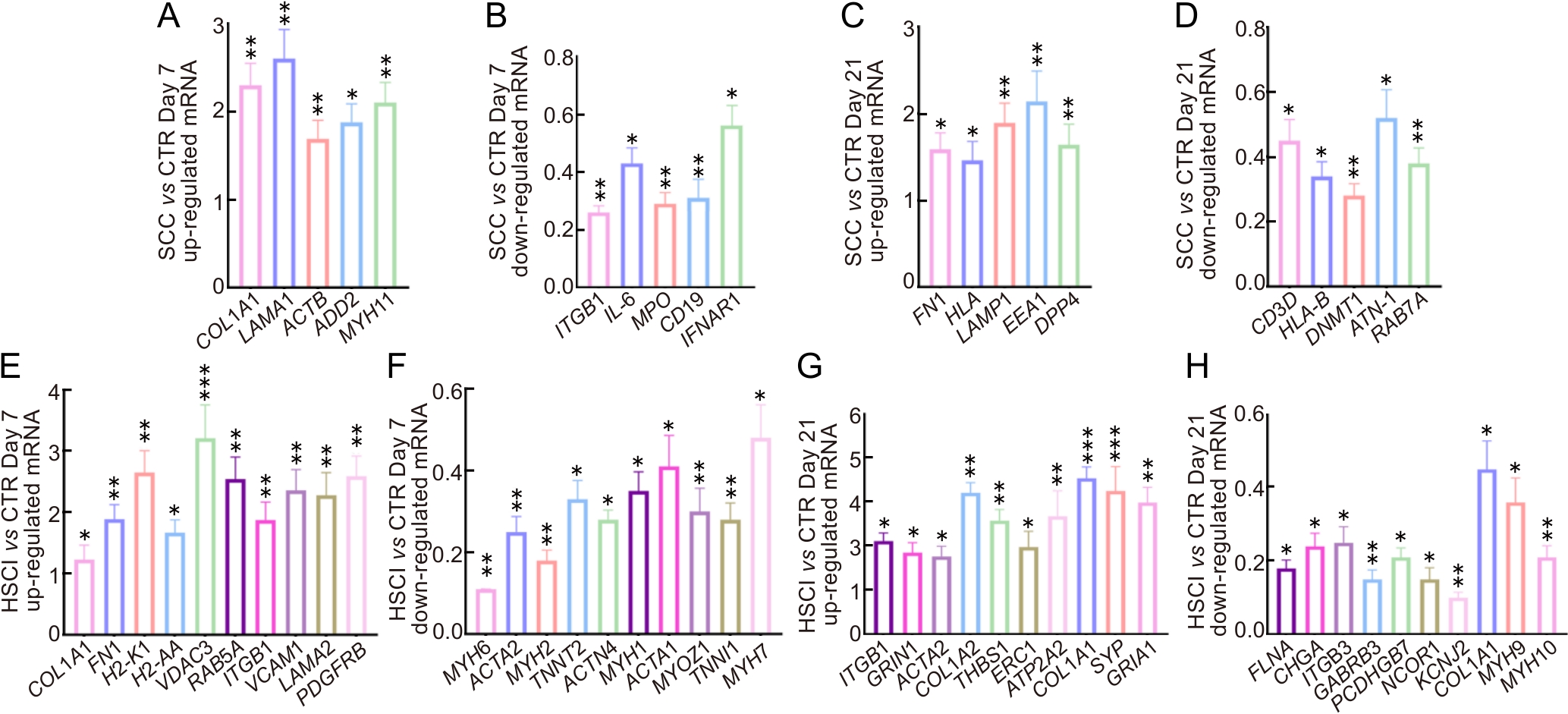
图4 实时荧光定量PCR验证表达差异基因的mRNA相对表达水平
注:A~D,与CTR组相比,SCC组在第7和21天上调和下调关键基因的实时荧光定量PCR结果;E~H,与CTR组相比,HSCI组在第7和21天上调和下调关键基因的实时荧光定量PCR结果。CTR,假手术对照组;SCC,脊髓压迫损伤组;HSCI,脊髓半横断损伤组。图中数据均以CTR组基因表达水平为1进行归一化展示。实时荧光定量PCR实验使用RNA测序后剩余的同一批小鼠组织样本进行检测(n=3)。?P<0.05,??P<0.01,???P<0.001。
|
Figure 4 Validation of mRNA expression levels of differentially expressed genes by real time fluorogenic quantitative PCR
Note: A-D, real time fluorogenic quantitative PCR results of the key genes that up-regulated and down-regulated in the SCC group compared with the CTR group at days 7 and 21; E-H, real time fluorogenic quantitative PCR results of the key genes that up-regulated and down-regulated at days 7 and 21 in the HSCI group compared with the CTR group. CTR, sham-operated control group; SCC, spinal cord contusion injury group; HSCI, hemisection spinal cord injury group. All data in the figure are normalized to a baseline of 1 for the CTR group. Real time fluorogenic quantitative PCR experiments were performed using the same batch of mouse tissue samples remaining after RNA-seq(n=3). ?P<0.05, ??P<0.01, ???P<0.001.
|
|
|
|
|