脊髓压迫和半横断损伤小鼠模型的时空基因表达谱及修复机制研究
|
|
徐波, 陈泰任, 方乾, 吴际
|
Research on Spatiotemporal Gene Expression Profiles and Repair Mechanisms of Spinal Cord Compression and Hemisection Spinal Cord Injury Mouse Models
|
|
XU Bo, CHEN Tairen, FANG Qian, WU Ji
|
|
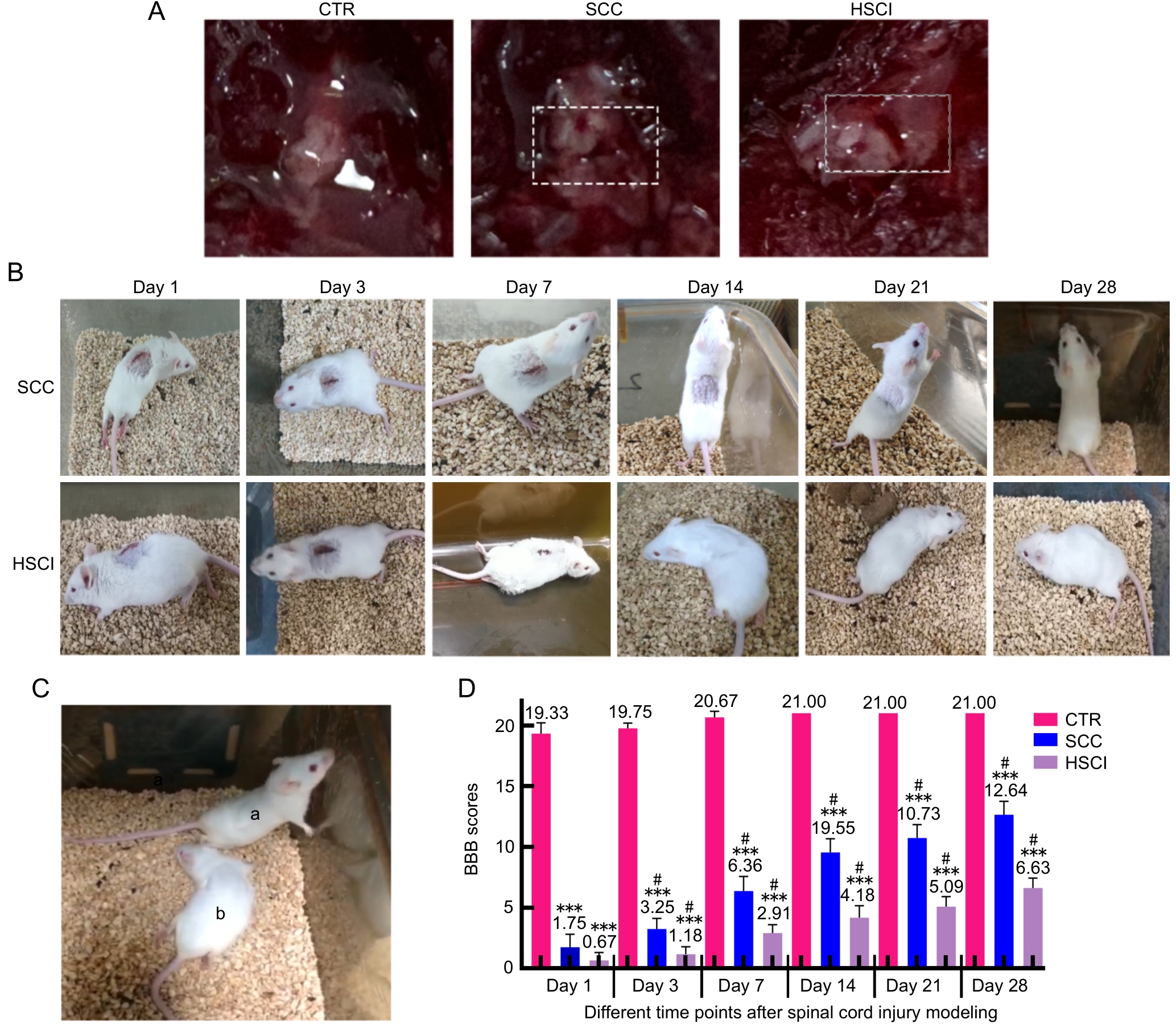
图2 假手术对照组、脊髓半横断损伤组和脊髓压迫损伤组小鼠宏观形态、恢复过程及运动功能的比较
注:A,CTR组、SCC组和HSCI组小鼠的脊髓体视镜明场图(白色虚线框内为脊髓造模状态);B,SCC组和HSCI组小鼠在术后第1、3、7、14、21和28天恢复情况;C,为术后第28天SCC组(标记为a)和HSCI组(标记为b)小鼠恢复情况的对比图;D,脊髓损伤术后不同时间点的BBB评分。CTR,假手术对照组;SCC,脊髓压迫损伤组;HSCI;脊髓半横断损伤组。???与CTR组相比,P<0.001;#与组内前一个时间点相比,P<0.05。
|
Figure 2 Comparison of macroscopic morphology, recovery process and motor function of mice in sham-operated control group, spinal cord compression and hemisection spinal cord injury group
Note: A, the spinal cord stereoscopy bright-field images of CTR group, SCC group and HSCI group, respectively(the white dashed box indicates the site of spinal cord modeling); B, recovery of mice in SCC and HSCI groups at 1, 3, 7, 14, 21 and 28 days after modeling; C, the comparison chart of the recovery of mice in the SCC group (marked as a) and the HSCI group (marked as b) on the 28th day after surgery; D, BBB scores at different time points after SCI modeling. CTR, sham-operated control group; SCC, spinal cord compression injury group; HSCI, hemisection spinal cord injury group. ???P<0.001, compared with CTR group; #P<0.05, compared with the previous time point within the group.
|
|
|
|
|