秦皮素对碘乙酸钠诱导骨关节炎模型大鼠的软骨保护与抗炎作用
|
|
刘智伟, 杨然, 连浩, 张玉, 金立伦
|
Cartilage Protection and Anti-Inflammatory Effects of Fraxetin on Monosodium Iodoacetate-Induced Rat Model of Osteoarthritis
|
|
LIU Zhiwei, YANG Ran, LIAN Hao, ZHANG Yu, JIN Lilun
|
|
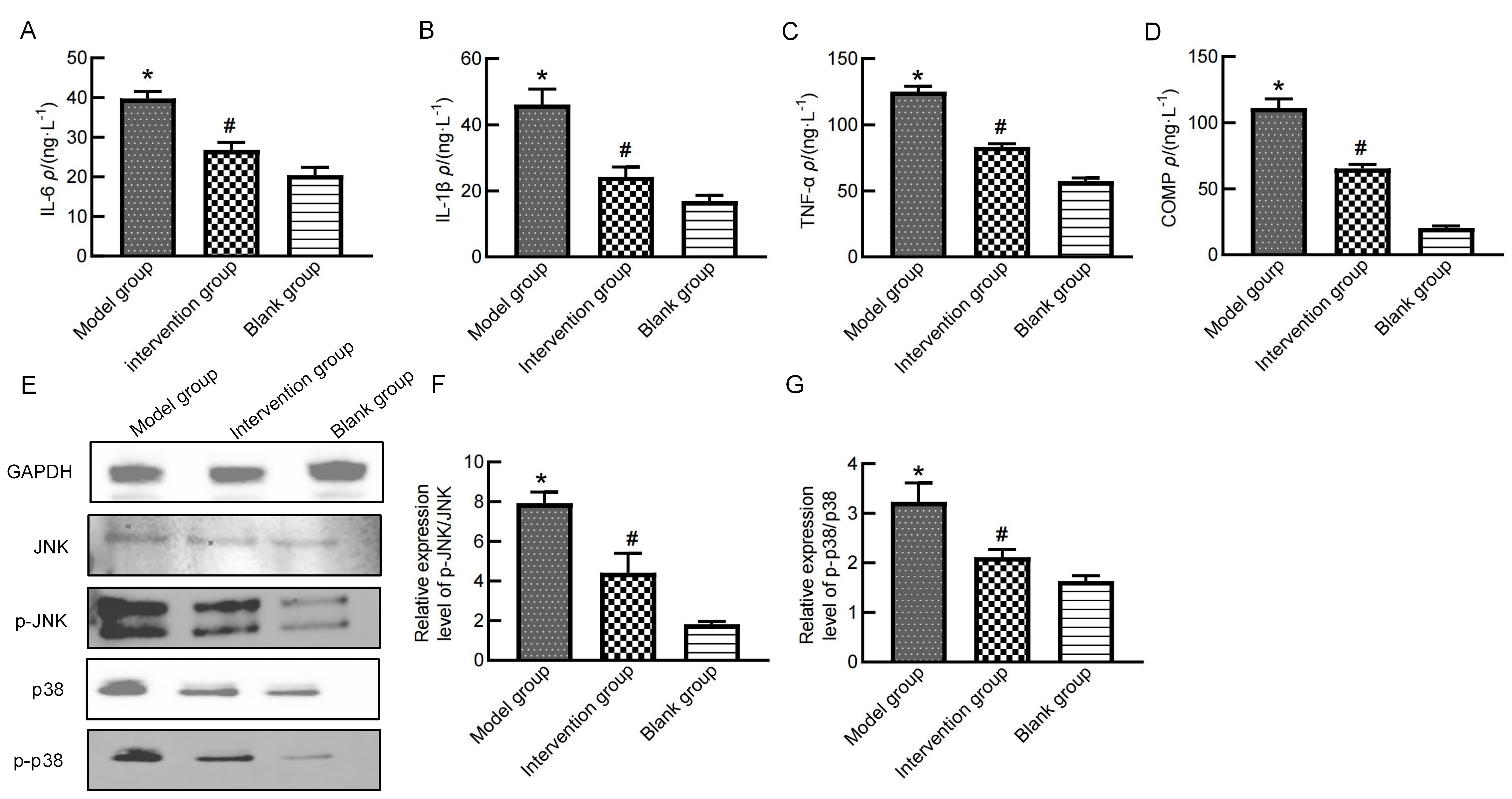
图3 秦皮素药物干预后大鼠血清和膝关节软骨组织中炎症相关蛋白的表达
注:A~D分别为ELISA法检测各组大鼠血清IL-6、IL-1β、TNF-α、COMP含量变化。E为蛋白质印迹法检测各组大鼠膝关节软骨组织中p38 MAPK、JNK、p-p38 MAPK、p-JNK蛋白表达。F、G为p-JNK/JNK、p-p38 MAPK/p38 MAPK蛋白表达量比值(反映JNK、p38磷酸化程度,代表通路激活程度)。空白组指先向右膝关节腔注射50 μL生理盐水,再腔内连续7 d注射50 μL 生理盐水的大鼠;模型组指右膝关节腔内单次注射50 μL新鲜配制的60 mg/mL碘乙酸钠建立膝骨关节炎动物模型,再连续7 d注射50 μL生理盐水的大鼠;干预组指右膝关节腔内单次注射50 μL新鲜配制的60 mg/mL碘乙酸钠后,再连续7 d每天注射5 mg/kg秦皮素(溶于50 μL生理盐水)的大鼠。每组6只大鼠(n=6),与空白组相比,*P<0.05;与模型组相比,#P<0.05。
|
Figure 3 Expression of inflammation-related proteins in rat serum and knee cartilage after fraxetin treatment
Note: A-D, show the serum levels of IL-6, IL-1β, TNF-α, and COMP detected by ELISA. E shows the expression of p38 MAPK, JNK, p-p38 MAPK, and p-JNK proteins in knee cartilage tissues detected by Western blotting. F and G show the ratios of p-JNK/JNK and p-p38 MAPK/p38 MAPK, reflecting the phosphorylation levels of JNK and p38, which indicate the activation levels of the corresponding pathways. The blank group refers to rats that were first injected with 50 μL of normal saline into the right knee joint cavity, followed by intra-articular injections of 50 μL of normal saline for 7 consecutive days; the model group refers to rats that were injected with one time injection of 50 μL fresh prepared monosodium iodoacetate (60 mg/mL)in the right knee joint cavity to induce osteoarthritis, followed by intra-articular injections of 50 μL of normal saline for 7 consecutive days; the intervention group refers to rats that were injected with one time injection of 50 μL fresh prepared monosodium iodoacetate (60 mg/mL)in the right knee joint cavity, followed by intra-articular injections of fraxetin (5 mg·kg-1·d-1, dissolved in 50 μL of normal saline) for 7 consecutive days. There were 6 rats in each group (n=6). Compared with the blank group, *P<0.05; compared with the model group, #P<0.05.
|
|
|
|
|